
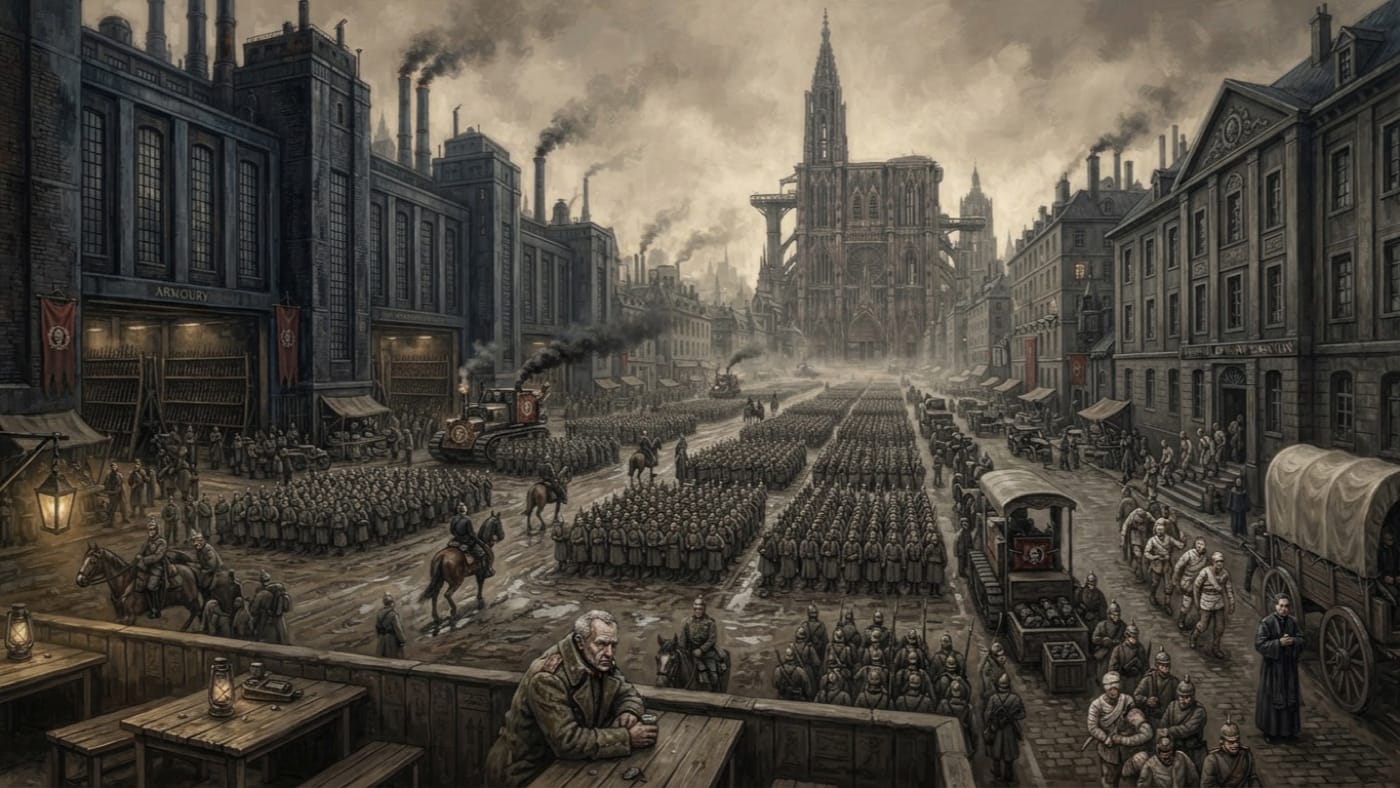
#A City Kept Inside the City
The levies are on the Parade Grounds before the Cathedral carillon has finished the morning office. Their boots carry to the Sanctum Mile as a second, coarser liturgy beneath the first. This is the Military City, the district of Strasbourg where the levies train, where veterans retire and where the machinery of war is maintained. It keeps its own laws, its own markets and its own priests. Clerks in the Sanctum Mile call it a city within a city, in the tone a cathedral canon uses for a wealthy chapel: respectful, and with one hand on the alms box.
The phrase grants no charter. The district answers to the Synod as every paving stone in the capital answers, and the Church that ordains its priests also ordained me. What it has is habit. Soldiers buy from soldiers. They confess to priests of their own district and settle small disputes under rules the Sanctum Mile has never bothered to read.
The capital lies deep in the safe heartland, entered in the registers as Zone 2. The Sagittal Line runs north to south far to the east, from Bastion-Königsberg down to Bastion-Constantinople, and everything the Dominion keeps lies west of it. By every map the Bureau of War has sealed, Strasbourg is a rear city. The Military City is where the rear keeps its front.
#The Parade Grounds
The Parade Grounds can drill ten thousand soldiers at a time. The figure measures ground: how many men the field will hold in ranks before the ranks become a crowd. It does not say how many stand there on a given morning, how many sleep in the district or how many will reach the Line. The Bureau of War likes the figure best when nobody asks those questions. Quoted alone, a capacity sounds very like an army.
Watch them anyway. The levies come to Strasbourg from the provinces of the Dominion, and for most of them the Grounds are where the war first becomes real and acquires a distance. In the Sanctum Mile the war is a column of figures crossing a desk. On the Grounds it is a sergeant's voice, a breech-loader heavier than any boy expected, and a field so wide that the recruit at one end cannot see the face of the recruit at the other.
The two views meet on this field and disagree. To the administration the Grounds mean readiness, a sealed assurance that the capital can form ten thousand levies into ranks. To the levy they are the vestibule of a sacrament he has not yet received and is not permitted to refuse. Both readings are correct. The Bureau files only the first.
#The Armoury
The Armoury holds weapons for twice as many men as the Grounds can drill: arms for twenty thousand. I give the figure as the census gives it. It counts equipment, and equipment has the great administrative virtue of staying where it is put. The census of A.S. 196, as cited, leaves three further columns empty: men trained, men present and men fit to carry what they are issued.
Maintenance is the district's quieter office. The machinery of war is cleaned, mended and kept fit for a front it may never see. Some of the men who do this work have never heard it fired, and they work beside men who will never stop hearing it. I will not walk the reader through workshops whose arrangement I have never been shown. I will say that a rifle is easier to keep than a soldier. It does not desert, it does not pray at the wrong hour, and when it fails it can be sent back.
Every weapon here exists twice, once in the rack and once in the ledger. The Holy Bureaus have always known which existence lasts longer. Racks rust. A properly bound and properly sealed ledger will outlast the rifle, the regiment and the war, and it will still insist on the original count.
#Veterans, Markets and Priests
The men who stay are what make the Military City a city and not an arsenal with lodgings. Veterans retire here. They come back from the Line to the district where levies are drilled and settle within earshot of the next intake. The registers do not say whether this is a comfort or a punishment.
The district's markets serve all of them, those leaving and those returned. I will not invent stalls for the reader's convenience. It is enough that the same streets sell to a recruit who has not yet left and to an old soldier who will never leave again. The district's priests pray over both, at the start of the road and at its end, and in the Military City the two are only a few streets and a few years apart.
General-Retired Marko Vey lives among them. He commanded a sector of the Line for twenty years and came back broken. Now he drinks in a tavern near the Parade Grounds, close enough to hear the drill, and tells stories that no one believes. I do not have the stories on file. I have only his circumstances: twenty years of command, a return, a tavern and an audience that will not credit him. I cannot certify that the stories are true. Whether they deserve to be heard is a separate question, and the answer is yes. The young men who laugh at him on their way to the Grounds have commanded nothing.
#The Hospital of Saint Sebastian
The Hospital of Saint Sebastian treats wounded soldiers and buries those it cannot save. As far as my folios record, that sentence is its entire charter, and I have found no reason to pad it with figures I do not have.
The wounded come back here, into the capital and into the district that trains their replacements. The Sanctum Mile prefers not to notice this. The war is run from a great distance through dispatches and requisitions, and its consequences are delivered to a hospital in the same quarter as the Parade Grounds. They arrive as bandage and splint, carbolic and fever, and, when those fail, a shroud and a priest. A man lying in a ward here may hear the drill of the men who will take his place.
The Holy Bureaus assign the general care of hospitals to Mercy. I have seen no record of how that care reaches these particular wards: who signs, who gives orders, who decides that treatment has ended and burial has begun. I note the gap. Somewhere a clerk makes that last decision with a pen.
Burial, in this war, is the one treatment that never fails.
#The Three Shellings
Strasbourg's older folios say the capital has not been attacked in four centuries. The sentence turns up in respectable places, including my own earlier pages on the city. It holds only if an attack is defined as something that arrives on foot.
The Military City "has never known the enemy's tread," per Bureau of War communiqué A.S. 198.
The Military City has never been occupied. It has been shelled on three occasions by agents of the Enemy, using ordnance smuggled through No Man's Land. The communiqué treated the absence of occupation as the absence of attack. The Bureau of War has since reclassified the shellings as "unscheduled architectural tests."
So there was no tread. Shells do not walk. The communiqué was accurate about feet and silent about everything that came without them, and the Bureau has always considered that an adequate standard of truth. The folios I am permitted to cite do not give the dates of the three shellings, the positions they were fired from, the buildings struck or the dead, if there were any. I decline to fill those spaces with plausible numbers. The Bureau of Records employs men for that.
The record does establish the district's posture. The Military City prepares as if invasion were imminent. The levies drill, the racks are kept in order, the Hospital tends its wards and its graves, and the old soldiers drink within sight of the young ones. The Line holds. It has held longer than anyone now on the Parade Grounds has been alive, and the Military City acts as though that deserves no gratitude at all. I consider this the most devout attitude in the capital.
Whether the Sin-Generals will march west again is a question for the commanders on the Line, for the Bureau of Doctrine and for the Creator, in descending order of availability. The levies on the Grounds do not wait for the answer. They have been ordered to be ready, and in Strasbourg that order is never withdrawn. It is only reissued.