
#On the Salvage Claim
"Some relics climb out of the mud on purpose." — Reed Market saying, as entered in the Codex record of the Ash-Glyph Marshworks
The Mud-Relic Syndicate is a cartel. I put the word first because the Syndicate would prefer another, and the Reed Market has already supplied one: the Yesterday Finders, a name that credits its bearers with a gift of prophecy they have done nothing to earn. They work out of Diver's Gut and the Reed Market of the Ash-Glyph Marshworks at the Danube's mouth. The war-dead of the Sagittal Line's eastern theatres come down to that place by barge and are put into the mud by coordinate. Publicly the Syndicate does legitimate salvage. In secret, according to the Marshworks lore, it plants relics and launders their provenance.
The Syndicate has no founding date on record, and no founder, oath or seal either. The Ledger will not invent a nativity for a criminal just because the column is empty.
A salvage claim in the Marshworks is lawful. A diver brings a corroded medallion up out of a burial shallow, and it is tagged, sealed, tithed and entered. The Church gets back a little of the sanctity it sent to the front in soldiers' packs, and everyone is paid according to station. The Syndicate sells something else. Its product is a recovery that has been made acceptable, an object fitted out with a history the Seal Sheds will stamp, whether or not the object ever lay where that history says.
#On Passage Through the Seal Sheds
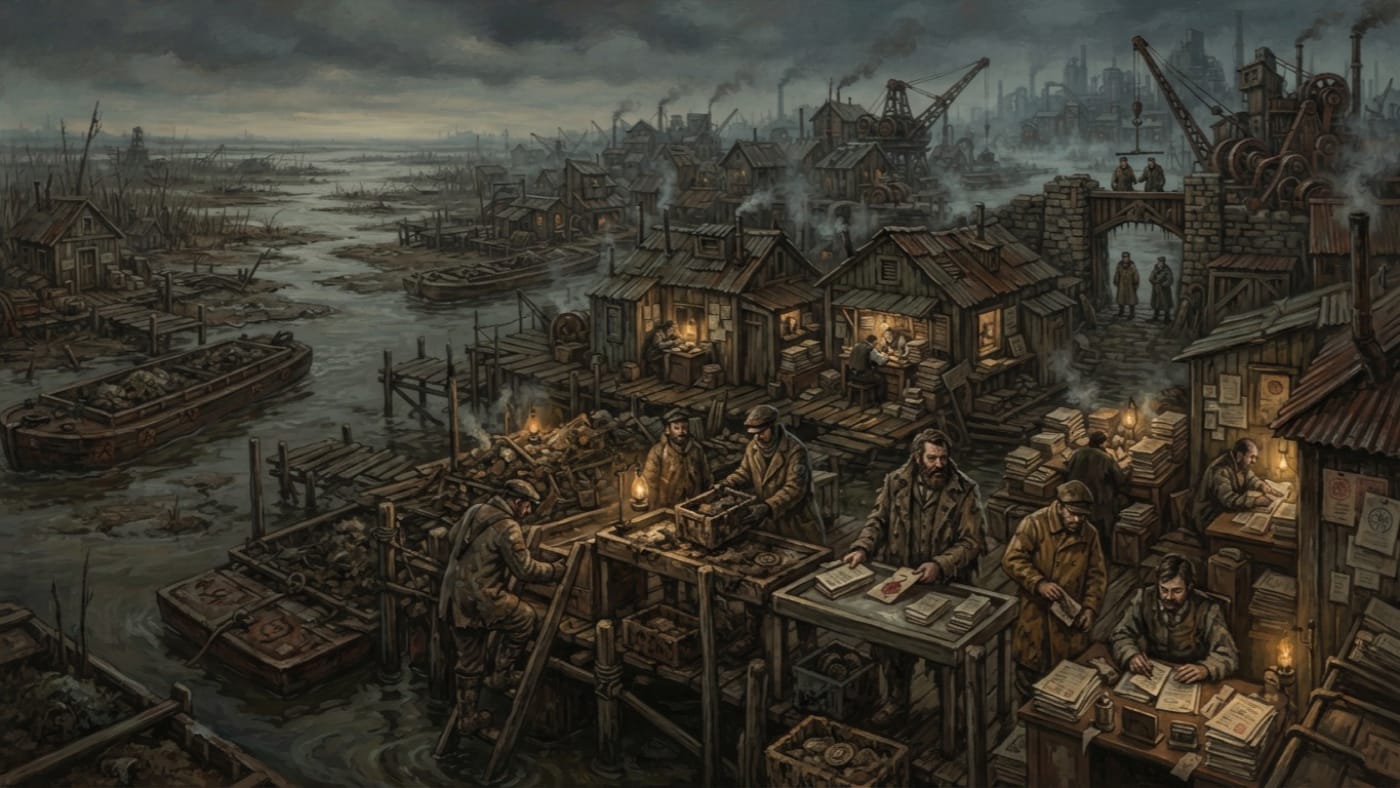
Everything enters at Diver's Gut. The sorting tables stand on a floating platform that heaves when a crew climbs aboard, and the mud comes up with the diver: it is in the seams of his oilskins, in the hollow of the medallion, and it sucks at the planks so that a man has to lift each boot like a confession he is reluctant to make. Bone goes into one basket, corroded metal into another and waterlogged timber into a third. Anything that might once have been consecrated goes to the end of the table nearest the Seal Sheds, where the fish-oil lamps are better trimmed.
An object on that table is still nothing in law. In the Marshworks the dead are called "unprocessed" until they have a tag, and objects are treated the same way. A salvage tag is invalid without a seal, and a seal goes unrecognized without a countersign. Each signature is a separate office, and each office sits on Seal Shed Row behind damp timber, wet ink and a queue. The lore names seal-shed capacity as the settlement's commercial bottleneck. Nothing moves without a tag, tags go missing, and the queue is longer than the season.
The Syndicate's business sits in that queue. The object itself costs the mud nothing. The history is what costs money: forged tags in the right hand, a bribed seal clerk who can find a confession receipt to staple to the tag, and a grid reference that sounds like a real grave. A counterfeiter's tag can pass a first glance, but a clerk's ledger entry gets it through an audit. The Syndicate pays for both. Where payment fails it uses violence, which the lore lists among its methods without saying more, and I will not embroider it.
Once tagged, sealed and countersigned, the medallion becomes a battlefield recovery. It joins the authenticated supply of relics that the Bureau of Records files and the Bureau of Relics places under recognized sacred custody. From there it travels in its writ as far as reverence and price will carry it. Reliquary fragments, medallions and consecrated instruments have all made this passage. I have no record of any single one in particular, and I will not make one up to decorate the paragraph.
#On Those Who Control the Work
"The dead are placed. The map is mercy." — Propaganda line of the Mortuary Cartography Office
Diver-Boss "Softstep" Maro controls the intake. Whatever comes up from the mud crosses his sorting tables before it reaches the Seal Sheds, and the parent entry says he takes a percentage. It also says he asks no questions about provenance. Nothing in the record makes him the Syndicate's founder, its proprietor or its titled chief, and the Ledger gives him no rank it cannot document. Two things about him are reported. He is said to leave no footprints, and before every dive he makes a small gesture that matches no Synod prayer and no catalogued heresy, which his divers copy without exception. Both are local observation and remain so here.
A laundered relic needs more than Maro's table. A plausible history needs a grave to come from, and the graves belong to Cartographer-Provost Lysa Vane, whose burial maps and casualty geography decide which shallows officially contain which dead. A planted object has to be carried out and recovered after dark, and Guildmaster Orren Pike's Lantern Guild of the Third Brine owns the recognized night routes. Anything leaving the settlement passes through the Causeway Gate, where the Ashbound Wardens enforce quarantine and collect fees. Each of these powers can obstruct the Syndicate. The record makes none of them a member.
Bribed seal clerks are documented. Universal complicity is not, though a reader may suspect it.
Debt does the rest. The causeway fees are higher than salvage wages, so the stranded work off what they owe in diver rotations, and the Bureau's own reports link those rotations to "cognitive irregularity." A diver bound by debt does not choose which mud he works. He goes down where he is sent, comes up with what is there, and puts it on Maro's table.
#On Finds That Resist Their Histories
"The marsh counts differently at night." — Marshworks counter-saying
So far all of this is ordinary vice. The trouble lies in what the divers call yesterday finds. These are relics that come up pristine, with no corrosion and no water damage, and sometimes with salvage tags already attached that bear dates still to come.
There are three questions about any relic, and the Seal Sheds would like them treated as one. The first is whether the object is materially what it appears to be. The second is whether its recorded custody is true. The third is whether the Church permits it to circulate. A relic authenticator who knows the trade examines these separately. A genuine fragment can arrive with a fraudulent history, and a perfect tag proves only that someone could afford a perfect tag. The Syndicate makes its money from the pressure on every office to settle all three questions with one stamp.
According to the parent entry, the Bureau of Alchemical Standards has examined eleven such recoveries since A.S. 194. It certified eight authentic and recorded three as indeterminate. Indeterminate does not mean fraudulent, and eleven objects do not make a census.
The Bureau of Alchemical Standards has certified eight of eleven inspected recoveries as genuine.
The Codex entry for the Ash-Glyph Marshworks treated material certification as a certificate of the whole relic. The Bureau of Alchemical Standards tests what an object is and how it responds. It does not test where the object lay, who carried it there or which clerk vouched for the journey. For those eight, the material is certified. The custody is not. The Bureau regrets that its own wording was copied without thought, and it regrets even more that the copy was its own.
The False Shore moves with the tides, and the freshest finds are reported there. The parent entry says a recovery team in A.S. 199 brought up a reliquary casket whose tag was stamped three days ahead of the recovery. Nobody has explained how the tag got its date, and I offer no explanation. Where the casket went is recorded as follows.
SALVAGE DOCKET — FALSE SHORE, A.S. 199 — EXCERPT Casket and contents removed under seal. Divers reassigned. Tag retained as exhibit. Destination of casket: ████████████. Inquiry from Records referred to ████████. Seal clerk of intake: name withheld pending ███████.
Planting and impossible recovery can exist side by side, and the Ledger keeps them in two columns. The Syndicate launders what it plants. It also launders whatever the mud gives up on its own, because the price of a history is the same either way. Whether the Yesterday Finders understand what they are selling is not recorded. The lore records only that Maro fears relics that arrive already tagged. A man who forges tags for a living has some cause to be afraid of the mud doing it for free.
#On the Present Exposure
According to the lore, two things threaten the Syndicate: an audit arriving, and a relic turning up twice. Either one sets two histories against one object, and nothing a clerk is paid can file both. Audit raids on Seal Shed Row are part of the settlement's institutional violence, and nobody pays the clerks to be present for them.
The Synod's Mortuary Cartography Office wants larger "recovery yields" from the marsh. The parent entry reports that recoveries tripled between A.S. 194 and A.S. 200. The Bureau of War wants the shallows worked harder, Pike says they are too bright to work safely, and in the meantime the Syndicate supplies the yield the Office asks for, with whatever provenance it can buy.
The lore also records what the Yesterday Finders are said to be planning: a staged "miracle haul" to gain political leverage. It is an intention that has not happened. If it does happen, the matter goes beyond Records and becomes Doctrine's concern, since a miracle certified on purchased custody is still, on paper, a miracle. The Creator's relics have always been sold under writ. Selling a forged writ is merely the faster method.
No suppression has been ordered and no ruling issued. The Bureau of Records holds the file open, the Bureau of Relics keeps receiving the stock, and the divers go on going down.