
#On the Guild's Standing
"If it shines, don't follow." — Marshworks proverb, which the Guild did not write and collects on nightly
Every settlement on the lower Danube has boatmen. Only the Ash-Glyph Marshworks has turned the boatman's lamp into a magistracy. The Lantern Guild of the Third Brine holds the lamps, the brackets and the route designations of the delta after dusk. With them it holds the one thing the marsh will not supply on its own, which is a way home in the dark that does not end in a sinkhole.
Its public purpose is safe passage, and its real holding is the night. Between the dusk fog and the dawn staking in the Glyphyard, no barge reaches the Charnel Moorings, no punt crosses to Diver's Gut, and no officer of any Bureau leaves the Ropewalk except on a route the Guild has lit and declared. The Bureau of Records and the Bureau of War jointly administer the dead sent down from the Sagittal Line. The Guild administers the hours in which the living are most likely to join them.
The Marshworks survey records a Lantern Guild Compact sealed in A.S. 88, or 1798 CE. The Codex has not inspected the instrument and does not know who sealed it or what they agreed. It cannot say whether the Compact founded the Guild or only recognized lamp-men who were already too useful to dismiss. The survey enters the countersignatures as War and Bells. In A.S. 88 the formal Synod was still two years away. War's business lay with precursor offices, and bell matters belonged to the Office of Bells constituted in A.S. 52. The Registry writes both under their later Bureau titles, as it writes most things: retrospectively, and without apology.
#On the Rackway and the Route Marks
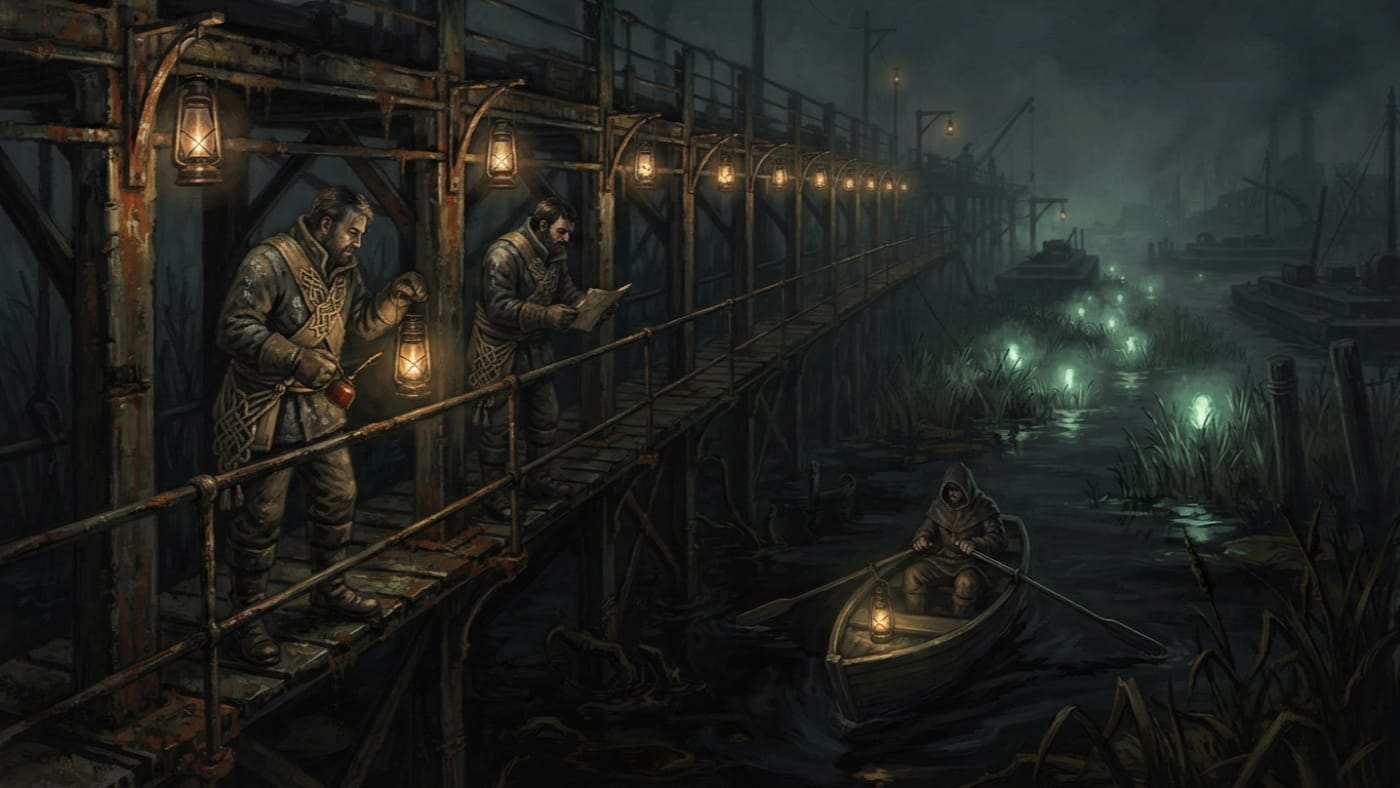
The Lantern Rackway hangs above the waterline on iron brackets bolted to the stilts of the Ropewalk. The brackets rust, and the tallow lamps sweat and gutter in the fog. Riggers climb out over the black water with oil, wick and dry cloth to keep each lamp burning in the order its route requires. When a rigger falls, the barge-handlers usually recover the body in the ordinary course of their work. Under the Rackway the patrol punts work the channels. Their pilots know soft ground by its smell before they can see it, and they know tarred rope by touch, because by midnight touch is the only sense left to trust.
Each coded lamp says one thing: this water carries a keel tonight. No one but the Guild may say it. A boat with a Guild mark may travel the routes the lamps declare. A crew holding a brine-mark, the local term for a Guild route permission, may follow, once the permission has been issued and the fee paid. Route marks pass hand to hand as lantern passes beside salt chits and stamped paper. Lantern fees appear in the settlement's revenue next to the bone tally and the salvage tithe, and they are the one levy the payer never resents at the moment of paying.
The Guild's people wear sashes worked with coded knots. The Codex has no dictionary of these knots and will not write one.
This is how maintenance becomes government. A route is safe because the Guild tends it. It counts as a route because the Guild declares it so. The second fact rests so closely on the first that no one in the Marshworks can find the join. The work is real, skilled, cold and frequently fatal. It is also done by a single hand, and no monopoly ever stood on better ground than honest work that nobody else is allowed to do.
#On the Answer from the Water
"If the light answers your oar, it wants your name." — Marshworks superstition
The corpse-light is a green-white phosphorescent bloom that rises over the burial shallows and the sinkholes. It mimics safe channels and, worse for the Guild, gives back patterns that resemble Guild signals from places where no lamp stands. A sequence is lit on the Rackway, and the same sequence, or something in its shape, comes back across open water with no bracket, no wick and no rigger behind it.
The Guild's authority rests on visible credentials. A lamp in its proper place, lit in its proper order, means passage. The water produces the same credentials.
For this the Guild keeps the Do Not Answer patterns. When the water answers, the crew stops trusting anything it can see. Lamps are doused or hooded in black cloth, and vinegar smoke is burned where there is vinegar to burn. The crew stays on the Guild-marked route it already holds and accepts no new heading from the water. The oarsmen are blindfolded and row by bell-click cadence, counting strokes, so the boat moves on practice and memory while the marsh shows them whatever it likes.
The precaution guarantees nothing. Guild crews say it brings boats home more often than looking does, and the Guild keeps count of the crews that return. No one has kept a count of the alternative.
The Seventh Bloom of A.S. 196 (1906 CE) shows what it costs to trust a familiar shape. False lights reproduced the stake geometry of the Glyphyard faithfully enough that a night barge followed them into a sinkhole. Three men drowned, and the markers were gone by dawn. The Bureau's finding was navigational error compounded by atmospheric conditions. The record does not say whether the crew had invoked Do Not Answer, and I will not guess on behalf of the drowned. Ropewalk talk of an earlier, undated night when hundreds drowned concerns a different catastrophe.
The Codex survey of the Ash-Glyph Marshworks states that the Bureau has spent thirty years declining to address the corpse-light's answering of signals.
The Bureau of Alchemical Standards made its first recorded notice of the corpse-light in A.S. 143. The classification has been pending from that notice to the present A.S. 201, a period of fifty-eight years. The Bureau has refused for longer than this office reported, and this office regrets having underestimated it.
#On the Price of Passage
"The marsh counts differently at night." — Marshworks counter-saying
Guildmaster Orren Pike rules this domain. He speaks in route codes even while praying, and, according to the Marshworks survey, at confession as well. His assigned chaplain has filed pastoral reports on the habit. Nothing else about him is entered here.
His power is the power to refuse. The settlement's proverb forbids following what shines. The Guild's unwritten corollary, which everyone observes, is that you may follow only what the Guild has lit for you, at its fee and on its terms. A crew without a brine-mark can stay ashore until dawn or trust the water's lamps. A rival barge that is refused a route has been refused the whole night.
The work needs hands, and the Marshworks supplies them through debt. Causeway fees outrun salvage wages with the regularity of a tide table. Debtors work off what they owe on night lantern shifts or diver rotations, and the night shifts have the highest mortality in the settlement. Burial surges bring forced night crews to keep the barges moving. Not every rigger on the Rackway after dark is a Guildsman, and not every one came willingly. The Guild did not write the arithmetic of the causeway. It does fill its rotas from that arithmetic, and it does not send the surplus back.
Pike's authority stops where other authorities begin. Cartographer-Provost Lysa Vane holds the burial maps and the Mortuary Cartography Office. The Guild may light a route over the Glyphyard, but it may not move a single grid underneath it. Diver-Boss "Softstep" Maro controls what comes up out of the mud and answers to no Guildmaster. The Ashbound Wardens hold the Causeway Gate and enforce the quarantine, which has been called temporary since A.S. 112, eighty-nine years ago. The Gate decides who enters the settlement. The lamps decide who moves inside it after dark. No treaty between the two powers has been filed, and none has been needed, because each takes its fee at a different hour.
#On Rival Claims
The Glow Choir meets in the reed tunnels and on the off-route shoals, where no Guild route runs. Its members worship the corpse-light as a calling intelligence. They sing to it, and by their own account the reeds sometimes hum back. The Bureau of Purity has visited them often and arrested none of them. Where the Guild hoods its lamps, the Choir answers with songs, lures and, when it suits, sabotage. The two keep opposite doctrines on the same water. The Codex records no organized war between them and names no Choir leader, because the record contains neither.
Reed Market talk adds a third doctrine: certain lantern codes, in the right pattern, are said to turn the glow aside. The Guild has never demonstrated this. A crew that stakes its keel on such a code is gambling.
The salvage trade travels by Guild light as well. Every relic that comes up at Diver's Gut and moves to the Seal Sheds after dusk goes on a lit route, and so does whatever the Mud-Relic Syndicate launders through forged tags and bribed clerks. No record shows any compact between the Guild and the Syndicate. A lamp does not inspect its cargo.
The Bureau of War does not acknowledge the Guild's authority. Its officers posted to the delta follow the Guild's lamp codes without exception, and they row blindfolded to a Guild clicker like any debtor. The Bureau of Bells ratified its current standard, the Bell Codex, in A.S. 115. Nothing I have seen shows that the standard governs a clicker in a punt, or that any Guild pilot has ever asked.
#On the Present Application
A.S. 201. The Mortuary Cartography Office, under Records and War, demands higher recovery yields from the shallows. Pike answers that the marsh has become "too bright to work safely." Both statements are on file, and neither has been answered.
The night rotas lengthen, and the debtors who fill them lengthen with them. Above the brackish water of the Black Sea's margin, the Rackway lamps burn in their coded order, rust weeps from the brackets onto the stilts, and the punts go out with black cloth folded in the bow. Out past the Glyphyard the water gives back some of the sequences. The crews have their instructions for that, and the Guild keeps its count.