
#On the Two Ends
The Munich–Sibiu Jubilee road begins in a warehouse and ends at a wall. Everything between is administered.
Munich holds the western end. It is a Zone 2 staging city and quartermaster depot where rail traffic from Strasbourg, Cologne and Kanzleiburg arrives and is sorted for the forward territories. It is also the last comfortable city before them. The Jubilee columns are outfitted there in keeping with that comfort: processed writs, clean chain, ration crates, and enough ceremonial confidence to make the first morning handsome. Bastion-Sibiu holds the eastern end. It is a Zone 4 fortress at old Hermannstadt, a Saxon citadel thickened into a bastion behind the Southern Carpathians. Readers raised on a lighter catechism call those mountains the Transylvanian Alps. Sibiu guards the passes and holds the middle stretch of the Sagittal spine between Przemyśl and Irongate. The maps colour Romania for the enemy. Sibiu keeps a different colour, and pays heavily for it.
The road is a separate thing from the Line. It comes at the Line from the western interior, in the way a confession comes at its verdict.
#On the Ground Between
Read as geography, the road is a lesson in leverage, taught one lost comfort at a time.
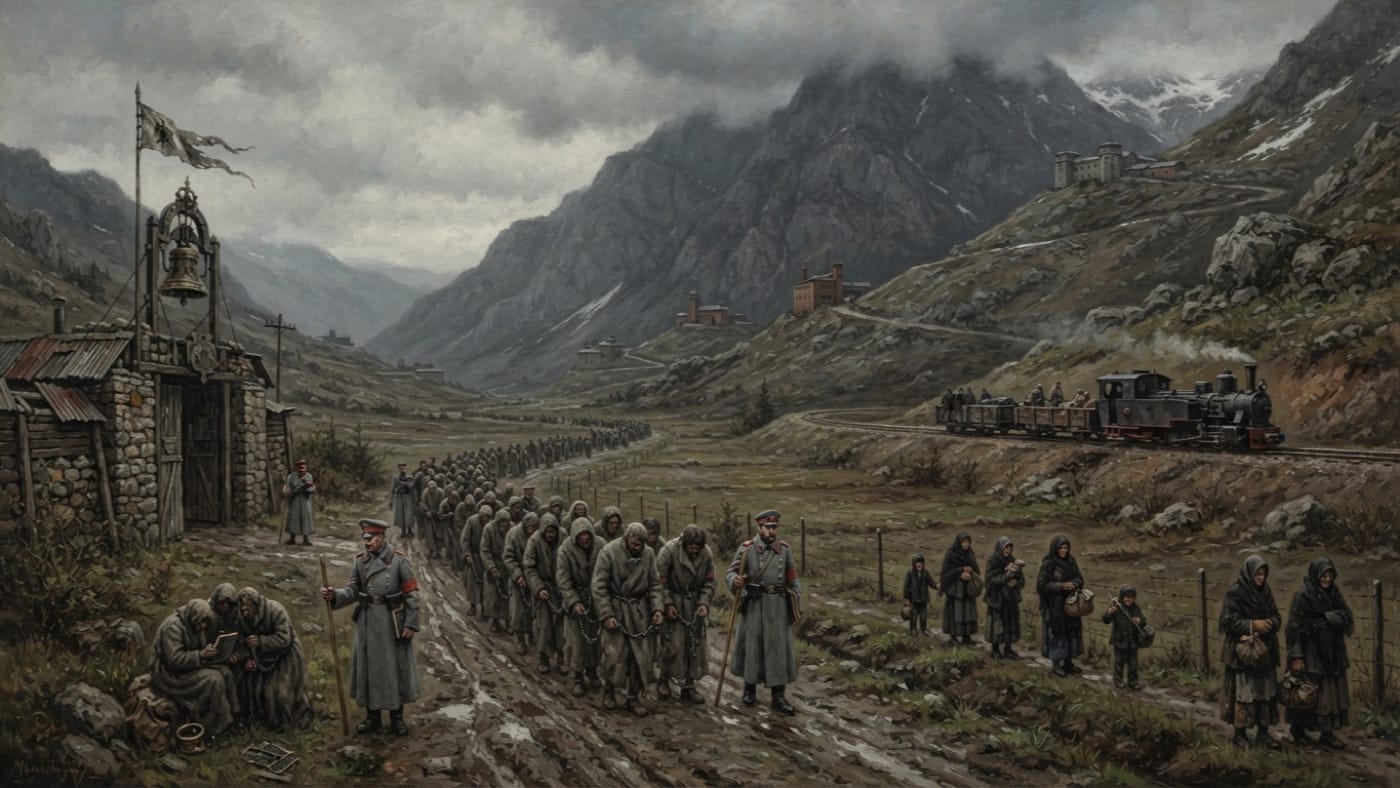
Near Munich the depots are generous, the villages sit close together and the wells are public. A thirsty penitent in the first days is a theological inconvenience. Water stands so near that withholding it takes effort, and effort is witnessed. Farther east the settlements thin. The approaches narrow. The grades begin, then lengthen, and the road climbs into open ground where dust becomes mud by afternoon and mud becomes dust again by the next bell. The shrine-post becomes the only roof, the checkpoint the only reliable water and the clerk the only person holding a pen. Every mile toward Sibiu moves relief from the countryside into the custody of the road.
The families learn this before the officials admit it. They follow the columns at a distance with purses, blankets, heirlooms and bread, keeping just outside the cadence like crows that have taken holy orders. Early on they have little to buy. Near the mountains they have everything to buy, and less with which to buy it.
Between Munich and the Carpathians lies Central Corridor country: Vienna's shrine-ruins, the Bratislava crossing, the Budapest yards. A lazy archivist sends every column through all three. The file records no such itinerary, and it does not say which pass carried the final ascent. Some clerks give the road's length as the seven hundred kilometres between Przemyśl and Irongate. That figure measures a gap in the Line. No pilgrim walks it.
The Road-Mercy file names Stations IV, VI and IX and a checkpoint called Black Pines. It names them because things happened there. It gives no distances, no sequence beyond the numerals and no account of what lies between. The hagiography of Saint Varric counts twelve stations of its own, and pious copyists have pressed that count onto this road like a stencil. The stencil belongs to them. The road has never submitted an inventory.
#On the Passage of a Column
A column leaves Munich with two kinds of metal on it, and junior auditors confuse them every season.
The first is the route tag. It is fastened to the pilgrim and carries a name, an offence class and a destination. The tag says who. The second is the passage token, which the Route-Stampers strike and seat with a bell-hour core tuned to the route's cadence, so the token rings as it moves and tells on its bearer. The token says where and when permitted. A pilgrim with a sound tag and a dead token is a body in the wrong place. A pilgrim with a sound token and a missing tag is a heresy in transit. The Handler carries the keys that hold both together.
Pilgrim-Chain Handlers wear ash-grey coats and the red cord of authority. They carry ranked keys, a tally slate sealed in wax, a ration gourd, and a brass mercy ring notched once for each issue of relief. Link-Runners haul the water and walk the latrine lane. A seconded Procession Marshal may set the beat. At bridges and narrows a Queue-Marshal decides whether a chained column yields to a supply train or the train yields to the column, and the answer is seldom the column. The whole apparatus smells of iron-rust, wet rope, sweat and the brine used to wash shackle sores. It sounds like links clinking in time, a cough moving down the line from mouth to mouth, and the next bell.
Each shrine is an inspection. The ring is read against the slate, and the slate against the shrine's route ledger. Headcounts arrive without warning. Water is staggered, because a whole chain drinking at once is a whole chain stopping at once, and a stopped chain is two steps from riot. A cuff loosened for a swollen wrist is a transaction. A rest knot is a transaction. A strip of bandage cloth is a transaction that the next checkpoint will want to see accounted for.
The Handler's authority is custodial and nothing more. The trade's slogan, "No step, no absolution," is more careful than its users. The step belongs to the pilgrim and the absolution to the priest. The Handler owns only the interval between, which near the mountains is the only property worth owning.
#On the Price List
In A.S. 136 the road's internal economy was entered into evidence.
Over three Jubilee seasons, which the file does not date one by one, a network of Handlers, shrinekeepers, checkpoint clerks and two Route-Stamper deputies sold relief along the corridor. They sold water, rest, bandage cloth, softer shackles, shade, slower cadence and loosened cuffs. In three documented cases they substituted a healthier body for a weakened pilgrim at audit. The official estimate counts eleven thousand off-ledger transactions. A larger figure circulates on the authority of a purported sealed file. No office has certified it, and I decline to adopt it.
The method was agreement. Ring, slate and shrine ledger had to tell one story, so the conspirators wrote one. Water drawn at night was entered as barrel loss. Bandage cloth was issued under "shroud trimming." Rest pauses were hidden inside hymns that ran a little long. None of it needed genius. It needed three instruments that were meant to check one another and were kept by people who could be paid.
The road set the prices. A cup near Munich was cheap because the river was near. The same cup above a grade, a few miles short of Black Pines, cost a signet ring, because nothing else wet was within reach. The conspirators did not invent that scarcity. They found where the road had already put it and stood there with a ladle.
Fourteen Handlers were burned outside Munich's Pilgrimage audit yard in late A.S. 136. The network was larger than fourteen.
#On the Formula and the Bells
Commemorative accounts of the reform state that the A.S. 141 formula "first brought road relief under ledger."
Corrected: relief on the Munich–Sibiu corridor was already logged before the scandal. The fraud consisted in falsifying those logs. The A.S. 141 formula did not introduce measurement. It introduced pre-allocation.
The A.S. 141 formula came five years after the burning. It allots relief in advance according to the march's prescribed conditions: the size of the column, the distance, the season, the grade, any scheduled spectacle, and the Church's official expectation of how much a penitent body ought to endure. I will not reproduce the arithmetic. The Bureau of Pilgrimage would like me to, which is reason enough. Under the formula, water issued at the allotted interval is lawful and water issued outside it is evidence. A thirsty pilgrim beyond quota no longer has a physical need. He has caused a discrepancy.
Bellway Harmonisation followed in A.S. 148. The bells were older. The Bell Codex had been ratified in A.S. 115, and route schedules, relief records and token cores all came before 148. Harmonisation tightened the arrival windows. On the lower road a late column is an embarrassment. On the upper road the same lateness falls where the wells are few, the grades are long and the next shrine is a clerk with a slate, so a missed bell now costs a Handler more than the quota's expected dead. Those two reforms, one counting water and one counting time, both press hardest on the ground nearest Sibiu.
#On the Present Condition
The Road-Mercy file, in its current form, records the road as still in Jubilee service in A.S. 201, with the A.S. 141 formula still in force. It records a refusal of water at Station VI in A.S. 199, made by a Handler who cited Road-Mercy precedent. Families still walk at the edge of the columns. Gourds still carry what the quota allows.
One ledger outlived the purge. Corridor Relief Ledger M-S/Black now serves as a training extract for Jubilee auditors. It preserves the road's price categories and none of the names. It is the most complete surviving description of the corridor's economy, and it says nothing about who laid the road, when, or to what specification. The road is older than any surviving record of it.