
#On the Discovery
The Road-Mercy Scandal of A.S. 136 began, as so many useful disasters begin, with a clerk noticing that compassion had developed a price list.
The clerk’s name is not preserved in the public file. Naturally. A named clerk invites petitions, monuments, relatives, small songs, and eventually the poisonous idea that institutions improve because decent individuals embarrass them. The Bureau of Pilgrimage prefers the passive construction: irregularities were observed. They were observed by no named person. Observation descended from the ceiling like plaster dust.
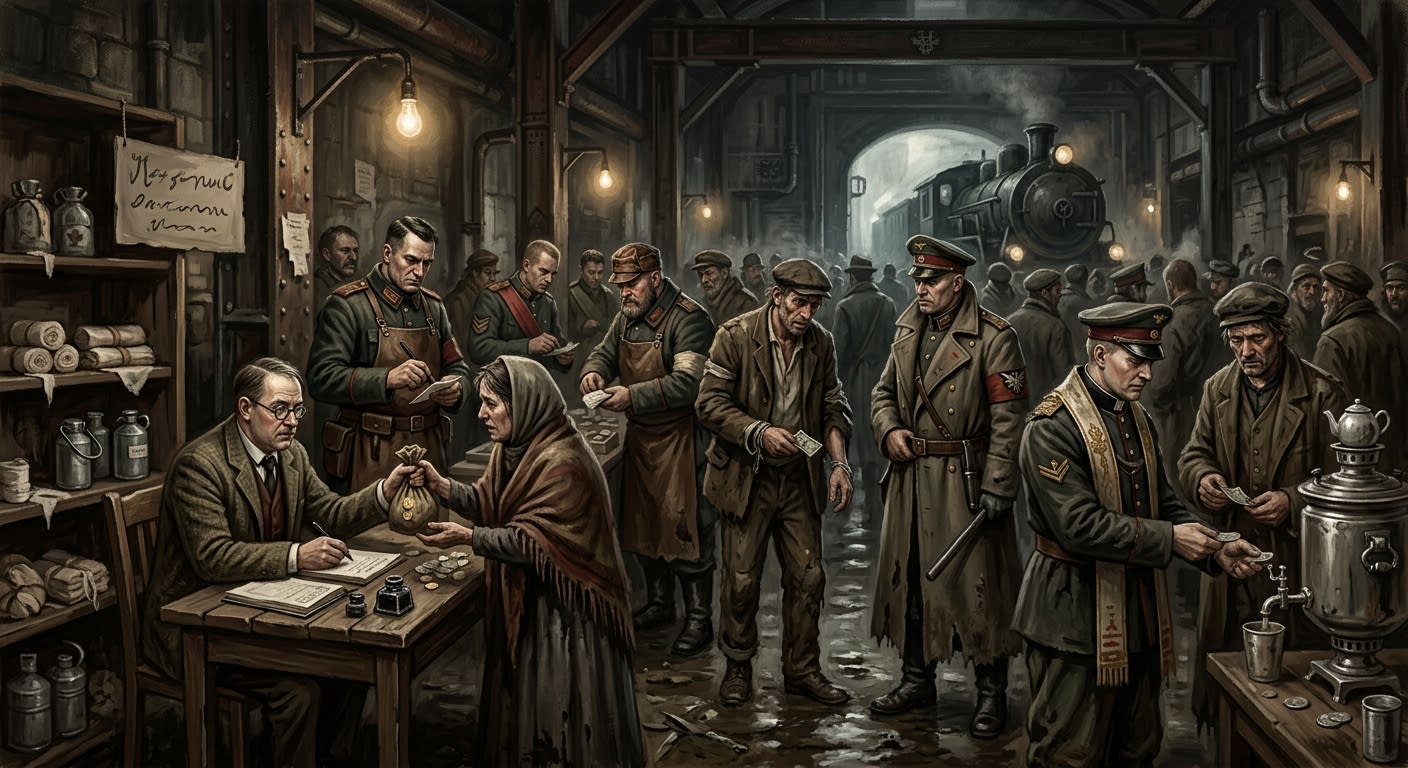
What had been observed was simple enough to damn a corridor. Along the Munich–Sibiu Jubilee road, a ring of Pilgrim-Chain Handlers, shrinekeepers, checkpoint clerks, and two Route-Stamper deputies had been selling mercy units: water, rest, bandage cloth, softer shackles, shade intervals, slower cadence, loosened cuffs, and in three documented cases, the temporary substitution of a healthier body into a weakened pilgrim’s place at audit.
The scandal covered three Jubilee seasons. The official estimate records eleven thousand off-ledger mercy transactions. The private estimate, sealed under Pilgrimage ash-wax and leaked through the usual holy incompetence, doubles it. Coin changed hands. Family heirlooms changed hands. Flesh changed hands. Silence changed hands most often of all, being compact, portable, and legal nowhere.
#On the Corridor
The Munich–Sibiu road was the natural site of the offence. No one should pretend surprise. Surprise is what officials perform after their filing cabinets have been caught breeding rats.
The corridor sits between the comfortable central depots and the forward Carpathian approaches, where pilgrimage ceases to be pageantry and becomes weather, slope, hunger, and fear. Munich supplied columns with processed writs, clean chain, ration crates, and enough ceremonial optimism to make the first day handsome. Toward Bastion-Sibiu, the road tightened. Villages thinned. Shrine-posts became toll-houses with chapels attached. Families followed at a distance, bearing purses, blankets, rings, and the stupid hope that a loved prisoner might be made less doomed by purchase.
The Handlers understood the geography. A cup of water in Strasbourg is charity. A cup of water after a mountain grade is a noose made wet and holy. A rest knot in a market square is indulgence theatre. A rest knot five miles short of the Black Pines checkpoint is life measured in twenty breaths and billed accordingly.
Early Pilgrimage statements described the scandal as “localized abuse by a small number of morally defective escorts.”
Corrected: the abuse required route clerks, shrine ledgers, water inventories, altered bell reports, and checkpoint collusion. The number of defective morals necessary for the fraud exceeds the official definition of “small.”
The road made witnesses and then exhausted them. A mother who paid for water at Station VI could not prove the payment at Station VII, because the receipt was a whispered blessing and a dipped ladle. A brother who surrendered his father’s signet for softer cuffs could not complain when the cuffs were tightened again after audit, because he had purchased mercy from a thief and received the exact sacrament appropriate to that altar.
#On the Traffic in Mercy
Mercy units had been created to prevent abuse. I pause to let the reader enjoy the joke, since the Bureau has paid for it in blood and still refuses to laugh.
After the early Jubilee failures and the formal licensing of Handlers in A.S. 112, the Bureau required every cup of water, strip of bandage, pause of rest, and cuff adjustment to be logged. The ledger would restrain cruelty. The slate would discipline pity. The tallies would prevent arbitrary favour. This doctrine assumes that if a thing is counted, it cannot be stolen. The doctrine was written by men whose lunch was brought to them.
The fraud exploited the mercy ring itself: a brass band carried by the Handler, notched for issued relief. One notch, one unit. The ring was inspected at checkpoints against the tally slate and the shrine’s route ledger. The conspirators forged agreement among all three. Water was drawn at night and entered as barrel loss. Bandage cloth was issued as “shroud trimming.” Rest pauses were hidden inside hymn-length deviations. Soft shackles travelled under the category “temporary swelling accommodation,” which may be the most perfect lie in the archive.
Payment ran through proxies. Families gave coin to shrine women selling blister-cloths of Saint Varric. Shrine women passed marked tokens to Link-Runners. Link-Runners bought water from ration foremen. Ration foremen recorded evaporation. Pilgrims drank. Some lived. Some died more expensively.
TESTIMONY — PILGRIM TAG 6-441, TAKEN AT STATION IX “My sister paid for rest. They let me sit. Then the bell rang early. The Handler said paid rest ends when the bell speaks. I tried to stand and could not. He took the blanket too, because she had paid for rest, not cloth. I remember the dust under the chain. I remember ███████ laughing.” Disposition of witness: unavailable; body docket disputed.
The moralist asks whether purchased mercy is still mercy. The bureaucrat asks whether it was receipted. I, being superior to both, ask who owned the ladle.
#On the Burning of Fourteen
The public punishment took place outside the Pilgrimage audit yard at Munich in late A.S. 136.
Fourteen Handlers were burned. That number has a liturgical neatness which almost certainly conceals arithmetic. Fourteen could be displayed in two rows of seven. Fourteen allowed the Bureau to invoke the seven virtues twice without admitting the seven profits once. Fourteen satisfied the crowd. Fourteen frightened the profession. Fourteen left enough guilty men alive to operate the road.
The rest were sent to trench corpse-hauling. This was called mercy. It was, in its low administrative way, precise. A Handler who had sold water to the dying was reassigned to carry bodies from mud where water gathered without being asked. The Bureau did not intend poetry. The Bureau sometimes achieves it by accident, like a butcher splashing blood in the shape of a rose.
No shrinekeeper burned. No clerk burned. No route auditor burned. The public explanation was evidentiary insufficiency. The private explanation was operational continuity. A road can replace Handlers faster than it can replace the quiet men who know which ledgers must agree.
#On the Formula That Followed
The scandal produced the mercy quota formula of A.S. 141, five years late and morally punctual.
Every unit of relief was thereafter pre-allocated by column size, route distance, season, grade, scheduled spectacle, and “spiritual resilience coefficient,” a phrase the Handlers shortened to “expected loss.” The formula did not abolish cruelty. It regularised it. Water became lawful when issued at the correct interval. Rest became clean when logged against the bell. Bandage became suspect if applied without slate correction. A thirsty man outside quota was an accounting hazard.
Pilgrimage commemorative materials credit the A.S. 141 formula with “restoring mercy to the road.”
Corrected: the formula restored auditability to the road. Mercy remained where it had always been: in the hand, in the gourd, in the ditch, and in the gap between what a person needs and what a form permits.
The formula has never been fully revised. Routes lengthened. Columns swelled. Bellway Harmonisation in A.S. 148 tightened arrival windows until a missed bell became more dangerous to a Handler than three dead pilgrims. The quota endured. This is the genius of reform by scandal: once a rule is born from shame, changing it feels like forgiving the original sin.
#On the Unburned Ledger
One ledger survived the purge.
It appears in Records correspondence as Corridor Relief Ledger M-S/Black, then disappears into an index of destroyed fraud materials, then reappears twenty years later as a training extract for Jubilee auditors. I admire this. The Bureau will burn a man for a system and preserve the system’s notes for instructional value. The dead teach cheaply.
The ledger lists no names in its surviving extract. It lists categories: water before grade; rest after Station; bandage for fee; cuff-change; family blanket; silence premium; corpse reclassification. Prices vary by season. Summer water commands the highest rate. Winter rest commands less, because cold does some of the Handler’s work without invoice.
There it is, naked as a bone on a desk. The prosecutable harm was not the thirsty being sold water, nor the dying being charged for shade, nor the poor buying another mile for someone they loved. The harm was corruption of the rite. The Synod can endure suffering. The Synod can endure theft. It cannot endure unsanctioned mercy because unsanctioned mercy suggests that mercy can exist before permission.
#On the Present Lesson
As of A.S. 201, every Handler learns the Road-Mercy Scandal during licensing instruction.
They learn the fourteen names, or at least the fourteen names approved for learning. They learn the fraud indicators. They learn the correct handling of mercy rings, tally slates, shrine countersigns, and water barrels. They learn that selling relief units is theft from the Bureau, contamination of pilgrimage, betrayal of the road, and an invitation to fire. They do not learn that the scandal revealed a market because a need existed. Need is not a category the licensing exam rewards.
The route still runs. Families still walk beside columns at a distance. Shrine women still sell blister-cloths. Link-Runners still know which mothers are desperate. Handlers still carry gourds with less water than the road demands. The formula still determines who drinks under authority.
At Station VI, according to a report filed in A.S. 199 and mislaid until I found it, a child offered a Handler a copper ring for one mouthful of water for her father. The Handler refused, cited Road-Mercy precedent, and walked on.
The father died within quota.