
#On the Drum and Its Cargo
A song in the throat dies with the throat. A song in brass waits for the clerk. — search-table saying, Auditory Heresy Division
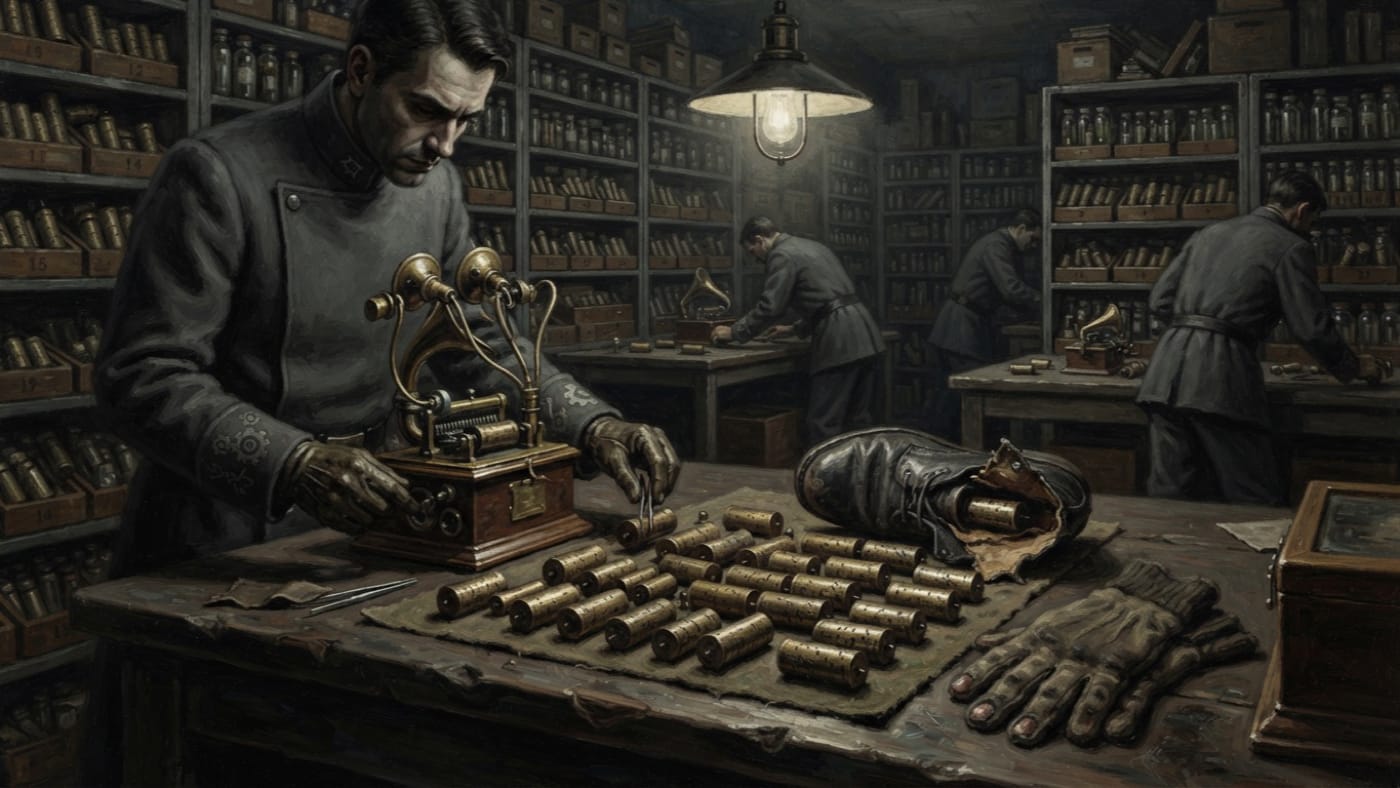
The music-box drum is a brass cylinder small enough to ride in a boot lining, and it carries a fragment of forbidden melody in a form that needs no one to remember it. That is its virtue to the smuggler. It is also its virtue to me. A memory must be extracted, coaxed, branded, or waited out. A drum need only be picked up.
Handlers know it by touch before they know it by sound: dull brass gone brown at the ends, a surface that catches at the glove, and the small cold comb of metal teeth that belongs to the mechanism the drum is meant to serve. The drum is a component, a cargo. It is not a music box. The full apparatus, its housing and whatever sets it sounding, travels separately when it travels at all, and the competent smuggler keeps the two apart as a poisoner keeps powder from wine. I decline to describe how the parts meet. The Bureau's own inventories disagree on the point, and I have no ambition to train apprentices from the Codex.
What the drum preserves is a phrase that can be reproduced outside the courier's skull. What the drum leaves behind is an object. Every virtue of the carrier is matched by an equal service to the prosecution, and the Bureau of Orison and Song has never been slow to accept a service.
#On the Divided Melody
The trade the Orison Licensing Acts created learned quickly that a whole song is a whole sentence. Fragmentation became discipline. Whisper Runners carry openings by mouth. Stitch-Score Couriers carry middle bars in thread-counts and colour sequences. Listening Cell Hosts deliver endings in rooms padded with coats. The drum enters this rotation as one more carrier among several, holding whatever piece the route owner assigns it. No rule I have found fixes the drum to any particular third. The smugglers' rules are fewer and harder: never carry the chorus, don't sell the ending, and above all, never be caught with a full melody in physical form, device or notation.
That rule divides the profession. The No-Device Purists hold that memory cannot be confiscated, and that a tune kept behind the teeth leaves nothing for the search table. The Mechanists answer that memory fades, mangles, and hums under stress, and that a frightened courier betrays himself with his own breath long before an Inquisitor lifts his boot. A partial drum, they say, is safer than memory alone. The Purists say a partial drum is a confession with the last page torn out. Both parties are correct, and both are arrested.
An unburned drum is a status object within the Unauthorized Melody Smuggler trade, the way an unbroken seal is a status object in my own. Its owner has kept a carrier through enough searches to make it a reputation. Its owner has also kept evidence through enough searches to make it a habit, and habit is the beginning of the copy "kept for safety," which is the beginning of the accidental whole.
The trade tells a story about that whole. A smuggler sang a full forbidden lullaby alone, and the room answered with the missing harmony. I record the tale as trade superstition and nothing more. No drum has been shown to summon anything. Saint Hessa of the Closed Mouth, the folk patron whom mothers invoke for singing without sound, is said to disapprove of the whole business of brass. She has filed no opinion with Doctrine.
#On the Trade in Comfort
The drum goes where sleep is short. It goes into laundries and into kitchens after curfew, into dockside bunks and pilgrim barns, into the rear wards of infirmaries where attendants want a quiet night and the licensed alternative is the Dormition Canticle. It moves during sermon windows, when the Orison Hour blares through cracked receivers and the approved voice covers the unapproved one. Orison Signal Engineers keep that official voice clean at the cost of their lungs. The smugglers repay them by hiding inside it.
The buyers are the people the Acts were written to protect. They are mothers who cannot sleep, widows who want grief that does not sound like a ration announcement, and soldiers in rear-towns who want one fragment from home before the bells call them forward. They pay in food, filters, medicine, a night's lodging, a passage favour. Coin is traceable. Gratitude is not, until a child hums the fragment in the stairwell the next morning.
In the Underchords of Bastion-Irongate, a melody fragment proves trust: who carried what, and where, and for whom. The value lies in the music and the vouching. The brass is only the vehicle, and no ledger I have audited prices a cylinder as coin.
The danger is real, and it runs both ways. Certain cadences do trigger or amplify breaches. Unhymns do ride inside comfort and corrupt official signals, and the Pale Chanters have shown what a phrase can do to company discipline. The smugglers have a proverb for it: if it comforts too fast, it kills. A drum is neither demonic by nature nor clean by virtue of being brass. It carries what it was given. Orison prosecutes the carrier without asking which.
#On Possession and Melody Intent
The charge is Melody Intent, within the Tongue-Crime family. The prosecutorial abstract allows intent to be inferred from notation, from coded embroidery, from a hummed correction, and expressly from possession of a music-box drum. No performance need be completed. Seizure need not catch anyone singing.
A silent drum is still evidence. The silence is the Inquisitor's opportunity. The crime the Acts define occurs inside the accused, where intent lives, and a brass cylinder in a boot lining is the most obliging external sign of an internal offence that Orison has ever been offered. Its owner may protest that it holds only a fragment. The fragment is the intent. The protest is noted.
Recognition does the rest. Tone Inquisitors, constituted in A.S. 96, test with bait-cadences and watch who flinches, who hums, who corrects the rhythm. A holder who mends a wrong note sung back to him across the search table has authenticated his own exhibit. Witnesses supply the remainder: the neighbour who heard something through the wall, the landlord who hears melody in arrears, the household that falls silent when Orison boots reach the landing. The Inquisitors carry boxes of their own. Whether those boxes share any workshop or design with the smugglers' drums is a question Orison has never answered, and I have stopped asking it at table.
An earlier working draft of this entry classed incomplete carriers as "non-evidentiary absent supporting testimony."
Withdrawn by the author before sealing. No such exemption exists in the Acts or their rubrics. An incomplete tune buys a smaller sentence, sometimes, and never an acquittal.
The penalties scale with the role the Bureau decides the drum reveals. Listeners have been flogged since the first season. Instruments and carriers are confiscated as a matter of course. Tongue-branding, standardised in A.S. 118, falls on those whose mouths the court believes did the work. Distribution brings immurement. Erasure from the Great Ledger of Souls is reserved for network leadership whose client lists implicate more than twelve households; a laundress with one cylinder in her boot is not a network, whatever the arresting officer's report would prefer. Listening Cell Hosts may go to penal choirs. Children of convicted households may go to Mercy orphanages, where the sleep schedule is approved and the Canticle is played.
The drum is a convenience to all this, and Orison can do without it. Vienna in A.S. 112 branded five thousand mothers for a lullaby about rain and barley carried in nothing but their mouths. The drum only spares the Bureau the inconvenience of listening first.
#On the Present Circulation
As of A.S. 201 the Acts remain in force, and the drums remain in boots. The Purists still distrust brass, and the Mechanists still prize an unburned cylinder above a full larder. The Bureau of Bells still wonders aloud whether a mechanism that sounds without breath falls under bronze-adjacent jurisdiction, and Orison still answers that the hand which carried it had intent enough for both offices. Mothers still pay in filters. Inquisitors still count seizures as performance, and the counts still rise, which Orison reads as vigilance rather than demand.
I have handled more of these cylinders than most of the couriers who carried them. They are cold, and they are small. They are admissible.