
#On the Day Sound Became Property
Rhythm is a leash. — enforcement placard distributed A.S. 94, revised never
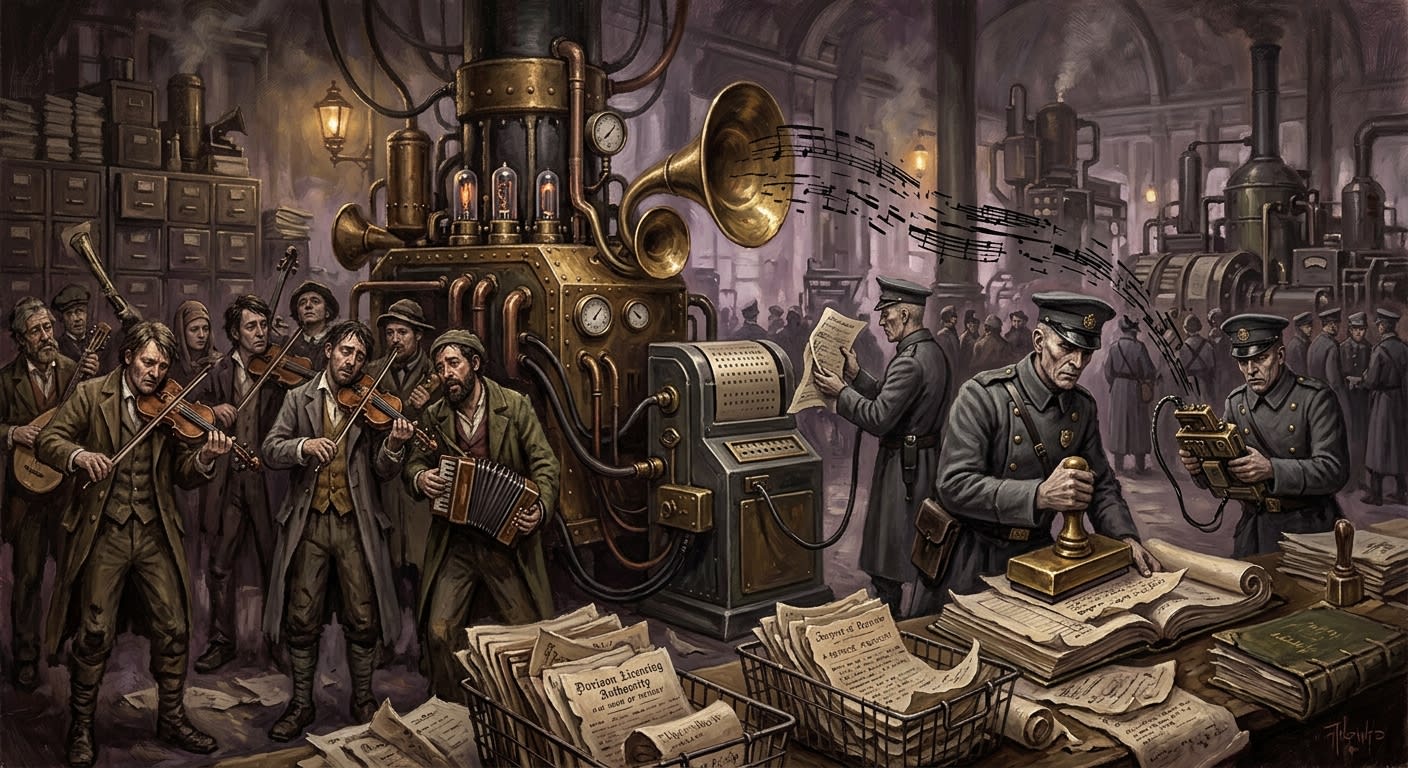
The Orison Licensing Acts of A.S. 94 placed every melody, cadence, whistled work-bar, dock chant, nursery lullaby, funeral response, marching refrain, calibration hum, street cry, grief moan, and tavern chorus under the jurisdiction of the Bureau of Orison and Song. Licensed or criminal. No middle category. No appeal.
A government owns land by map, labor by tithe, bodies by census, movement by pass, speech by oath, and death by certificate. A government that wishes to survive the age after the Sundering must own sound as well, because sound moves faster than writs and carries disobedience in smaller containers. A pamphlet requires paper. A rifle requires metal. A song requires one mouth and one person foolish enough to remember being loved.
The Acts were issued four years after the Concordat of Strasbourg, when the Synod had acquired enough machinery to govern and enough terror to suspect that machinery might not suffice. The Bureaus were still hardening around their appetites. Records wanted copies. Purity wanted offenders. Bells wanted sequence. Doctrine wanted meaning. Orison wanted the air between one skull and another. It received it.
#On the Cause, Real and Useful
The public cause was safety. The public cause had enough truth in it to become useful, which makes it more irritating. Certain cadences do attract hostile attention from beyond the Sagittal Line. Certain intervals widen old wounds in the air. Certain counter-hymns turn comfort into panic, order into appetite, prayer into invitation. Pale Chanters have twisted company discipline with a phrase. The Great Deceiver is a musician when music is useful and a silence when silence does more harm.
The Acts had theology, precedent, casualty lists, acoustic reports, and enough frightened bishops to make any decree look merciful. The private cause was dominion. The Synod had learned that a district may obey curfew and still hum rebellion through the walls. A factory may meet quota and keep time with an unlicensed work-song older than the Concordat. A regiment may march to approved bells and survive by a mother’s forbidden tune in the trench after midnight. The state can command the body and still lose the pulse.
Early Orison commentary described the Acts as “protective regulation of dangerous frequencies.”
Corrected for internal instruction. The Acts regulate dangerous frequencies, harmless frequencies, sentimental frequencies, ancestral frequencies, drunken frequencies, and any other vibration insufficiently grateful for permission.
Before A.S. 94, Orison licensed hymnals, public choirs, and devotional broadcast. After A.S. 94, licensing reached down from cathedral lofts into kitchens, laundries, smithies, docks, nurseries, barracks, pilgrim barns, and funeral rooms. The great legal motion was simple: public sound became supervised sound; private sound became suspected sound; suspected sound became prosecutable sound. Behold governance with good lungs.
#On the Text of the Acts
The Acts divide sound into five administrative classes. Licensed Devotional Sound: hymnals, chants, Sky-Sermon responses, approved public prayers. Licensed Functional Sound: work-bars, foundry calibration hums, rope-haul cadences, marching counts, rail-yard calls. Licensed Comfort Sound: orphanage sleep phrases, hospital quieting lines, Mercy-approved grief responses, and the infamous Dormition Canticle, a four-bar lullaby whose chief virtue is that no healthy child has ever mistaken it for comfort. Suspended Sound: ancestral melodies under review, regional funeral airs, pre-Concordat village tunes, sailors’ calls, and anything too common to ban without delaying production. Criminal Sound: everything else.
The fifth class ate the first four.
A work-song performed without current permit became Criminal Sound. A licensed hymn sung with altered interval became Criminal Sound. A mother’s lullaby became Criminal Sound unless it matched an approved Mercy pattern, and Mercy patterns were written by people whose children were either theoretical or already institutional property. A whistle at a loading dock became Criminal Sound if its cadence resembled a suspended folk air. A child’s counting-rhyme became Criminal Sound if a Tone Inquisitor heard the devil in the numbers, and Tone Inquisitors hear devils the way tax clerks hear unpaid coin.
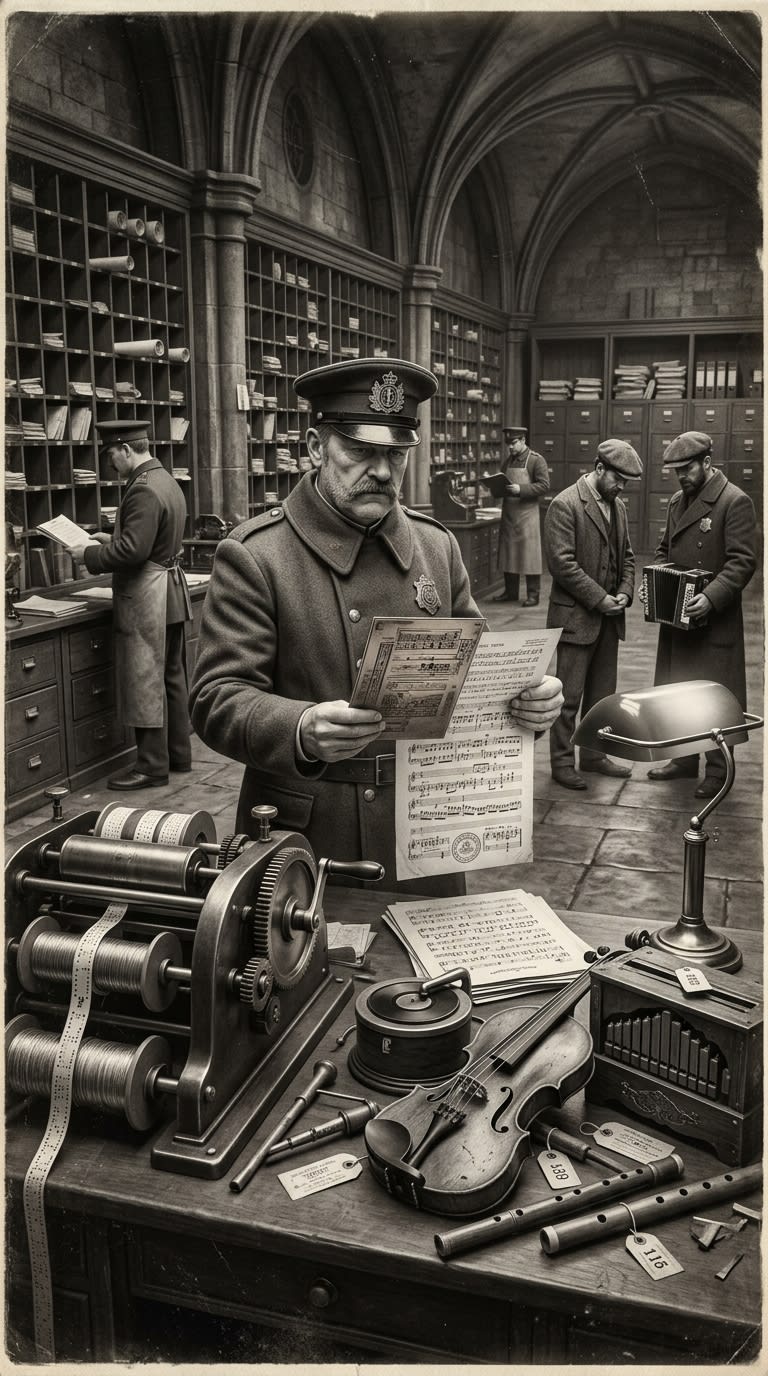
The category called Melody Intent was the knife. It allowed prosecution without completed performance. Intent could be inferred from notation, from possession of a music-box drum, from coded embroidery, from a hummed correction, from a child asleep during an unapproved cadence, from the way a household fell silent when Orison boots reached the landing. I have seen men convicted for less. I have also convicted men for less. One must not become sentimental merely because the mechanism is disgusting.
#On Enforcement in the First Season
The first season of enforcement was clumsy, zealous, and hungry for examples. Orison printed the placards. Records opened sound registers. Purity supplied escorts. Street-vicars preached obedience to licensed rhythm. The Bureau of Bells complained that Orison was trespassing on bronze-adjacent authority, then discovered that complaint itself might be classified as unlicensed cadence if delivered too musically. The complaint became prose at once.
Raids began in Strasbourg’s Candlewick districts: laundries, nurseries, boarding rooms, work sheds, and back rooms where women sang to keep infants quiet while the Orison Hour blared its approved holiness through cracked receivers. The first prosecutions were deliberately ordinary. No demon cult. No Rationalist choir. No enemy hymn. Laundry receipts. Pillow hems. A tune about sleep. A dock chant about rope burn. A mourning response with one interval older than Orison’s seal.
The Eleven Laundry-Women of Candlewick gave the Acts their first scaffolded grammar. Purity arrested eleven women carrying complete lullabies transcribed on laundry receipts. Bureau of Festivals arranged public executions with its usual gift for vulgar prettiness. Records filed the matter under sanitation. Orison listed the melodies as recovered and neutralised. The neighbouring tenements memorised the songs within a week. The Bureau killed the paper. The song walked out in someone else’s mouth.
Tone Inquisitors were constituted in A.S. 96 because denunciation proved too crude for a state aspiring to elegance. A neighbour could invent a hum out of spite. A landlord could hear melody in arrears. Orison required expertise, which in Bureau language means a witness expensive enough that courts will stop asking questions. Failed Orison Signal Engineers became hunters. Perfect pitch became probable cause. Bait-cadences became traps with handles.
#On the Trade the Acts Created
The Acts did not end unlicensed music. They created the Unauthorized Melody Smuggler as neatly as a forge creates a nail. Before A.S. 94, a grandmother teaching a lullaby was a grandmother teaching a lullaby. After A.S. 94, she was a node in an illicit transmission network, though her knees hurt too much for such glamour.
Crime professionalised because comfort still had demand. Mothers needed sleep. Dock crews needed time. Soldiers needed fragments from home. Widows needed grief that did not sound like a ration announcement. Children needed songs whose emotional content exceeded the sound of a clerk clearing his throat. The Bureau provided the Dormition Canticle. The market provided smugglers.
Fragmentation followed. No single carrier held a full tune. Whisper Runners (Unregistered) carried openings. Stitch-Score Couriers carried middle bars in thread-counts and colour sequences. Listening Cell Hosts (Unregistered) delivered endings by mouth in rooms where the walls had been padded with coats. Music-box drums carried dangerous fragments in brass cylinders small enough to hide in boot lining and loud enough to ruin a life if struck at the wrong search table.
AUDITORY HERESY DIVISION — INTERNAL NOTE The Acts increased reportable melody incidents by █████ percent between A.S. 94 and A.S. 101. Interpretation approved for public use: enforcement revealed pre-existing corruption. Rejected interpretation: █████████████████████████████████████████. Destroy after reading unless required for budget defence.
The underworld understood Orison faster than Orison understood itself. A banned melody became currency because possession implied trust. A fragment became bond, signature, password, dowry, farewell, route guarantee. In the Underchords of Bastion-Irongate, a melody fragment could prove who carried what and where. The state made song contraband. Contraband acquired price. Price acquired law.
#On Penalty and Escalation
The first penalties included flogging for listeners, imprisonment for performers, confiscation of instruments, and seizure of notation. The Bureau soon judged these measures insufficiently instructive, by which it meant insufficiently horrifying to children. Tongue-branding was standardised in A.S. 118. The branded tongue speaks with scar tissue. The scar tissue speaks for Orison.
Distribution brings immurement. Network leadership brings erasure from the Great Ledger of Souls when client lists implicate more than twelve households. Listening-cell hosts may be reassigned to penal choirs, where they sing approved doctrine until their throats learn obedience or split. Children are removed to Mercy orphanages with approved sleep schedules and the Dormition Canticle, that musical plank passed off as a cradle.
A public digest described the penalties as “graduated, corrective, and proportional.”
Revised. The penalties are graduated in the way a staircase descends into a cellar. Corrective in the way a brand corrects flesh. Proportional to the Bureau’s fear, which is vast and poorly tuned.
The Vienna Incident of A.S. 112 supplied the terror model. A folk lullaby about rain and barley spread through pilgrim quarters among mothers who could not sleep. Within a month, five thousand mothers were branded, tongues charred black with hymn-fire, children reassigned to Bureau of Mercy orphanages, lullaby classified as an unsanctioned cadence exhibiting potential for doctrinal contamination. Potential did magnificent work in that sentence. It carried five thousand women to the iron without breaking a sweat.
The Dormition Canticle of A.S. 134 supplied the replacement model. Bureau of Mercy and Orison approved four bars for orphanage sleep after committee review, ward observation, and the sort of musical consultation that makes honest instruments pray for fire. Forty infants were tested at the Strasbourg Central Orphanarium. Thirty-eight displayed compliant rest. Two fell asleep. Both were later discovered deaf. The Canticle remains approved. Approval, unlike music, does not require evidence of function.
#On Jurisdictional Appetite
The Acts enlarged Orison’s quarrels. Bells claimed rhythm touched sequence. Orison claimed sequence became voice once the faithful counted aloud. Mercy claimed lullabies within orphanages. Orison claimed comfort sound. War claimed marching cadence. Orison claimed martial breath. Records claimed copies of all sound registers. Orison supplied copies in a format too expensive to store. Doctrine claimed meaning. Orison claimed meaning when sung. Purity claimed bodies. Orison claimed mouths.
The dispute with Bells produced the funniest memoranda in the post-Concordat archive, which is not praise. Bells argued that a work cadence struck by hammer belonged to bronze-adjacent jurisdiction. Orison answered that the worker’s breath, not the hammer, carried intent. Engineering asked whether steam-whistle codes fell under either office. Both said yes. Records requested a consolidated taxonomy and received seven ledgers, three appendices, two threats, and a hymn.
The Acts also gave Doctrine a theological convenience. If a sound produced obedience, it could be licensed. If a sound produced comfort outside obedience, it could be prosecuted. If a sound produced both, a committee could own it until one function died. This is the holy middle: ambiguity rendered taxable contradiction.
#On the Present Force of the Acts
As of A.S. 201, the Orison Licensing Acts remain in full force. The placards still read No private hymn. The slogan still reads Rhythm is a leash. Every hymnal, choir, work-bar, orphanage sleep phrase, funeral cadence, dock call, punishment drone, marching psalm, Sky-Sermon response, and public devotional packet lives under Orison’s ear. The Acts have acquired amendments, circulars, field clarifications, evidentiary rubrics, bait-cadence protocols, suspension schedules, exception registries, and enough marginalia to bury a horse.
They have not acquired mercy.
Tone Inquisitors hunt with forks and boxes. Sky-Sermon Attendance Auditors mark acoustic anomalies during broadcast hours. Orison Signal Engineers keep the official voice clean with saint-dust and ruined lungs. Smugglers carry fragments through cuffs, pillows, boot linings, and throats. Saint Hessa’s mouth remains closed. Children still sleep better to crimes than to licensed comfort.