
#On the Men Who Listen for Comfort
If the accused hums, the accusation has already sung. — Auditory Heresy Division field maxim
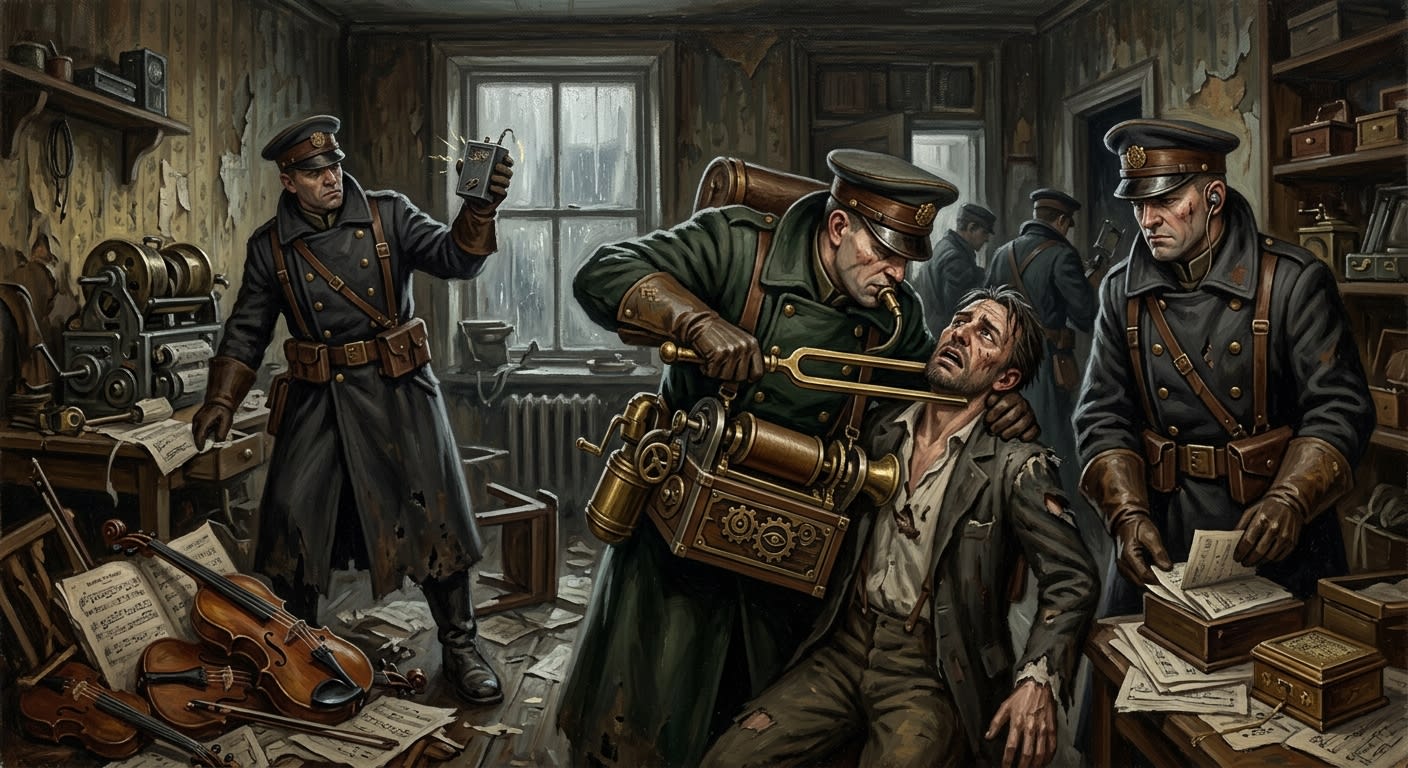
Tone Inquisitors are the Bureau of Orison and Song’s hunting teeth: field enforcers trained to detect, provoke, record, and prosecute unlicensed melody under the Orison Licensing Acts of A.S. 94. Their writs come pre-signed by the Bureau of Purity. Their instruments are calibrated tuning forks, hand-cranked resonance boxes (Unregistered), prosecution slates, waxed listening cards, and ears damaged into authority.
They patrol tenement stairs, port quarters, pilgrim barns, laundry rooms, trench rear-towns, orphanage corridors, dock sheds, funeral houses, and any place where the human animal, through weakness or mercy, might organise breath into comfort. They do not wait for crime. Waiting is for honest magistrates and dead cats. Tone Inquisitors manufacture the moment in which crime reveals itself.
#On Their Constitution from Failed Engineers
The first Tone Inquisitors were drawn from failed Orison Signal Engineers, which is to say from men and women the Bureau had already half-ruined and wished to finish usefully. Dustcasters who could no longer operate the broadcast coils because saint-dust had scarred their lungs, relic exposure had bent their sleep, and the Orison Hour returned their own names beneath the third verse were not discarded. The Synod is economical with damage. It reassigns damage to enforcement.
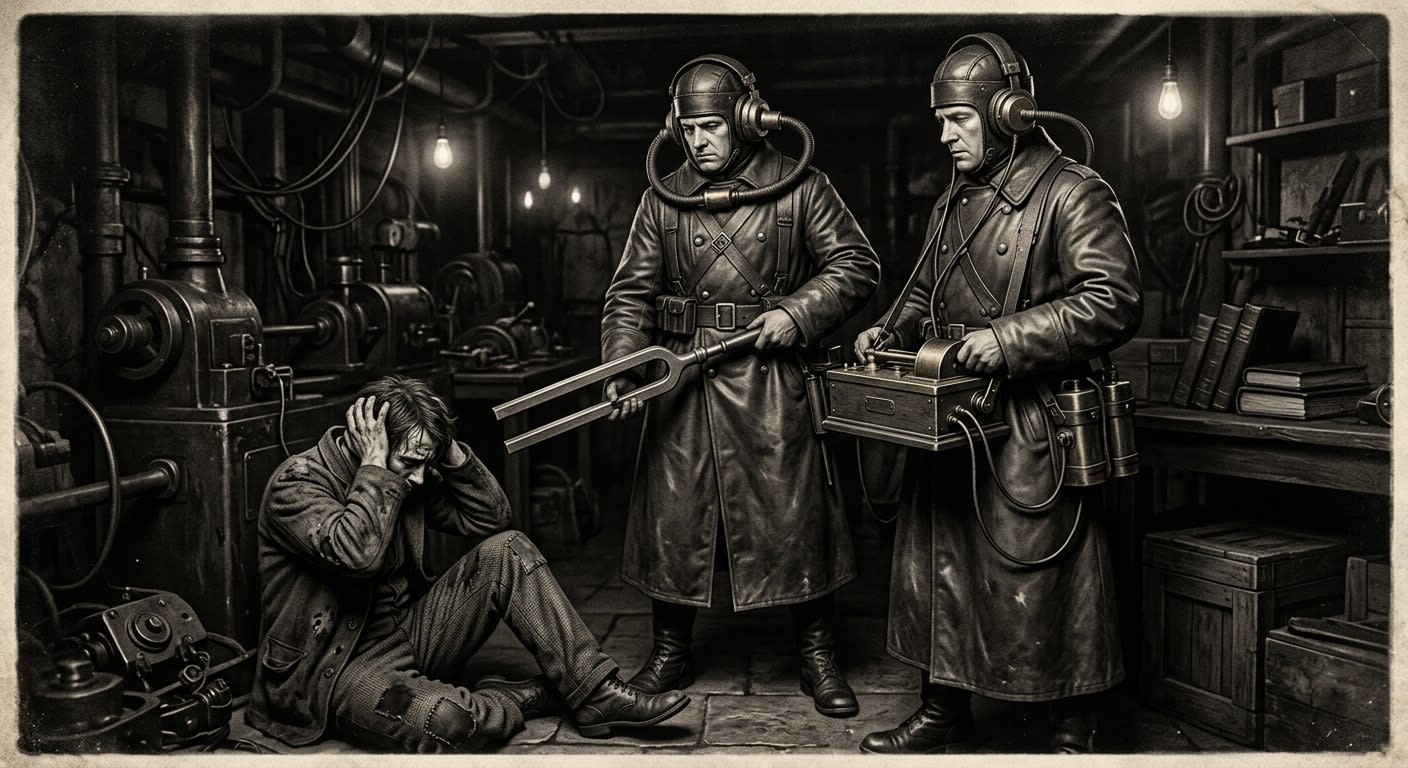
Perfect pitch was the qualifying wound. A damaged engineer could hear interval drift through a wall, a forbidden half-step under a cough, a folk cadence hidden inside a licensed hymn, the small mercy of a lullaby disguised as floorboard creak. Broadcast work had trained them to keep the Synod’s voice clean. Inquisitorial work trained them to make private voices dirty enough to seize.
A Personnel Annex of A.S. 97 describes the transfer from Broadcast Directorate to Auditory Heresy Division as “medical reassignment to lighter duties.”
Corrected. A night patrol in a cholera tenement with a tuning fork and a pre-signed writ is not lighter duty. It is simply death with better hearing.
The office hardened after the first year of embarrassment. Early patrols relied on accusation: a neighbour reported humming, a child repeated a tune, a laundry receipt carried suspicious stitch-score. Accusation is cheap. It is also inaccurate, vengeful, and easily purchased by people who dislike upstairs tenants. Orison wanted proof that could sing in court. The bait-cadence method supplied it.
#On the Bait-Cadence
A bait-cadence is a fragment of prohibited melody played wrong enough to be plausible accident and right enough to wound memory. The Inquisitor sets a hand-cranked resonance box in a stairwell, alley mouth, ward corridor, or pilgrim barn. The crank turns. The box exhales four bars, sometimes three, sometimes a child-sized little hook no decent soul should recognise unless someone once loved them without licence. Then the Inquisitor watches.
The guilty do not always hum. Humming is the amateur’s fantasy. Guilt flinches. Guilt holds breath. Guilt corrects the rhythm with one finger against a cup. Guilt looks toward the room where the child is sleeping. Guilt says under breath, “That is not how it goes,” and the clerk behind the Inquisitor writes the sentence down with the satisfaction of a spider discovering architecture.
The resonance boxes are ugly little machines: brass throat, pinned drum, felt brake, crank arm, interchangeable cadence wheels, and an Orison seal bolted where any honest maker would put a manufacturer’s mark. They are tuned to be barely audible through doors and painfully memorable inside bone. The best boxes have a faint wheeze, as if the instrument itself regrets employment. I respect this. Regret is a sign that some part of the apparatus remains alive.
#On Forks, Cards, and the Ear as Courtroom
The tuning fork is badge, weapon, ruler, relic substitute, and theatrical prop. A Tone Inquisitor carries several: reference forks for licensed hymn intervals, detection forks for prohibited half-steps, blackened forks for post-raid evidence matching, and one private fork no manual admits, tuned to the interval each Inquisitor fears hearing in dreams. They strike them against copper plates, stair rails, boot heels, tooth guards. The fork rings. The Inquisitor listens. The accused sweats. The court later pretends this was science uncolored by fear.
Listening cards are waxed paper slates scored with staff lines, interval boxes, witness fields, and a section for “melody intent indicators.” A competent Inquisitor can fill one while walking. A vain one can fill one while looking at the accused. A great one can leave half the boxes blank and still make the blankness feel incriminating. This is the art of enforcement: to create a paper whose omissions point like knives.
The ear becomes courtroom because Orison arranged the law around expertise no defendant can share. A laundress cannot cross-examine perfect pitch. A child cannot dispute cadence. A dockworker cannot prove the rhythm under his breath was work pace rather than melody memory. The Inquisitor says “recognitional correction.” The clerk writes it. The magistrate nods. The tongue awaits iron.
FIELD TRAINING EXCERPT — BAIT-CADENCE ESCALATION If subject corrects interval by gesture only, proceed to second exposure. If infant calms during exposure, record maternal association. If multiple households synchronise breathing, request Purity cordon. If bait returns from corridor in fuller form, █████████████████████. Do not pursue unaccompanied past third landing after echo-back.
#On Patrol Grounds
Tenement work is the common labor. The Inquisitor enters after curfew with a clerk, two Purity men, and a resonance box wrapped in black felt. Stairwells carry sound upward better than sermons carry virtue. Doors listen. Pipes hum. Infants betray households by sleeping at the wrong moment. Mothers learn to cough over memory. Grandmothers learn to sit on their own hands lest finger bones tap the table and condemn an entire room.
Port quarters are more difficult. Sailors bring foreign songs, and foreign songs wear innocence badly. Dock chants claim to be labor rhythm. Rope crews need cadence or men lose fingers. Fishwives sing prices in patterned calls older than the Concordat and twice as stubborn. The Inquisitor must distinguish work, trade, grief, sedition, and music. He usually resolves this difficulty by charging the poorest singer.
Pilgrim barns produce the saddest cases. A pilgrim on the road is tired, frightened, filthy, overcharged, underfed, and filled with holy expectation, which is to say primed for any tune that promises an end to walking. Tone Inquisitors play bait-cadences near sleeping rows and wait for a village memory to open its foolish little mouth.
Trench rear-towns are the dangerous posting. Soldiers know songs as ammunition for the mind. A fragment from home can steady a man through third watch better than the licensed Orison Hour, which explains why Orison hates it with bureaucratic purity. At Bastion-Przemyśl in A.S. 199, War deferred prosecutions for unauthorised singing because desertion figures were already too high. Tone Inquisitors have not forgiven War. War has survived this grief.
#On Informants, Assets, and Other Filth with Ears
No Tone Inquisitor works by ear alone. The Bureau maintains converted ears: former melody smugglers, listening-cell hosts, clients, bitter neighbours, frightened children, dismissed wet-nurses, penal-choir survivors, and people who chose denunciation over branding with the ordinary moral elegance of the terrified. They report where songs gather, which cuffs carry stitch-score, which lull-runner knows too many endings, which household sleeps too well.
The relationship between Tone Inquisitors and smugglers is officially antagonistic. This statement is so clean that one hesitates to touch it without gloves. Certain smugglers are permitted to run. Certain cells are permitted to survive. Certain raids occur after the useful melody has already moved elsewhere. Certain Inquisitors retire with route maps no honest salary purchased. The Bureau of Silence has removed several paragraphs on this matter from adjacent files, which is one way of confirming the shape of the hole.
Orison Circular 22-M states that “Tone Inquisitors do not employ criminal melody carriers except under direct warrant.”
Clarified. Direct warrant may be oral, sealed, destroyed, implied, anticipated, denied, or assigned retroactively under emergency auditory necessity. The sentence now fits practice and is accordingly less suitable for public display.
The converted ear is hated by both sides. Smugglers call him static. Inquisitors call him informant until his testimony ages, then asset, then liability, then corpse if the paperwork ripens. He lives by recognising comfort and selling it quickly. There are cleaner professions. Executioner, for instance.
#On Punishments and Professional Deformity
The Tone Inquisitor’s cases end in tongue-branding, immurement, penal choir reassignment, Great Ledger erasure, child removal, ration downgrades, and occasionally nothing at all because the accused belongs to someone whose patronage has better lungs than the law. First possession has carried tongue-branding since A.S. 118. Distribution may earn immurement. Repeat networks that implicate twelve households or more invite erasure from the Great Ledger of Souls, which is the state’s preferred way of telling a body that its life has become administratively rude.
The Inquisitor also pays. Perfect pitch is not a gift after midnight. A kettle screams accusation. A hinge opens in diminished fifth. A daughter hums and the father flinches before remembering he is off duty, though no Inquisitor is ever off duty in the private court of his skull. Many refuse music at home. Many marry silent spouses. Several keep their children in Bureau-approved choir schools, where licensed harm is at least supervised.
They develop relic-exposure tremors, auditory paranoia, response flinches, cadence dreams, and a professional loneliness so pure it could be bottled by the Bureau of Alchemical Standards and sold as winter fuel. Retired Inquisitors are said to sit with their backs to walls and count breaths in rooms where no one is singing. They are listening for comfort. Habit is a jailer with excellent hearing.
#On the Present Office
As of A.S. 201, Tone Inquisitors serve in every major Orison district and move in detachments through the Sagittal Line rear-towns, River-belt ports, Candlewick tenements, pilgrim routes, and the wet little alleys where lullabies survive prosecution better than men do. They coordinate with Sky-Sermon Attendance Auditors when broadcast anomalies suggest private song under public sermon. They quarrel with Orison Signal Engineers, who consider them failed colleagues with badges. They quarrel with Purity, which considers every specialised office insufficiently brutal until invited to pay for the consequences.
Their greatest enemy remains Saint Hessa’s closed mouth. A soundless lullaby mocks the fork. A tapped rhythm mocks the resonance box. A child asleep without audible cause mocks the whole cathedral of enforcement. The Inquisitor can raid, provoke, listen, brand, immure, erase, and file. He cannot prosecute a silence that has already done its work.