
#On the Stones Made Smooth
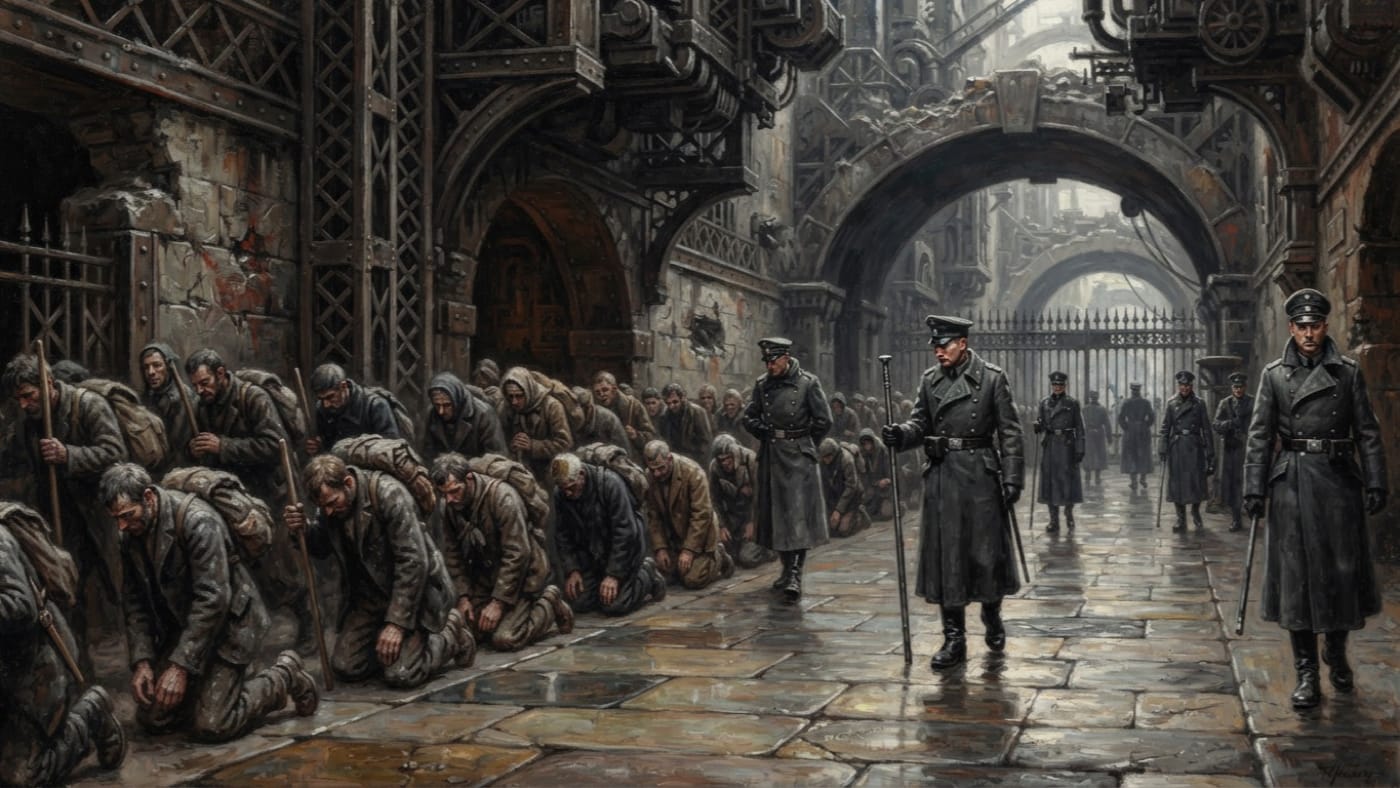
The Nave Approach is the third named stretch of the Via Stahlhand. The pilgrim enters it from the Ash Bend and leaves it at the Hammer Line. It is also the only part of the route that the pilgrims have finished building themselves. The Bureau laid the course through the Kärntner Gate breach of Vienna in A.S. 95, and knees did the rest. The Wall Cut is irregular and the Ash Bend is narrow. The Approach is smooth, and no mason can claim the smoothness. Every pilgrim who has crossed it has left a little skin, wool and contrition and carried away a matching fraction of stone.
The published description of the Via says that the third hundred metres "enter the Nave Approach." On where the Approach ends, it says only that the Hammer Line begins. I decline to supply chainage the Bureau of Engineering never certified. A codex that invents measurements to look thorough has confused itself with a tariff schedule.
The surface can be certified. Its stones have been rounded at the edges and polished across their faces by the one force in the Church that never requests leave, which is repetition. Pilgrims did this, one file at a time, in the posture the Bureau of Pilgrimage still requires of them. The posture wore the road, and the road now rewards the posture. Doctrine could not have designed a neater circle if it had convened a council for the purpose.
#On the Passage of Knees
By the time a file reaches the Approach, its knees have already been interrogated. The Wall Cut has taught them the breach's old edges. The Ash Bend has narrowed the file and filled its ears with the names of the garrison dead, recited at whatever speed the crowd permits. The pilgrim comes to the smoother stone with a knee-cloth gone damp and gritty and a wax token warming in one fist. Somewhere about the pilgrim is a printed caution against theatrical bleeding, which most have stopped needing to read by now.
The first sensation is relief. It is brief, and it misleads. Smooth stone spares the kneecap the separate insult of each ridge and shard. The thigh, the hip and the lower back are given nothing, and neither is the accumulated arithmetic of everything behind. On rough ground the body complains in one place at a time. On polished ground it complains everywhere at once, because it finally has room to notice.
Watch a file of forty cross it. The young speed up, mistaking ease for permission, and are slowed by the elderly in front of them. The veterans set their jaws and refuse to change pace for anything as frivolous as comfort. The widows do what widows do along the whole Via: they move as if collecting a debt. On the earlier stone, knee-cloths snagged; here they slide. On the earlier stone, hands braced against masonry. Here they press flat to the floor and come up grey.
The Approach does not hurt less than the rest of the route. It hurts differently, and nearer the end, which in matters of penance counts for more.
#On Those Who Remain Upright
Licensed guides walk the Approach upright. So do ward-surgeons and persons of doctrinal office, under the exemptions that govern the whole Via. On the Wall Cut this arrangement looks like logistics. On the Approach it looks like a sermon.
The floor makes the difference. Over rough stone, the guide's boots and the pilgrim's knees both fight the ground, so the difference in posture reads as a difference in task. Over smooth stone the ground has already surrendered. The kneeling file crosses a surface made gentle by generations of other knees, and the guide strides over the same polish with the indifference of a clerk crossing a counting-house floor. Every bruise that smoothed that stone was paid for by someone on all fours. The boots collect the dividend.
I will not pretend this troubles me. A guide on his knees cannot correct a posture, catch a fainting widow or stop a pilgrim from pocketing grit. A kneeling ward-surgeon is a patient with a satchel. A person of doctrinal office who kneels in public is an argument the Church cannot afford to lose. The Bureau's exemptions are sound. On the Approach they are also conspicuous, and the Bureau has never learned the difference between an arrangement that can be defended and one that looks well.
I walked the whole Via upright in six minutes, the Approach included, and someone filed a complaint. The complaint did not survive Strasbourg. The polish was pleasant underfoot. I record this because accuracy is my office, and because knees have no standing to dispute it.
#On the Altar Ahead
Everything the Approach does, it does toward something. Ahead lies the Hammer Line, the last eleven metres, where speech is forbidden. Beyond it lies the Impact Plate before Saint Rupert's altar. The posture stays the same and the purpose sharpens.
The memory the route exists to compress belongs to the Siege of Vienna in A.S. 95. When Althazar of Pest came through the breach, Bishop-Warden Clemens Stahlhand stood upon Saint Rupert's altar and struck him down with the reliquary mace of Saint Aldebrand. Saint Rupert keeps the altar. Saint Aldebrand keeps the mace. The distinction matters more to the Bureau of Doctrine than to anyone kneeling, which is exactly why it must be written down.
The blow fell at the terminus. The stones of the Approach are road, polished by use, and no Bureau has certified any one of them as a battlefield relic. Any guide who suggests otherwise to a foreign delegation is trading on proximity and should be fined for it. Even the terminus no longer holds the stone that took the blow.
Earlier guidebooks identified the Impact Plate at the end of the route as the original stone struck by Clemens Stahlhand's blow.
Corrected. The Impact Plate is a bronze-rimmed contact substitute installed in A.S. 112. The original strike-stone fractured into three pieces and was removed to the Basilica of the Ledgered Saints in Strasbourg. The pilgrim kneels toward a substitute, across a road worn smooth by earlier pilgrims, in memory of a stone kept elsewhere. The Bureau considers the chain of custody complete.
The Approach prepares its pilgrims for contact at two removes, and it prepares them well. By its end the Ash Bend's names are behind them, the body has spent its complaints, and the file has gathered itself for eleven metres of silence and a forehead pressed to bronze. The Approach does not impose the silence. It provides the exhaustion that makes silence easy to obey.
#On What the Knees Have Left
The Wall Cut keeps the breach, and the Ash Bend keeps the names. The Approach keeps only the record of its own use, written in the one hand stone accepts. Stone kept in a basilica is custody. Stone worn down on a road is testimony, and the better kind, because thousands gave it without knowing they were signing.
The doctrine of the Via forbids anyone to mistake the route for the movements of the battle. The siege supplied the blow. The pilgrims supplied the polish. On the Approach, the second has become easier to touch than the first.
On the first of November the stone of the Via hums. No office has certified whether the polished stretch hums louder, softer or at all, and I do not intend to be the first to guess in print. The Bureau of Tithes denies owning anything on the Via. It has found no way to deny owning the hum, because it has found no way to price it.