
#On the Final Eleven Metres
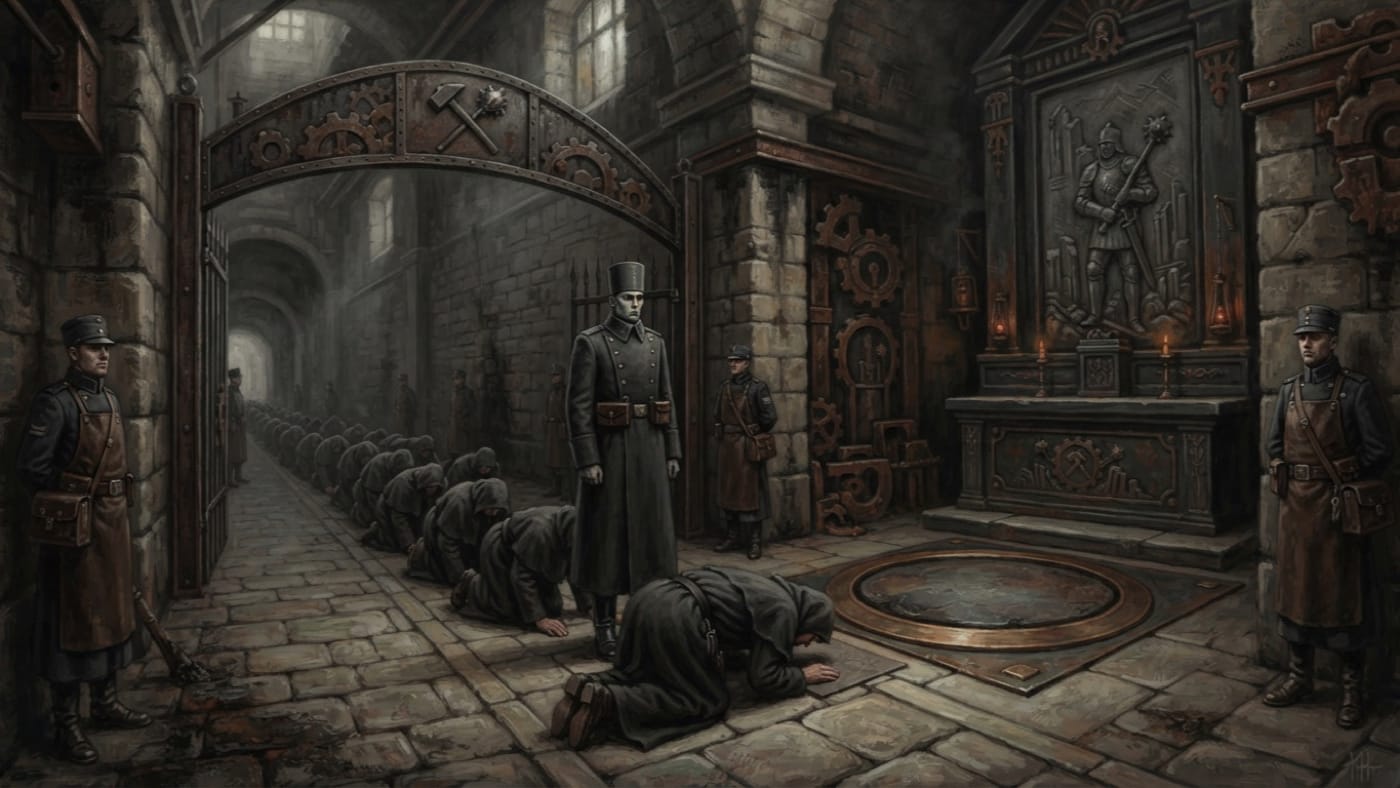
The Hammer Line is the last eleven metres of the Via Stahlhand, the four-hundred-and-eleven-metre penitential road laid through the Kärntner Gate breach of Vienna. It begins where the Nave Approach ends. It finishes at the Impact Plate before Saint Rupert's altar, where the road stops because there is nowhere holier left to crawl. A clerk with a measuring chain could cross it in nine strides. Pilgrims take longer. They arrive on their knees, and by that point they have been on them for most of the morning.
The name comes from the Siege of Vienna in A.S. 95, when Bishop-Warden Clemens Stahlhand struck down Althazar of Pest with the reliquary mace of Saint Aldebrand. Althazar was a mortal sorcerer-lord who commanded the Rationalist remnant and its daemon-cult allies. The broadsheets have since promoted him to king, to general, and once to a Sin in person. I have stopped correcting them, because correction only encourages the broadsheets. The route was arranged during the consecration works that followed the siege. The Church ratified the miracle in A.S. 104, in the same year it beatified Clemens, so the blow got its paperwork nine years after it got its corpse.
The Hammer Line does not trace the Bishop-Warden's last steps. Nobody close enough to count those steps was in any condition to count, and the men who laid the Via wanted an approach for pilgrims, not a footprint. The road's official doctrine calls it a penitential compression of siege memory. Eleven metres were enough. Nobody can certify the exact distance Clemens covered, and nobody is asked to.
#On Silence and Licensed Knees
Speech ends at the Hammer Line. I once wrote that the ban improves the acoustics and, for once, the theology. I stand by both halves of that sentence. I will add a third observation that the Bureau has never written down: a silent file cannot complain.
Consider the file when it gets there. Forty penitents entered at the outer fracture, each issued a knee-cloth, a wax token, and a printed caution against theatrical bleeding. They have crawled through the Wall Cut. They have crawled the Ash Bend, where the guides recite the names of the garrison dead at a speed set by crowd density. They have crawled the Nave Approach, whose stones are worn smooth by earlier knees. By the time the file reaches the final eleven metres, the guides have finished the names and the penitents have run out of courage. Any question asked there would be a bad one. How much farther. Is this the place. Does it count if I stop. The silence rule settles all three questions before anyone can ask them.
The posture exemptions stop at the knee. Licensed guides, ward-surgeons, and persons of doctrinal office walk upright the whole length of the Via. They have to, because nobody can manage a file, catch a fainting penitent, or stop a pocketed relic-crumb from a kneeling position. The exemption leaves them their full height and takes their voices. On the Hammer Line the guide still towers over the file, and like the file the guide says nothing. A guide on those eleven metres governs with height and stillness alone. Everyone kneeling there knows it.
The ward-surgeons find this restful, they tell me. On every other stretch of the Via they are asked whether a bruise is holy or merely a bruise. On the Hammer Line nobody may ask, so the bruise stays undiagnosed and the surgeon stays sane.
#On the Stone Offered for Contact
The Impact Plate is a stone rimmed in bronze and set into the old floor. Only the rim is metal. The stone sits low enough that a kneeling pilgrim has to bow fully to reach it. That is the design. Each pilgrim presses a forehead to the bronze and listens, while the forty behind wait their turn in silence.
The plate is a substitute. The true strike-stone cracked into three pieces and was removed to the Basilica of the Ledgered Saints in Strasbourg, where it now lies under a custody order with a great deal of wax on it. Vienna kept the floor. Strasbourg took the relic. That division is fair by the Synod's standards: the capital takes what can be catalogued and leaves the provinces what can be knelt on.
Earlier guidebooks sold at the breach identified the Impact Plate as the original stone struck by Clemens's blow.
Withdrawn. The Impact Plate is an authorized contact substitute installed in A.S. 112. The original strike-stone, in three pieces, is held at the Basilica of the Ledgered Saints in Strasbourg. Guidebooks repeating the earlier claim are to be surrendered at the Central Corridor headquarters in exchange for the corrected edition, at the corrected price.
According to the Via's own record, the substitution was necessary. The original fracture had begun to shed warm dust into the mouths of pilgrims who pressed their faces to it. The dust was authenticated, sold for a short while, condemned, and quietly kept in three episcopal cabinets. Those are four steps, and an outsider would expect the third to cancel the second. They have misunderstood the Church. Condemning a relic marks the end of its sale. The relic stays in the cabinet.
The plate itself makes no claim. It is stone and bronze, installed under seal, and it is accurately described in the current guidebooks. The foreheads pressed to it believe whatever they believed when they first knelt at the outer wall. The Bureau of Pilgrimage certifies the contact and leaves the belief alone.
#On the Inspector and the Child
I walked the Via upright in six minutes. At the Hammer Line I fell silent. I have been accused of many things. Nobody has accused me of talking on the Hammer Line.
Pilgrimage filed a complaint about my posture. It went to Strasbourg and came back with the notation of the Bureau of Doctrine: No corrective action. Knees reserved. Pilgrimage then proposed a rail, and the office kept the memorandum it had hoped would never be read.
PILGRIMAGE INTERNAL MEMORANDUM — POST-INSPECTION Subject: Drax passage, unauthorized upright completion. Recommendation: install discreet posture enforcement rail at Hammer Line. Doctrine response: █████████████████████████████████ Subsequent action: rail cancelled; exemption drafted.
The rail was never installed. Visitors who claim to have bruised a shin on it are bruising themselves on a memorandum. The exemption I had already exercised was then written down, which is the usual order of things.
Note what the rail would have governed. It would have controlled knees. Knees are the easiest part of a penitent to control and the least dangerous. The Hammer Line's only real threat came on its own feet, and no rail could have stopped it.
A child once stood on the Hammer Line and asked why Clemens had needed a mace if Heaven was present.
The child was standing up, too young for the knee-cloth and too old to be carried. The question broke the silence rule. Worse, it was a good question. The guide fainted. The file did not move. Some of the forty were surely asking themselves the same thing, and they kept quiet because the rule told them to. The child was later assigned to catechetical strengthening. The record says nothing else about the child, and I will add nothing to it.
#On What the File Hears
Seventeen testimonies taken after the siege agree that the blow produced a low note lasting nine seconds. They agree on the length. They do not agree on what made the sound, and the Bureau of Records has not tried to make them.
Modern pilgrims who press their foreheads to the rim report one of three things. Some hear the note. Some hear bells. Some hear nothing and weep from disappointment, and the guides log the weeping as a valid devotional outcome. None of the three reports proves where a sound came from. The Bells of Saint Rupert are restricted objects. They are inspected by sight and never rung by human order. The feast peals in present-day Vienna come from substitute bells cast in A.S. 112. That was the same year the plate was installed, and the two were separate projects with separate ledgers. A pilgrim who hears bells at the plate has heard something. The Bureau of Bells will gladly tell that pilgrim it was not the true bells.
On the first of November the stone of the Via hums. I say the Via's stone, not the Hammer Line's, because nobody has fixed how far the hum runs, how long it lasts, or what causes it. The pilgrims on the final eleven metres hear it with their foreheads to the bronze. Those still on the Ash Bend hear it through their knees. No guide may comment on it while standing on the Hammer Line, and the guides who stand elsewhere choose not to.