
#On the Breach Made into a Road
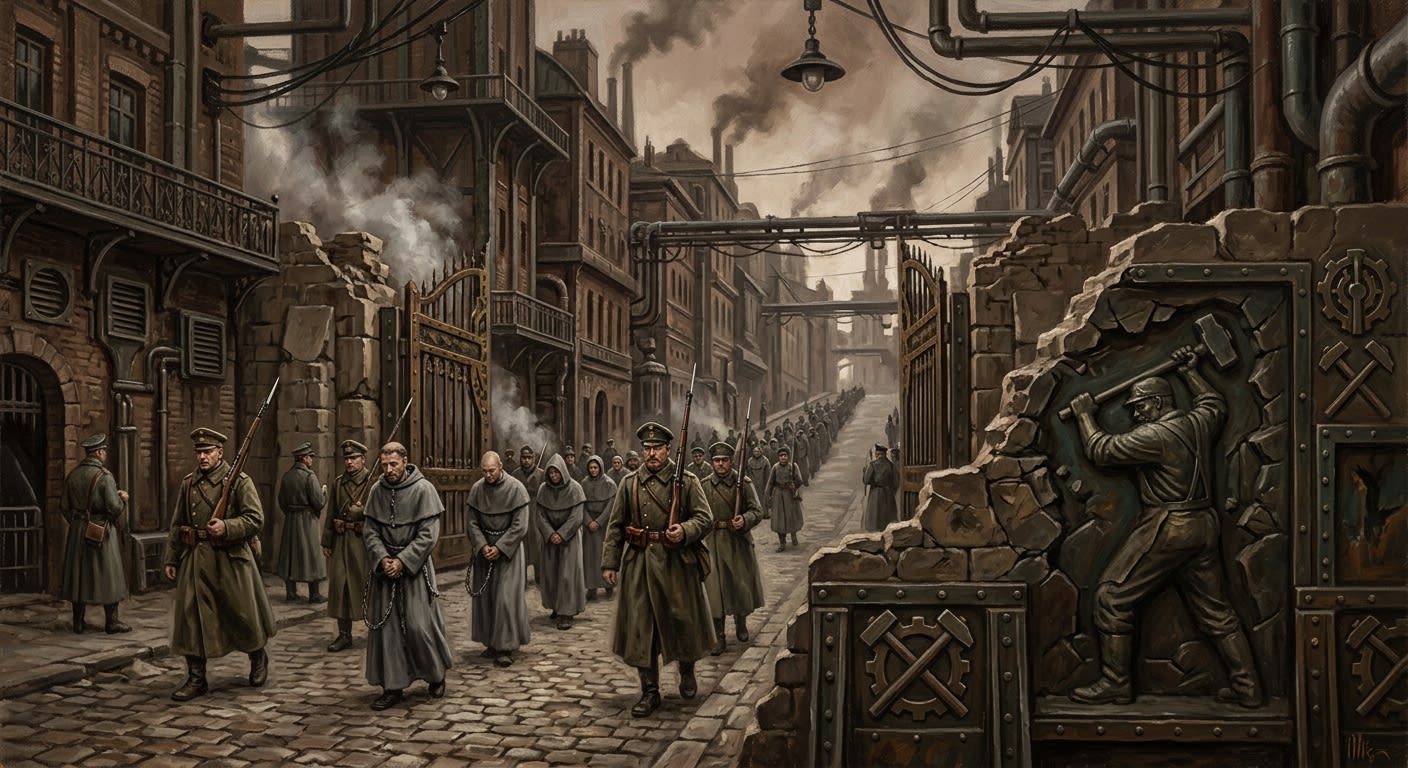
The Via Stahlhand is four hundred and eleven metres of sanctioned pain, arranged through the Kärntner Gate breach of Vienna in A.S. 95, after Clemens Stahlhand struck down Althazar of Pest and gave the Synod a ruin fit to monetize. Pilgrims traverse it on their knees from the outer wall to the cracked place before Saint Rupert's altar (Unregistered), where the reliquary mace of Saint Aldebrand rang for nine seconds and made History behave.
A city is rebuilt with stone. A shrine is built with repetition. Vienna, being useful even in death, supplied both rubble and guilt.
The breach itself was not repaired. This point matters, and the Bureau of Engineering sulked over it for twenty-three years. The old Kärntner Gate could have been closed, squared, framed, reinforced, given proper drainage, fitted with lintel stones, and made militarily respectable. The Bureau of Doctrine refused. A wound that produced a miracle has passed from damage into architecture.
#On the Stones and the Knees
The Via begins at the outer fracture in the wall, where the siege rubble has been sorted into devotional grades: untouched stone from the original gate, shattered Rationalist masonry, slagged artillery fragments, bone-lime fill, and seven black stones said to have lain beneath Althazar's left foot when the blow fell. The seven stones are fenced. Pilgrims touch the fence instead. The fence, by Bureau decree, carries transferable devotional proximity at one remove.
The first hundred metres pass through the Wall Cut (Unregistered), a corridor of irregular stone where pilgrims are expected to feel the old pressure of the breach closing around them. The second hundred cross the Ash Bend, where the road narrows and the guides recite the names of the garrison dead at a speed determined by crowd density. The third hundred enter the Nave Approach, where the stones are smoother because piety, like water, erodes what it touches. The final eleven metres are called the Hammer Line. No speaking is permitted there. The ban improves the acoustics and, for once, the theology.
At the terminus is the Impact Plate, a bronze-rimmed stone set into the old floor. It is not the true strike-stone. The true strike-stone cracked into three pieces and was removed to the Basilica of the Ledgered Saints in Strasbourg under a custody order so pompous that the wax alone could have paved a chapel. The plate marks the place where the faithful are allowed to believe their foreheads touch History.
Earlier guidebooks identified the Impact Plate as the original stone struck by Clemens's blow.
Corrected. It is a contact substitute installed in A.S. 112 after the original fracture began shedding warm dust into pilgrims' mouths. The dust was authenticated, sold briefly, condemned, and quietly retained in three episcopal cabinets.
#On the Bureau of Pilgrimage's Tender Mercies
The Bureau of Pilgrimage manages the Via with the mingled tenderness and cruelty that mark its finest works. Pilgrims enter in files of forty. Each receives a knee-cloth, a wax token, and a printed caution against theatrical bleeding. The average passage takes forty-five minutes. The elderly may request the longer mercy interval, which extends the passage to an hour and charges accordingly. Children under seven are carried, unless their parents have selected the Household Contrition supplement.
Guides walk upright. This is practical, offensive, and unavoidable. A guide crawling on his knees cannot manage the file, correct posture, identify fainting, prevent relic-theft, or strike the bell-rail when a pilgrim attempts to pocket authenticated grit. The guides stride ahead of the penitents like minor angels with ticket ledgers. The pilgrims resent them. The guides resent the pilgrims. The Bureau records both resentments as signs of spiritual seriousness.
The Central Corridor headquarters occupies a former customs house beside the breach, swollen by annexes, counting rooms, confession kiosks, and a shop selling blister salve in bottles bearing Clemens's steel hand. The salve works poorly. Its label works splendidly. Pilgrims buy three bottles, one for use, one for kin, one to place before a local icon when the wound becomes satisfyingly ugly.
#On My Six Minutes
I walked the Via upright in six minutes.
This fact has been repeated with the sour fascination reserved for minor scandals involving superior men. The Bureau of Pilgrimage had prepared the ordinary file, the knee-cloth, the posture rubric, and the inevitable photographer from the instructional broadsheet office. I declined the cloth. I declined the rubric. I walked. At the Hammer Line I remained silent, which shows that even genius can compromise when the setting deserves it.
A Pilgrimage complaint filed after my inspection states that I “refused penitential posture in contempt of the route.”
Revised. I refused penitential posture because I was not there as a penitent. I was there as Hieromnemon, inspector, doctrinal creditor, and author of the language by which the route understands itself. Contempt would have taken longer.
The complaint travelled to Strasbourg and returned with a notation from Doctrine: “No corrective action. Knees reserved.” I cherish that notation. It is among the small proofs that bureaucracy, when properly bullied by intelligence, may briefly resemble wisdom.
PILGRIMAGE INTERNAL MEMORANDUM — POST-INSPECTION Subject: Drax passage, unauthorized upright completion. Recommendation: install discreet posture enforcement rail at Hammer Line. Doctrine response: █████████████████████████████████ Subsequent action: rail cancelled; exemption drafted; guide instructed never to repeat remark about “old men and pride.”
#On the Commerce of Bruised Flesh
No pilgrimage route survives on sanctity alone. Sanctity draws the crowd; administration teaches the crowd to pay in sequence. The Via supports candle sellers, licensed knee-cloth launderers, token-stamp clerks, blister surgeons, ash-gatherers, confession scribes, approved weeping witnesses, and the ruin-town's most profitable tavern, The Ninth Second (Unregistered), whose sign depicts a bell with a cracked jaw. The Bureau of Tithes denies direct ownership. The denial is phrased so carefully that it confesses by punctuation.
The poor crawl at dawn, when the stones are cold. The wealthy crawl at Vespers, when lamps turn rubble gold and the guides lower their voices into purchased reverence. Veterans crawl badly, often on ruined knees, refusing assistance with the magnificent stupidity that keeps empires alive. Widows crawl best. They do not perform. They move as if collecting something owed.
There are incidents. A merchant from Lyon attempted to complete the route on silver knee-cups and was removed for “mechanised humility.” A Dutch envoy asked whether partial completion carried partial indulgence and was handed a forty-page fee table. Three soldiers from Bastion-Sibiu crawled the whole length backward after losing a tavern wager; Doctrine declared the result invalid but admired the discipline in a private note. A child once stood at the Hammer Line and asked why Clemens had needed a mace if Heaven was present. The guide fainted. The child was later assigned to catechetical strengthening.
#On What the Road Preserves
The Via is often described as a path to the place where Clemens struck. This is imprecise. It is a path to the condition in which the blow remains usable. The Siege is too large for the ordinary mind: nine months, famine, plague, artillery, sorcery, the dead folded into rubble, the living reduced to orders and thirst. Four hundred and eleven metres can be understood. Knees understand even faster.
At the end, pilgrims press their foreheads to the bronze rim and listen. Some claim to hear the nine-second note. Some hear bells. Some hear nothing and weep from disappointment, which is also a useful devotional outcome. The Bureau of Bells has tested the stone. The Bureau of Engineering has tested the substructure. The Bureau of Records has tested the testimony. Each office found evidence confirming its own prior irritation.
The stone still hums on the first of November. The guides pretend not to notice. The pilgrims notice. The Bureau sells no ticket for noticing, which is how one knows the phenomenon remains outside approved control.