

#On the Man They Made a Myth
I am Valerius Drax, and I will tell you of Clemens — not the saint they are trying to manufacture, not the marble jawline the Bureau of Orison stamps onto prayer-cards for the infantry, but the man who stood on the altar of Saint Rupert with a mace in his fist and bone-dust in his lungs and swung.
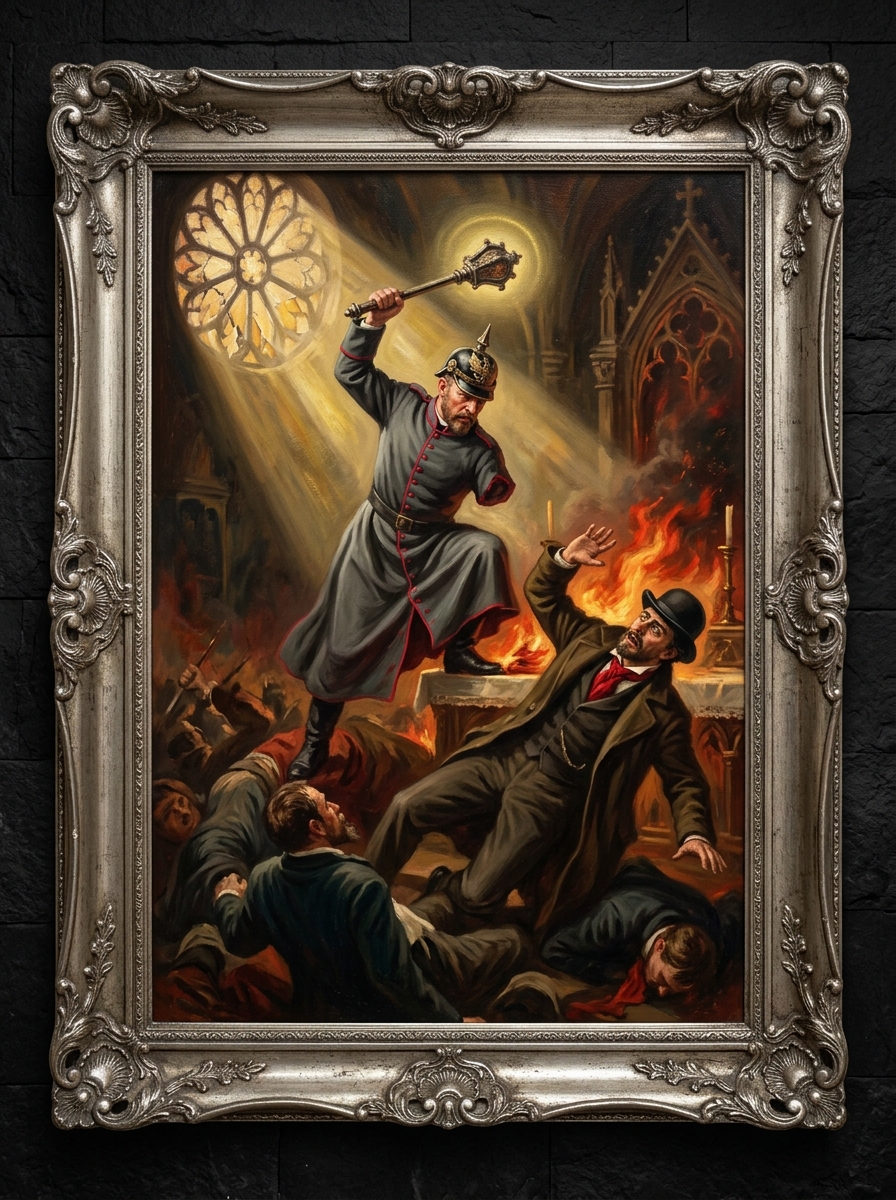
That single blow — the Blow of Saint Rupert, as the Bureau of Doctrine has ratified it — broke the Siege of Vienna, shattered Rationalist command, and gave the Synod the founding myth it required to bind a continent. Whether the blow was miraculous or merely well-timed is a question I am forbidden to answer, which is itself an answer.
#On His Origins
Clemens was born in the gutted shell of Vienna sometime around A.S. 55 (A.S. 55), when the city was a graveyard that had not finished dying. His father was a garrison chaplain; his mother, by Bureau records, "a woman of the lower sacristy" — which is the Bureau's way of saying they do not know her name and have decided not to care.
Earlier editions of this dossier listed Clemens's birth year as A.S. 49, based on parish rolls recovered from the Basilica sub-crypt.
The rolls in question were water-damaged and partially eaten by rats. The Bureau of Records has revised the date to "approximately A.S. 55" and reassigned the archivist who relied on rodent-gnawed vellum as primary source material.
He rose through the ranks of the Vienna garrison not through piety — that came later, and violently — but through a talent for logistics that the Bureau of War prizes above all other virtues. Clemens could feed a regiment on a quarter-ration. He could march men through mud that swallowed mules. He earned the epithet Stahlhand — Steel Hand — not for any gauntlet, but because his supply manifests were so precise that quartermasters called them "iron-fisted." The gauntlet came later, after a Rationalist shell took three fingers from his right hand at the Battle of the Outer Ramparts in A.S. 93. The Bureau of War fitted him with a steel prosthetic. The Bureau of Orison fitted him with a legend.
#On the Nine Months
The Siege of Vienna is its own article, and I will not rehearse nine months of famine and bombardment here. What matters for this dossier is what Clemens did within those months.
He rationed the communion wine into antiseptic. He burned the pews for heat. He ordered the cathedral bells melted for shot, then countermanded himself at the last hour — a decision the Bureau has since declared prophetic, since it was those bells that rang when the blow fell. He hanged two deserters and pardoned a third who had stolen bread for his children, then had the pardoned man promoted to sergeant. He wrote seventeen letters to Hierarch Augustinus requesting reinforcement. Sixteen went unanswered. The seventeenth arrived after the Siege was already broken.
The contents of the seventeenth letter, and in particular the Hierarch's reply (received posthumously, A.S. 104), are sealed under Bureau of Records classification IX-Tertiary. The tone of both documents has been described by those who have read them as "incompatible with the sanctity of either party." Further inquiry is not advised.
By the eighth month, Vienna's garrison was eating boot-leather and plaster scraped from the walls of the Basilica. The Rationalist artillery had cracked the eastern rampart. Sorcerer-elements — daemon-cult remnants allied with the besieging force — had begun to manifest in the lower districts. Clemens did not retreat to the citadel. He moved his command post to the altar of Saint Rupert, in the nave of the cathedral, and he waited.
#On the Blow
The ninth month. The sorcerer-lord Althazar of Pest breached the western wall with a column of things the Bureau of Purity has declined to classify. Clemens took the reliquary mace of Saint Aldebrand from the cathedral vault — the same reliquary the Rationalists had denounced as "pig bones" a century earlier — and walked out to meet him.
What happened next has been told so many times that the truth, if it existed, drowned in the repetition. The Bureau's ratified account: Clemens struck Althazar on the altar steps. The blow rang the marrow of the earth. Iron split. Skulls cracked. Demons scattered into ash-clouds. The bells of Saint Rupert — the bells he had saved from the smelter — pealed of their own accord, and the peal carried across the city, across the trenches, across the Rationalist lines, and the besiegers broke.
Stamped Errata: "Miracle unverified; but useful."
The above erratum, which appeared in the Bureau of War's operational summary (A.S. 102), has itself been classified as an erratum. The Bureau of Doctrine has retroactively verified the miracle as of A.S. 104, concurrent with Clemens's beatification. The officer who authored the original "useful" annotation has been posthumously reprimanded.
I have read the operational summary. I have read the veterans' depositions. I have read the Bureau of Purity's sealed report on the "anomalous thermal event" that accompanied the blow. None of them agree on anything except the outcome: Vienna survived. The Rationalist order collapsed. And Clemens Stahlhand, Bishop-Warden of a ruined city, became the most politically convenient corpse in the Synod's history.
#On His Death and Convenient Sanctity
Clemens survived the Siege by eight years. He spent them rebuilding Vienna's walls, quarreling with the Bureau of Records over supply audits, and — if the sealed correspondence is to be believed — writing letters to the Hierarch that grew progressively less reverent with each passing season.
He died in A.S. 103 of what the Bureau calls "exhaustion of the pneumatic humours," which is the Bureau's way of saying his heart gave out. He was forty-eight, or perhaps sixty, depending on which rat-gnawed parish roll one consults. The Bureau of Orison began beatification proceedings within the year — an unseemly haste that suggests the political value of the dead man exceeded the theological.
The steel gauntlet — the real one, not the hagiographic replacement — is sealed in the reliquary vault of the Basilica of the Ledgered Saints in Strasbourg. Pilgrims may view it on the Feast of Saint Rupert, through glass, at a distance of six feet. The mace remains in Vienna, mounted above the altar where the Blow fell, chained to the wall with consecrated iron.
The Bureau of Orison sells prayer-cards bearing his likeness. The Bureau of War names barracks after him. The Bureau of Doctrine cites his miracle in every sermon on the efficacy of relics. And the Bureau of Records — whose seventeen letters went unanswered — files him under "PERSONNEL, DECEASED, BISHOP-GRADE, VIENNA DISTRICT," with a cross-reference to "RELIQUARY INCIDENTS, ANOMALOUS."
A steel hand. An iron faith. A mace full of bone-dust that may or may not have been pig. And a blow that, whatever its provenance, bought the Synod a continent.
The Bureau is grateful. The Bureau is always grateful. Gratitude costs nothing, and the dead cannot invoice.