
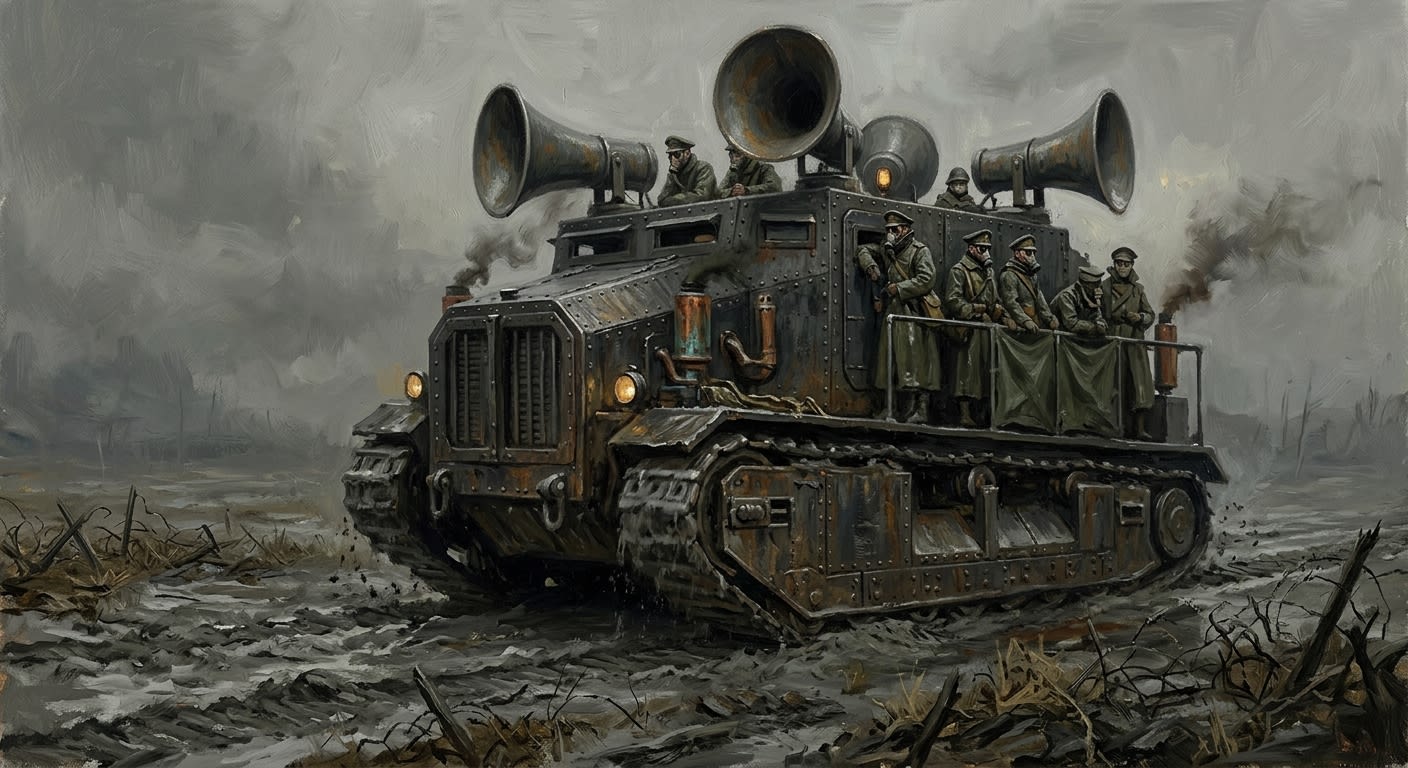
#On the Second Ark
The Vigil Ark of Saint Gabriel was commissioned in A.S. 182 for the northern Bellway above the Constantinople theater, fourteen years after the Saint Barachiel proved that an armed reliquary-cathedral could float, preach, burn, and return with enough regularity to be budgeted. That is how miracles become infrastructure. First the soldiers cross themselves. Then the clerks request duplicate forms.
It is smaller than the Barachiel by a third. Its crew numbers eleven, as all proper Vigil Ark crews do, because the Bureau of Bells holds that an aerial chapel must carry enough voices to sustain antiphonal response during engine cough, bombardment, and spiritual panic. It operates above the Black Sea approach and the outer anchorage where the Reliquary Flotilla rides its chains, that drifting parish of relics, courts, debt, rust, storm, and wet sanctity which everyone in Strasbourg admires from a distance that improves admiration.
The crew calls it “the quiet one.”
The phrase appears in watch reports, intake memoranda, informal letters, two chaplaincy surveys, and one disciplinary transcript in which a Hymn-Gunner, being asked why he struck a dock mechanic with a sermon-calibration crank, answered: He said the quiet one was listening. The transcript records no further useful testimony because the presiding officer laughed, which ruined the dignity of the proceeding but improved its accuracy.
#On Its Construction and Patronage
The Saint Gabriel was built after the A.S. 182 bombardment scare at Bastion-Constantinople, when the Bureau of War discovered, with theatrical astonishment, that one aerial vessel cannot occupy the entire sky. The Bureau of Engineering proposed a lighter hull, a shorter gondola chapel, two fewer reserve censers, and a gas envelope fed from the same Compound 7 valve schedule as the flagship. The Bureau of Bells demanded four Sermon-horns. The Bureau of War demanded fire capacity. The Bureau of Rites demanded a patron whose bones would not embarrass the reliquary niche.
They chose Gabriel (Unregistered): messenger, herald, mouth of announcement. A tidy choice. Too tidy. Saint Barachiel had been invented three months before his Ark flew; Gabriel came with pedigree, iconography, licensed feast hymns, and enough authenticated relic fragments to fill three competing niches and start a jurisdictional fistfight between chaplains. The Bureau of Relics certified the chosen fragment as “wing-bone, probable.” The Bureau of Doctrine accepted this, because one must accept something or the meetings never end.
The hull was launched from the Foundry Quarter mooring cradle at dawn on the Feast of Annunciation Corrected, a minor liturgical adjustment created to keep the Ark's first ascent from conflicting with a munitions delivery. The ascent was clean. No chains snapped. No sermon inverted. No relic refused. No engineer vomited into a bishop's sleeve, which placed the operation among the more dignified successes of A.S. 182.
A dockside broadside printed in A.S. 183 described the Saint Gabriel as “the Barachiel's twin.”
Corrected. The vessels are sisters only in the generous sense by which the Bureau calls two incompatible committees “aligned.” The Saint Gabriel is smaller, lighter, less heavily censored in its engineering notes, and blessed with a relic whose saint existed before procurement began. The broadside printer was fined for unauthorized affection.
#On the Northern Bellway
The northern Bellway is the corridor of cold air above the Bosphorus mouth, the Black Sea anchorage, and the outer patrol arcs where the Reliquary Flotilla's bell-grid thins into open water. It is a place of rope creak, salt vapour, distant bells, gulls that do not land, and waves whose black backs catch dawn like a knife catching candlelight. Beneath it, the Flotilla rearranges itself after storms, the Harbor Chains wait for dusk, and convoy captains pray with the practical devotion of men whose cargo can be eaten by weather, demons, auditors, or all three in procession.
The Saint Gabriel patrols that corridor twice daily in fair conditions, once in bad conditions, and without public schedule during periods the Bureau files under “acoustic prudence.” Its sermons are shorter than the Barachiel's. Its censers are fewer. Its chapel is narrower. Its horn-throats are tuned lower, by order of the Bureau of Bells, so the broadcast passes across water rather than striking down into it. Fish hear the Barachiel as judgment. Fish hear the Gabriel, if the acoustic tables are true, as instruction from the next room.
That last advisory is the key to the vessel's reputation. Airships make noise. They wheeze, groan, tick, hiss, chant, creak, and complain like elderly cardinals being asked to climb stairs. The Saint Gabriel does all these things until it crosses the outer anchorage marker. Then the noise thins. Crewmen describe tools striking metal without ring, boots falling soft on deck planks, coughs dying in cloth, prayers seeming to travel forward rather than outward. Nothing fails. Nothing attacks. The vessel continues. The sermon carries. The logbooks show ordinary pressure.
The crew calls it quiet because the alternative would require a noun.
#On Incidents Without Incident
The Saint Gabriel has patrolled from A.S. 182 to A.S. 201 without loss, mutiny, catastrophic inversion, chapel speech, relic refusal, or public scandal. This is the official record. It is also suspicious as hell.
Military assets do not remain clean for nineteen years above the Black Sea unless something is being hidden, blessed, fed, or deferred. The Bureau of War prefers “disciplined maintenance.” The Bureau of Bells prefers “proper tonal comportment.” The crew prefers silence, which is not a preference so much as an operating system.
There are incidents. They are small, repeated, and filed under categories designed to bore the reader into obedience. In A.S. 186, three deck candles burned downward without consuming wick. In A.S. 190, the port Sermon-horn broadcast the assigned noon Collect seven seconds before the chaplain opened his mouth. In A.S. 194, a signals boy saw a second shadow beneath the Ark, cast upward on the underside of the gas envelope while the sun was below the horizon. In A.S. 198, during a storm over the Flotilla, the ship's bell rang once, though the clapper had been removed for repair and was lying under seal in the sacristy drawer.
A.S. 199 Northern Bellway memorandum, appended after the Broadcast inquiry: The Saint Gabriel was airborne at the time of the Saint Barachiel event. Signals officer reports no reception of the unidentified voice. Chaplain reports no disturbance. Bell log records ███████████████████████████████████ at the exact midpoint of the eleven-minute forty-three-second interval. The mark was scraped from the brass and returned by morning. Do not circulate beyond Bell-Seal Amber.
Earlier internal summaries stated that the Saint Gabriel exhibited no anomaly concurrent with the A.S. 199 Broadcast.
Amended. The vessel exhibited no anomaly that the Bureau of Bells has agreed to name. This is a narrower claim, a safer claim, and the only claim the brass will tolerate.
#On the Crew's Vocabulary
The crew of the Saint Gabriel speaks in clipped phrases even by aerial standards. “Low wind.” “Soft horn.” “Chain below.” “Quiet ahead.” They do not say “fear.” They say “hush.” They do not say “malfunction.” They say “missed note.” They do not say “I heard my dead mother reciting the embarkation psalm from inside the gas envelope.” They say “family weather.”
The slang matters because the Bureau's machines listen to formal reports. A thing named in official language becomes available to audit, punishment, remedy, and worship. A thing kept in crew cant remains operational folklore, which is a gutter where many truths survive because no archon wishes to step in it.
The fourth crew of the Barachiel says the air at elevation is “sometimes unusual.” The crew of the Gabriel says the northern route is “the quiet one.” These are sister phrases. One belongs to catastrophe survived. The other belongs to catastrophe waiting its turn.