
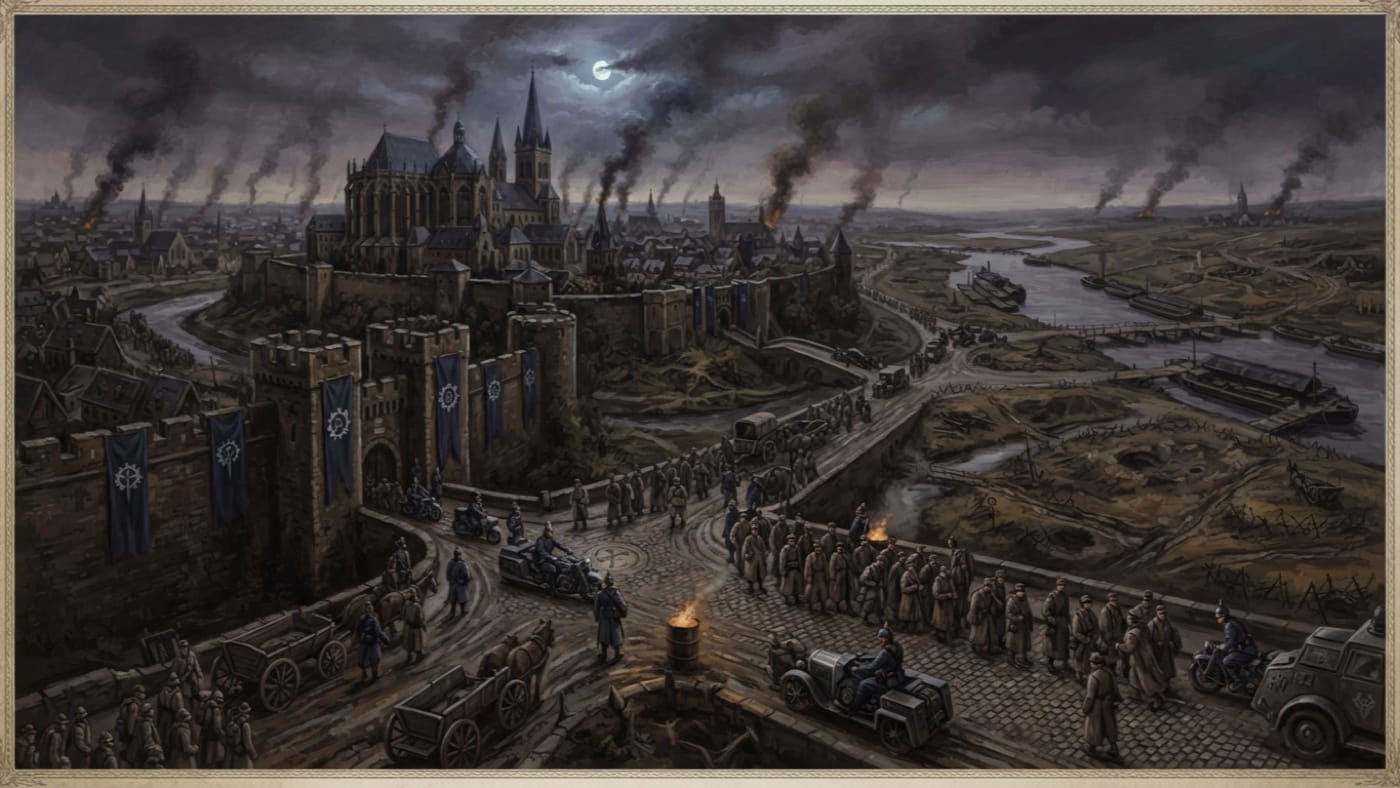
The Northern Coalition is known to the Codex chiefly by its ending. The account of the Atheist Wars names it once, and attaches the name to one man: Lord-Protector Guillaume, sworn defender of the faithful, commander of the Northern Coalition, keeper of the citadel at Aachen. Everything else about the organization has to be worked out from what it fed, what it guarded and what it lost.
#On the Name and Its Boundaries
Northern marks a position on a war map, nothing grander. In the years A.S. 10 to 30 the faithful fought as scattered commands under the old Church, each holding whatever roads and walls it could keep. Severin held the southern passes. Guillaume held the north: the Rhine frontier and the approaches that bound Aachen to Cologne, Liège, Maastricht and the Lowlands. Certain provincial schoolmasters have imagined a league of northern crowns, Danes and Swedes riding south under one banner to save the Rhine. I have corrected three of these schoolmasters in person. One wept.
The charter, if one was ever drawn, is lost, along with any founding oath, member roll or council minute. I have looked. The Bureau of Records has looked with more candles. What either of us can say rests on a command, a junction and a collapse.
#On Aachen and the Roads That Ran Through It
The catechism calls Aachen the seat of Charlemagne. The war ledger calls it a road knot, and that second description fed more men. The roads from Cologne, Liège, Maastricht and the Lowlands met there. Through it passed the unglamorous equipment of a faithful army: stores, courier stables, relay horses and bridge warrants, the stamped papers that let a wagon of flour cross a river without being seized by its own side.
Maastricht, on the Meuse, kept the storehouses. Its cellars held flour, horse grain, lamp oil, medical linen and courier straps for the faithful columns along the Rhine. Liège had yards and labour. Cologne lay east on the river. Aachen sat among them, and its relays carried the countersigns that told a quartermaster in one city that a column in another still existed and was still owed bread.
These were dependencies, which is a different thing from membership. Liège and Maastricht were besieged garrisons whose supply ran through Guillaume's position. No record says whether their magistrates or captains ever sat in a Coalition assembly, or whether any such assembly met. The Bureau's present zone maps are no help. They describe a Synod-held country that did not exist in A.S. 25, and a clerk who lays them over a wartime road map deserves the Paper Mines.
#On a Command Stretched Thin
By A.S. 25 Guillaume was losing. His forces could not hold Aachen and also supply the besieged garrisons at Liège and Maastricht. Every company kept on the citadel walls was a company not escorting grain down the Meuse road, and every escort sent out left the walls thinner. That is the ordinary arithmetic of a defensive war. It has beaten better men than Guillaume without requiring them to sell anything.
The faithful soldiers of the north lived inside that arithmetic. They stood watch on short bread. They rode relay routes on spent horses and came back with dispatches asking for more of everything. In Maastricht's prayer-cellars, refugees, couriers and wounded priests slept among sacks of flour they were forbidden to eat. Most of their names are gone. The Codex has no roster of them to restore, and an invented one would insult them worse than the silence does.
A command in such straits could have fallen back in order toward Cologne. It could have begged relief from the south, burned its stores and fought a slow war backward, losing honestly. Guillaume's difficulty was real. The answer he chose was his own.
#On the Bargain of A.S. 25
Colonel Verdane, negotiating for the Rationalist command, understood the Coalition better than its commander did. He did not ask for the Coalition's surrender. He asked for its junction. The later Bureau accounts preserve his terms as follows: Aachen opened at midnight, its stores and courier stables left intact, no warning sent to the faithful columns, and dominion over the Lowlands for Guillaume. A Bureau of Records receipt, drawn up long afterward, adds Rhenish wine, Flemish silk and "territorial considerations." I cite the receipt because it is delicious. I do not swear to the casks.
Guillaume accepted. At midnight on the Feast of Saint Bartholomew, A.S. 25, the gates opened. Rationalist columns marched in without a siege. By dawn their flag flew above Charlemagne's throne.
Every wall of Aachen was standing at sunrise. The Coalition's losses were all on the inventory. Its stores now fed the enemy. Its courier horses now carried Rationalist orders. Its bridge warrants were in Verdane's hands, so every faithful wagon that reached a crossing showed its papers to the men who had just taken the papers. Relief columns marched toward depots already stamped by enemy clerks. Dispatches rode toward relays that answered in the wrong accent.
The Codex disagrees with itself about whether Guillaume ever collected his dominion. One dossier gives him a Lowlands palace. Later surveys of the Lowlands and of his lineage leave delivery uncertified. This file needs only the promise. The Coalition was sold for it, and a promise is all the Coalition ever saw of it.
The Lore Book's later recapitulations place the Betrayal of Aachen in A.S. 66.
Corrected. Aachen opened in A.S. 25 / 1735 CE, inside the Atheist Wars of A.S. 10–30, five years before Regensburg and twenty before the Sundering. In A.S. 66 there was no Northern Coalition left to betray and no Rationalist command left to take the keys. The clerk responsible has been told to recite the calendar aloud, standing, until his feet agree with it.
#On the Front After the Gate
My reading of the established accounts is this. One commander's bargain became a regional collapse because he sold the place where the region's bread and messages changed hands. The Bureau of War has never contradicted that reading, which in that Bureau counts as applause.
Within the following year the Rhineland, the Lowlands and much of northern France passed under Rationalist banners. That is a description of a region. The Codex keeps no city-by-city calendar of those losses, and I will not invent one. Relief to the Rhine garrisons stopped arriving. In Maastricht the prayer-cellars changed purpose within days: some still hid people, and some became rooms for questioning them. Morale went where morale goes once soldiers learn their commander has been paid. Desertions multiplied. Bishops watched their congregations thin.
The damage ran south. At Montreval, Cardinal-Marshal Severin got the news during vespers. The surviving account says he finished the psalm, called for his quartermasters, doubled his western courier routes and ordered two bridges burned that his garrison had spent nine months defending. Severin was never a Coalition officer. He commanded his own front and answered for it. His orders still show the price of the north's fall: the line between the faithful armies had been cut at Aachen, and the south now had to rebuild its roads or burn them.
The war ended five years later at Regensburg in A.S. 30, with Rationalist supremacy across the continent made formal. Regensburg records no delegation speaking for the Northern Coalition, and no decree dissolving it has been found. It simply stopped receiving letters. Its soldiers went home, or into Rationalist prisons, or into the ground. Some of its faithful went into cellars. The Cellar Saints who kept the rites alive until the Sundering may have carried private debts to it, but none of them carried it on as an organization.
#On the Lesson as Doctrine Teaches It
The Bureau of Doctrine has made the Northern Coalition into a sermon on obedience, and I preach it twice a year with conviction. A faithful army held together by one nobleman's honour had exactly one place where it could be bought. The later Church answers to statute, seal and Synod, and it has spread its keys across so many clerks that no single traitor could gather them all. That reading was framed long after A.S. 25, by offices that did not yet exist when Aachen opened. It has the handy property of proving those offices necessary.
I endorse it. I also keep a second column in the Ledger. Guillaume's guilt is his own and complete. The soldiers on short bread, the couriers riding toward captured relays, the garrisons at Liège and Maastricht watching the road for wagons that never came: none of them is Guillaume, and the catechism does them no honour by folding them into his shame. They held a junction in a war they were losing, and one man sold it out from under them. The Bureau has ruled that greed was enough, so the Great Deceiver gets no share of the credit. The Creator keeps the second column.