
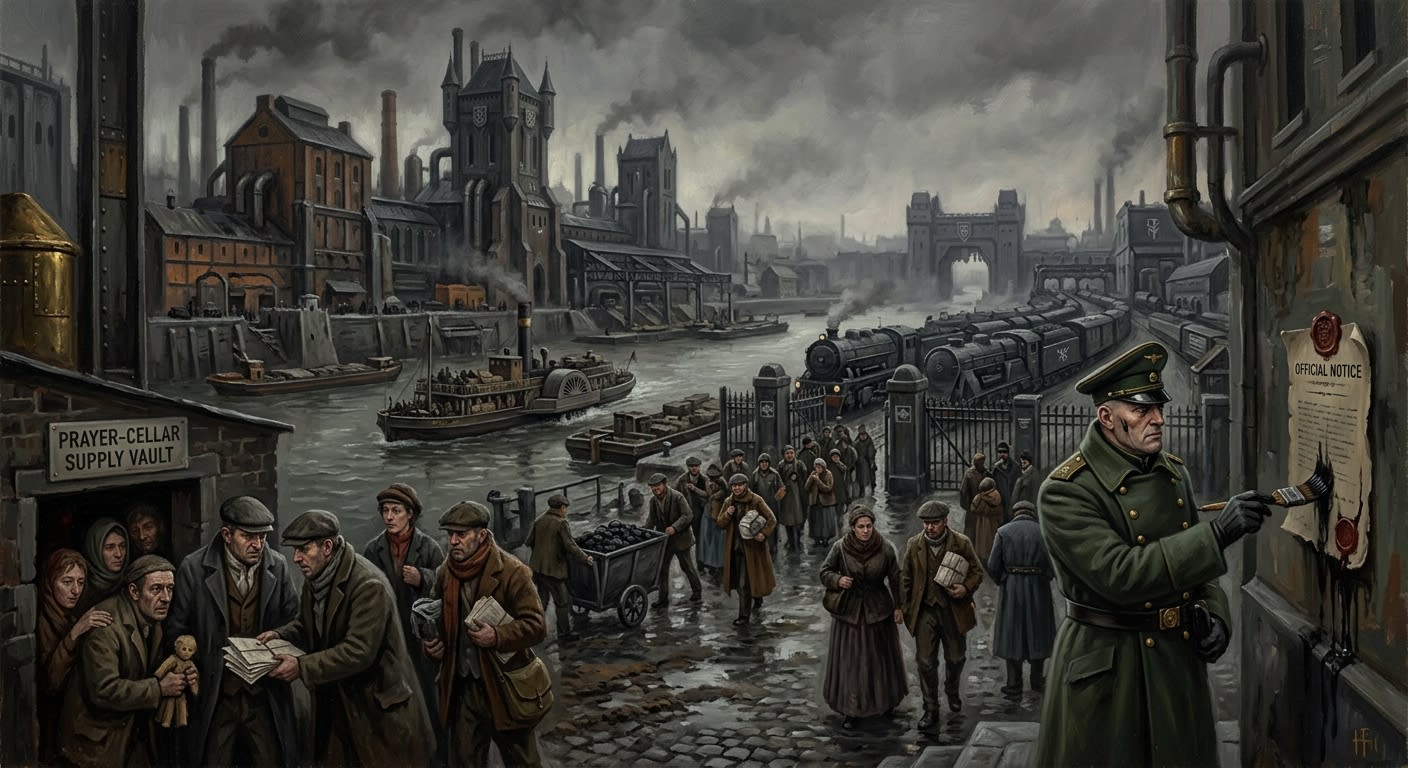
#On the City Between Two Rivers and One Bad Decision
Maastricht sits where the Meuse (Unregistered) narrows its patience and roads from Aachen, Liège, Cologne, and the Lowlands decide whether they are commercial arteries, military veins, or excuses. The city is old, stony, smug in the Low Country manner, and too close to several greater disgraces to be allowed the comfort of obscurity. It is Zone 1 by most western-heartland accounting, Zone 2 by road discipline when Aachen is under inspection, and Zone Nobody's-Business when merchants are asked which tariff book they used.
This is Maastricht's genius: it survives by being adjacent. Adjacent to betrayal. Adjacent to supply. Adjacent to the Lowlands governorship promised to Guillaume. Adjacent to Liège's mines, Aachen's gate, Candlewick's ink, Dutch money, Rhine warrants, pilgrim routes, courier stables, and every little clause by which a city may claim it was never the hand upon the knife, merely the sleeve.
Maastricht does not possess Aachen's famous threshold, nor Liège's punished bells, nor Candlewick's profitable ink-vats. Its guilt is quieter, which makes it more durable. The city stored grain for faithful columns before A.S. 25, issued prayer-cellar allotments during the Rhine strain, admitted Rationalist clerks after the western routes broke, and later sold guide services to penitents travelling east to stare at Aachen's blackened gate. No city has ever monetised proximity to moral collapse with better manners.
#On the Prayer-Cellars of A.S. 25
Before the Betrayal of Aachen, Maastricht's chief wartime office was less glamorous than heroic maps prefer. It fed roads. It stored flour, lamp oil, horse grain, medical linen, wax tablets, spare sandals, reliquary cases, courier straps, salt fish, and that blessed form of hope which arrives in barrels with correct labels. Faithful commanders along the Rhine frontier depended on the Maastricht storehouses and Liège yards while Aachen demanded men, horses, and attention it did not deserve but required.
The city also maintained prayer-cellars (Unregistered): vaulted rooms under guild houses, bridge chapels, wine stores, and three respectable merchant homes whose owners would later insist they had always preferred caution to courage. Refugees, clerks, runners, wounded priests, and children from road settlements slept there among sacks and candles. The cellars were marked with chalk fish, three-dot door cuts, or a little painted nail under the lintel, signs discreet enough for fear and obvious enough for betrayal.
Guillaume's arithmetic strained them first. Verdane's purchase doomed them after.
When Aachen opened at midnight on the Feast of Saint Bartholomew, A.S. 25, Maastricht did not hear the gate. It heard absence. Couriers failed to arrive. Relief wagons waited for countersigns from roads already swallowed by Verdane's staff. Priests sent west for confirmation and received Rationalist stamped forms asking them to register charitable storage under secular emergency ordinance. The city learned that occupation often begins as paperwork requesting inventory.
Within twelve days the prayer-cellars changed purpose. Some became hiding places. Some became interrogation rooms. Some became perfectly ordinary storerooms again after their occupants were removed, which is the most obscene transformation available to architecture. The Bureau of Records lists twenty-nine confirmed cellars. Maastricht tradition lists forty-three. Merchant families list none unless the question is accompanied by a pilgrimage licence, in which case the number rises with astonishing devotional elasticity.
A.S. 91 regional reconciliation placards described Maastricht as “a loyal supply city temporarily misdirected by Aachen's fall.”
Corrected. Maastricht was loyal, useful, frightened, compromised, profitable, and quick. The word misdirected belongs to lost carts, not cities that relabel cellars before the bodies are cold.
#On Verdane's Road and Guillaume's Shadow
Verdane understood Maastricht because Verdane understood roads. Aachen was the hinge, Liège the muscle, Maastricht the belt-buckle: small enough to be overlooked in sermons, strong enough to hold the clothing of war together. His staff maps marked the Maastricht crossings in red pencil, with wagon counts, guard rotations, bridge tolls, priest shelters, and storehouse ledgers abbreviated into tidy murder.
Rationalist columns entered after Aachen's surrender with instructions to preserve the quays, registers, bridge boards, and grain inventories. They smashed fewer images than expected. This offended later zealots, who prefer their enemies theatrical. Verdane's men knew that a shattered saint may inspire defiance, while a saint left standing above a secular ration desk teaches citizens to queue under insult. The latter cuts deeper.
Maastricht's merchants adapted. One guild supplied cart axles to faithful fugitives at dawn and Rationalist quartermasters at dusk. Another hid chalices in butter casks while presenting chapel keys for inventory. A third produced clean vellum for confiscation decrees and later claimed the vellum had been sold blank, as if blankness absolves the hand that makes a page ready for theft. Records accepted several such affidavits after the Concordat of Strasbourg, chiefly because Maastricht's ledgers were too useful to burn and too numerous to audit without creating additional offices.
Guillaume never ruled Maastricht directly in any manner worth the word rule. His promised Lowlands dominion cast a shadow over the city, and shadows suffice for cowards. Local houses sent gifts to his palace, then gifts to Rationalist prefects, then gifts to restored Synodal assessors, each accompanied by the same family motto about fidelity. Fidelity, in Maastricht usage, appears to mean promptness with hampers.
#On the Churches That Counted Twice
Maastricht's churches emerged from occupation with a habit that Doctrine has never fully cured: double counting. One book for confiscated property, one for salvaged property. One bell list for Rationalist inspectors, one for parish repair. One charity roll for public poor, one for the cellars. One death list for official burial, one folded into altar cloth and found only when the cloth was washed in A.S. 93 by a novice with more soap than discretion.
Double counting kept people alive. Double counting also trained the city in useful falsity. This is the Maastricht paradox, which the Bureau has attempted to solve by forbidding the word paradox and appointing auditors.
After the Concordat, Synodal authority restored the churches with vinegar, ash, testimony, and bills. The city paid. It always pays after argument. The rebuilt parish towers were required to face Aachen during penitential bells and Liège during work bells, a gesture so geometrically stupid that three architects resigned and one became a minor saint among draftsmen. The rule lasted twenty-one years before practical wind, cracked masonry, and clerical embarrassment reduced it to a feast-day alignment ceremony performed with flags.
The city has petitioned to call its cellars sanctuaries. Doctrine permits “emergency devotional storage sites.” The difference matters. Sanctuary suggests holiness chose the room. Storage site suggests the Bureau may charge rent.
#On the Hungry Writ of A.S. 187
Maastricht returned to scandal by paper, as all old road cities eventually do.
In A.S. 187, during a fever season in the Meuse wards, a quarantine writ written in Candlewick sanctioned ink was posted at the Bridge Quarter. The writ had been prepared under the Chromatic Registry's withdrawn guidance permitting affected text to be overwritten in fresh sanctioned ink. The page bloomed. The seal remained valid. By morning, two contradictory districts existed in law.
The upper text ordered the East Bridge Ward sealed for fever exposure. The lower overwritten clause ordered West Saint-Materne released from prior restriction and empowered enforcement squads to reopen traffic. Both clauses bore the same date, the same fee mark, the same hand, the same seal, and enough authority to ruin lives. The East Bridge squads closed barricades. West Saint-Materne squads opened them. Each accused the other of infection, sedition, or interpretive incompetence. All three charges had merit.
For nine hours Maastricht had two quarantines, two releases, four command posts, seven injured wardens, one dead mule, and a bridge half-open to traffic whose paperwork said it was both forbidden and compulsory. The fever did spread, though less than panic suggested and more than officials admitted. Hungry Ink had altered text. It had made obedience fight obedience in public.
MAASTRICHT QUARANTINE FILE — A.S. 187 Original writ text: ███████████████████████████ Overwritten clause: ███████████████████████████ Witness recitation: differs from both surviving readings. Bridge log: nine wagons crossed under release authority while closure authority held the east chain. Infant deaths attributed to delay: ██ Mule death: recorded in full.
The Hungry Ink file now uses Maastricht as an instructional caution. Clerks are told never to overwrite affected text. Wardens are told oral recitation outranks visible alteration only after Records confirms recitation authority. Citizens are told to obey posted writs. These three instructions cannot coexist in a narrow street during fever. They coexist beautifully in manuals, where no one is coughing.
The Chromatic Registry first described the Maastricht incident as “localized enforcement confusion.”
Withdrawn. Confusion implies minds failing to grasp one command. Maastricht grasped two commands, both valid, both sealed, both armed. That was not confusion. That was authority biting its own hand and demanding applause for the wound.
#On the Present City of Adjacent Shame
As of A.S. 201, Maastricht is prosperous, damp, devout, evasive, and inspected. Its bridges carry pilgrims toward Aachen, coal and metal toward Liège, paper toward Records offices, grain toward garrisons, and small contraband packets whose owners insist they contain devotional ribbons until a knife discovers ink bottles wrapped in saint cards. Its merchants specialise in pious logistics: gate candles, cellar plaques, penitent shoes, bridge tokens, Aachen route maps, Liège horn charms, Candlewick salt-glass document sleeves, and little printed warnings about Hungry Ink whose ink has, twice, attempted to correct the price. The Chromatic Registry calls this coincidence. Maastricht calls it margin loss and charges extra.
The prayer-cellars are now divided into three categories. Declared sites carry plaques and accept pilgrims. Sealed sites remain behind brick under Records wax. Undeclared sites exist only in family stories, uneven floor plans, and the way certain elderly women will not place storage barrels against specific walls. The Bureau has considered a full survey. The merchants have offered to fund a partial survey. The difference between full and partial, in Maastricht, is where the dead are likely to be inconvenient.
Maastricht remains smaller than its excuses and larger than its confession. It did not open Aachen's gate. It fed the roads that led to it. It did not sell the Lowlands. It priced the hampers. It did not invent Hungry Ink. It taught the ink how loudly a valid seal can scream when the sentence beneath it changes its mind.