
#On the City of Iron Throats
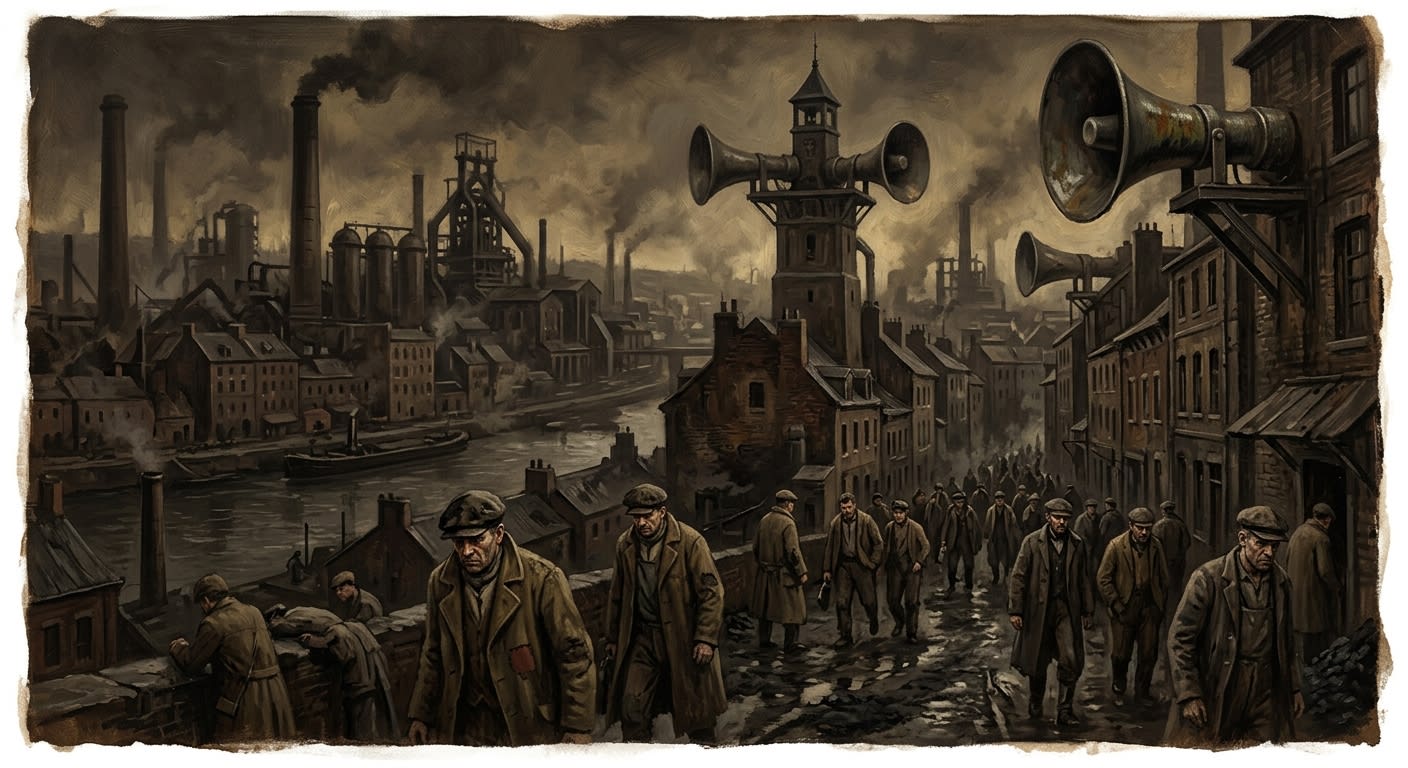
Liège is a city that learned, with admirable pain and insufficient speed, that iron may be dug from earth, forged into work, hung in towers, struck by men with blackened hands, and still remain the property of Heaven once Strasbourg has decided the matter. It sits upon the Meuse, near the Lowlands road-knot, close enough to Aachen to have smelled the gate when it opened in A.S. 25 and close enough to Cologne to hear, in clear weather and obedient imagination, the memory of the bells that broke Wrath’s Host. Its hills are coal-black. Its workshops are red-throated. Its people speak with the clipped impatience of miners, smiths, carriers, bell-casters, and women who have spent all day washing soot from children who will be sooted again before supper.
Do not imagine Liège as a frontier city. It is worse. Frontiers can plead extremity. Liège is a heartland industrial city with frontier habits: underground maps, shift-codes, river locks, guild tempers, and the secret conviction that a man who keeps the furnaces hot has earned the right to make noise when noise is useful. Such convictions are the manure in which civic heresy grows. The Bureau of Bells has spent nearly a century salting the bed.
Liège’s registered importance is plain enough for a quartermaster: coal, iron, rivets, bell-metal scrap, chain links, rail fittings, lock plates, horn bodies, furnace grates, and the small cruel instruments by which larger cruel instruments remain assembled. Its unregistered importance is older. It is a city of local time. Before Strasbourg’s clocks flattened the continent into sanctioned peals, Liège lived by mine bells, foundry whistles, river calls, chapel strokes, guild hammers, and the cough of men entering daylight by cage. Work below ground does not obey the sun. Work near molten metal does not wait for Vespers. Work in a shaft where gas collects and rock shifts learns its own calendar by survival.
Strasbourg found this intolerable.
Liège is not famous because it makes iron. Many cities make iron and remain boring, which is a mercy. Liège is famous because its miners rang shift-bells without sanction, were scourged for three days, returned to the mines on the fourth, and increased productivity under horns they were not permitted to read the schedule for. The Bureau has cited this outcome in four training manuals, six sermons, two labour circulars, and one private memorandum so smug that even I, a connoisseur of sanctified arrogance, found it over-seasoned.
The city endures. That is its virtue and its indictment.
#On Liège Before the Bells Were Taken
Before the Synod’s full acoustic settlement, Liège lived by competing jurisdictions of sound. Cathedral bells marked feasts. Parish bells marked baptisms, funerals, parish boundaries, and disputes between priests who disliked walking to each other’s doors. Guild bells marked loading, unloading, wage-count, furnace start, furnace death, shaft descent, shaft rise, river lock, and accident. Household bells rang from stairwells when soup was ready or a child had fallen into something expensive. The city rang because the city was made of cavities: mines under streets, cellars under workshops, river tunnels, kiln throats, bell towers, pockets in stone where sound entered and came back altered, as though the hill itself had taken advice.
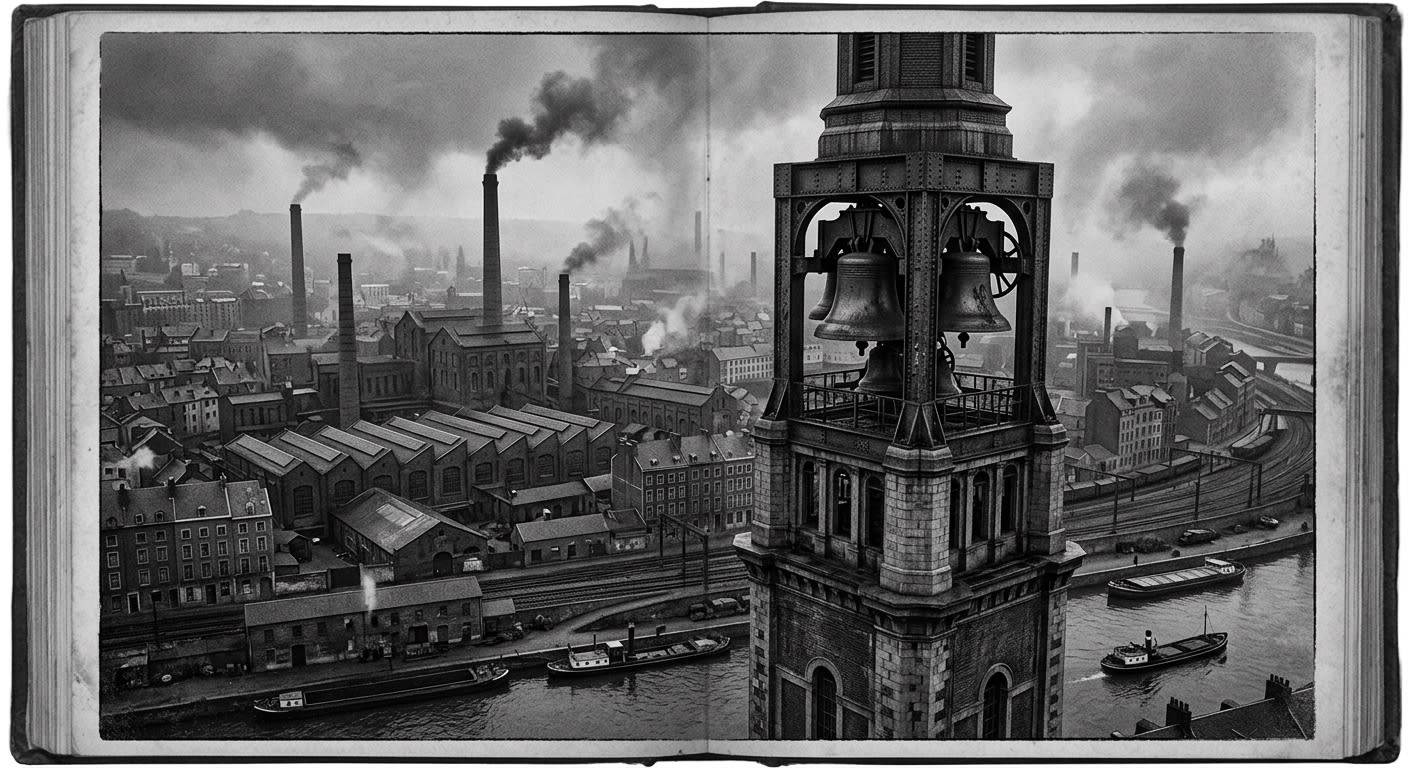
The old bishops tolerated much because bishops in mining cities learn the theology of compromise quickly or are discovered in wells. A miner late to descent endangered his crew. A pump delayed by liturgical sequence drowned a gallery. A furnace idled at the wrong hour wasted fuel and invited explosion. Local schedules arose from hazard. The bell-rope became a tool no less than pick, lamp, wedge, and chain.
The Atheist Wars gave Liège its first modern wound. During the middle years of the conflict, faithful columns along the Rhine frontier depended upon Liège and Maastricht for supply while Aachen demanded men. Guillaume could not feed the garrisons, hold the citadel, defend the roads, and maintain the posture of noble competence upon which aristocrats depend for digestion. Verdane saw the strain. He priced it. The result was Aachen’s midnight opening and the collapse of the northern faithful front.
Liège did not open a gate. This has been its favourite defence ever since. It is true and insufficient. The city’s storehouses fed men who never arrived. Its chapels hid fugitives, then were searched. Its abandoned cellars near the Meuse held wounded faithful after Rationalist patrols cut the roads. Its bells were wrapped, muffled, seized, relabelled, and in three cases melted for secular clockworks so offensive to taste that the Bureau of Doctrine later destroyed the diagrams on aesthetic grounds.
The Sisters of the Martyrdom passed through the Liège approaches in those years. Three unnamed spans outside the city burned under their doctrine of transit denial. Their action delayed columns long enough for reliquaries and children to escape westward before Guillaume’s sale finished what cowardice had begun. Liège remembers the bridges in songs. The Bureau permits the songs under local melody restriction, meaning they may be sung only at tempos that make grief difficult.
A devotional broadsheet once credited Liège with “saving the northern faithful front through bridge sacrifice.”
Corrected. Liège did not save the front. Liège delayed the bill. Delay has value; exaggeration has costs; both are entered here without perfume.
After the Sundering, when Hell corrected Reason with all the subtlety of a falling cathedral, Liège returned to usefulness. Coal does not become less necessary because demons exist. Iron does not lose sanctity when the man smelting it has bad politics. Strasbourg’s later genius lay in refusing to waste productive cities merely because they had been occupied, frightened, compromised, or noisy. It taxed them instead. Taxation is forgiveness with teeth.
#On the Mines Beneath the Meuse
The Liège mines run under hill, street, chapel, yard, and memory. Their oldest galleries were dug by men who marked direction with chalk crosses and saints’ initials. Their later galleries were surveyed with chain, lamp, and Bureau of Engines instruments whose operators looked at the old chalk marks with educated contempt and then followed them because contempt is no substitute for ventilation.
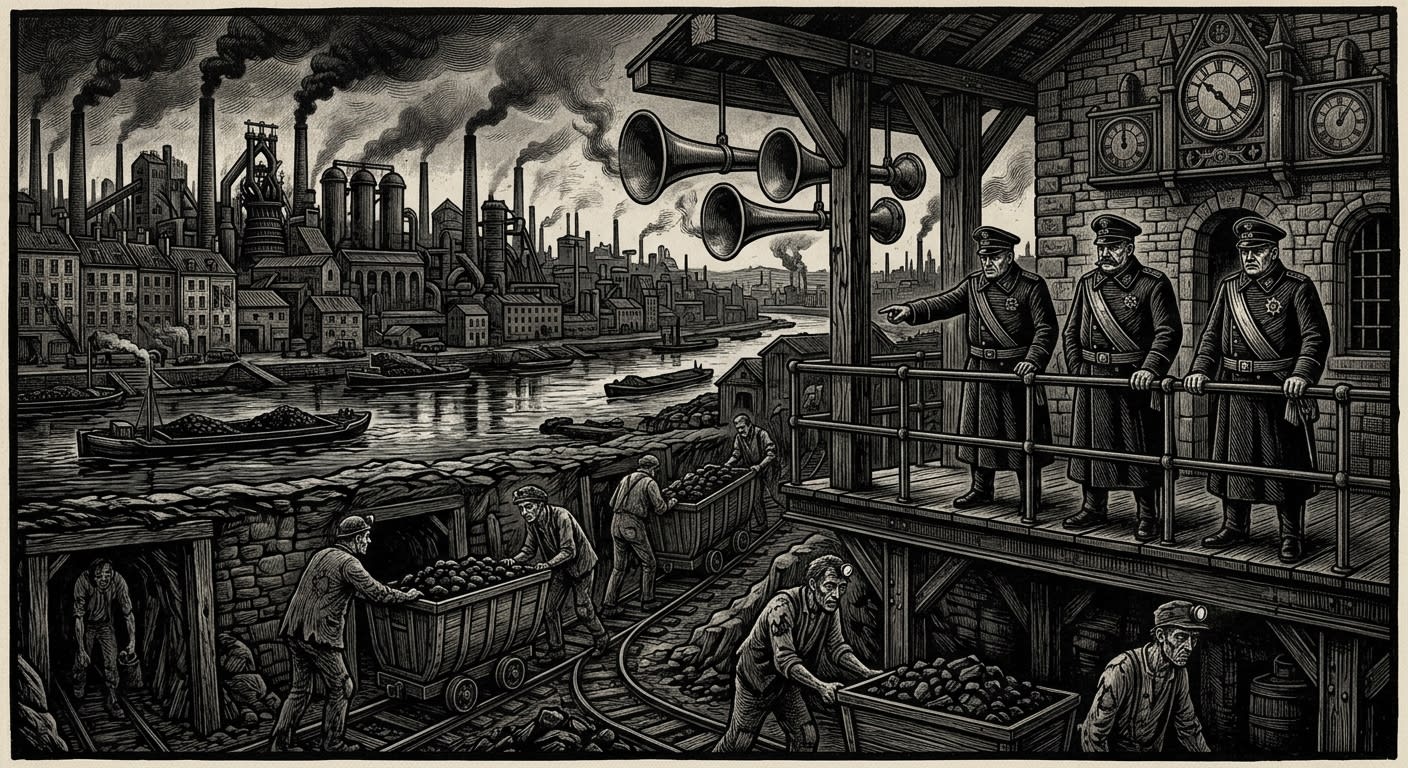
Mine-work breeds private law. Underground, rank thins. A boy with a lamp may outrank a foreman if the lamp detects gas. A woman counting cage returns may correct a priest if the count is short. A bell sounded early may mean panic, discipline, collapse, rescue, shift change, or the discovery that one’s cousin has been reduced to a red smear beneath stone. Liège miners learned to hear difference in metal. A cracked bell meant roof stress. A hard double strike meant pump trouble. A slow triple meant bodies. A rolling hammer-stroke along rail meant gas. The Bureau of Bells calls this unauthorised semantic proliferation. The miners called it staying alive.
Here lies the heart of the city’s sin. Liège did not merely ring bells. It made bells mean what local necessity required. Meaning escaped the Bureau. A bell for work became a bell for rescue; a bell for rescue became a bell for gathering; a bell for gathering became a bell for dispute; a bell for dispute became a bell capable of assembling five hundred soot-faced men in a square before a Bell-master’s carriage had finished turning its wheels. Strasbourg tolerates hunger, grief, even incompetence when correctly filed. It does not tolerate unsupervised assembly by bronze.
The miners’ guild defended itself with the usual language of practical men caught committing theology. They said the shift-bells were old. They said the rhythms predated the Bureau’s present tables. They said the mines were dangerous. They said no doctrinal statement was intended. They said the bell was a tool. These pleas were all true. That is why they failed.
The Bureau of Bells held that bells are sacraments given voice. A sacrament used as a work whistle is either profanation or evidence that work has become liturgy without paying the appropriate fee. The Bureau chose profanation because it sounded cheaper at first hearing.
#On the Bell Scourging of A.S. 108
The Bell Scourging began after the Feast of Saint Verral in A.S. 108, when miners at the Sainte-Barbe lower galleries rang their own shift sequence during a pump crisis without waiting for the diocesan Bell-master’s dispensation. The pump crisis was real. Gallery Seven had taken water. Twenty-eight men were below, six boys among them, one mule, three lamp carriers, and a foreman named Otte Marcin who appears in the Records file only because his widow later corrected the spelling with such fury that the clerk developed a nosebleed.
The local bell rang eleven times. Eleven was not a permitted emergency number under the Cologne schedule then in use. The nearest licensed alarm required seven strokes, pause, three strokes, pause, one stroke, and priestly witness if the alarm occurred during a feast window. The miners had neither time nor priestly witness. They had water. The bell rang. Men came. The pumps started. Twenty-one survived.
The Bureau prosecuted the bell.
The first day was legal. Bell-masters sealed the tower, removed the clapper, suspended the guild’s sound privileges, and ordered the foremen to present all local signal tables. The miners presented three tables and hid nine. The second day was instructive. Scourging posts were raised in the guild square. Every registered bellman, rope-hand, shift caller, and table keeper received lashes according to proximity to meaning: clapper-hand first, rope-hand second, table keeper third, foremen last, because men who write schedules sin with durable ink. The third day was theological. The whole guild processed past the removed bells while Bell clerks read from the Codex on lawful sound. Several miners fainted. The Bureau recorded “receptive posture.”
Then came the melting. The shift-bells were taken down, weighed, blessed in reverse order, broken, and smelted. Their metal was divided. Some entered shackles for condemned bell-offenders. Some entered counterweights in the new horn towers. One small portion went to Strasbourg for inclusion in a demonstration clapper used in Bureau lectures on acoustic obedience. I have heard it struck. It has an ugly note, which is appropriate.
RECOVERED GUILD SCRAP, SAINTE-BARBE DISTRICT “They took the bell that called us up from water. They gave us a horn that calls us down to work. If God hears the difference, ███████████████████.” Disposition: burned as sentimental sedition. Copy retained by Doctrine for tonal analysis.
The mines reopened on the fourth day. This fact has become Bureau scripture. The workers descended under horn blast at sanctioned intervals. Output rose within the month, though the Bureau neglects to mention that output rose because every shift was lengthened to compensate for lost signal flexibility and because injured men were replaced with boys from poorer districts. Sanctified efficiency often contains a child at the bottom of it. The Bureau of Mercy prefers not to look down.
#On Horns, Shackles, and the New Schedule
Liège’s sanctioned horns are not bells. This distinction permits the Bureau of Bells to claim victory while regulating the devices anyway, a double authority so elegant that I nearly applaud. The horns are brass-throated, wall-mounted, locked behind grillework, and sounded by licensed wardens at intervals prescribed in Schedule 14-L. The miners are not permitted to read Schedule 14-L. They are required to obey it. The arrangement has lasted ninety-three years, which proves that absurdity, once bolted to wages, becomes custom.
The horn tones lack the old bell language. This was intentional. A horn can blast descent, rise, danger, cease, and assembly, but it does not carry the layered civic memory of bronze. It cannot mourn without sounding like a sick cow. It cannot summon a parish grandmother who has known the bell since childhood. It cannot make a square fill before a magistrate notices. It is loud, useful, ugly, and obedient. The Bureau adores it.
The shackles made from bell-metal were issued first to local punishment cells, then to travelling Bell inspectors as teaching objects. Convicted unauthorised ringers were sometimes chained with Liège metal during sentencing. This is tasteless and effective, the Bureau’s favourite marriage. A man punished for striking a bell feels the old bell around his wrists and understands, without a sermon, that the state has converted his sound into restraint.
Liège guild families developed their own counter-rites. Children were taught to tap tables in patterns that mimicked the forbidden sequences without producing audible bell tone. Women drying laundry clipped pins in groups of eleven along lines facing the old tower. Miners coughed twice before descent and once after rise during the feast week of the Scourging. The Bureau classified these gestures as “sub-acoustic memorial evasions” and spent three years deciding whether a cough could be prosecuted as a bell. It decided no, under protest.
A Bureau of Bells circular stated that “all Liège acoustic resistance ceased after Schedule 14-L.”
Clarified. Formal bell resistance ceased. Informal gesture, cough-code, pin-count, table-tap, boot-scrape, and laundry-sequence behaviours continued at tolerable nuisance levels. Tolerable nuisance is not innocence. It is budgeting.
The mines acquired a new profession: the Horn Warden. Not a miner, not quite a Bell officer, not quite a clerk. He keeps the schedule locked in a tin case, sounds the horn, records compliance, and is hated by men who know he too was born in soot. The best Horn Wardens develop deafness early. The worst retain hearing and opinions.
#On the Faulty Mirrors
Liège’s second great embarrassment came from glass rather than bronze, which proves that the city’s talent for civic hazard is versatile. In A.S. 201’s public catechism the incident is taught as a warning about calibration, though the true file sits under Purity because every mirror in the Dominion is secretly a theological accusation waiting for a face.
On certain holy days, villagers stand before Bureau-issued mirrors and recite lineage aloud. If the mirror fogs, mortal warmth is confirmed. If it does not, inquisitors presume demonic substitution. The rule is brutal, simple, and popular among men who like tests with visible answers. In A.S. 190, a batch of Liège mirror plates supplied through a subcontracted furnace yard failed to fog during a northern parish inspection. The whole village was executed to be safe. Records later determined the mirror backing had been overtreated with a coal-salt wash that resisted breath condensation.
The report used the phrase “calibration error.”
Liège protested that the batch had passed inspection. The inspector protested that the inspection standard was supplied by Strasbourg. Strasbourg protested nothing, which is how Strasbourg confesses. The furnace yard was fined. Two foremen vanished. The parish remained dead. Purity retained the right to execute on unfogged mirrors because withdrawing the test would endanger confidence in the test, and confidence in the test had already cost a village, making retreat uneconomical.
The mirror scandal worsened Liège’s existing reputation: not merely noisy, but unreliable in instruments by which the state distinguishes man from impostor. The city’s defenders argued that industrial cities produce defects because they produce objects. This is a strong argument in taverns and a weak one before a tribunal. The tribunal’s reply was that a defective instrument which kills a village has performed a doctrinal act whether intended or not.
Since then, Liège mirror works operate under doubled breath tests. Workers exhale onto every tenth plate, then onto a control spoon, then sign a warmth slip. The slips are archived for seventeen years. A rumour persists that some workers whisper names of the dead parish over the plates before packing them. Purity investigated and found no sedition, which means either no sedition existed or the workers had learned to whisper like professionals.
#On the River, the Road, and Aachen’s Shadow
Liège lives in Aachen’s shadow without sharing Aachen’s classification. This annoys both cities. Aachen is the famous warning, the gate that opened, the polished threshold, the barefoot litany. Liège is the harder lesson: the city that did not betray but enabled, supplied, rang, misheard, survived, corrected, and returned to work before the bruise had coloured.
The roads between Cologne, Liège, Maastricht, and the Lowlands remain military arteries. During the Atheist Wars they carried relic carts, fugitives, Republican Guard patrols, Sisters with oil under their habits, Verdane’s staff riders, and the sort of merchant who can smell a regime change before the ink dries. In the present age they carry coal contracts, bell-metal audits, pilgrim overflow, horn parts, chain fittings, and penitents travelling to Aachen who stop in Liège to buy black bread because penitence goes poorly on an empty stomach.
Liège merchants have become expert at adjacent shame. They sell Aachen gate-penny replicas stamped as devotional tokens, tiny horn charms, table-tap primers disguised as children’s counting books, and small blackened medals showing Saint Bartholomew with a closed gate behind him. The Bureau tolerates most of this commerce because memory that pays tariff is preferable to memory that gathers in unpaid corners. Tithes has no objection to grief once grief is priced.
The Meuse itself complicates discipline. Barges carry coal, scrap, tools, and rumours downstream faster than a Bell inspector can follow. River workers developed whistle codes after the Scourging, arguing that whistles were neither bells nor horns under the first wording of Schedule 14-L. The Bureau closed that gap in A.S. 119. The river workers moved to chain-taps. The Bureau opened a file. The file remains open, fat, and slightly damp.
Liège’s river locks now display Triune Knot plates on every gate, stamped deep enough to catch soot. Gatekeepers recite a short bell-law before opening traffic. The words are perfunctory; the lock movements are exact. Men can believe many wrong things and still operate machinery well. This, I regret to say, is one reason the Synod keeps them alive.
#On Bell Inspectors and Useful Hatred
The Bell Inspectorate keeps a permanent office in Liège above a former guild counting room, a deliberate insult filed under rental efficiency. Its clerks answer to the Bureau of Bells, borrow muscle from Purity, request figures from Records, and complain about soot to Mercy whenever their lungs acquire evidence. The office contains three locked cabinets: one for horn schedules, one for offence slips, one for confiscated table-tap primers printed as arithmetic cards. The third cabinet is fullest. Children, as ever, are the true archive of forbidden systems.
Inspectors walk the city in pairs. One listens. One watches mouths. The listening inspector carries a tuning fork, wax plugs, licence tabs, and a little red book of prohibited intervals. The mouth-watcher records coughs, whistles, hammer falls, boot scrapes, laundry-pin arrangements, and suspicious pauses in drinking songs. No city in Europe has produced more jurisprudence on whether a man clearing phlegm may be assembling labour unlawfully. This is not satire. It is case law, which is satire that has found employment.
A.S. 152 saw the Iron Rattle Inquiry, when three foundries were accused of using cooling-chain strikes to transmit wage complaints across the south bank without horn licence. The accused masters blamed thermal contraction. The workers blamed loose links. The inspectors blamed conspiracy, which was wise, since conspiracy carries better fees than physics. Engines & Furnaces performed tests and concluded that the chain-rattle could convey four distinct messages if the striker possessed rhythm, resentment, and an unhelpful familiarity with metal. Six men were fined. Two were transferred to Ulm. One chain was blessed, cut into eleven lengths, and distributed to training houses.
Hatred has made the city efficient. The miners hate Bells and arrive on time to deny giving cause. Bells hates the miners and audits with monastic appetite. The foundries hate inspectors and maintain cleaner signal logs than pious towns that love them. Tithes hates everyone and collects the fines. Doctrine approves the arrangement because mutual dislike, when properly channelled, forms a civic brace stronger than affection. Affection asks questions. Hatred keeps receipts.
#On the Present City
As of A.S. 201, Liège is productive, watched, resentful, useful, and acoustically disciplined in all public registers. The cathedral bells ring by Strasbourg schedule. The mine horns sound by sealed table. The river locks answer by licensed chime. The foundries start on lawful blast. The mirror works breathe on command. The guilds no longer possess bell privileges except for a single annual memorial stroke on the Feast of Correction, rung by a Bureau officer while guild elders stand five paces away with uncovered backs.
The old bell tower of Sainte-Barbe remains empty. Its rope was removed. Its stair was sealed. Its bell chamber holds a plaque bearing the approved sentence: Work is holy when time is obedient. Soot gathers on the plaque faster than cleaners remove it. Children dare one another to climb the outer drain and tap the stone beneath the chamber. If caught, they are fined, catechised, and made to polish horn grilles. This is sound policy. Let the child learn where the state keeps its throat.
Liège has petitioned twice for restoration of local emergency bell privileges in deep-mine crises. Both petitions included casualty tables showing delays under horn protocol. Both petitions included testimonials from widows. Both petitions included technical notes from Engineers stating that local bell signals, if narrowly defined, could reduce deaths. The Bureau of Bells denied both petitions in language so cold it could preserve fish.
Engineering Appendix 7 to the second Liège petition recommended “limited restoration of legacy bell signals for subterranean emergency use.”
The recommendation is withdrawn from public circulation. Bells do not become safe because death is nearby. Death is always nearby. This is the founding condition of government.
The city obeys. Not quietly. Never quietly. Obedience in Liège has a scraped-metal undertone: boots on grates, carts over plates, chains in locks, coughs before descent, pins clipped in wrong numbers, table taps ending when a stranger enters. The horns sound. Men descend. The furnaces open their red mouths. The Meuse carries coal barges past chapels whose bells ring only when told.
At Ninth, the lawful peal crosses the river and enters the mine mouths as a weakened tremor. Below, men pause with lamps in hand. Some cross themselves. Some count the strokes. Some remember the old sequence and do not move their lips.
Above them, Liège holds its tongue in iron.