
#On a Word Without a Border
Lowlands is a word the Bureau of Records uses the way a sacristan says "the cupboard." Everyone knows roughly where it is. Nobody has measured it, and several offices keep things in it they would prefer not to list. It names the flat, canal-cut, Synod-held country west of Aachen, where Bruges, Ghent and Antwerp say their devotions and move their freight in the same wet air. It is a regional expression. It has no capital, no charter, no governor and no line on any map I am prepared to sign.
This annoys cartographers. It suits everyone else. A province with a border has to defend it, tax it, and settle which village lies inside. A region without one can be raised in a war council, written into a surrender, and traded for wine.
The Netherlands are a separate matter, and readers who confuse the two will be corrected with the ferrule of my pen. The Dutch hold their own coast in Zone 0. They are independent, solvent, unrepentant and non-hostile, and Amsterdam does their counting. The Synodal Lowlands lie south and west of them in Zone 1, under Strasbourg's seals. The two countries share canals, accents, and an appetite for a decent margin on herring. They do not share a sovereign.
#On Roads, Rivers, and Stores
Aachen's plate calls that city a road knot between Cologne, Liège, Maastricht and the Lowlands. This is accurate and insufficient. The knot mattered because of what hung from its western end.
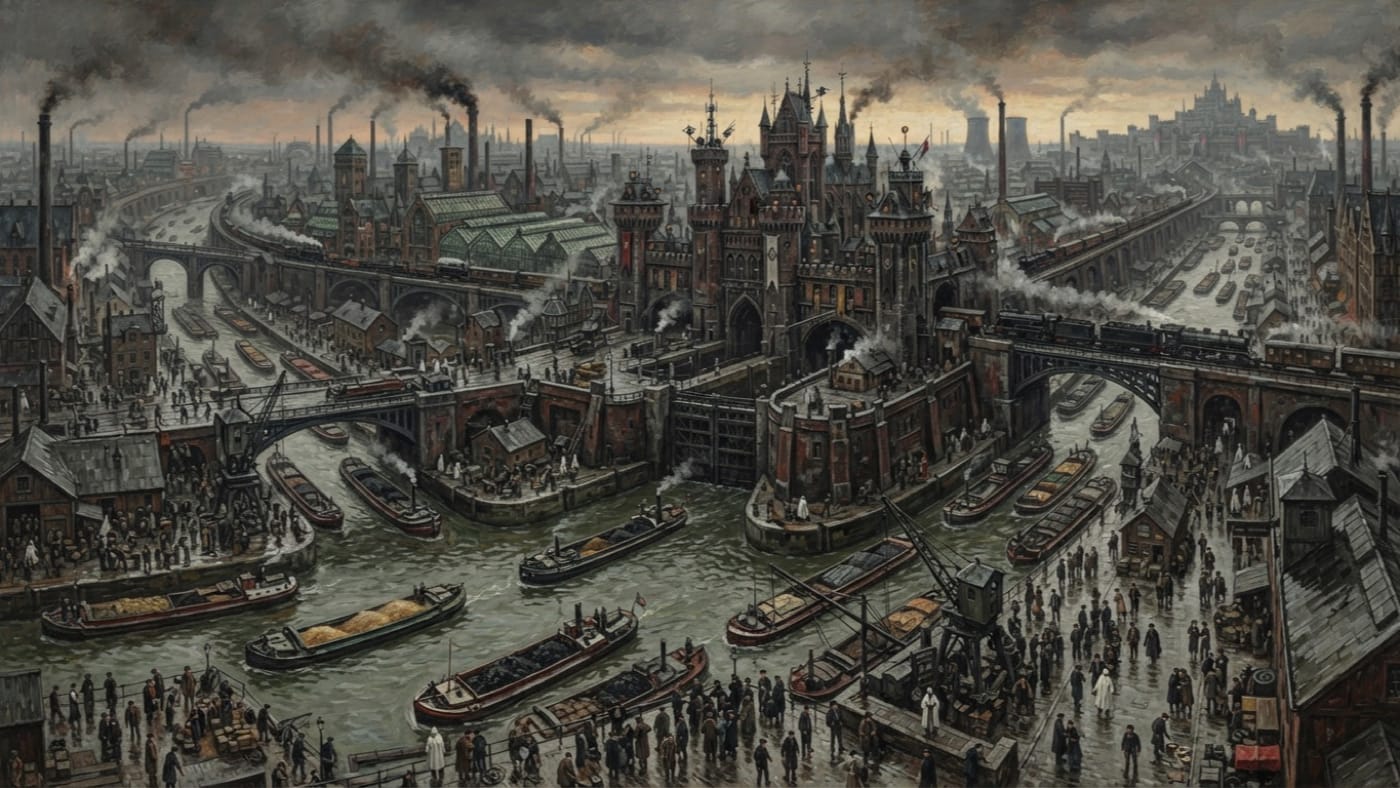
Follow the Meuse. Liège sends coal, iron and recovered bell-metal through its locks and down a river its bargemen know better than any inspector. Maastricht sits at the seam between Zone 1 and Zone 2 like a clerk at a door. It feeds roads, stores flour and keeps the crossings. Past them the country flattens into water and warehouse: the canal quays of Ghent, the guild halls and glasshouses of Bruges, and the cranes of Antwerp on the Scheldt. At Antwerp, grain is received, weighed, entered, blessed and sent inland toward the Low Country cities and the heartland beyond.
None of this is glamorous. Glamour belongs to bastions. The Lowlands deal in what bastions eat: bonded grain, salt fish, cloth by the bolt, rope, lamp oil, paper, relic cases and letters of credit. To a Rationalist staff officer in A.S. 25, this country was a pantry with a harbour attached. To a nobleman losing a war in his own gatehouse, it looked like a crown.
#On the Price of a Gate
In A.S. 25, in the middle of the Atheist Wars, Lord-Protector Guillaume surrendered Aachen to the Rationalists. The Lore Book gives his price in one line: dominion over the Lowlands. It is the cleanest sentence ever written about him, and he did nothing to earn its economy.
Colonel Verdane made the offer. He wanted the citadel intact and the stores unburned. He wanted the courier stables taken whole and the bridge warrants in hand before a chapel bell could summon anyone useful. A man who wants a junction undamaged is thinking about what lies beyond it. Verdane was thinking about the Lowlands long before Guillaume was. He simply let Guillaume believe the idea had been his.
The Bureau of Records holds what it calls a receipt: forty casks of Rhenish, twelve bolts of Flemish silk, and territorial considerations. I cite the Bureau's account. I do not vouch for the cooper. The silk deserves attention. It was Flemish. Guillaume was paid an advance in the cloth of the country he was selling.
The gate opened at midnight on the Feast of Saint Bartholomew, and the Betrayal came through it in ordered ranks. Aachen's plate records what followed: the northern faithful front broke, and within a year the Rhineland, the Lowlands and much of northern France lay under Rationalist banners. That account gives no register of which canal city fell on which day, and I will not invent one. On the Meuse and the Scheldt, the change came as such changes usually do. A new face sat behind the toll desk, and the parish received a printed form requesting an inventory.
Did Guillaume ever collect? On this the Codex quarrels with itself. One dossier gives him a palace and a governorship. The Gate Litany says he never received the Lowlands, only a folio. Both carry Bureau seals. A regional survey does not need to settle the matter. The dominion was promised as the price of the gate, and that promise is all this file requires.
Older regional primers, copying inherited Lore Book entries, placed Aachen's fall, and with it the Lowlands' passage under Rationalist banners, in A.S. 66.
Corrected. Aachen opened in A.S. 25. The country it was sold for came under Rationalist banners within the following year, which gives the canal cities some twenty years of secular administration before the Sundering. Primers bearing the old number are to be withdrawn and pulped into Ghent paper, where they will at last do honest work.
#On Occupation and the Return of Seals
Rationalist administration did not wait for the law to catch up. It had been signing warrants for five years before the Treaty of Regensburg crowned the Republic in A.S. 30 and secured confiscated Church property under its clauses. The Lowlands suffered as rich country suffers, with few sieges and many inventories. Chapel plate was weighed. Relic cases were itemised and sold. Guild charters were re-stamped in secular ink. The canal tolls continued, because occupiers also need their barges to float.
The Republic held supremacy for fifteen years, from Regensburg until the Sundering on 1 November A.S. 45. After that night the hidden Church came up out of its cellars, unevenly and one city at a time. It moved through a country where Rationalist clerks still held the keys and nobody could say which office remained competent. The cities returned to the Church's books by separate writs, on separate dates, under separate seals. Bruges signed under black wax during the Night of Black Decrees in A.S. 58. Others signed earlier, later, or twice. Only with the Concordat of Strasbourg in A.S. 90 did a formal Synod exist to file them all in one cabinet.
What survived the whole sequence was local: guilds, lock-keepers, dock clerks, and parish registers kept damp but legible. Regimes came and went at the toll desk. The man behind it often stayed.
#On the Cities and Those Who Work Them
Bruges is the region's showpiece and its standing case-file. It trades in glass, stone, dyed cloth, relic fittings and canal freight. The Bureau of Purity once exiled three generations of its stonemasons for grotesques heretical in symmetry. Masters, journeymen and apprentices went together, and the city lost the memory of a craft along with the hands that held it. The masons who remain carve obedient saints on public façades. The dyers give their greys penitential names. The glasswrights cut inspection lenses for the offices that inspect them. Bruges is prosperous, which is why the white cloaks visit so often.
Ghent keeps the water and the paper. Its quays move canal freight between the Scheldt and the inland towns. Its Records activity has made it a city where cargo and memory are weighed by the same clerks. A Ghent porter is paid by the load and a Ghent copyist by the page, and both have learned to recognise an inspector's step on the stair.
Antwerp counts. Its dock accountants enter grain received, relics in transit, stones weighed and bills discounted. Then they send the cargo inland toward Ghent, Bruges and the heartland. Rope-walkers, grain porters and salt-scale clerks earn their bread under chapels built close enough to the warehouses to be taxed together. Antwerp is Synodal and says so loudly. It stands beside the Dutch the way a poor relation stands beside a rich cousin at a wake.
Behind these three lies the inland approach. Liège has its coal, its ironworks, its mines and its river locks. Maastricht has its crossings, its stores, and the prayer-cellars of A.S. 25 that it still prefers not to count. Neither is a canal city. Both belong in the region's account, because the Lowlands eat what the Meuse brings down and pay for it with what the Scheldt brings in.
The people deserve one plain sentence, and they shall have it. They work, and they work well. The lock-keeper opens on time. The bargeman knows the shoals. The widow who keeps her late husband's weigh-house books keeps them better than he did. Each of them goes to Mass and means it.
#On the Present Condition
In A.S. 201 the Lowlands remain Synod-held, wet, solvent and watched. The war is far to the east and reaches this country as orders: cloth for uniforms, glass for lenses, bonded grain, paper for warrants, and cases for shrines that need a fresh saint. Dutch hulls bring Dutch credit into Scheldt waters, and Antwerp's clerks enter it with the expression of men handling a borrowed chalice. Penitents bound for Aachen pass through Maastricht and Liège and buy bread on the way. The memory levy stays at Aachen's gate. The Lowlands pay ordinary tithes, ordinary tolls, and the steady price of being useful.
I have asked in Bruges, Ghent and Antwerp for any document naming Guillaume their lord. The clerks looked at me as though I had asked for a receipt for the weather.