
#On the Northern Office
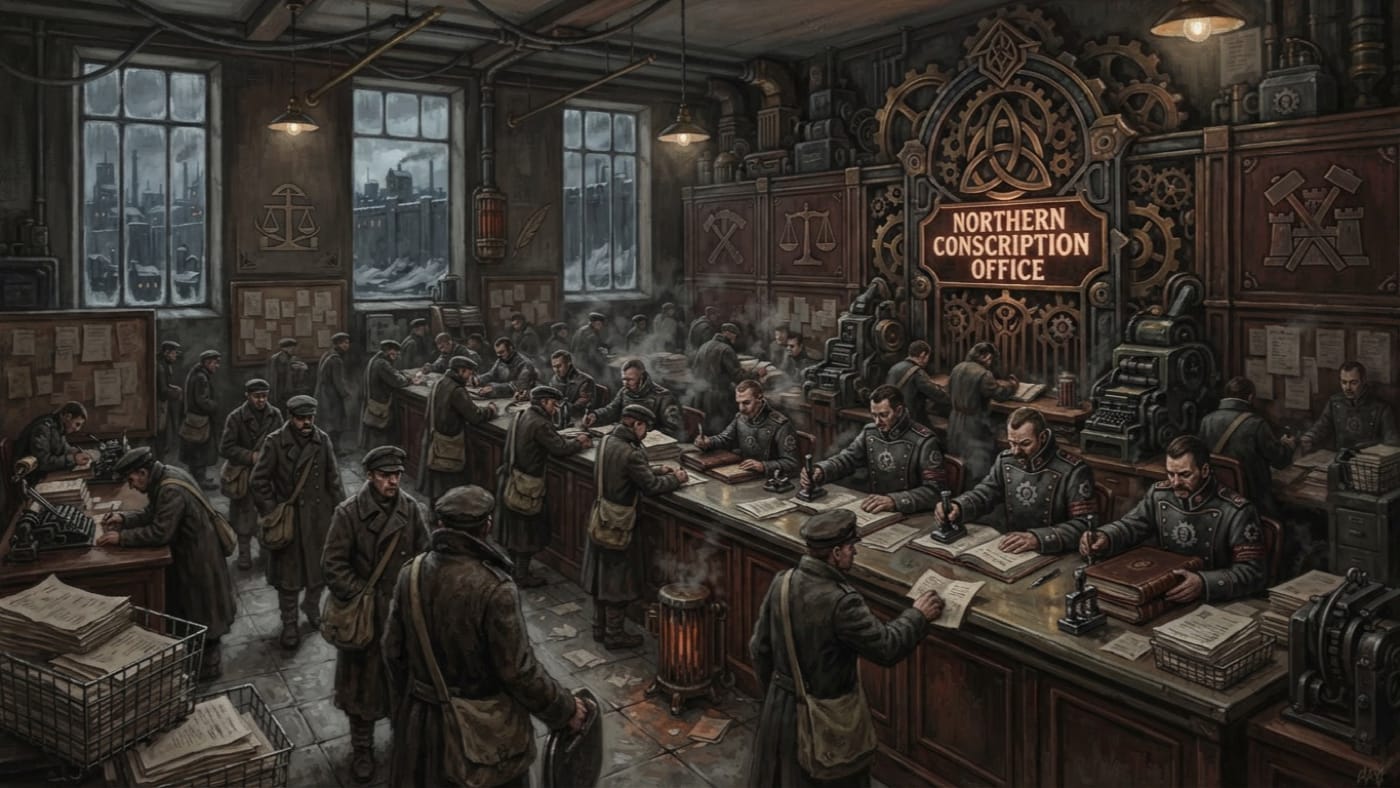
The Northern Conscription Office sits at Bastion-Königsberg, at the far end of every road the Bureau of Conscription maintains, and it receives men. The Bureau's own entry lists it among the regional offices kept at the Synod's major mustering centres, alongside the Central Processing Yard at Lorn and the Southern Intake at Saffron Bastion. It gives all of them the same task. Incoming quotas are set against outgoing casualty reports, column against column, until the bastion's sum closes or a clerk is found to blame.
That is Conscription's claim on the office. The second claim belongs to the Bureau of War, whose name heads the standard briefing read to arrivals. One Bureau places the desk in its regional network. The other signs the sermon delivered across it. I have looked for the instrument that settles the matter, whether a charter, a joint minute or an organisational table ruled by some clerk with a straightedge and a death-wish. I found nothing. Two Bureaus share one desk, and the desk is untroubled.
The record available to me gives the office no founding year, no founder, no chief and no street. It has a function. A man comes to Königsberg because a column in a ledger needed him there, and the roll records that he came willingly. Both entries are correct by the Synod's standards, and the office's work is to keep them on the same page.
#On Voluntary Assignment
"Every man at Königsberg volunteered. Every man at Königsberg was also assigned. The Bureau sees no contradiction between these statements, and neither should you." — Bureau of War, Northern Conscription Office, standard briefing
The doctrine behind the briefing is the compulsory offering, which the Bureau of War preaches without blushing. Service is a gift owed by the faithful to the Creator, and the Bureau holds that collection does not stop it being a gift. Conscription's charter formalised this with a category it calls "voluntary spiritual surrender." The category is broad. It holds the genuine volunteer and the man who learned of his volunteering at the mustering yard, and it records both in the same hand.
The system that feeds the north is general and thorough. The Bureau of Records keeps the census. Levy Assessors check it against parish birth-rolls and confession ledgers. The Bureau of Mercy grades the body, a field chaplain hears a confession at a rate of sixty souls an hour, and the conscript's place in the Book of Promise is reconciled with the place he actually turned up. Before he reaches the Line, he kneels for the Trial of Loyalty and is required to weep on the correct line. His wrist is stamped with the Triune Knot in ink that does not wash out for nine days.
The record does not show any of this being repeated at Königsberg, and none of it has to be. By the time a man reaches the Baltic, the ink on his wrist has usually faded. His folded assignment papers have not. Out of the long liturgy of collection, the Northern Office is credited with only the last entry: the receipt of a man the Synod has already classified and assigned, and the matching of that receipt against the bastion's losses.
The Bureau of Conscription was founded in A.S. 110, at the same time as the First Continental Levy.
The Bureau of Conscription's own entry records this correction. The First Continental Levy was decreed in A.S. 110 (1820 CE). The Bureau that processes its results was constituted in A.S. 112 (1822 CE), under the joint seal of War and Doctrine. The years in between are classed as "preliminary operations." The Northern Office's founding date is not among the corrections because no date for it has ever been offered.
#On the Northern Requirement
Königsberg's published assessment gives about twenty-two thousand military personnel and four thousand Bureau staff across all offices. The Northern Conscription Office is one of those offices. The figure does not say how many clerks it holds, and I will not invent a number for it. What the figures do show is the size of the appetite. A garrison of twenty-two thousand on the Baltic shore loses men to frost, sickness, accident and the Line's ordinary attrition, and each loss is a line the office must fill.
The posting does not fill itself. The same assessment calls Königsberg a posting nobody requests, and it reports transfer applications at three times the rate of any other sector of the Line. Those are the parent assessment's figures, given here as that assessment gave them. They describe a city that men are sent to and would rather leave.
The route north runs through Warsaw, the forward staging city, and then along the Northern Corridor's northern spur through Białystok. Kanzleiburg sorts and dispatches for the whole northern system. From December to March the harbour freezes, and everything the bastion eats, burns and conscripts comes overland. The office owns none of this railway. It waits at the end of it, ledger open, for whatever the spur delivers.
Inside the bastion one more constraint applies. Sea Wall sentries rotate every six weeks, half the standard period elsewhere on the Line, and the Bureau of Purity interviews each man as he comes off the Wall. The rotation moves a soldier from the rampart to other duty in the same city. It does not end his service or carry him out of Königsberg. It does mean the Wall uses up watches faster than any other stretch of the northern Line, and the gaps must be filled from the same rolls. Conscription's general rule for the Line is a nominal tour of five years, which the Bureau may extend "by grace" as the front demands. The front always demands.
#On Applications to Leave
Arrival and departure are handled in different places. A man is received at Königsberg, at a regional office standing at the bastion itself. His application to leave goes south to Kanzleiburg, where a dedicated sub-office handles transfer requests from Königsberg alone. Both the Königsberg and Kanzleiburg entries record that this sub-office has a staff of four. At last count its backlog was eleven years.
The two offices have different jobs. The Northern Conscription Office accounts for men coming in. The Kanzleiburg sub-office reads the petitions of men who want to go. Nothing I have found places either under the other, and nothing allows the four Kanzleiburg clerks to be counted as the Northern Office's staff. They are the other half of the system, and they sit at the other end of the railway.
The eleven years measure the pile of applications. They do not fix any one man's wait. A backlog is a quantity of paper and makes no promise to the man whose application is in it. Some men do leave. The bastion's own assessment records soldiers returning from Königsberg to the southern sectors, and the officers who receive them describe them as quieter than before. Transfers are granted. The record shows that they happen, but not how often, how quickly, or by what criteria they are chosen.
The rhetoric is less modest. A man assigned north hears that he volunteered, serves a tour the Bureau may extend by grace, and is told his application is under review in a city several hundred miles away. None of that adds up to a sentence of permanent exile, and none of it was written to read as permission to go home.
#On the Present Account
The office functions. That is its whole condition in the A.S. 201 assessment, and it is the only verdict the Bureaus have recorded. Quotas arrive along the spur when the frost allows, casualty returns go out on schedule, and the roll closes each cycle with the willing and the assigned written into the same column.
The difficulty is in keeping that column full. Since A.S. 190, the force the garrison calls the Grey has been held under the Bureau of War's designation Unknown Forces, Extradoctrinal Classification Pending, and the classification has stayed pending. The Northern Office does not deal in classifications of that kind. It must keep supplying a posting men do not request, against a threat the Synod has not finished naming, from rolls that answer to two Bureaus and a charter nobody has produced. Castellan-Warden Ingrid Halvorsen holds the walls, and Rector-Chaplain Wendelin Grau holds the bell-schedule. Neither is recorded as having anything to do with the office's ledger, which sits in its own register, unbothered by either.
The ledger and the briefing still agree. Every man at Königsberg volunteered, and every man at Königsberg was also assigned. The paper settles the matter, and the four clerks at Kanzleiburg take their next petition from the top of the pile.