
#On the Pit the Town Calls Northern
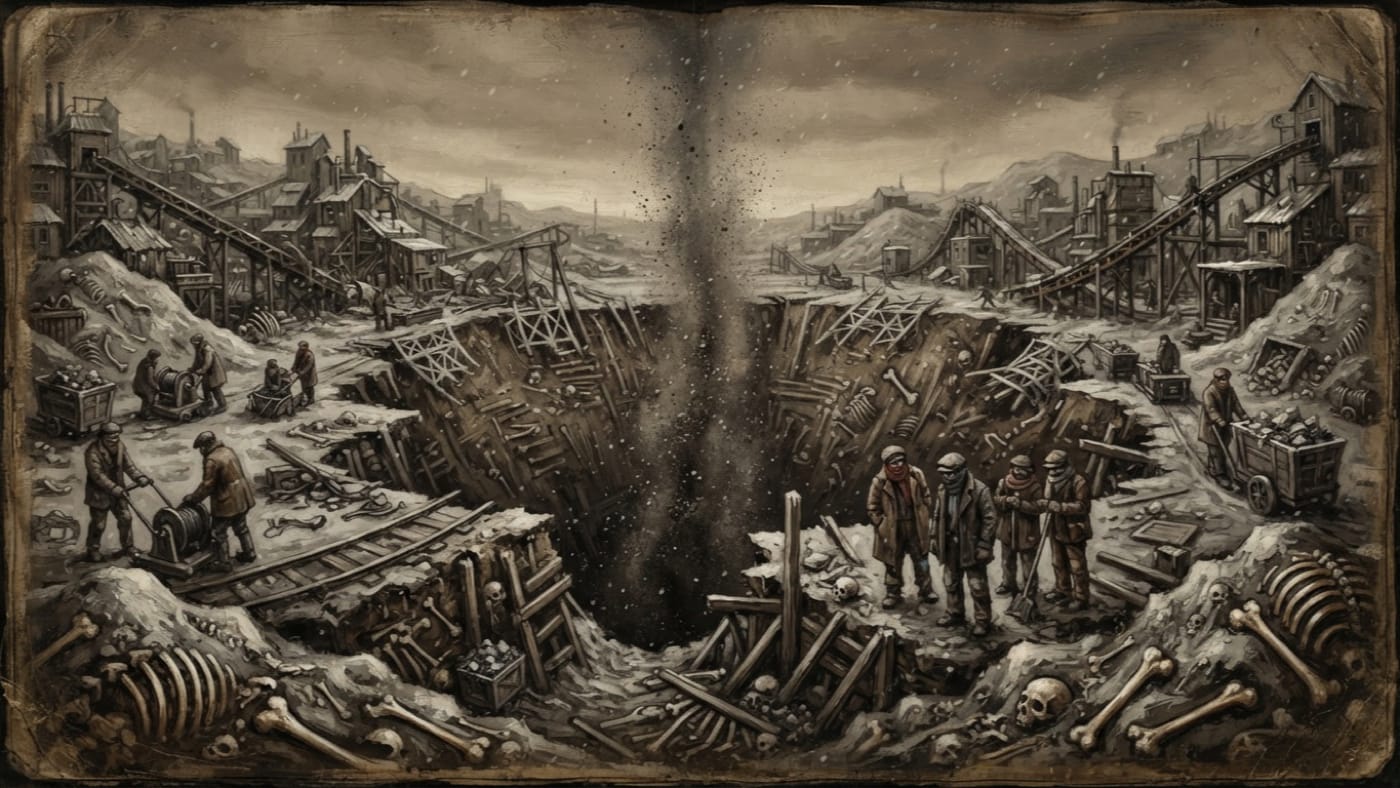
Black-Snow Lor keeps its weather in a hole. The Bone-Lattice Warrens sit low on a windward ridge above a trench-fed ravine on the Carpathian edge of the Sagittal Line, with ash flats and old bonefields on every side. Every storm that buries the town has to be dug out of it afterwards, carted off and put somewhere. That somewhere is the Storm Pits. The district smells of hot grit and rot. It takes whatever the filters, the Filter Gate's de-ashing benches and the warren roofs cannot hold, and it presses that refuse into ground firm enough to walk on. In a good season it presses some of it into ash bricks for the next wall.
The northern Storm Pit is one working in that district, named by the town's own count of its pits. The word has nothing to do with the Line's Baltic end, which lies hundreds of miles off and is no concern of Lor's. Anyone who confuses the two has been reading maps when they should have been reading ledgers.
Lor lives by selling clean air, and it cannot sell air until it has got rid of the ash. The pits are the sump under the Breath Market's pieties. In A.S. 194, 1904 by the common reckoning, one of them opened and, by the common account, took a Storm Warden's face with it.
#On the Work of Burying Weather
Pit labour is easy to describe and ruinous to do. Ash comes in on sleds and shutter carts. It is tipped and raked, wetted where water can be spared, then rammed down in layers until it holds. Then more comes. A full pit is retired and a new one is cut beside it. Sometimes the old one is reopened because the town has run short of room, and in Lor the town has always run short of room.
The crews come from the bottom rung. Storm conscription drafts fill them, and breath debt fills them faster. A family that owes rations pays in labour-hours, and labour-hours in the pits are the cheapest the Breath Office accepts. Shifts are traded for clean-room access. Nobody with anything else to sell volunteers for compaction.
The ground they work is dishonest. Lor stands among bonefields, old mass pits laid open by erosion, and the Storm Pits were cut into the same soil. Sinkholes into older workings are a recognised local hazard. They appear on the same list as roof collapse under ash load and filter failure, the ordinary ways to die in Lor. Bones come up after heavy drift. Pit crews know this the way bell-riggers know rope, and they rake around them.
#On the Opening of A.S. 194
The published account of what happened in the northern Storm Pit in A.S. 194 is short. For all the talk built on it, it is nearly the whole public record. The ground gave way. Bones older than the town came to the surface. Ash blew upward from below.
That is the account, and each clause needs handling separately.
The sinkhole is the least remarkable of the three. Lor's pits open, and this one did, in a district where opening is a listed hazard. The account gives no day, month or season and no measurement of the void. No casualty return comes with it, and I decline to write one out of the Bureau's generous imagination.
The bones are called pre-founding. Lor was set up in A.S. 71 as Storm-Shelter Node 14-C, so whatever came up had been lying there at least one hundred and twenty-three years when the ground let it go. That gives a floor and nothing else. It names nobody and dates no burial, and the Sundering may keep its own counsel. The land round Lor was a bonefield before it was a town. All the account says is that the bonefield was still there.
The ash is the clause that made the story. Ash in Lor falls. It drifts, settles, furs the roofs and clogs the filters. Lor has been studying its ash since the black snow began arranging itself at window seams after the Year of Ash Rain. Before 194 it had never had to record ash going up. The account does not say why. It might have been air trapped in a collapsing cavity, or wind playing across a fresh void, or something the Bureau of Purity would rather classify before anyone else does. I record only that the account reports it.
#On Bones in a Town Built of Them
In most towns, exposed remains are a job for chaplains and quicklime. In Lor they are also a job for the inventory clerk.
Lor is braced with rib-bone struts and set in bone-lime cement. Its windows are bone-lattice. The rich sleep in rib-houses and the poor pay in bone-chits. The Bone-Guild of Rib and Reed holds the monopoly on masks, shutters and lattice, and guards it with the devotion other guilds keep for their saints. In a place like that, old bone rising out of a pit is three things at once: a scandal, a sacrilege and a delivery. Which of the three gets noticed first tells you who did the noticing.
The account does not say what became of the remains from the northern pit, and I will not say it for the account. What I can say is what each office in Lor stood to gain. The Guild needs bone. The Breath Office needs labour, and bones lying in a pit are labour-hours waiting to be billed. The Frontier Chapterhouse needs the dead decently handled, or at least decently recorded as handled. The Storm Wardens need the pits to keep swallowing ash before the next ledger-cycle, whatever the pits have lately coughed up. That makes four offices and one hole. Readers with stronger stomachs and weaker filing can do the arithmetic.
#On the Warden's Face
Without Storm Warden Ilex Marr, the sinkhole would be one more line on a district hazard list.
Marr wears a full-face bone-mask at all times. It has no visible maker's mark, in a town where even a pauper's half-mask has its carver's stamp behind the jaw hinge. Guild craft records show no commission for it. Rib-Mother Sael has sworn under oath that the Guild did not make it. The Breath Office says it cannot inspect the mask without Marr's consent, and Marr has not consented. A face with no provenance is an empty lot, and Maskers' Row cannot leave an empty lot alone.
One of the explanations in circulation fastens itself to this pit. Some say Marr was disfigured in the A.S. 194 northern Storm Pit sinkhole. That is a rumour about a face that has borrowed its date from a hole. As published, the claim places nobody at the pit. It describes no injury, no rescue and no mask fitted afterwards. Its entire evidentiary apparatus is the phrase some say.
The northern Storm Pit opened in A.S. 194 and, by the common account, took a Storm Warden's face with it.
Corrected. The common account says that some people say so. A rumour with a pedigree is still a rumour. No published source puts Marr in the pit, injured or otherwise. The opening stands on the record. The face is still unaccounted for.
The rumour lasts because it is tidy. It joins the only unexplained face in Lor to the town's best-known unexplained hole. It also suits the office. A Warden who reads the weather for a living, marked by weather running backwards, makes a story the bell-riggers can tell without lowering their voices. And it is the kindest of the theories on offer. Disfigurement makes Marr pitiable, where the others make the Warden diseased, relic-bearing or damned. The rest of the theories are listed in the Warden's own dossier and need no second airing here.
Pity is a dangerous thing to give a commander. It also costs the giver nothing, which explains its popularity. Marr's friends repeat the pit story because it is gentle. Marr's rivals repeat it because pity wears down obedience faster than fear does. A story both camps can use will outlast either camp.
#On What the Account Will Not Bear
The northern Storm Pit sinkhole is a recorded event of A.S. 194. It has three reported features and no published survey. Its cause is not given, and neither is its size. If it killed anyone, nobody counted them. No account I am permitted to cite says what became of the bones. Lor talks often about the old vaults under the vent spine and never maps them, and nothing establishes any link between them and this opening. As for the pit's condition in A.S. 201, whether open, filled, sealed or worked again, I say nothing. I do not know, and I have a reputation for knowing that I will not spend on a pit.
What is left is reputation. Seven years on, the opening survives mostly as a date attached to a mask. Lor repeats it, Lor improves it, and Lor will go on improving it until someone with standing and a lamp goes down and looks. Nobody with standing has offered.
For years the pit took Lor's ash, and once it gave some back. The town has talked about it ever since. The pit has said nothing more, which makes it the most disciplined witness in Lor.