
#On the Row Between the Ward and the Registry
"Show your docket and keep walking." — Notary Row usage, addressed to everyone except those carried
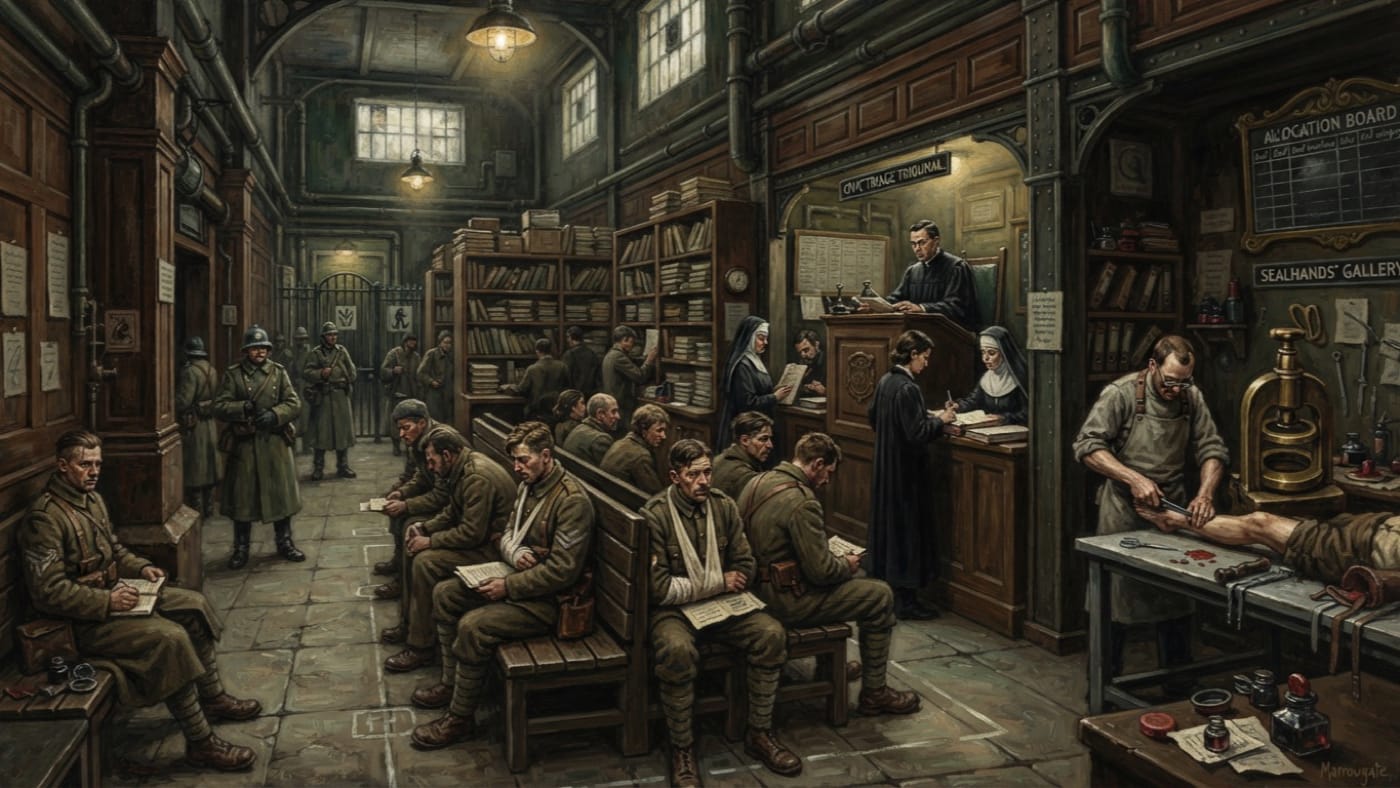
Notary Row is the district of Marrowgate where a medical finding becomes something a gate guard must obey. It lies between the White Ward blocks and the seal registries. A man carried out of the infirmary therefore passes the court before he reaches the archive, and the archive accepts him only after the court has decided what he is. The surgeon-notaries keep their offices on the Row. The record offices keep their files there. The Civic Triage Tribunal holds its hearings in the Notary Row Tribunal Hall, and the Sealhands' Gallery keeps its saws close enough to the benches to be heard.
Every survey of the Row says it smells of ink, wax and antiseptic. I have filed several of those surveys and they are all correct. Nothing on the Row changes faster than the people sitting in it.
The petitioners wait where they can smell the broth in the corridor and hear saws in the operating galleries. On the allocation boards, bed windows are chalked up at midday and wiped off whenever the facts disagree with them. All the relief in the district can be heard, smelled and read on a board, and none of it may be touched until it is sealed. I know of no better school of patience in the Church, and none with a higher rate of failure.
The Hall itself is a lesson in seating. Its benches are divided by chalk lines. Clean-zone petitioners sit nearest the clerks. Grey cases sit under the north window, where the draught keeps fever in plain view. Black-zone appeals sit behind a screen that spares the court the sight of them and does nothing about the smell. A man can learn his likely outcome from the floor before anyone opens his file.
#On the Passage of a File
Take a representative case. I give it no name, because the Row would only take the name away. A soldier comes up from the Wagon Quays with a crushed forearm, a fever not yet decided and a tag written by a Ward-Sister in a hand gone soft from lack of sleep. He takes the bench his tag assigns him and waits under the north window.
Magistrate-Physic Toma presides. He hears a cough and works out the risk to the ward. He looks at a wound and works out what it will leave behind in law. Clerk Vessa sits below him and writes each ruling in the form that will survive appeal. Toma decides. Vessa makes the decision last. When the soldier's turn comes, the Ward-Sister presents the tag and a Sealhand sets down a surgical recommendation beside it. A Sanitation inspector may lodge an objection. A relative may speak if solvent, well connected or loud under the right patronage.
The Tribunal rules by category. Treat grants a bed window, which means time, linen, broth, examination and the right to suffer inside authorised walls. Hold keeps him under the north window. Review keeps him on the bench with a docket number while the arm goes on dying at its own pace. Our soldier receives Cut.
The ruling crosses the Row to the Gallery. There a Sealhand amputates and notarises at the same sitting, in the same grey apron, under the same brass ring. The registry then revises the file. The sequence is fixed: the court authorises, the Sealhand cuts and seals, the registry rewrites. Without all three steps the Ledger does not recognise the loss, and a man missing an arm can still be called up for duties that need two.
Chief Sealhand Orin heads the guild whose rings make the second step lawful. He does not plead before Toma and takes no orders from him. Toma has no authority over the guild's rings.
The cut-stamp records the amputation and changes the man. His prior file is sealed. His pre-excision designation may no longer be used in any official proceeding. His duty is recalculated and his employability reassessed. Prosthetic obligations attach to the stump before the stump has closed. He came into the Hall as a corporal and leaves it as a revised entry. The wound will close. The file will carry the debt for as long as he lives.
#On the Trade at the Office Doors
Every ruling on the Row has a price nearby. Bed priority can be bought. So can a shortened quarantine, a set of clean papers or a death moved into a cheaper column. Part of this trade is lawful and arrives as fees, extensions and witness charges. The rest arrives in envelopes. Tribunal clerks in black cuffs learn which forms can be delayed, which can be hurried, and which can vanish under a blotter and come back after payment with a new interpretation. Bed tokens change hands outside the Wagon Quays before the windows have even been posted.
After the stamp, the soldier owes money. The Prosthetics Guild fits his arm cheaply and adjusts it dearly, through its own fitters, on its own schedule. A missed payment becomes medical debt. The Tribunal converts that debt into a work prescription, and the prescription sends him back to the wards to drag carts, boil linen or stoke kilns. Every week of his life now follows the Hall's ruling: which white line he may cross, which ration chit he may draw, which name he answers to at muster.
The Stitchmarket deals in what the offices will not sell openly: forged documents, counterfeit rings and work on names. Its market people say their most expensive route touches Notary Row. I believe them about the price and decline to map the route. Their richest trade is the identity reversal, which puts back a name or a file status that the cut-stamp sealed. It regrows nothing. A man may buy back his name and still have only one hand to sign for it.
#On the Clean Paper and the Fourth Night
The clean paper plague of A.S. 199 revealed what the Row had become. Certificates of health went from White Ward and Mercy Market through the Notary Row registries to the Wagon Quays. From there they travelled to supply towns and bastions whose officers trusted wax over a cough. The certificates said the bearers were clean. The bearers were sick.
Two kinds of seal were involved, and the Row would prefer to discuss only the first. Counterfeit seals are a crime against the guild that issues the real ones. Genuine seals pressed onto false findings are worse, because those certificates passed through the registries exactly as procedure requires and carried a lie without a single mark of forgery. The paper itself spread no fever. It got the men who carried fever through the checkpoints, and the checkpoints asked nothing more of it.
Ward tallies forwarded through the registries in A.S. 199 recorded zero infection.
Withdrawn. The tallies recorded zero cleared infections, which the registries had treated as the same figure. The bodies were counted separately and later.
The official audit found systemic fraud in health certification. It made no finding about who organised it. I have none to add, and I note for the record that no surviving finding ties the Sealhands to the affair.
On the fourth night the Marrowwind began correcting the Tribunal's own files. Names of cleared patients reappeared under the black fever columns. Death certificates lost their stated causes and took new ones. Twenty-six bed ledgers marked vacant bled ink through the page. Every correction reopened a question the Row had considered closed. A debt calculated on a false clearance now depended on a finding that had been struck out. A work prescription issued to a "recovered" man now named a patient. Quarantine admissions, delayed burials and debt reversals followed, each one argued in the Hall on the same benches.
The Row's real difficulty is evidence. The corrections can be observed: wet ink, white dust, a changed column. Their author cannot. Records describes the corrections as almost always true, and the qualification is deliberate. The Bureau of Records admits a correction only when a living witness corroborates it. My own Bureau holds that the dead are filing amendments. That is the Bureau's reading. No registry on the Row has stamped it.
#On the Present Condition
This survey records the Row as of A.S. 201. The year is the date of the inspection and not of the district's founding, for which the archive gives no year and I offer none.
Hearings continue. The benches fill by intake bell, the north window still lets in its draught, and the black screen is patched more often than it is cleaned. Auditors read the registries with the care of men who expect to be blamed. Since the counterfeit ring surfaced in the Suture Slums, every brass seal on the Row is examined twice: once by the patient, who fears it, and once by the clerk, who fears for it.
The Row's authority still depends on whether petitioners can reach it. The Sanitation Chapter controls the gates, the cordons and the crossings. If Prefect Salvius closes a corridor, a perfectly valid Tribunal ruling cannot get a bleeding man over the white line, and the bed window it granted expires empty on the board. The Tribunal wants quarantine review brought into its Hall and Marrowwind corrections placed under its jurisdiction. These are its ambitions and none of them has been granted. The Chapter has means of its own for making hearings arrive too late to matter.
Every petitioner on the Row still holds the docket. The registries still hold the files, and the wind has shown that it can reach them.