
#On the Market
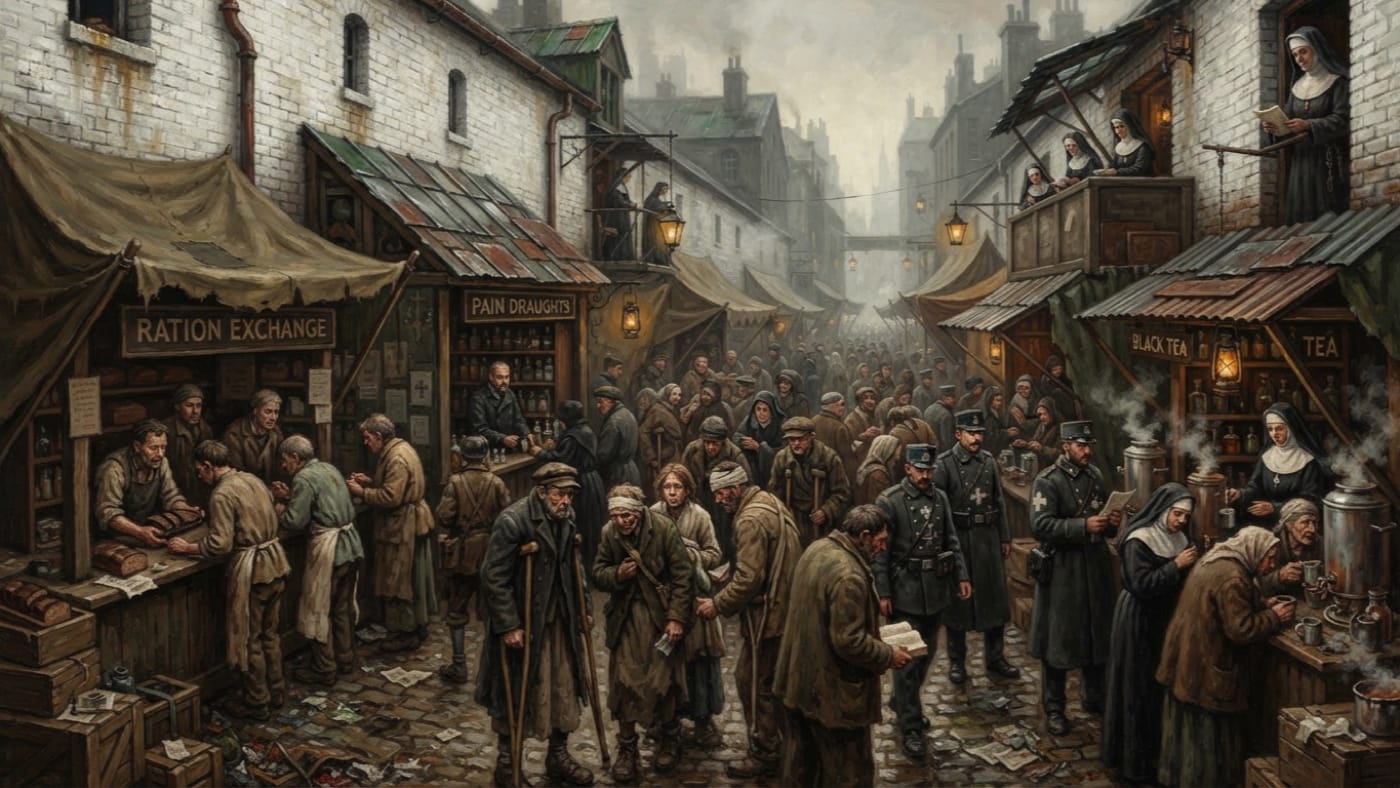
Mercy Market smells of tallow and sour bread. In Marrowgate, that smell is the first honest document a customer will receive.
It is one of the named districts of Marrowgate, the inland medical port where wagons dock at quays and the cargo is the wounded. The record gives it three trades: ration exchange, pain draughts and black tea. A ward orderly coming off the linen boil buys tea. A washer-labourer with two chits and four mouths trades one chit for something that will stretch. A convalescent with a fresh stump and an unsigned discharge buys whatever the bottle-seller will hand over without a question. Then they go back to the wards, the kilns and the queues, and the city goes on saving the Line.
The walls are whitewashed brick set in bone-lime mortar. Rusted iron gutters drip onto stitched canvas awnings. Salvaged glass catches the lamplight, and tallow-wax seals close jars, crates and now and then a mouth. The district's boundaries, its dimensions and its founding appear in no record I have been permitted to consult, and I have been permitted to consult a great many.
#On Rations and Relief
"The dead will forgive pain but never forgive miscounting." — Marrowgate superstition
Marrowgate counts value in coin, ration chits, stamped medical scrip and oath-notes of medical debt. Bed tokens also circulate, illicitly, sold elsewhere by people who should be hanged. A citizen of this city learns early that wealth means pain relief, clean linen, a warm bed and a certificate that will survive inspection. Gold is a rumour. A chit is supper.
Ration exchange is the market's first liturgy. Chits cross the counters and are traded down for bread, up for tea, or sideways for a neighbour's surplus when a shift has swallowed the hour at which the official counter closes. No exchange rate survives in the records I hold. What survives is habit. The labourer from the kilns knows what his chit bought last week, and he learns this week's price by paying it.
Black tea is tea. I say so because Marrowgate turns every warm liquid into a sacrament, and the tea has so far resisted promotion. It is bitter, hot and cheap enough to drink standing up. Workers come off ward shifts with their knuckles cracked from lye and hold the cup in both hands.
Pain draughts fall under a different jurisdiction. Bitter pain-liquor is regulated in Marrowgate, and the bottles on Mercy Market's counters vary in provenance and in honesty. Some are the plain comfort of a plain trade. I decline to certify their contents. The morphic draughts are another matter. Their allocation belongs to the Mercy Chapel of the Unburdened, where pain relief is rationed as a sacrament and the sacrament is rationed like pain.
A customer may buy bread with a chit. Relief from the Chapel is received, which is a different verb with a different price.
#On the Chapel's Territory
The Mercy Chapel of the Unburdened lists Mercy Market as part of its territory, together with its chapel wards. Its public purpose is pain relief and prayer. It keeps draught stores, chapel guards and confession archives, and it uses them the way an archive uses ink: steadily, and for the record.
Territory is a theological word, and I choose it with care. The record does not show the Chapel owning every stall, licensing every bottle or holding a charter that shuts out rival trade. What it shows lasts longer than a charter. The people who buy tea in Mercy Market are the people who will one day need a morphic draught. The Chapel holds the stores, the guards who stand in front of the stores, and the confessions of everyone who has asked. A stall-keeper who displeases the Chapel has broken no law. He has simply become a man whose mother's next draught is now under consideration.
The record lists its methods as sacrament rationing, quiet blackmail and the lever of sanctuary. Sister-Matron Ilka is kind and immovable, and the second quality is what has always kept the first affordable. Brother Dane knows people's secrets. In a city where everyone confesses to gain ward access, knowing the secrets amounts to knowing the district.
The Chapel does not rule the market alone. The Sanitation Chapter commands the cordons, inspections and quarantines, so whoever crosses a whitewash line into the district crosses it on Sanitation's paper. The Civic Triage Tribunal allocates beds, issues legal-medical judgments and prescribes labour. The customer at the bread counter may have come there under a work prescription and may have to leave at its bell. The Sealhands legalize the surgery whose survivors come here to buy relief. Every one of these powers reaches into the market. None of them governs it.
#On Clean Paper
Here the market enters history, and it comes in by the wrong gate.
During the clean paper plague of A.S. 199, health certificates were issued to men and women whose fevers advanced under their linen. The paper said cleared. The body disagreed. The false clearances travelled from the White Ward to Mercy Market and through the wider traffic that ran from Notary Row to the Wagon Quays. From there they went on to supply towns and bastions whose officers trusted a seal before a cough.
Consider what a market is. It is where a city agrees to trust the person in front of it long enough to trade. A ration counter cannot listen to a lung, and a tea-seller has no fever chart. Like every corner of Marrowgate, Mercy Market rested on the assumption that a stamped person had been inspected and found fit to stand in a queue among other people. In A.S. 199 that assumption was sold in bulk. The certified sick bought bread, drank tea, stood shoulder to shoulder with orderlies coming off shift, and carried their papers and their illness back the way they came.
The record names no first infected stall, no guilty merchant and no tally of the market's dead. I add none. The official audit found systemic fraud in health certification, a finding of admirable breadth and convenient anonymity. The Marrowwind supplied the particulars elsewhere when it re-entered cleared names under the fever columns of the Tribunal's files.
Ward tallies, A.S. 199: zero infection among certified persons.
Withdrawn. The audit of A.S. 199 found systemic fraud in health certification, and the corrected records re-entered cleared patients as infected. No one ever counted how many of the false clearances passed through Mercy Market. The Bureau regrets the zero. It was the best-kept figure in Marrowgate.
The Sanitation Chapter concluded that paper must be inspected more closely. The market's own conclusion went unrecorded and showed in its conduct. A ration chit could be genuine while the hand holding it lied. A clearance could carry its seal and be worth nothing. A draught could be real and still be refused. Every permission in the district had been shown to fail, and every permission was still required.
#On the Other Market and the Wind
Mercy Market must not be confused with the Stitchmarket. Visitors confuse the two, and some officials find the confusion convenient. The Stitchmarket is a cartel. It works through the Suture Slums and the drainage routes beneath the clean streets, and it deals in forged clearances, bed tokens, stolen anaesthetic and illegal surgery. It calls itself labour placement. It exists because the lawful counters run short, and it grows with every draught the Chapel withholds and every bed the Tribunal delays. No record shows that Mercy Market's merchants organize it, or that the Chapel does. Scarcity breeds a second market as surely as a ward grows a back stair.
The Marrowwind is the other neighbour. Its classification is still Category Two Localized Atmospheric-Scribal Anomaly, though "localized" covers more ground every year. As of A.S. 201 its incidents are increasing. The chalk gust once kept to the Lime Yards and the White Ward corridors. It now reaches the Wagon Quays, the washhouses of the Suture Slums, the Mercy Chapel steps and, twice, the private chamber of Prefect Salvius. The record I hold places no correction inside Mercy Market or in its traders' accounts. I decline to invent one for the sake of symmetry.
The Bureau of Doctrine holds that Marrowwind corrections authenticate nothing by themselves and that its testimony needs living corroboration. The doctrine is sound. A wind that corrects death classifications does not thereby become a court for a disputed loaf. The Bureau has not settled what moves it. The Sanitation Chapter speaks of particulate. Other offices speak of rebuke, or of mimicry. My own preference is on file, under seal.
#On the Present Exchange
The market opens because the wards empty at shift change and the people inside them are hungry. That is its charter, and it needs no seal.
The bread is still sour and the tea still bitter. Chits still cross counters worn pale by hands, and the bottle-sellers still keep the honest bottles behind the others. The Chapel still holds the stores of the real thing and still keeps its archive of who asked. Sanitation still owns the lines a customer must cross. The Tribunal still decides whether that customer will be at a bench or in a bed when the bell rings. The Bureau of Mercy would like fewer people to die of fraudulent clearance. The Bureau of Records would like the corrected ledgers sent to Strasbourg and the rest forgotten.
Everything withheld here is useful, and that usefulness is what makes withholding it so effective. Two years after its certificates were caught lying, Marrowgate still demands them at every line a hungry person must cross. The people of Mercy Market still produce them. The only alternatives are the drainage tunnel and the back of the queue.
The file is closed. The bread will be sour again at dawn.