
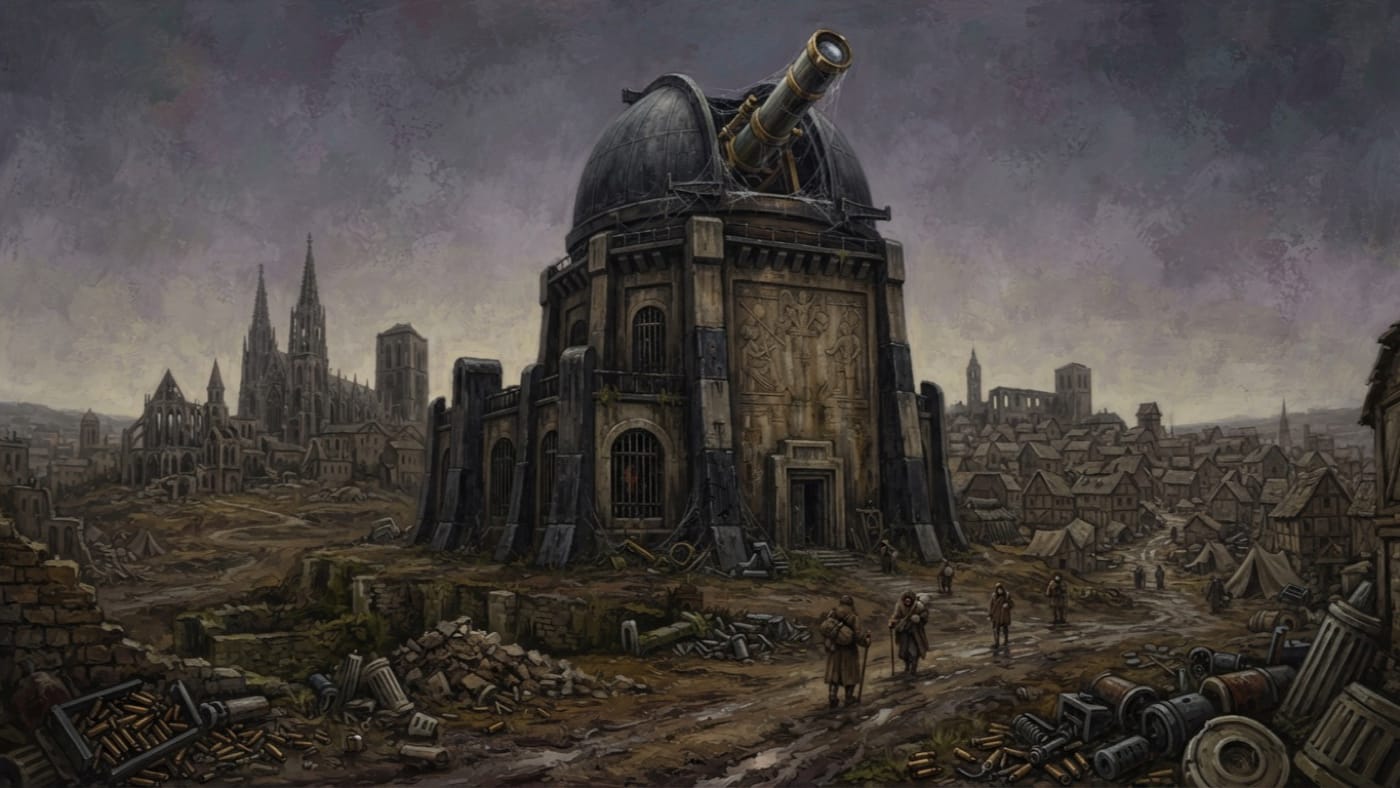
Current-condition survey — A.S. 201. The Observatory's construction year remains unrecorded.
#On the Building and Its Two Prepositions
"They spent a cathedral's treasury to look at the sky, and then the sky looked back. The Bureau has not yet ruled whether this constitutes a return on investment." — Drax, personal notation, filed nowhere
The Observatory at Vienna is a Republican building that has outlived its Republic in a city of the Synod. The Codex has met it under two names. The accounts of the Treaty of Regensburg call it the Observatory at Vienna. The Bureau's history of the Rationalist Republic calls it the great Observatory of Vienna. The Bureau of Records has ruled that the two prepositions describe one building, raised from one treasury under one regime. A lesser archive would have opened two files and let them quarrel for a century. Ours keeps one. The old court's Imperial observatory is a different file, and no record joins its premises, staff or instruments to this one.
What can be defended is brief. The Church's wealth paid for it. It cost more than a cathedral. It measured stars. It stands empty in Vienna, among the shrine-ruins and the living pilgrim town grown up around them on the Central Corridor. Its telescope remains in place, pointed upward.
The Ledger records no address, no survey of its rooms and no inventory of its brass. The Ledger records what the Ledger can defend.
#On the Purse That Built It
Articles thirty through thirty-nine of the Treaty disposed of a millennium of tithes, bequests, monastery lands and reliquaries of gold and silver in a single sentence of admirable economy: "All assets presently held by ecclesiastical bodies are hereby declared instruments of public education and shall be administered by the Prefectural Treasury for the advancement of Reason." The Council of Nine governed from the old Imperial Palace, held that treasury and spent it. Academies. Artillery. Prefectural offices of mahogany and brass. The Observatory.
My respect for the arrangement is professional and permitted. My contempt is doctrinal and required. The Treaty turned sacred patrimony into public instruction by redefinition alone. A clause sufficed where a miracle would once have been needed, and the Prefectural Treasury administered that clause with a punctuality the Bureau of Tithes has studied ever since and has never once praised in writing.
Confiscation and persecution were one operation conducted at two desks. The articles that took a chapter's plate were followed by the articles that took the chapter. Clergy who refused public recantation went to the "centres of rational correction." Those who escaped went below ground with the Cellar Saints. Their altars' gold went to the assayer's scale. Somewhere in the long arithmetic between the cell and the scale, a telescope was bought.
I say "somewhere" with care. The Bureau holds no appropriation for the building, no contractor's bill and no record that this chalice or that reliquary became this lens. The link is the Treaty's own: confiscated wealth, administered for Reason, built the Observatory at Vienna. That suffices for the prosecution, so it will have to suffice for the reader.
The comparison of cost is the Republic's own boast, preserved in the Bureau's history: the Observatory cost more than the cathedral it replaced. The record gives no sum and names no cathedral. It does not say whether that cathedral was pulled down, converted or simply outspent and stripped of its importance. The faithful of Vienna will name it for you, with the saint and the bishop's last words thrown in. The faithful of Vienna will name a great many things. The Ledger does not.
Saint Stephen's has its own file. The Republic housed its Academy of Vienna there and set a brass orrery where the high cross had hung. The orrery belonged to the Academy. The telescope belongs to the Observatory. No charter yet recovered says whether the Observatory answered to the Academy, to the Council directly or to some third body of Republican savants. I decline to invent one. The Rationalists invented enough.
#On What It Measured
The record says the Observatory produced measurements of stars. It does not say which stars, how many or to what end. One suspects the stars did not ask to be measured. They have filed no complaint, and the Bureau of Oaths treats that silence as consent.
Measurement was the Republic's liturgy. Its Governance of Measurement held that whatever could be measured could be administered, and whatever could be administered could be improved. Its prefectural offices pinned graphs of grain yields, infant deaths and falling church attendance to every wall. An observatory in the capital made the same argument on a larger scale. A government that could fix the position of a star could surely fix the position of a citizen, and the citizen was invited to reach that conclusion while paying for the instrument.
I do not condemn the telescope. The Church reckons its feasts by the heavens and has never been ashamed of arithmetic. The Bureau of Engineering measures everything it is permitted to touch and several things it is forbidden to. A lens is a lens. The heresy was the Republic's further claim that anything the lens could not record was absent, and that a natural explanation, once printed in the prefectural bulletin, closed the matter.
That claim lasted until the forty days.
#On the Omens and the Breaking
Two years after Regensburg came the Year Without Dawn: A.S. 32, 1742 CE, forty days without a sunrise. Rationalist astronomers called it a natural eclipse. Whether any of them worked in Vienna, whether the Observatory was finished by then, or whether its instrument was trained on the empty east through those forty mornings, the Ledger cannot say, and I will not pretend it can. Papers styled "logs of the Vienna observatory" for those weeks circulate in unpublished drafts and pilgrim gossip. None has been authenticated. None is cited here.
The chronology appended to the Lore Book enters the Year Without Dawn under A.S. 129.
The Year Without Dawn occurred in A.S. 32 (1742 CE), two years after the Treaty of Regensburg and thirteen before the Sundering. The A.S. 129 entry is withdrawn. The Bureau regrets nothing. It has corrected the page.
The Red Flood of the Danube followed in A.S. 34, with the river boiling crimson for three weeks. The Eastern Silence came in A.S. 38, when the Balkan villages stopped writing. Each omen was filed, explained and published. Doctrine teaches that they were warnings, issued in order to a regime that had trained itself out of any capacity to receive them. I am content to let Doctrine teach it. Doctrine has the better seal.
On 1 November A.S. 45, 1755 CE, came the Sundering. Central command in Vienna broke. Western prefectures and offices limped on unevenly for a time before they were absorbed or displaced, but the Council's capital never again governed the continent it had measured so carefully.
The Observatory did not cause the Sundering. Nor did it predict it, and no rupture opened beneath its floor. The Bureau will entertain no pamphlet that claims otherwise. Its offence is plainer and entirely administrative. It was the Republic's costliest means of looking upward, and when the sky failed, the Republic owned no instrument built to report it.
#On the Present Condition
The Rationalists built as men build who believe they are building for eternity. Their continental supremacy lasted fifteen years, and several of their buildings have lasted much longer. The Synod repurposed what it could, reconsecrated what it might and demolished the rest. Vienna itself was besieged and reclaimed in A.S. 95. The town that grew back around its ruins now lives on candles, lodging and the sacred delay it imposes on every supply train bound for the eastern works.
The Observatory received none of these dispositions. It stands empty.
The Ledger records no order of closure, no year of abandonment, no seal on the gate and no custodian. It does not record whether the telescope still turns on its mounting, or whether its lens would show anything to a man who put his eye to it. It records only the vacancy and the instrument, which the Republic bought with the Church's silver and then left behind.
The telescope points at a sky that, since A.S. 45, has not always been a sky. The Bureau has not ruled on what it is the rest of the time.