

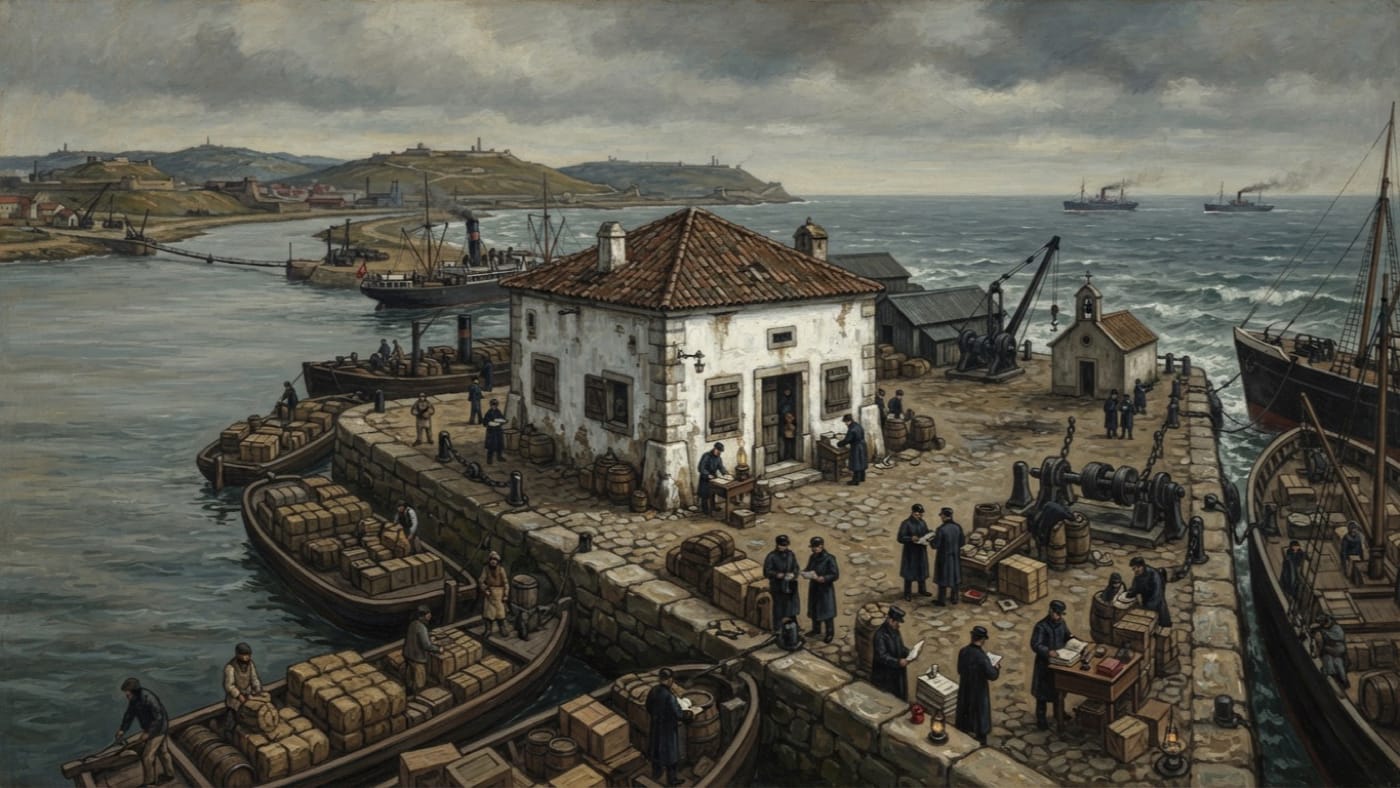
#On the Little White Office at the Mouth
Survey entered A.S. 201 / 1911 CE. That is the year of this survey. It is not the year the office was founded, and it marks no act of the office.
The lower Tagus ends in a little whitewashed office. The river has stopped being Iberian there and has not yet agreed to be Atlantic. The office has a title longer than its documented history: the Office of Final Inland Accounting. It also has a motto, and the motto makes a larger promise than the title does.
The Bureau's published Tagus survey sets down what is known in one sentence. At the mouth stand chain posts, customs chapels, wet-seal rooms, quarantine sheds, "and the little whitewashed Office of Final Inland Accounting, where river cargo becomes sea cargo and every crate must surrender its earlier innocence." The same survey gives the motto and then calls it false. It also prints a four-line summary under the office's heading. Nothing else is on record. No founding year survives in any file this desk has seen, and no founder, roster or chief clerk. No source extends the office's reach past the riverbank where it stands.
Some readers think a missing founding is a scandal. It is a vacancy, and the Ledger respects a vacancy more than a guess. A clerk who invents an origin to fill an empty column has committed the very sin this office was built to prevent. He has let something pass into the record uncounted and then pretended to count it.
#On the Conversion of Category
The office's documented work is one act of naming. River cargo becomes sea cargo.
The crate does not change. Cork from the Portuguese valleys is still cork when the tide takes it, and salt is still salt. Cured fish comes no closer to a saint for having passed a whitewashed wall. The category changes. Upriver, a cargo has the standing of a river cargo. At the mouth it is entered under the maritime heading, and from then on it is a different thing in the eyes of every office that reads its papers.
The survey's phrase about surrender is exact. Every crate "must surrender its earlier innocence." River innocence is local. A barge known at Toledo, taxed at the mills, delayed at the fords and argued over in the Brown Court has at least been seen by Synodal eyes all the way down. The sea has seen nothing. The crate leaves behind a familiar past and takes on a foreign future, and the office stands at the line between the two.
What the conversion requires on paper, the survey does not say. It names no form, no tariff, no hand-off from one clerk to the next, and it gives no penalty for refusing. I decline to write them in. The Bureau has shown me one fact: the category changes here. Anyone who supplies the rest is writing fiction on Bureau letterhead. My letterhead has suffered enough already.
#On the Neighbours of the Office
The survey puts the office among other installations. It does not put them under the office.
Chain posts stand at the mouth. Customs chapels stand there too. So do wet-seal rooms and quarantine sheds. The text lists all of them in one breath with the office, and listing them together proves only that they are near each other. Nothing in the record says the office runs the chains, staffs the chapels, keeps the wet seals or empties the sheds. The record does not even say how far apart they stand. A careless reader will draw an organizational chart from one sentence. A careful reader will draw a riverbank with several buildings on it and leave the lines between them blank.
The traffic around them is broader still. According to the survey, Synodal authority at the mouth "thins into harbour contracts, escort pledges, tithe farming, naval insurance, Pilgrimage licences, and arrangements with Portuguese magistrates who can bow so precisely that refusal appears devotional." These are the conditions the office works in, and none of them is shown to be within its powers. The Bureau of Tithes farms its own tithes. The Bureau of Pilgrimage licenses its own pilgrims. Portuguese magistrates bow on their own account. No document says any of them reports to the small white building.
The survey also describes what the water carries. Outbound ships take salt, wool, cured fish, cork, saint-water, contraband books, and "letters written in hands too careful to be honest." Inbound ships bring coin, rumour, Dutch instruments, British cloth, African resins, and sailors who have heard prayers in ports where Strasbourg's bells arrive only as gossip. All of it passes the mouth in one direction or the other. The survey does not report how much of it passes the office.
#On the Joint Summary
Here is the summary as the Tagus survey printed it, uncorrected and unexpanded:
The heading names the office. Four rules sit under it. A summary groups its contents, and it does not swear to who carries them out. Here is the limit of what each line says.
The first line repeats what the survey's prose already established. Category changes at the mouth. It is the one rule tied to the office by both the sentence and the stamp.
The second line says that Synod seals are inspected before tidal release. It does not say who inspects them. It gives no standard for passing a seal and no fate for a seal that fails. The wet-seal rooms stand nearby, and that fact tempts the reader to connect them. Resist it. Two items are near each other in a sentence, and that is all. "Before tidal release" does tell us the order of things: inspection comes first and the tide second. Any clerk who has watched a captain run for the ebb knows how often that order holds.
The third line holds foreign instruments "pending doctrinal harmlessness." The survey's inbound list includes Dutch instruments, so the rule plainly has something to apply to. It gives no test for harmlessness and no time limit on holding, and it names no office that pronounces the verdict. "Pending" is the Church's most patient word. An instrument held pending harmlessness waits on Doctrine, and Doctrine keeps no calendar a merchant would recognize.
The fourth line makes unmanifested devotional water subject to seizure. That records liability. It does not record that anything has been seized, and it does not say how often seizure happens. Saint-water goes out on the outbound list. The rule therefore falls on the cargo the Church most wants counted, because the Church blessed it, and most wants taxed, because pilgrims will pay for it. Undeclared devotional water may be taken. The survey reports no case of its being taken, and this desk invents none.
#On the Motto and the Tide
Nothing leaves the river uncounted.
The survey prints the motto and passes judgment straight away: "This is false, but noble in the way a small dog barking at thunder is noble." I do not overturn the survey's ruling. I do note how the motto is built.
The motto is about leaving. It promises nothing about arriving. The survey's smuggling report shows the cost of that wording. Bell fragments leave under fish, and that is the direction the motto covers. Forbidden pamphlets come in inside cork bales. The motto says nothing about that direction, the office's documented rules say nothing about it, and the tide carries the bales either way. The sailors' work chants carry melody scraps that the survey says Orison inspectors "cannot prosecute easily because sailors can make any tune sound like labour if enough rope is involved." Those chants go out and come back, and nobody counts them in either direction.
The survey then shares out the catch: "Tithes catches coin. Purity catches fools. Records catches paper. The sea catches the rest." The office is not among the catchers named, and the omission is in the survey's own wording. I keep it. The motto claims to count everything. The survey's account of the mouth gives the remainder to the sea.
A smaller fact matters too. The survey calls the office little. I do not count that as an insult. A small office with a total claim is the most honest object at the mouth, because nobody could mistake it for a fortress. The chains are made of iron. The quarantine sheds rest on whatever authority quarantine has. The office has whitewash, a name and one sentence of belief. Beyond its walls, past Lisbon's outer roads, the survey reports that "the water widens, and with width comes insolence," and the Atlantic takes the cargo the office has renamed.
#On the Limits of the Count
The office remains in A.S. 201. I can say that much because the survey describes it in the present tense. The survey records no rise or fall for the office and no incident in its history. It records no ruling or appeal, and no clerk whose name has survived. It records a building, a change of category, four rules under one heading, and a motto that the same page calls false.
Nothing leaves the river uncounted. The survey has counted the office, and it found that the office has not counted the river.