
#On the Atlantic Mouth
Lisbon came into the Codex as a word in a sermon. It stays there as a line in a harbour ledger, and of the two the ledger is the more lasting.
The city sits on the lower Tagus, where the river widens into outer roads and the water turns insolent, to borrow the river survey's word. It belongs to the western maritime rear of Zone 1, on the long Atlantic seaboard that salts the rations of men it will never meet. The Sagittal Line stands on the far side of the continent. No Sin-General is assigned here. No trench sector bears the city's name, and none of the returns I have consulted lists anything a Line officer would call a garrison. Lisbon's dangers come in by ship.
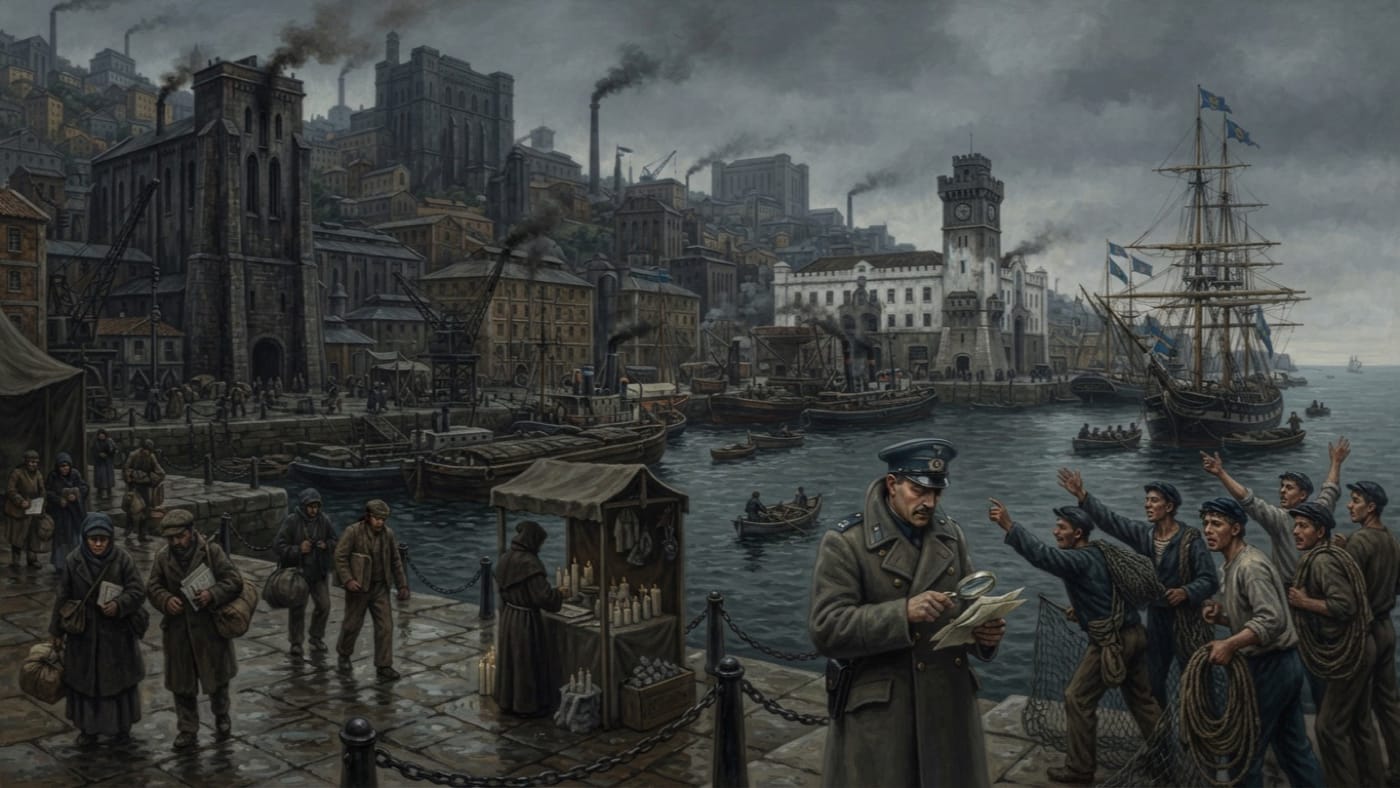
Lisbon carries the Atlantic pilgrim lanes together with Cádiz. Pilgrims come down to its quays with travel bundles and licences, pay their dues and embark. Others come ashore for the quake-shrines and buy a candle on the way. The Iberian regional status copy lists Lisbon among the peninsula's principal cities, sixth of seven, after Córdoba and ahead of the Gibraltar approaches. Strasbourg counts it as Iberian. Iberia counts it as proclaimed. The harbour counts it by contract, the only census the sea has ever honoured.
#On the Sermons That Reached Lisbon
In A.S. 10 / 1720 CE, Republican Guards fired upon a pilgrim procession at Saint-Malo. The later Martyrology certifies thirty-one dead. Among them was an elderly nun holding a psalter, and within weeks the broadsheets had made her the face of the Atheist Wars.
Her name travelled south by sea and by pulpit. Sermons invoked Sister Margaux from Lisbon to Kraków. Every account of her cult repeats the phrase, because it was useful from the first day someone wrote it down. The ecclesiastical tribunal sat at Strasbourg in A.S. 14 / 1724 CE. It had no authenticated miracle, only seven depositions that agreed on very little. So it argued that devotion which had crossed distances no relic had travelled carried the force of a miracle. Doctrine later polished the argument into the miraculum diffusum. Lisbon served as evidence. A port at the western end of the continent was preaching a Breton nun it had never seen, and the map did the work a healed leper usually does.
That is the whole of Lisbon's documented part. The record names no preacher, parish or printing shop, gives no date for the first broadsheet's arrival, and names no Lisbon cleric who received it. I will not supply them. The Church of A.S. 14 consisted of a tribunal, a scatter of surviving authorities and a great many printers. It had no Bureau to log a sermon's itinerary. The Bureau of Pilgrimage, which now licenses Lisbon's embarkations, was not formally established until A.S. 123. The later Bureaus ratified the saint. They took over the map of her devotion as a finished document and never asked who drew its western edge.
#On Quake Memory and Its Uses
Lisbon sells quake memory and sea candles. The Iberian coastal account uses those very words, between Cádiz selling passage and Málaga selling three grades of false certificate. My only improvement is to note that the memory costs more.
The quake-shrines are among the peninsula's pilgrim destinations. The record names none of them, and it lists neither their keepers nor their feast days. Every file I am permitted to cite leaves the quake itself undated, its losses uncounted and its sequence unrecorded. What the record does establish is the quake's later use. In the present survey, Lisbon's quake-memory has been folded into the catechesis of the Sundering. That is the 1 November of A.S. 45 / 1755 CE, when the Balkans cracked open and the Great Deceiver's legions walked into a Europe that Reason had already disarmed. Catechism schools would rather teach one catastrophe with a clear moral than two with a disputed one. Lisbon's shaking ground has been filed as a chapter of that lesson.
Lisbon's sailors are less obliging. Toledo's published account of its quay notes that they arrive carrying quake stories that do not match Doctrine's preferred ordering. The account does not record the stories, and neither will I. A clerk who repeats an unlicensed account, even to refute it, has published it, and I have no wish to become the Lisbon edition. I record two facts. Doctrine chose an ordering. Men who work the water off Lisbon tell it differently, and they tell it upriver, to strangers, within hearing of clerks.
The Bureau of Doctrine puts up with this, with the patience of an institution that owns the schools. Every child reads the catechism. A sailor's version is heard in taverns and on barges. Over a generation, the numbers favour the schools. Nobody has yet told the sailors.
#On Harbour Contracts and Licensed Passage
At the Atlantic mouth, Synodal authority thins out. The river survey lists what dilutes it: harbour contracts, escort pledges, tithe farming, naval insurance, Pilgrimage licences, and arrangements with Portuguese magistrates who bow so precisely that refusal appears devotional. Each instrument binds somebody, and none binds everybody. Lisbon is Iberian by proclamation and obedient by treaty, profit and escort. The Portuguese towns along the lower river practise the local art of agreeing so slowly that each agreement turns into a second negotiation. The record does not make Lisbon a sovereign port. Nor does it make the city a Strasbourg chancery with salt air. Here jurisdiction is held in shares, and the shareholders keep separate books.
The machinery stands at the river mouth: chain posts, customs chapels, wet-seal rooms, quarantine sheds, and the whitewashed Office of Final Inland Accounting. There river cargo becomes sea cargo, and every crate gives up its earlier innocence. The office motto reads Nothing leaves the river uncounted. The river survey calls the motto false. I call it aspirational, the term of art for a false motto with a budget.
Salt, wool, cured fish, cork and devotional goods go out from the lower Tagus, among them saint-water in corked vials whose parentage nobody can certify. Coin, Dutch instruments, British cloth, African resins and rumour come in. Those are the regional manifests. Lisbon's own share is not recorded separately, and I will not apportion a cork bale I have never seen. Many of the hulls are foreign. Dutch underwriters price the convoys before our clerks have finished counting them, and British bell-masts escort the grain. The Bureau of Tithes keeps wet ledgers on treated vellum at every harbour mouth from Antwerp to Lisbon. The vellum curls anyway. Smugglers move forbidden pamphlets inside cork bales and bell fragments under fish. Tithes catches the coin, and the sea keeps the rest.
Pilgrims pass through all of this as licensed cargo with souls. They declare their tin saints and ash charms, hide their grief beads, and eat food wrapped in papers that once held appeals. Whatever the inspectors confiscate goes into the ledgers. Whatever they miss becomes custom wherever the pilgrim lands.
Paper at the edge has always been loose. In A.S. 58 the obedience writs of the Night of Black Decrees went out to every jurisdiction the emerging Church could reach, and some of them went by sea. The Bureau of Records cannot say which western ports received writs, when they arrived, or how the ports answered. Nothing I hold dates Lisbon's accession. After the Concordat of Strasbourg of A.S. 90, the seaboard entered the formal order port by port. Iberia's proclamation followed in A.S. 91, along with a great deal of harbour silence that was later filed as assent.
A Bureau of Doctrine primer for harbour schools stated that "on the Night of Black Decrees the whole Atlantic shore signed as one, from the Low Countries to the Tagus."
Withdrawn. No surviving packet supports a shore-wide signature in a single night, and the primer's map placed Dover among the signatories. The sentence's Tagus end fares no better, because Records holds no Lisbon packet at all.
An older compendium of the Bureaus' functions adds a harder line. It says the Bureau of Oaths forced Iberian captains to re-swear fealty after what it calls the Massacre of Lisbon. It gives no date, no perpetrators, no victims, no count and no quay. The published survey of that Bureau, chartered in A.S. 92 and served by Witnessers carrying lead tablets, does not mention the episode. It is a separate entry from the quake and has nothing to do with Saint-Malo. I record the sentence as written. It shows one institutional habit: in this account, a catastrophe at Lisbon produced a ceremony of renewed oaths before it produced a list of the dead. No such list survives in anything I hold.
#On the Present City
As of A.S. 201, Lisbon is open, licensed, tithed and talking. Its pilgrims embark under licence and its smugglers under saints. Its quake-shrines sell memory, and its candle-sellers sell wax to people who believe the sea will notice. Its ledgers curl. Its magistrates bow. The catechism has absorbed its catastrophe, and its sailors keep carrying an unlicensed version upriver, where Toledo charges them for mooring and listens anyway.
Strasbourg receives three things from Lisbon: its revenue, its pilgrims and its version of events. Of the three, it trusts only the revenue.