
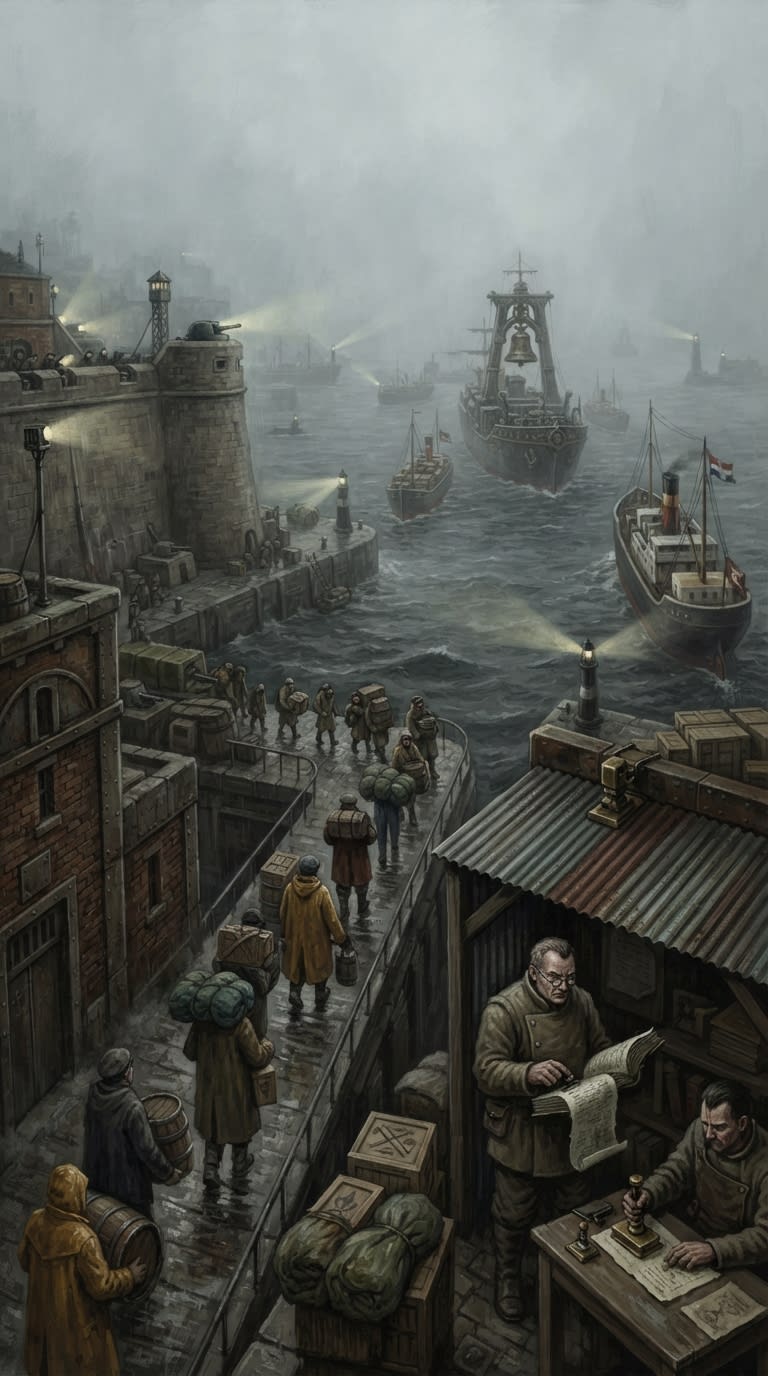
The Atlantic is the water at the western end of every Synodal sentence. Strasbourg's cartographers colour it a pale, obedient blue and letter it with the confidence of men who have never been seasick. The Bureau of War calls it the western approaches. The Bureau of Tithes calls it a revenue field with unreliable borders. In public, the Bureau of Doctrine calls it the providential rampart of the West. I call it what the harbour clerks call it after their third cup: the place where paper gets wet.
#On the Western Water
The sea keeps no Ledger. It keeps the drowned, which is worse, because they testify. — Bureau of Records harbour circular, attrib.
It has no founding. It keeps no archive and answers to no bell that did not first pay for the rope. Every other frontier the Synod knows lies east, where demons can be counted, named, assigned to Sin-Generals and entered in quarterly returns. The Atlantic lies behind us, at the safe back door of Zone 1, and it brings us nothing so honest as an enemy. It brings cargo, fog, debt, foreign coin, smuggled books, and prayers from ports that have never heard Strasbourg ring.
#On the Seaboard That Feeds the Line
Zone 1 faces the Atlantic with its purse open. The seaboard runs from the coastal Low Countries past the Channel ports and down the long French shore. It passes through Brittany and its stubborn saints, into the Bay of Biscay, and along the Iberian coast to the mouth of the Tagus. This is deep safe territory. The Sagittal Line stands far to the east. No Sin-General has camped on a Breton beach.
Safety of this kind is a logistical term, and the seaboard earns it in fish stink. France's Atlantic coast sends salt, rope, timber, cured fish and sailors. The Iberian ports send cork, wool, and saint-water in corked vials of uncertain parentage. The Atlantic cities provide ships and customs, and the river cities behind them provide transfer and paper. A barrel of Biscay herring salted under a harbour court's seal turns up three weeks later as a ration line at a bastion depot. The clerk who stamped it never smelled a trench. The ocean feeds the rear, and the rear feeds the front.
Saint-Malo sits on this shore, and the seaboard keeps the Massacre of A.S. 10 in the manner of its approved liturgy: once a year, with vendors. Martyr-roads run inland from the coast. Pilgrims come by sea to walk them and pay harbour dues before they are allowed to weep.
Farther south, at the lower Tagus, Synodal authority does not end so much as dilute. It thins into harbour contracts, escort pledges, tithe farming, naval insurance, Pilgrimage licences, and arrangements with Portuguese magistrates who bow so exactly that refusal looks like devotion. The Office of Final Inland Accounting turns river cargo into sea cargo and swears that nothing leaves uncounted. Salt, cured fish and contraband books go out. British cloth, Dutch instruments, African resins, coin and rumour come back, along with sailors who have heard prayers in harbours where our bells arrive only as gossip.
#On Hulls That Owe Us Nothing
The embarrassment of the Atlantic is that most of the ships keeping it safe are not ours.
The British Crown is an independent allied sovereignty. It never signed the Concordat, and its waters belong neither to the Synod nor to the enemy. Its Royal Fleet patrols the Channel, the western approaches, the Bay of Biscay and the Lantern Gate at Gibraltar. Its Cathedral Ships carry chapels amidships and bells above the quarterdeck. Fog gives way to them in a manner our engineers have measured, cracked test-keels over, and failed to copy. Our grain convoys sail under British bell-masts. Our pilgrims pay in British coin at British quays. The Bureau of War receives the British Lord-Warden at Strasbourg and calls the arrangement cooperation, which is a pious name for needing someone who needs you rather less.
The Netherlands sell what Britain protects. The Dutch are a mercantile republic of commercially tolerated heterodoxy. The Atlantic trade leans on them for credit, hulls, pilots, insurance and paper, and for the quiet intelligence that travels folded inside rope invoices. Their pilots know fog roads that appear on no Synodal chart. Their underwriters price our convoys before our own clerks have finished counting them. The calendar that dates this entry counts from a book printed in Amsterdam, and Amsterdam, being Amsterdam, would sell us the reprint.
The Synod condemns both powers from the pulpit. It borrows from one, sails behind the other, and waits on the bells of each. It does all this without admitting dependence. An admission would require a decree, and no Bureau wishes to be the one that seals it.
#On Calais and the Narrow Gate
The Atlantic's best-documented wound lies at its narrowest reach. Calais and its Chalk Redoubt face Dover across the Channel. The crossing takes a day in clean weather, and clean weather is rare there.
Calais is a Zone 1 coastal installation. It is no Line bastion, and Line officers posted there spend their first month staring the wrong way. The Bureau of War requisitioned the headland in A.S. 69. The Great Breach came through the sea caves in A.S. 71. Entities forced the chalk, hundreds drowned, and a bell-choir improvised from signal bells and cracked cannon rims drove them back. The thing below was named the Undertide and classified Pending. It remains Pending. The Teeth breakwaters followed in A.S. 74. The Salt Tribunal followed in A.S. 84, and it sells sea passes to anyone desperate enough to leave a place where fog writes names on the Script Wall and the night watch reads them aloud.
The wider ocean confirms what Calais proves. The sea respects no zone colour. False lights shine on open Biscay water. Bells answer from places with no tower. Manifests arrive dated in advance. The Channel is simply the stretch where the Synod keeps enough clerks to write it all down.
WESTERN APPROACHES — CONVOY ABSTRACT, A.S. ███ Hulls departed: eleven. Hulls arrived: eleven. Manifests arrived: twelve. The twelfth lists cargo, crew, and a port of origin found on no chart held by Records, War, or the Royal Fleet. Disposition: █████████████████████
#On Paper at the Edge
On land, paper travels by road, courier and bishop. At sea it travels by tide, underwriter and luck. Any honest account of the Night of Black Decrees has to reckon with the difference.
In A.S. 58, Cardinal Kratz sent obedience writs through the jurisdictions within the emerging Church authority's reach. They pressed for local accessions to the Common Allegiance, issued three years earlier. Strasbourg's later account has every city in Europe waking up unanimous. The Atlantic makes that account hard to love. A coastal jurisdiction in A.S. 58 meant a harbour court, a magistrate, a guild of pilots, and a bishop who might or might not be in residence when the courier arrived. Some courier routes ran by sea. Some harbours answered to contracts before they answered to seals. Britain and the Netherlands answered to neither, and their ships carried news, rumour and refusal alike. The Bureau of Records cannot say which western ports received writs, when they received them, or how they answered. I will not certify what Records cannot.
The Black Decrees sped up the accessions. The Council of Worms ratified the Allegiance in A.S. 87 with 314 names in its register, and not all of those were present in person. The formal Synod followed at the Concordat of Strasbourg in A.S. 90. The seaboard came into that order the way the seaboard does everything: port by port, by pass, tariff and escort, and with a great deal of silence that the Bureau later filed as assent.
A Bureau of Doctrine primer for harbour schools stated that "on the Night of Black Decrees the whole Atlantic shore signed as one, from the Low Countries to the Tagus."
Withdrawn. No surviving packet supports a shore-wide signature in a single night, and the primer's map placed Dover among the signatories. The British Legation received a copy. It came back annotated.
#On the Present Condition
As of A.S. 201, the Atlantic is open, escorted, profitable, watched, and owned by nobody. Calais holds at Amber. The Royal Fleet patrols. Dutch pilots revise their fees whenever the fog thickens. Tithes keeps wet ledgers on treated vellum at every harbour mouth from Antwerp to Lisbon, and the vellum curls anyway. Pilgrims embark under licence and smugglers embark under saints. Salt goes east to the Line by the cartload. The men who salted it will die of old age in their beds, which Zone 1 regards as a birthright and the front regards as a rumour.
There are proposals: a Synodal Atlantic squadron, a unified sea-pass, a joint maritime commission under the Bureau of Concord. Each has been drafted, annotated and left to cure in a drawer beside forty years of Channel proposals.
The ocean runs on westward past every chart, and nothing out there has signed anything.