
#On the Inherited City
Kanzleiburg received its present name in A.S. 95, when Synodal military command absorbed the Prussian state and Berlin was decreed to be what its offices already were: a chancellery with a fortress attached. The Old City received no comparable decree. Its churches were raised before the Synod, its markets were held before those churches, and its beer-halls were pouring before anyone in the municipality had the nerve to regulate them. A renaming changes the letterhead. The lanes kept their habits and paid the new stationery no attention.
Readers who want a foundation year will not get one from me. Records certifies none, and I decline to lay a cornerstone for the comfort of schoolmasters. The Old City was not founded in any sense a clerk could stamp. It accumulated: a market cross here, a parish wall there, a brewer's cellar that outlived three owners and one government. The Church took the steeples in its turn, and the unoccupied crosses above the older naves are honest about who arrived second.
The city around the quarter is the administrative brain of the north. It seats the Northern Hierarchate on Archonate Isle and pushes the northern supply along the Hamburg–Kanzleiburg–Warsaw route toward Bastion-Königsberg and Bastion-Brest. Kanzleiburg lies in the Central Heartlands, west of the Sagittal Line and safe by every measure the Bureau of War publishes. That safety is paid for in paperwork, and the Old City is where much of the paperwork goes to drink.
#On the Lanes and Their Inhabitants
The Old City is crowded with people who once served, still serve or are owed something for having served. Retired officers keep rooms above shops whose owners sold them gloves in their lieutenancy. Wheelwrights work within earshot of the rail yards they will never be permitted to enter. Parish widows hold the pension correspondence of husbands who died on the northern line, and they know the Hierarchate's forms better than the junior clerks who issue them. Brewer families have held the same cellars longer than any Bureau has held a charter. Garrison tailors measure colonels. Street accountants keep other men's ledgers on folding boards for a fee, and the Bureau of Records considers the profession irregular for the excellent reason that it has never managed to audit one.
Serving officers come in from the Garrison Quarter for supper and do not live here. The quarters are distinct, and the distinction matters to both of them: the Garrison Quarter commands, while the Old City remembers what commanding cost and keeps its accounts. A captain may arrive at a hall to drink and leave having been told, at length and by a retired major, why his supply returns were late.
None of this makes the Old City a republic. Its kitchens are inspected. Its tithes are collected. Its sons are levied for the line, and its widows are paid, when they are paid, by the same offices that took the sons. Purity's white mantles walk these lanes as freely as they walk any others in the Heartlands. What the inhabitants possess is competence. They have stood inspection, signed muster rolls, filed claims and contested them through three appeals. An order that reaches them must be administered against people who know exactly how administration is done, and that makes a foolish order expensive.
#On the Common Tables
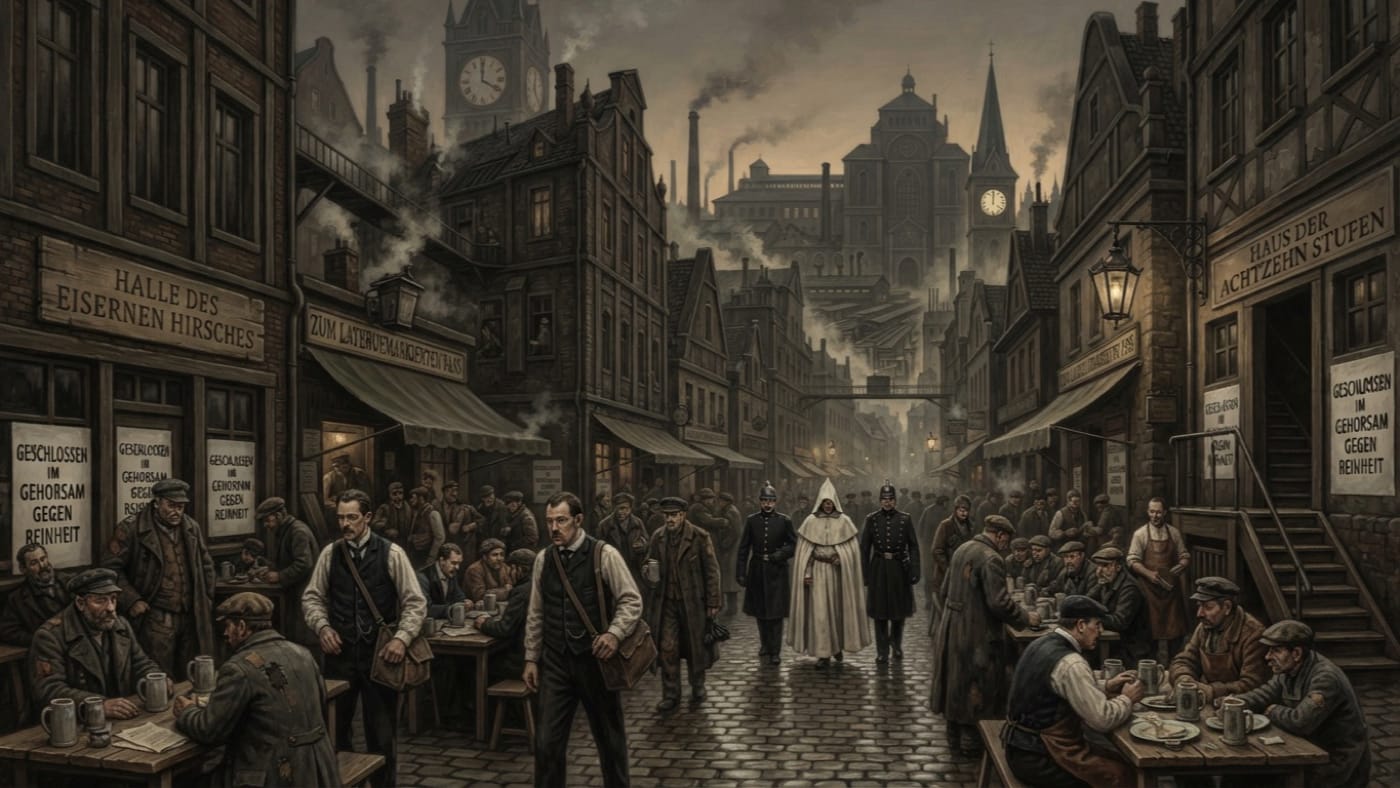
The beer-halls are the reason the quarter matters to anyone who governs Kanzleiburg. They do far more than pour beer.
The halls are the district's assembly rooms. They are its informal courts, where a quarrel over a fence or a debt is heard by men with standing and closed before any magistrate learns of it. No statute recognises those courts, and no statute has needed to. The halls are where veterans meet, where a wheelwright hires an apprentice, where a regimental tailor learns which officers have been promoted and will therefore pay late. Condolences are taken there when the casualty sheets come back from Brest. Complaints are lodged there too, by people who know that a grievance spoken at the right table reaches the Hierarchate faster than one posted through the proper slot.
They also feed the quarter. A hall serves meals to men who keep no kitchen. It rents rooms to clerks between postings. Municipal clerks keep their supper benches there, and officers are served through the side door when it would be undignified to be seen at the front. Close the halls and you have taken away the district's supper, lodging, labour exchange and condolence office in a single afternoon. The beer goes with them.
Three halls stand near the old parade route and appear by name in the record of A.S. 140. The Hall of the Iron Stag is remembered for its proprietor, who asked an inspecting patrol whether it held a fire-safety certificate for clearing a room of two hundred and twelve drinking citizens. That figure was the headcount on one night. It is no licence capacity, and anyone who prints it as one will receive a letter from me. At the Lantern-Marked Cask, a retired major asked whether ninth bell had been audited against ecclesiastical time or rail time. At the House of Eighteen Steps, whose name Records has never forgiven, a brewer's widow asked whether unfinished beer would be compensated under the seizure provisions or the spoilage provisions.
The Codex holds no proprietors' names, no addresses and no plans of the cellars. Visitors who claim to know which stair is the eighteenth are counting their own.
#On the Curfew and Its Suspension
The Curfew Standoff of A.S. 140 has its own plate, and the reader who wants the full three days should go there. The Old City requires only the outline, because the outline shows what the quarter can do without raising its voice.
The notice set two deadlines. Service ended at ninth bell and assembly at tenth. Later retellings collapse them into one eviction at nine, and this is how a retelling makes itself unfit for the Ledger. Neither bell corresponds to an hour on a foreign clock.
On the first night, a patrol entered the three halls named above. It consisted of a Records clerk, two municipal watchmen and a young Inquisitor in a white mantle. The questions recorded above were put to them, and no blows were struck. The register for the night lists seventeen fines across the three doors, no tables cleared, and two songs interrupted and then resumed. It does not divide the fines between the halls, and neither will I.
The owners met before dawn and agreed to obey. Every hall in the Old City was shuttered by noon. Each bore the same placard: CLOSED IN OBEDIENCE TO PURITY. The district's suppers, lodgings, hiring tables and condolence benches went dark together, and the Garrison Quarter discovered by evening how much of its business had been conducted across Old City tables.
On the second day, the officer corps petitioned the Archon. The petition cited morale, readiness, informal dispute resolution, veteran welfare and domestic order, and it warned against "unscheduled sobriety among command personnel." On the third day, the Archon suspended enforcement pending operational review. The halls reopened by dusk.
Old City retellings hold that the Bureau of Purity apologised.
Corrected. Purity issued no apology. The suspension came from the Archonate, which thanked Purity for its vigilance and did not require it to say anything at all.
The settlement was practical and left the forms untouched. The fines were held in abeyance and never collected. Inspection authority was preserved in principle. No review date was set, and no further enforcement window was scheduled. No later Purity report on the matter has been found. Records filed the affair under municipal coordination, which is a diplomat's word for an awkward week. This is the only known retreat of Purity from a beer-hall. It was a retreat from that one curfew and nothing more. The white mantles went on inspecting chimneys, kitchens and bookcases throughout the north with undiminished appetite.
#On the Present Observance
As of A.S. 201, sixty-one years after the standoff, the Old City halls close on the second day of its anniversary from noon until ninth bell. The placards are the same ones, or faithful copies of them: CLOSED IN OBEDIENCE TO PURITY.
Purity ignores the observance. The Northern Hierarchate records it as a traffic variation, a term it applies to most things it would rather not discuss. Archonate Isle offers no comment. The office has changed hands since A.S. 140, and the Codex will not pretend to know whose hands they are.
At ninth bell the shutters come up. Garrison officers wait at the thresholds, though none of them was alive in A.S. 140. They enter and order the first round in silence. Then the toast is given.
The toast is not printed. Every lane in the quarter knows it, and Records knows that every lane knows it, and the Codex declines to be the first to set it in type. The matter stays with the people who drink to it.
The quarter answers to the Synod in every particular that can be written down. What it keeps beyond that, it keeps at table, and the Bureaus were wise enough after A.S. 140 to stop asking.