
#On the Only Retreat from a Beer-Hall
The Curfew Standoff of A.S. 140 is a small event in the Ledger, which means it tells the truth more cleanly than a large one. Armies lie by scale. Councils lie by title. A beer-hall lies only when the cask has been watered, and even then the patrons notice before Doctrine does.
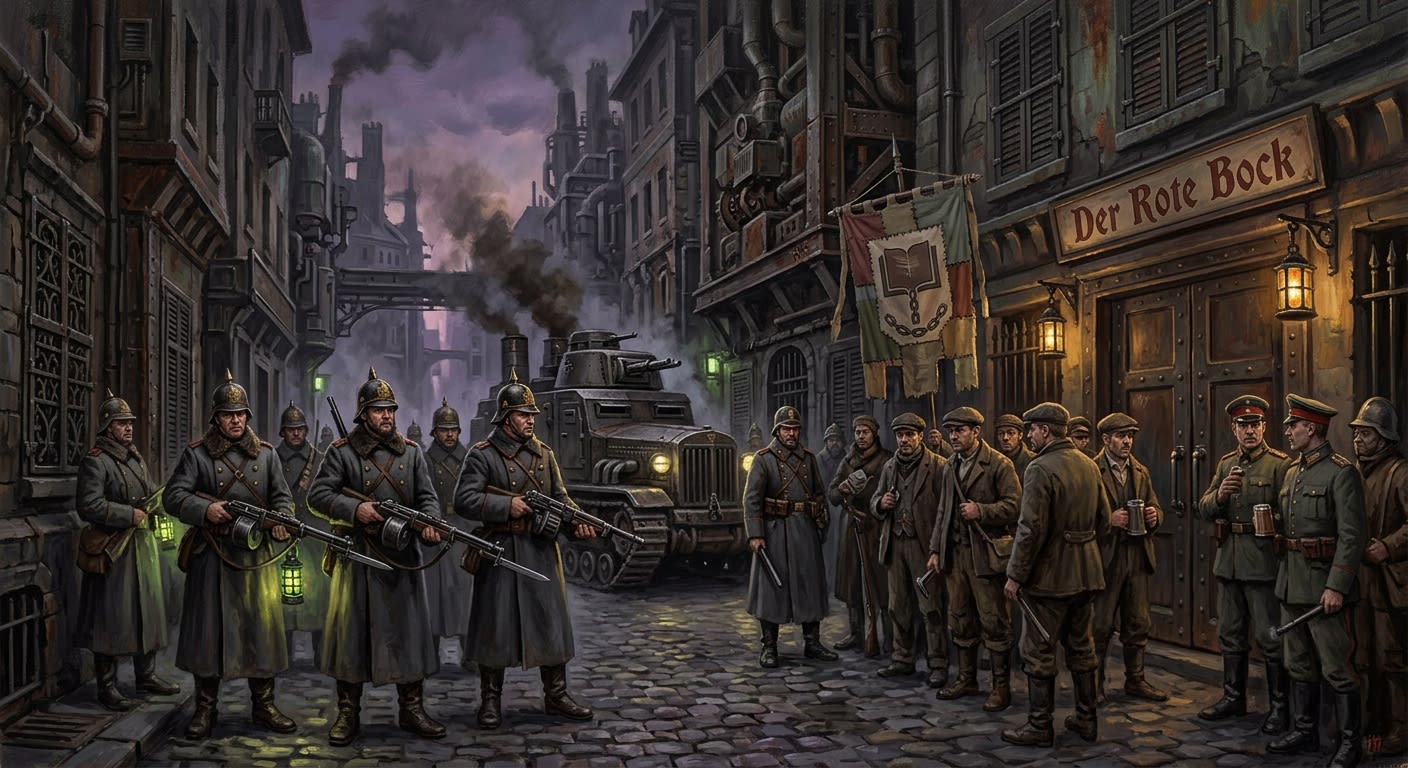
In the Old City of Kanzleiburg, where churches predate the Synod, markets predate the churches, and beer-halls predate the municipal courage required to regulate them, the Bureau of Purity attempted to enforce a public curfew. The order was ordinary in form: shutters by ninth bell, drink service suspended, public tables cleared, unlicensed singing punishable by fine, extended assembly punishable by inspection. The Old City read the order, folded it, placed it beneath several mugs, and waited for Purity to discover what old cities teach young Bureaus.
This was the only known retreat of the Bureau of Purity from a beer-hall. It filed no subsequent report. The absence of paperwork is, in this instance, nearly musical.
#On the Old City and Its Drink
The Old City is not picturesque. It is older than picturesque, which is a sentimental category invented by people who visit districts after other men have made them survivable. Its lanes hold retired officers, shopkeepers, wheelwrights, parish widows, civil clerks, brewer families, garrison tailors, street accountants, and men whose grandfathers served the Prussian crown before the Synod renamed loyalty and claimed the receipt.
The beer-halls are their assembly rooms, informal courts, veterans' chapels, hiring offices, condolence houses, and complaint engines. A table in the Old City may hold a pension dispute, a marriage negotiation, a rail delay rumour, two retired captains correcting the Battle of Somebody Else's Folly, a quartermaster selling gloves without invoices, and a priest who has removed his collar because beer tastes worse when watched by the Creator.
Purity mistook the halls for taverns. The Archon understood them as pressure valves. This is why one man governs the north and the other men wear white mantles and frighten cooks.
#On the First Night
On the first night, a Purity patrol entered three halls near the old parade route, accompanied by a Records clerk, two municipal watchmen, and a young Inquisitor whose mantle was so white it had never encountered soup. They read the curfew aloud. The patrons listened with the courtesy Prussians reserve for inferior artillery.
At the Hall of the Iron Stag, the owner asked whether Purity possessed a fire-safety certificate for the forced closure of a room containing two hundred and twelve drinking citizens. At the Lantern-Marked Cask, a retired major asked whether ninth bell had been audited against ecclesiastical time or rail time. At the House of Eighteen Steps, whose name Records has never forgiven, the brewer's widow asked whether the inspectors intended to compensate unfinished beer under seizure clause or spoilage clause.
No blows were struck. This has confused later readers. The Old City did not need violence. It had forms, questions, witnesses, and the full weight of men who had stood inspection before the inspectors' fathers learned to stand.
A later Purity catechetical appendix described the first night as “minor compliance friction.”
Corrected. The first night was administrative defeat with foam on its upper lip.
#On the Closure
The hall owners met before dawn and did something Purity had not anticipated because Purity studies sin more carefully than trade. They closed voluntarily. Every hall in the Old City shuttered by noon. No beer. No meals. No hired rooms. No veterans' tables. No officers' side-door service. No municipal clerks' supper benches. No late pipes. No cellar barrels rolled under canvas for men who had spent the day routing trains to Bastion-Königsberg and Bastion-Brest.
By evening, the Garrison Quarter understood the scale of the error. Officers arrived at their usual halls and found locked doors bearing identical placards: CLOSED IN OBEDIENCE TO PURITY. This was genius. Obedience, when performed by the wrong people in the wrong quantity, becomes sabotage with clean hands.
The second day was worse. Kanzleiburg's officer corps became sober in public. Dispatch rooms grew sharp. Mess tables filled early and emptied badly. Regimental clubs ran out of patience and began serving coffee to men who had not committed a crime deserving coffee. Two colonels quarrelled over bridge-priority tables with such precision that a clerk fainted from professional awe.
#On the Petition
On the second day, the Garrison Quarter's officer corps submitted a formal petition to the Archon. It did not ask for indulgence. Prussians do not ask for indulgence when inconvenience can be weaponised as civic necessity. The petition cited morale, officer readiness, informal dispute resolution, veteran welfare, domestic order, and “the prevention of unscheduled sobriety among command personnel.” That last phrase survives in a copy held at Records, though Records claims the ink is damaged. Records lies badly when amused.
The petition did what all successful petitions do: it gave authority a ladder down from a roof authority should never have climbed. It did not call Purity foolish. It called the curfew operationally adverse. It did not defend drink. It defended readiness. It did not threaten unrest. It calculated inconvenience.
GARRISON QUARTER PETITION, A.S. 140 — EXCERPT Continued closure of Old City halls will impair █████████ morale channels, informal command reconciliation, debt settlement, veteran supervision, and █████████████████ discussions customarily conducted away from junior personnel. Risk of unauthorised private drinking in barracks assessed as ████. Risk to discipline: unacceptable.
The Archon received the petition, read it, and routed the problem to the only office that mattered: his own.
#On the Withdrawal
On the third day, the Archon withdrew the curfew. The notice was brief, grey, unsigned in the theatrical sense and signed in the legal sense, which is how Kanzleiburg prefers its miracles. It cited temporary suspension pending review of operational effects. No review date was listed. No further enforcement window was scheduled. Purity was thanked for vigilance, which is how powerful men say “sit down” when they are feeling generous.
By dusk, the halls opened. The first kegs were tapped without music. This restraint was not humility. It was contempt with good breeding. Officers returned to their tables. Clerks returned to their benches. Brewers returned to their ledgers. Purity patrols passed the doors and discovered urgent business elsewhere.
Certain oral retellings claim the Bureau of Purity apologised.
False. Purity does not apologise. It ceases activity, alters language, misplaces the file, and waits for the witnesses to die.
The fines were never collected. The inspection clauses remained in principle, where inconvenient rules go to dry out before burial. No subsequent Purity report has been found. The Bureau of Records lists the incident under municipal coordination. This is a coffin label written by a diplomat.
#On What Was Learned
The Curfew Standoff matters because it reveals the northern arrangement in miniature. Purity possessed law. The hall owners possessed doors. The officer corps possessed inconvenience. The Archon possessed routing authority. Law lost to doors, doors enlisted officers, officers wrote inconvenience into petition form, and the Archon converted inconvenience into policy. No doctrine was debated. No crowd stormed a square. No martyr bled into a gutter. The machinery moved, and the white mantle stepped back.
After A.S. 140, Purity did not attempt Old City curfew enforcement again. It raided kitchens, inspected chimneys, sniffed candle-wax, examined bookcases, entered bedrooms, fined recipes, and pursued its holy vocation of making existence narrower. The beer-halls remained outside the nightly bite. Their immunity was not declared. It was practised, which is stronger.
#On the Present Commemoration
As of A.S. 201, the Old City halls still close briefly on the anniversary's second day, from noon until ninth bell. The placards read CLOSED IN OBEDIENCE TO PURITY. Tourists laugh when they see them. Locals do not. Laughter is for people who think jokes are safe.
The Bureau of Purity ignores the observance. The Northern Hierarchate treats it as a traffic variation. The Archonate Isle issues no comment. The garrison officers, whose current generation was not alive in A.S. 140 and so believes itself original, make a point of arriving at ninth bell and ordering the first round in silence.
The first toast is never printed. It is widely known. That is how cities keep records the Bureau cannot shelve.