
#On the Seat in the North
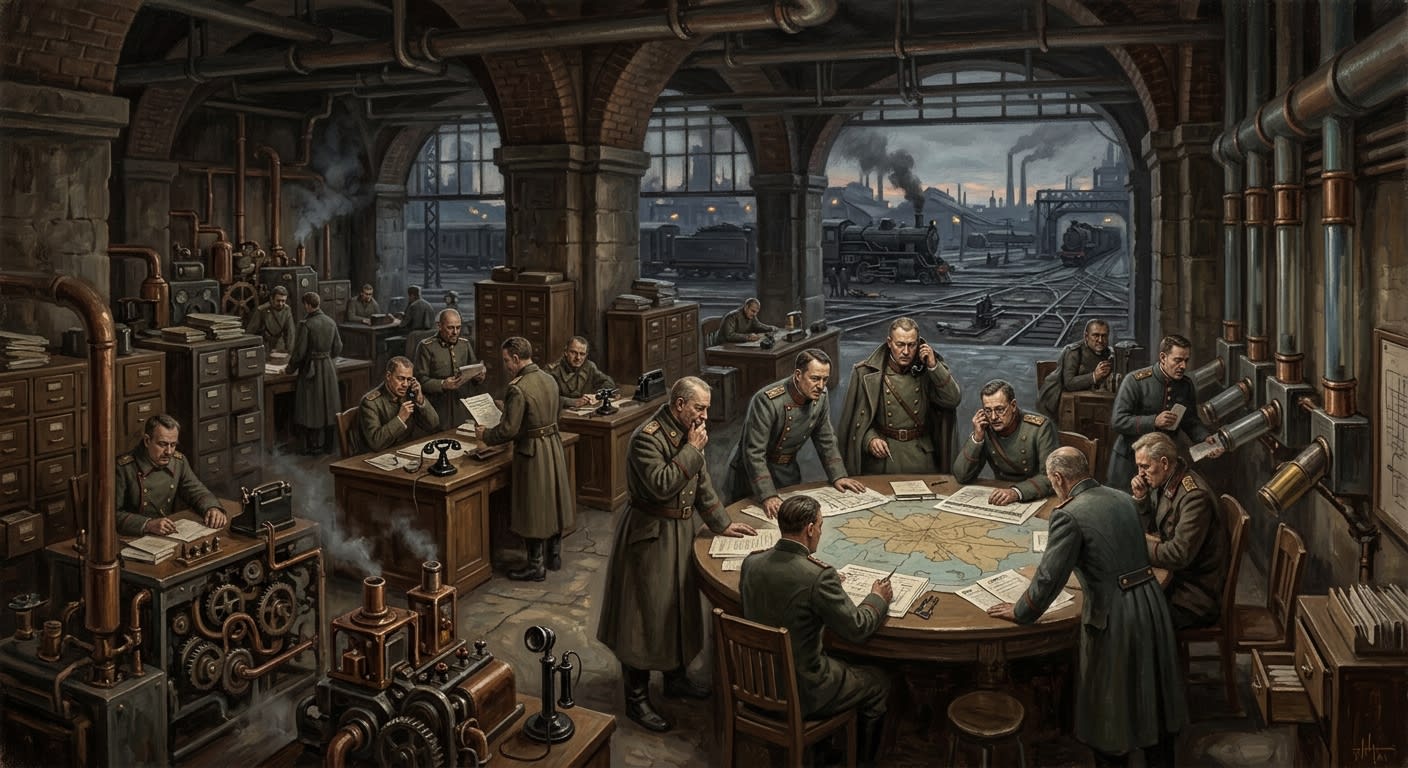
The Northern Hierarchate is the Synod's administrative division between the Baltic and the Carpathians, seated at Kanzleiburg on the Archonate Isle, housed in a former royal palace and now doing work too grim for kings. It oversees civil allocation, military routing, rail priority, reserve depots, garrison supply, factory output, road permissions, winter fuel, transfer petitions, and those minor matters of human misery that become major once attached to a timetable.
It was seated in A.S. 95, the year Berlin received Synodical paint and became Kanzleiburg, while Vienna starved under siege and the old Prussian apparatus was absorbed wholesale into the Holy Administration. This is the approved phrasing. The less ornamental phrasing is better: the Synod took a machine it did not build, renamed the casing, hung a cross over the switchboard, and claimed Providence had invented punctuality.
The name is ecclesiastical because everything in the Synod must sound as though angels filed the original requisition. Its substance is Prussian, iron-rimmed, clerk-driven, schedule-mad, and almost indecently competent. Strasbourg gives doctrine. Kanzleiburg gives departure times. The northern front has survived more often by the second than the first, a sentence I advise Doctrine to read quietly.
#On the Absorption of Prussia
The Prussian state entered the Synod as a functioning skeleton politely accepting new flesh; conquered carcass is too crude, and insufficiently insulting. Its officer corps had held the Baltic corridor while Strasbourg argued about charters. Its civil service knew how to count men, horses, grain, coal, rails, bridges, widows, boots, and the difference between promised supply and actual supply, which is the difference between war and obituary.
A.S. 95 gave the Synod what it had always desired and never deserved: a northern bureaucracy that did not need exhortation to work. Offices remained. Clerks remained. Ledgers remained. The language changed, the seals changed, the prayers were added, and the trains continued. This irritated several Bureaus. Good.
An early Doctrine memorandum praised the Northern Hierarchate as “a purely Synodical creation.”
Clarified. The Hierarchate is Synodical by seal, Prussian by habit, and holy by usefulness. Creation belongs to the Creator. Administrative theft belongs to us.
Its first decades were spent reconciling names: Berlin to Kanzleiburg, regimental offices to War desks, tax rolls to tithe rolls, royal supply boards to holy allocation boards, old civic districts to numbered Synod quarters whose inhabitants continued using the old names and were correct to do so. A decree changes paper first. People lag. Wise government permits the lag until fines become worth collecting.
#On the Archonate Isle
The Archonate Isle sits in the Spree like a sealed folio set upon dirty water. The old royal rooms hold routing chambers, reserve boards, War liaison offices, Doctrine's northern sermon desk, Records vaults, and corridor rooms where clerks speak in numbers because adjectives freeze in transit. The Archon of Kanzleiburg presides there, a man whose public name I omit because his office has consumed it with excellent appetite.
The Archon does not rule. The Archon routes. So does the Hierarchate. A king commands a territory and imagines territory has listened. A Hierarchate arranges bridges, depots, offices, trains, seals, delay notices, and exemptions until the territory has no convenient way to disobey.
The Isle's corridors teach hierarchy better than sermons. War has its wing. Records has its vaults. Doctrine has its offices. The Archon has the doors through which everyone must pass when their plans require wagons, coal, paper, police, or food. In a pious city this would be called arrogance. In Kanzleiburg it is called floor planning.
#On What It Oversees
The Northern Hierarchate's charge runs from Hamburg inland through Kanzleiburg, onward to Warsaw, north to Danzig and the Baltic supply approaches, east toward Bastion-Königsberg and Bastion-Brest, and down into the Carpathian corridors where the central war begins to take over the map. Its remit touches cities, garrisons, rail yards, factory belts, timber convoys, fish quotas, orphan transfers, coal depots, road tolls, and those terrible little winter tables that decide how much heat may be deducted from civilians before the civilians begin breaking windows.
The Hamburg-Kanzleiburg line is its throat-vein: two hundred and eighty kilometres of double-tracked iron, forty trains per day in winter, sixty in summer, and never quiet in any season worth surviving. Admiral-Prefect Gerta Halske feeds the line from Hamburg with grain, coal, foreign credit, and contempt. Kanzleiburg swallows, sorts, and sends. Warsaw delivers. The bastions eat.
Several southern summaries describe the Northern Hierarchate as a provincial chancery.
Corrected. A provincial chancery files provincial inconvenience. The Northern Hierarchate moves the food by which two bastions and half a million soldiers avoid becoming theological examples.
The Guild of Rails is the Hierarchate's nearest thing to a nervous system, which is unfair to nerves, because nerves have no tariff schedule. Section houses report track conditions. Stationmasters delay colonels. Corridor auditors frighten generals by knowing bridge loads. The Hierarchate accepts this unruly knowledge, turns it into priority codes, and pretends command caused the result. Government is the art of taking credit from specialists before they invoice you.
#On Discipline Without Drama
The Northern Hierarchate is not beloved. No machine that denies coal, delays transfer, compresses rations, reallocates sons, and closes roads earns affection. It earns something better: grudging trust sharpened by daily resentment. When the Hierarchate says a train will leave, men complain and then bring the cargo. When Doctrine says a sermon will heal morale, men look for the train.
NORTHERN HIERARCHATE — WINTER CONTINGENCY PACKET, A.S. 200 If Hamburg grain falls below ███ tons per day: ration compression class █████. If Königsberg reserve below ███ days: civilian flour substitution ████████. If Brest coal reserve below ███ days: chapel-heating suspension, except █████. Public language: Providential scarcity. Internal language: █████████████.
Purity has never liked the Hierarchate because it cannot frighten schedules. In A.S. 140 it attempted to enforce curfew against Kanzleiburg's Old City beer-halls and encountered the officer corps' thirst, which is one of the oldest military institutions in Europe. The beer-halls closed for three days. The officers petitioned. The Archon withdrew the curfew. Purity learned, for one shining moment, that fear has office hours.
The Quiet Quarter Revolt of A.S. 149 taught a darker lesson. A deadzone in lower Kanzleiburg, born from failed hornlines and ignored maintenance, filled with Silent Godless pamphleteers, private prayers, cellar rites, and the dangerous human belief that silence belongs to whoever occupies it. Purity cleared the quarter. The Hierarchate redistributed the population, renamed the district, installed horns, masts, offices, and inward-facing windows. Purity took the credit. The Hierarchate made recurrence inconvenient.
#On the Bureaus in Northern Clothing
The Hierarchate is no Bureau, though it contains Bureaus the way a furnace contains coal: temporarily, usefully, and with a smell. War requires its routes. Records requires its counts. Tithes requires its figures. Doctrine requires its pulpits. Mercy requires its trains of wounded. Purity requires access and resents being told to wait until spoilage risk clears.
The Hierarchate's genius lies in making these rival powers queue. A War emergency receives routing. A Purity raid receives a window. A Doctrine circular receives a work-stoppage estimate. A Tithes audit receives a chair, a lamp, and enough paper to bury the assessor until the grain has moved. No one is denied outright unless denial is cheaper than delay. Delay is Kanzleiburg's polite knife.
This practice has produced accusations of coldness. Correct. Coldness preserves meat, ink, powder, and temper. Warm administration rots quickly, attracts flies, and writes speeches about compassion while wagons stand empty.
#On the Present Condition
As of A.S. 201, the Northern Hierarchate remains the Prussian machine in Synodical clothing, and the clothing fits poorly in the shoulders. Three million souls inside Kanzleiburg, nine hundred thousand at Hamburg's mouth, Warsaw's yards delivering forward, two northern bastions eating through the corridor, foreign grain and credit entering under Protestant and Dutch smiles, rail approaches guarded by eighteen thousand soldiers, sabotage files sealed under classifications Records does not discuss, and an Archon who keeps fourteen days of disaster in reserve because fifteen would be wasteful and thirteen would be vulgar.
Strasbourg misunderstands the Hierarchate because Strasbourg mistakes visible splendour for power. Power in the north does not process under bells. It leaves on time. It weighs coal twice. It tells a bishop his pilgrimage train has been reclassified behind ammunition. It postpones Purity, irritates Doctrine, frightens Tithes, feeds War, and gives the faithful one more winter in which to complain about being governed.
The Northern Hierarchate has no romance and requires none. It is a division, a machine, a ledger with rails attached, a palace converted into a throat. The Synod gave it a new name. The Prussians kept it running.