
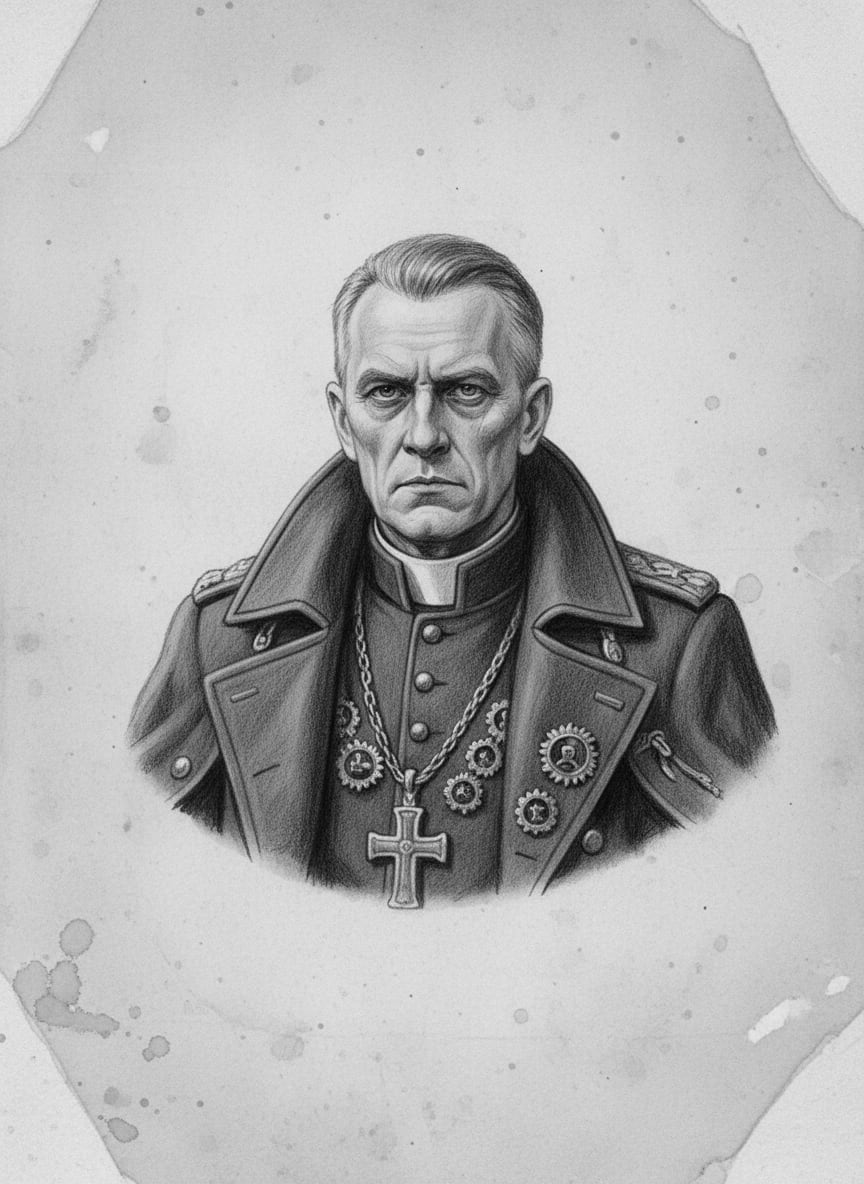
#On the Man Whose Name Is Public
The Archon of Kanzleiburg is a public official whose name appears on forms, appointment registers, requisition notes, winter fuel circulars, civil appeals, rail emergency orders, beer-hall curfew exemptions, and those little grey memoranda by which three million people are instructed to continue being useful. I will not reproduce the name here. This is not secrecy. It is courtesy to authority properly understood.
A lesser administrator needs a name because his person must carry his office. The Archon has achieved the cleaner arrangement: the office carries him. He is the Archon as a signal box is the signal box, as a timetable is the timetable, as a locked cabinet marked NORTH-CORRIDOR RESERVES is neither charming nor forgettable. His authority precedes his face into every room. By the time he enters, obedience has already found a chair.
He governs from the Archonate Isle, where the Northern Hierarchate's seat, the Bureau of War's northern command, Bureau of Records' second-largest archive, and Doctrine's grim little sermon office stare at one another across corridors polished by clerks who have never once mistaken cleanliness for importance. Strasbourg possesses splendour. Kanzleiburg possesses sight-lines. This explains much.
#On the Prussian Machine
The Synod absorbed Prussia. Prussia, being Prussia, continued to function after absorption with the mute contempt of a machine whose casing has been repainted by children. The Archon governs through that machine: district offices, rail boards, grain ledgers, reserve depots, marshalling-yard clocks, municipal police rosters, factory quotas, civil petitions, garrison requisitions, and the old Prussian habit of answering a crisis with a stamped sequence rather than a sermon.
The Bureau of Doctrine dislikes this habit because it works without needing Doctrine. The Bureau of Records admires it because it produces paper in obedient stacks. The Bureau of War relies on it because generals, left alone with logistics, become poets of disaster. The Archon neither flatters nor insults these Bureaus. He routes them.
Earlier summaries described the Archon of Kanzleiburg as the ruler of the northern Synod.
Clarified. He does not rule. He routes. A ruler demands obedience and is disappointed. A router arranges paths until disobedience becomes delayed freight.
His desk is famous for its absence of decoration. No reliquary miniature. No sentimental icon of the Creator. No portrait of the Synod Council (Unregistered). Three boards stand behind him: inbound, reserve, failure. Inbound records what has arrived. Reserve records what may be spent. Failure records which assumption must be killed before it kills men. This is the closest Kanzleiburg comes to theology.
#On Hamburg, Halske, and the Northern Throat
Hamburg is the throat. Kanzleiburg is the swallow. Grain, coal, timber, oil, shells, cloth, medicine, replacement boots, field nails, coffin boards, prayer stools, and clerical vanity enter by sea and move east by rail. The Hamburg-Kanzleiburg line is the northern Synod's most heavily trafficked iron, two hundred and eighty kilometres of double track watched by soldiers, track men, thieves, widows, informants, and the occasional priest who believes rails respond to blessing. Rails respond to maintenance. This is among their finest doctrinal qualities.
Admiral-Prefect Gerta Halske answers to the Archon in civil administration and to War in military logistics, which means she answers to paper twice and to Hamburg first. The Archon understands this. He has not tried to tame her. He sends her shortage tables, berth consequence sheets, and corrections in blue pencil. She sends back unloading realities, British captain lies, Dutch credit alarms, and the occasional note containing no salutation. Their correspondence is said to be cold. Cold things preserve food.
The Longshoremen's Brotherhood, Stevedores' Compact, and Coal-Heavers' Union all appear in his corridor reports under the respectful category “labour bodies requiring practical handling.” This phrase has saved lives. It has also offended Purity, which prefers categories that can be raided. The Archon prefers categories that keep trains leaving.
#On Fourteen Days
I asked the Archon what would happen if both the Hamburg rail line and the Elbe barge route (Unregistered) were cut. The question was theatrical. Mine often are. He answered without even granting theatre the dignity of a pause: the northern front would have fourteen days of reserves.
I asked what happens on the fifteenth day.
He said, “You will write about it, Drax, and I will have already fixed it.”
The sentence has circulated in Strasbourg as arrogance. Strasbourg hears everything as personality because Strasbourg is a city of offices with mirrors. In Kanzleiburg, the sentence was arithmetic. Fourteen days means grain depots, coal bunkers, auxiliary barge stations, reserve wagon teams, civilian ration compression, emergency rail bypasses, Guild of Rails section authority, military priority codes, and three sealed measures that Records has refused to show even me, which is rude, dangerous, and probably sensible.
ARCHONATE ISLE — NORTHERN RESERVE PACKET, A.S. 200 If Hamburg-Kanzleiburg main line severed: activate ████████████ diversion through ██████████. If Elbe barge route concurrently severed: ration class reduction █████; civilian concealment language ██████████. If Königsberg reserve falls below ███ days: authorise █████████████████. Public doctrine: confidence.
War speaks of courage. The Archon speaks of days. The first is useful at gravesides. The second is useful before anyone needs one.
#On Strasbourg's Misunderstanding
Strasbourg mistrusts the Archon because he does not appear to need fear. The Bureau of Purity thrives on fear. Doctrine cultivates fear into obedience. Records binds fear into file discipline. Kanzleiburg produces obedience by sequence: form, counterform, allocation, dispatch, arrival, confirmation. A citizen who misses the sequence suffers. A citizen who follows it eats, receives coal, keeps employment, sends a son to the right depot, and learns that salvation may resemble a numbered window with a competent clerk behind it.
A confidential Doctrine note called the Archon “insufficiently expressive in matters of piety.”
Corrected for accuracy. The Archon expresses piety by keeping northern regiments fed. Doctrine may continue expressing piety by finding adjectives for hunger.
He attends liturgy on required days, signs attendance ledgers without flourish, contributes to public fast funds, and does not permit sermon hours to obstruct rail surge windows. The local clergy resent this with discipline. The population accepts it with Prussian gratitude, which is to say they complain accurately and arrive on time.
His enemies have tried the usual accusations. Ambition fails because he refuses ornament. Impiety fails because the audits pass. Corruption fails because his accounts are clean in the maddening way of men who have discovered that unused influence bites harder than stolen money. Cruelty fails because he does not enjoy suffering. He merely budgets it.
#On the Archon's Instruments
The Archon's power rests in instruments other men consider beneath dignity. The reserve board. The rail slot. The coal chit. The factory exemption. The delay stamp. The bridge inspection order. The beer-hall curfew suspension. The winter ration table. The transfer denial whose bland wording keeps a frightened regiment from bleeding experienced men into paperwork. These are small things only to those who have never been governed by them.
The Bureau of War northern commander shares a corridor with him. This is wiser than friendship. Friendship creates expectations; a shared corridor creates collision at manageable speed. Their compact is unwritten: War names the necessity, the Archon names the route, both lie to Strasbourg only as much as victory requires. I approve of this arrangement. The Bureau does not lie. It clarifies operationally.
The last clause has prevented several disasters and caused several sermons. Active heresy, in Kanzleiburg, must be more than a song, a rumour, an insufficiently reverent beer-hall toast, or a dockman's obscene comparison between an Archdeacon and a mule. It must obstruct movement. This definition is unofficial. It is also why trains leave.
#On the Present Assessment
The Archon is not beloved. Kanzleiburg does not waste love on offices. He is trusted in the specific manner one trusts a bridge after crossing it in winter: without affection, with memory, and with a private list of repairs one hopes have been made. Factory men curse him. Rail men respect him. Clerks fear his pencil. Priests dislike his clocks. Halske writes to him as one professional knife writes to another.
He will remain unnamed here because a name would diminish the thing. The northern Synod's survival does not hang upon a heroic face looking east from a balcony. It hangs upon routing tables, reserve depots, coal tenders, grain sacks, ferries, section houses, and the cold little office where a Prussian Archon reads disaster before disaster knows it has been scheduled.
Strasbourg gives orders. Hamburg feeds the throat. Kanzleiburg makes the orders move and the food arrive. The Archon signs the movement, not because signatures are sacred, but because trains prefer certainty and hunger is punctual.