
#On the Kingdom Beneath the Vales
This survey was commissioned in A.S. 201 to set down what the Bureau of Records can actually defend about Phocis. Its compiler is the Hieromnemon, who accepted the task because nobody else wanted it and because the subject is a kingdom ruined by its own confidence, which is a subject I understand professionally.
Phocis held the central basin that the fog has since taken. Its royal heartland lies east of the present frontier, deep inside what Doctrine now calls Syrion's country, in the Balkan valleys that were farmland before they became a hazard notation. Readers who know the name from schoolroom antiquity should forget it. This Phocis had no temples to borrow and no famous dead to quote. It had vines.
Some frontier registers have used "Shipka" loosely for the whole eastern country, and a few clerks have taken that to mean a second kingdom. There was no second kingdom. Bastion-Shipka is a fortress on the western approaches, built long after the court went quiet and named in defiance of that defeat. Phocis was the kingdom the fortress was named against. Confuse the two again and the Bureau will assume you also confuse a grave with a gravedigger.
The commission has no king's name, no dynasty, no capital, no surveyed border and no founding year. These gaps were not overlooked. They were sought, found empty, and left empty. The Bureau does not fill a void with ornament simply because the void looks untidy.
#On the Harvest and Its Clerks
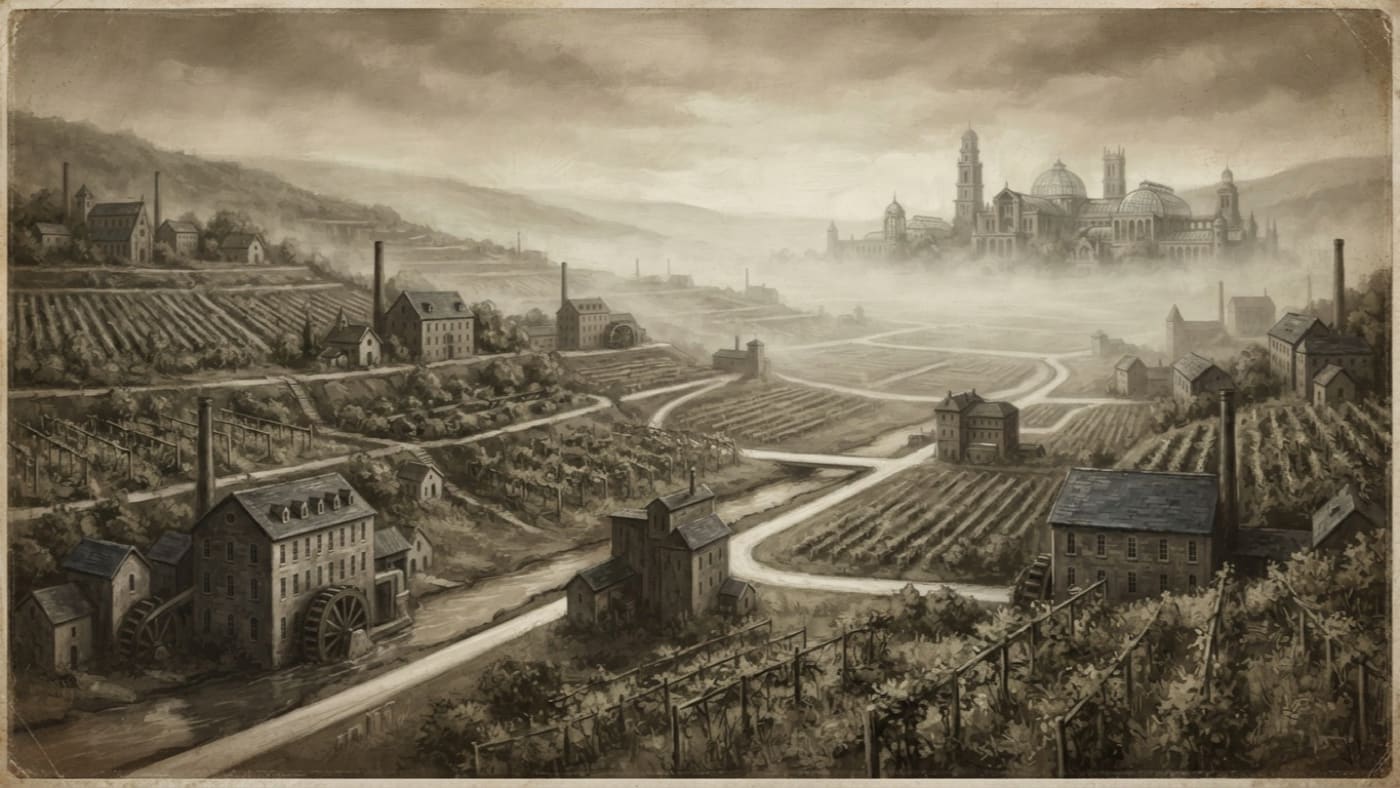
The surviving description begins with the ground. Vineyards climbed the slopes in ordered rows. Orchard terraces stepped down toward the rivers. Drainage canals kept the low fields from souring. Mills stood on the rivers and turned grain into flour, and the flour went in carts along the white court roads, which were pale enough to see from the ridges at dusk. Tax houses waited at the ends of those roads. Garrisons kept the river crossings.
This was a working country. Wine was pressed, grain was ground, and loads were carried, counted and entered in the tax rolls. Phocian clerks kept the rolls with a care the Bureau of Records would admire if it had any admiration left to give, and in their own hands they boasted that they could predict the harvest down to the bushel.
The boast is real. Its arithmetic is not. Later satirists, this office among them, have improved the figure until it covers dowries, funerals and fractional priests. The survey records the boast and ignores the improvements. No Phocian tax rate survives, and neither does a harvest total or a single written law. Whoever claims otherwise is selling something.
What survives is a temper. The administration was proud of foreseeing things. It assumed the year would behave because the ledger told it to. It arranged its obligations as if obligation were a kind of weather it controlled. Seed went in at the hour the rolls had set. Tithes went out when they were due. Roads were kept white because a white road proved the crown was minding the country.
I do not mock the farmers. They pruned and hauled and dug the canals clear, and the Creator does not count sweat as vanity. I mock the court, which took the farmers' labour as evidence of its own foresight, and which mistook a full granary for a theology.
#On the Night of a Thousand Lamps
The court's end is received tradition. It survives as an attributed account, not as a royal chronicle or the testimony of a named witness. The survey gives it in that form and no other.
It happened during the Sundering, and the tradition gives no exact night. The Sundering itself is fixed at 1 November A.S. 45. The feast belongs to that collapse, but no source puts it on that date, and the Bureau will not join two dates just because they share a catastrophe.
The court met under glass chandeliers to celebrate a rational peace. One version of the tradition remembers the toast as the Dawn of Reasoned Peace. The phrase is kept here as the court's own words and is not offered as proof of any treaty. The king, who has no name in this survey, raised his cup. The musicians made ready to play.
Between sip and song, the hall stopped working.
Nobles settled back into their chairs. Servants leaned against the pillars they had been walking past. Guards lowered their halberds slowly, the way men set down a load they have been told they may set down. Nobody gave an order. Nobody carried a dish to the next table. The music never started.
The lamps kept burning. They had been filled for a long feast, so they burned until the oil ran out and then went dark one at a time over a hall where no servant rose to trim a wick.
Royalist fragments record that the Phocian court was put to death by invisible blades during the first collapses in the east.
Corrected. The received account has no wound, no blade and no fallen body. The court did not fall. It reclined. This correction removes the massacre and nothing more. What happened to the sleepers afterward, and whether anything inside them was still awake, this office does not certify.
Every preacher on the frontier wants to know what the sleepers felt. The survey does not know. Some accounts describe relief on their faces. A described face is not testimony. The Bureau records the posture and leaves the soul to the Creator, who has never yet filed it with us.
#On the Valleys After the Court
The court went quiet first. The country followed slowly.
The haze spread from Phocis valley by valley. It went over the vineyards, into the mills, along the drainage canals and under chapel doors. No source gives it a schedule. The Lore Book speaks of decades going uncounted and generations sinking into stillness, and the survey assigns no date to any valley, to the loss of any building, or to the moment any field became part of Syrion's domain. The Bureau of Cartography has tried to date the spread. Its attempts are held in a drawer labelled Fiction, Devotional.
What the sources do give is the order in which work failed, and that order is worse than any date.
The bells went first. Village bells stopped ringing the hours, then stopped ringing for the dead, then stopped altogether. The Bureau of Bells keeps this as the earliest symptom on any front, and in Phocis it came before the harvest failed.
Then the mills. The wheels still turned in the rivers, but at intervals no miller would have kept. The machinery wore itself to powder while sacks of grain lay rotting beside it. The grain had been grown, cut and carried. Every part of the work had been done except the last, and the last never came.
Then the records. Patrols kept returning, and the station logs stopped matching them. Men came back from missions no one remembered ordering, and missions on the books came back with no men. The kingdom that had predicted its harvest to the bushel could no longer agree with itself about who had marched where.
SURVEY ANNOTATION, A.S. 201 — Phocian ledgers recovered from the western margin continue in a regular hand for ██ pages after the last recorded decree. Columns are ruled. Dates are entered. Every entry below the dates is blank.
I will say this plainly once. The haze did not burn Phocis or tear it down. It left the vines standing, the mills turning and the canals open, and took away the reason for any of them. The structures are still recognisable. Their purposes are not.
The lowlands drowned in time. The reed flats around the western approaches were Phocian fields once, and some of the kingdom's stone survives there: small fortlets, half-sunk towers and curtain walls held together with ivy. None of this traces a royal boundary or makes a complete inventory. It proves only that Phocian masons once built where the fog now lies.
#On the Western Fortress
Bastion-Shipka belongs to a later age and a different stubbornness. It rose while the defensive frontier was being consolidated, in the decades when the Sagittal Line became something soldiers could hold, if not yet finish. Its builders worked long before the formal Synod existed. The Synod later took their labour into its doctrine, as the Synod does.
The fortress stands on the western approaches, a long way from the vanished royal seat. Its builders took the old Phocian fortlets out of the marsh and set that kingdom's stone into new walls. They then did what the old court had stopped doing. They rang the bells on time, kept the schedules and maintained the pumps. They checked every log against the patrol that filed it.
Phocis had the cleverer clerks. Shipka keeps the bells ringing. The Bureau of Doctrine has spent a century and a half explaining why the second matters more, and the garrison has spent the same century and a half proving it at the pumps.
None of this means the kingdom has been recovered. The heartland stays east, under the fog, inside the Vales. Shipka holds the western edge. It has not crossed into the old kingdom, and this survey does not claim it has, or that it will.
The Great Deceiver offers rest. Phocis took it at table, with a cup half raised. The garrison at Shipka is still awake.