
#On the Province That Lay Down
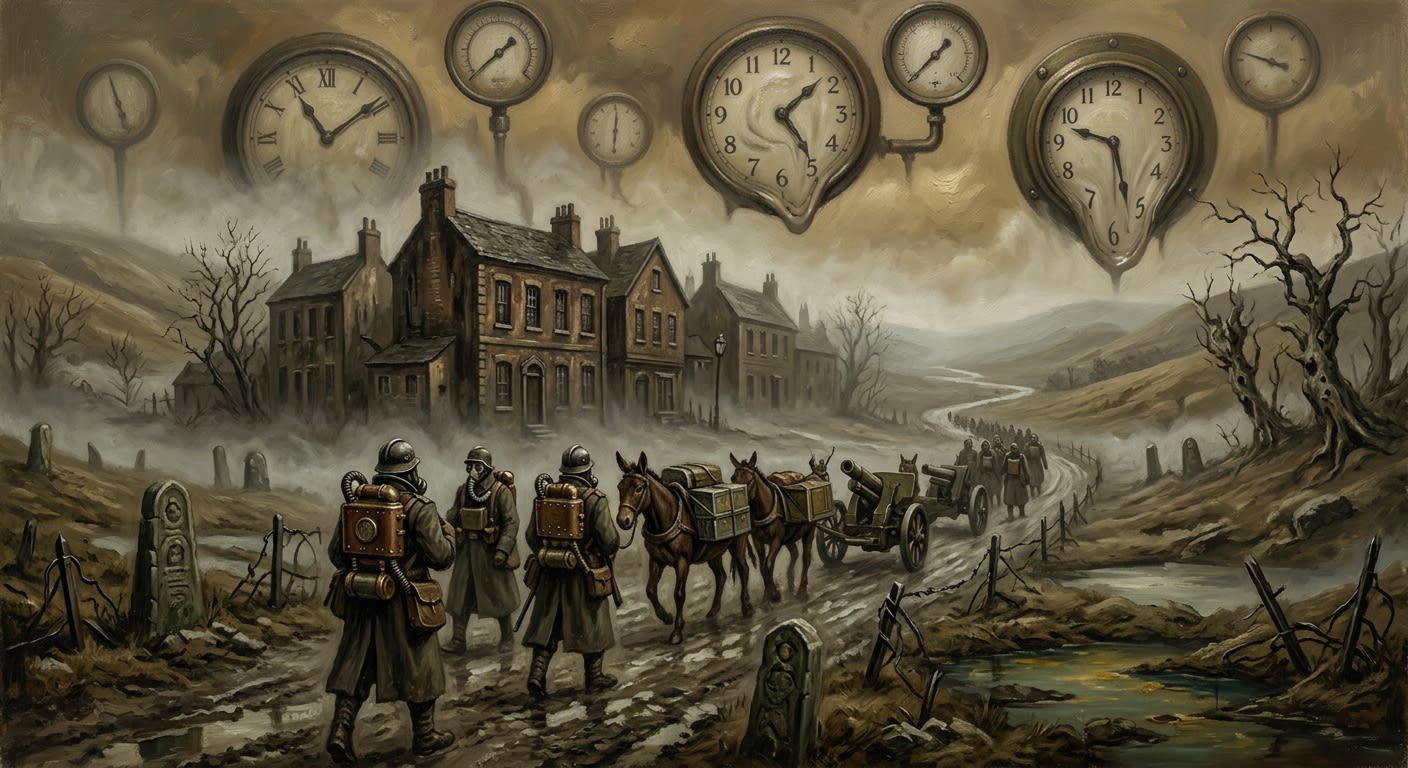
The Vales of Stagnance occupy the eastern approaches beyond Bastion-Shipka, spilling through the Bulgarian highlands, old Serbian valleys, forgotten Hungarian marches, and those border territories whose names survive in the Bureau of Records only because ink is more stubborn than geography. They are Syrion's domain: fog without haste, dusk without conclusion, rest without mercy.
A map will show ridges, rivers, roads, settlements, ruined bridgeheads, and survey marks. The map lies with professional elegance. Roads in the Vales may return to their own beginnings. Rivers leave their beds when no one watches. Valleys lengthen under marching feet. A hill observed at dawn may stand half a mile east by Vespers, or have been there since the Sundering, or be remembered by every survivor as a lake. The Bureau of Cartography, after generations of humiliation, has adopted a useful convention: each new map of the Vales is filed as devotional fiction unless three witnesses die while confirming it.
The old catechisms called the region Syrion's Pillow. This phrase has been withdrawn from approved instruction, chiefly because it made children laugh and commanders underestimate the threat. Pillows do not swallow provinces. Pillows do not return survey parties with fourteen different maps and one identical face drawn in every margin.
#On the Old Kingdom of Shipka
The Vales were not always grey. That sentence has produced more bad sermons than any other in the Shipka chaplaincy, but it remains true, and truth occasionally deserves parole from usefulness.

Before the Sundering, the central basin belonged to Shipka: vineyards on ordered slopes, white court roads, river mills, tax houses, orchard terraces, and a royal bureaucracy so proud of its harvest predictions that one feels, across the centuries, the palm of Providence preparing to slap it. Shipkan scribes claimed they could calculate grain, wine, labour, dowry, tithe, flood, and funeral within an error margin of two bushels and half a priest. They did not calculate Sloth.
On the Night of a Thousand Lamps, the court gathered under glass chandeliers to celebrate a rational peace that had already begun to rot in Europe's mouth. The king lifted his cup. Musicians prepared the first chord. Between sip and song, the hall softened. Nobles settled in their chairs. Servants leaned against pillars. Guards lowered halberds as if receiving permission from a superior officer. The lamps burned until their oil ended. The court slept. The valley followed.
Earlier Royalist fragments record that the Shipkan court was massacred by invisible blades during the first eastern collapses.
Corrected. No blade was necessary. The bodies did not fall. They reclined. Several wore expressions of such relief that the first Synod copyists tried to redact them as demoralising. The redactions failed to improve the facts.
From Shipka, Syrion's haze moved valley by valley: over vineyards, through mills, along drainage canals, under chapel doors, into the ledgers of men still writing last season's accounts. Villages stopped ringing bells. Mills turned once a month. Wheels ground themselves to powder while grain sacks rotted untouched beside them. Patrols returned from missions that, according to station logs, had never been ordered.
Modern Shipka was named in conscious defiance of that first defeat. The Synod nailed a waking fortress to the western edge of a sleeping kingdom and called the gesture doctrine. As gestures go, it was expensive, muddy, and correct.
#On the Sun That Refuses Its Office
The first sensation in the Vales is not terror. Terror takes energy. The first sensation is relief.

The air is cool, soft, and silver. Sound lands close. Orders spoken ten paces away arrive as intimate suggestions. The sun hangs low at the horizon and declines its own setting with the languor of an archon avoiding audit. Shadows do not point correctly. In certain basins they collect under stones like spilled ink; in others they detach from bodies and lag behind until the traveler notices and makes the error worse by staring.
The fog is never uniform. It lies in folds, shelves, ribbons, curtains, pools, stairways, corridors, and pale rooms without walls. It makes architecture out of omission. A patrol may enter a bank of fog and find itself walking along an avenue bordered by orchard trees in bloom, though no orchard has grown there for one hundred and forty years. Another may see a chapel door standing upright in open marsh, hear Mass within, open it, and spend three days listening to a sermon whose first sentence never ends.
Rivers in the Vales refuse discipline. They reverse without flood, braid without tributary, and settle into pools whose surfaces show not the sky but earlier weather. The Bureau of Engineering once marked the River Krim as a dependable western flow. Three years later it flowed north. A year after that it was found running through the abandoned nave of a church not recorded on any map, though parish bells could be heard beneath the water when counted in prime numbers.
The land grows no proper season. Frost may silver a July saddle. Spring flowers may bloom under December ash. Fruit may hang green for decades, then rot in a single afternoon when a bell is struck nearby. The Vales' farms, where still recognizable, keep tools in furrows. Oxen stand before ploughs, muscles intact, eyes filmed, waiting for a command that will never arrive or has already been given in a century no one can reach.
#On Stillness Fields and Drag Corridors
The Vales contain two principal temporal terrains, though the word contain flatters both the terrain and the clerk who tries to file it.
Stillness Fields are zones where time ceases to obey the local majority. A traveler may cross one in an hour and emerge one week older than the world. Another may spend a week inside and rejoin his unit before the coffee cools. There is no pattern the Synod has established, despite admirable waste. The Bureau of Engineering deployed seventeen chronometric instruments into known fields: twelve returned showing different centuries, three returned showing the same second repeated, and two did what sensible instruments do when ordered into the Vales — they declined further correspondence.
Stillness Fields drift. A ridge safe yesterday may be wrong by morning. Soldiers mark suspected fields with bell-stakes, coloured twine, and little prayer flags. The fog ignores these warnings with the serenity of an auditor exempt from consequence.
Drag Corridors (Unregistered) follow roads, riverbeds, old processional ways, and in one documented case the route of a tax collector who died before the Concordat and apparently kept walking from professional spite. Time in a corridor stretches like wax near a reliquary flame. Columns enter at normal pace. Relief columns pursue. Both vanish into the same grey legal dispute.
Years later, men may step out with boots still wet from the morning they entered. Some have aged decades. Some have not aged at all. Some carry newspapers from years no press has printed, letters addressed to children who are now older than their fathers, rations fresh enough to eat and bullets corroded into lace. The Bureau of Medicine calls the survivor condition temporal fragmentation. The soldiers call it being eaten by Tuesdays. The soldiers, as usual, have the superior doctrine.
Drag Corridors feed on expectation. A road believed to be reliable is more dangerous than open marsh, because the mind relaxes into the old obedience: left foot, right foot, milepost, bridge, village, supper. Syrion adores routine. Routine is fatigue wearing a uniform.
#On the Preserved Villages
The Preserved Villages (Unregistered) are the Vales' most perfect obscenity.
A preserved settlement may appear whole: doors latched, wells covered, hearths warm, bread on boards, goats tethered, laundry stiff on lines, a child's toy half-carved beside a knife whose handle remains polished by a hand no longer moving. The first moments tempt relief. Relief is how the Vales open their mouth.
Sometimes the villages are empty. More often they are inhabited by people who have not been permitted the dignity of death. They stand in kitchens, roads, barns, chapels, market squares, bedrooms, and at thresholds. Eyes open. Lungs working. Skin greyed but intact. No rot. No response. Move them, and by next dawn they are found where they stood before, with dust returned to the same shoulder and the same fly crawling the same cheek if flies have bothered that village at all.
FIELD RECOVERY EXTRACT — PRESERVED VILLAGE #7, A.S. 199 Subject cohort: ██ persons standing in market square and adjacent lanes. Estimated arrestation: ████ years. One infant recovered from maternal arms, skin pink, pulse present; mother desiccated, hands locked around child. Infant aged ███ months during extraction and cried in a dialect no living interpreter recognized. Record sealed under VERMILLION.
The inhabitants are not statues. Their pupils contract. Their hands sometimes tighten around tools. Once or twice a year, according to Bureau of Medicine testimony, one may speak a single sentence after the lips have already stopped moving. The sentences are not prophetic. Prophecy would be too useful. They are domestic, banal, vicious by their ordinariness: The soup will catch. Tell Marek to bring the ladder. I meant to wake before rain.
Expeditions are forbidden to remain overnight in a Preserved Village unless ordered by sealed writ and accompanied by Hourglass observers. The rule followed the A.S. 181 survey, whose team photographed Village #7 and departed after six days. The inhabitants had not moved. The photograph, developed in Sofia, showed one villager turned toward the camera.
#On the Throne of Mists
At the center of the Vales — center being a ceremonial word here, not a measurable one — drifts the Throne of Mists.
Every description agrees on clouded glass and fog. All other details revolt. Fourteen survivors of the Cartographic Expedition of A.S. 73 described the Throne as tall, low, floating, buried, near, impossible, broken, new, cold, warm, winged, roofless, crowned with Art Nouveau spires, small enough to hold in a hand, and shaped like the room where each witness first learned shame. The Bureau of Records reconciled the testimony by commissioning a composite drawing and then burning it for excessive agreement.
The Throne rocks between waking and dream. It appears above ridgelines that do not align, behind villages already passed, reflected in water that has no surface, or at the end of roads which the map insists terminate in quarry pits. No scout has reached it. Several have returned convinced they sat in its vestibule for eleven years, waiting for a clerk who never called their name.
The Bureau of Doctrine identifies the Throne as Syrion's seat. The Bureau of War identifies it as a strategic command locus. The Bureau of the Hourglass identifies it as a sustained temporal sink with symbolic properties. The Bureau of Records identifies it as a filing problem. These are the same sentence in four vestments.
No article of doctrine should imply that Syrion requires a throne in any mortal sense. A Sin-General is not a prince waiting in a chamber. He is the chamber, the waiting, and the fatigue that makes the petitioner sit down before being summoned. The Throne of Mists is either his palace, his lure, his wound, or his handwriting written across the country in glass.
#On Armies That Do Not March
The Vales are garrisoned by patience.
Along fog margins stand corrupted humans and lesser demons arrayed in ranks that may have held since the Sundering. Weapons lowered. Faces slack. Armour beaded with dew. Flags hanging without wind. A naive observer might call them inactive. A dead observer would agree, briefly.
The Patient Army advances when the fog advances. A field's width per season. A ridge per decade. A road junction while the defenders argue whether the road junction existed yesterday. No drums mark the movement. No shouted order carries across the line. One morning a sentry looks up and the ranks are nearer. He reports this. His officer files a measurement. The next morning the sentry is seated on the parapet, smiling, and the ranks are nearer still.
Still Ones (Unregistered) haunt the nearer fields. They stand where sight can pin them. Blink, turn, sneeze, pray too long, and they have crossed the distance. They carry no blade. They require no blade. Their tactic is the eyelid.
Grey Heralds enter before an offensive and speak kindly. They tell soldiers they have done enough. They tell mothers the water can wait. They tell clerks the form may be filed tomorrow. The words are poison because they are true in every ordinary context. Syrion wins by placing ordinary mercy in an extraordinary war.
Time-Eaters (Unregistered) move through Drag Corridors and subtract experience. A patrol hears wings, or no wings, or remembers the absence of wings afterward. Then an hour is gone. Then a day. Then a childhood room the soldier has always remembered becomes inaccessible, like an archive shelf bricked over by a careless mason.
The Slumber-Hulks belong to the deeper catalogue: chain-bound masses of arrested time, siege bodies moving with the speed of centuries. Their stillness envelope has been measured at one-seventh normal time in the A.S. 194 Shipka engagement, though the Hourglass drag-gauge flatlined at the centre, suggesting temporal excision rather than deceleration. The chains may predate Syrion. This notation sits under Seventh Seal. It suggests a war before ours, prisoners before ours, and a jailer who may have failed before the Synod learned to stamp paper.
The Vales are also home to smaller mercies that kill: a dry chair in rain, a warm bed in trench mud, a kitchen from childhood, a voice behind a door saying supper is ready. The soldier who enters that room may still be standing outside it when found.
#On Expeditions and Acceptable Losses
The first great expedition into the Vales was the Cartographic Expedition of A.S. 73: three hundred men, instrument wagons, bells, priest-observers, survey chains, and the arrogant optimism of young institutions. Fourteen returned. Their maps contradicted each other in every particular except the face drawn in the margins. The maps were burned. The fourteen survivors were questioned, blessed, quarantined, reassigned, and cited whenever a budget request required drama.
Reconnaissance teams carry irregular bell clocks, prime-count cards, stimulant tins, rope harnesses, and witness knives. The knives are not for demons. They are for comrades who begin to sit down and cannot be moved before the fog thickens. The Bureau of Mercy objects to this practice in memoranda written at safe distances.
The Processional Arsenal once deployed hymn-drones into the Vales, flooding the fog with psalms. The lull lifted. Soldiers shook themselves awake. Every listener aged by months in a single afternoon. Beardless boys grew whiskers; grey arrived in hair still damp with youth. The Synod declared the exchange acceptable. This is the sort of sentence the Ledger records without trembling because vellum has no conscience.
#On the Western Edge and the Present Threat
The Vales press hardest against Shipka, but their margins are not lines. They are symptoms.
Westward seepage first appears as sound loss. Orders fail to carry. Bells arrive dull. Telegraph taps soften. Then clocks disagree. Then men stop noticing the disagreement. By the time a visible fog bank appears, the Vales have already sent their clerk ahead to prepare the paperwork.
Hourglass observers at Shipka classify the marsh corridor as a persistent low-grade stillness field, Syrion-adjacent and sub-threshold. Sub-threshold is a comforting phrase used by men who sleep under roofs. It means the anomaly has not yet earned capital letters. It also means the anomaly has been present long enough to become part of procedure, which is how every catastrophe applies for citizenship.
A.S. 194 brought the Slumber-Hulk to within three miles of Station Two. A.S. 196 brought the Somnolent Communion Cells in the stilt-hamlets. A.S. 199 intensified face-less reports from Preserved Village recoveries and increased fog-margin drift in the Reed Road sector. A.S. 201 finds the garrison capped at four months, the wake-bells revised every seventy-two hours, and the soldiers chewing stimulants with the sacramental desperation of men who know sleep is no longer private.
Rear-echelon pamphlets describe the Vales as "static enemy territory."
Corrected. Static things do not arrive late, early, sideways, and inside the dream of a sentry who has not slept for six days. The pamphlet author has been invited to Shipka for field instruction. He has requested postponement.
The Synod will not reclaim the Vales by charge, treaty, or proclamation. Reclamation requires motion, and the Vales exist to abolish motion first in the body, then in the will, then in the grammar by which a commander forms the sentence advance. Our countermeasures are bells, rotation tables, stimulant rationing, mathematical anchors, rope, hate, and duty repeated until repetition itself becomes defiance.
At the Vales' edge, the fog waits in folds. It does not hurry because hurry belongs to creatures afraid of lateness. Syrion is never late. Time reports to him with lowered eyes.