
#On the Pamphlet and Its Occasion
"Mothers kissed their sons at the mustering gates, as instructed." — from my own entry on the First Continental Levy
The document under examination is a pamphlet of the Bureau of Mercy bearing the title On the Joyful Surrender of Offspring to Providence. I, Valerius Drax, Warden of the Sacred Ledger, survey it in A.S. 201, ninety-one years after the decree it was made to accompany. Its compiler is unnamed. No register I am prepared to cite records the date of its first issue, and I will not invent one to comfort tidier minds.
The decree is better documented. In A.S. 110 / 1820 CE, Kargath of Gluttony devoured Brașov and Maldrake of Wrath set the passes of Thrace burning, and after that the feudal levies of the border principalities no longer existed. Strasbourg answered with the First Continental Levy: one son in ten from the households of the Synod's territories, to be received and drilled by the Bureau of War instead of by the lords who had marched their men into Kargath's mouth. War and Doctrine sealed the decree together. Records furnished the census. Purity furnished the reason nobody argued.
Any clerk could see what was missing. A decree can name a boy, a ledger can enter him, and an Inquisitor can stand at the gate to see that he walks through it. None of them can tell his mother what to do with her face.
Mercy took that office.
#On the Joy Required of Parents
Read the title slowly. The compiler wasted none of it.
Joyful settles the emotion before the cover is opened. Surrender is the word for a garrison handing over its keys, and it admits with startling candour that something is being taken. Offspring is a stud-book word. No mother calls her son her offspring at supper. The pamphlet calls him so because it needs him at a little distance from her before he has even left the yard. And Providence, the Church's term for the Creator's governance of events, receives him. Providence has the great administrative advantage of signing nothing.
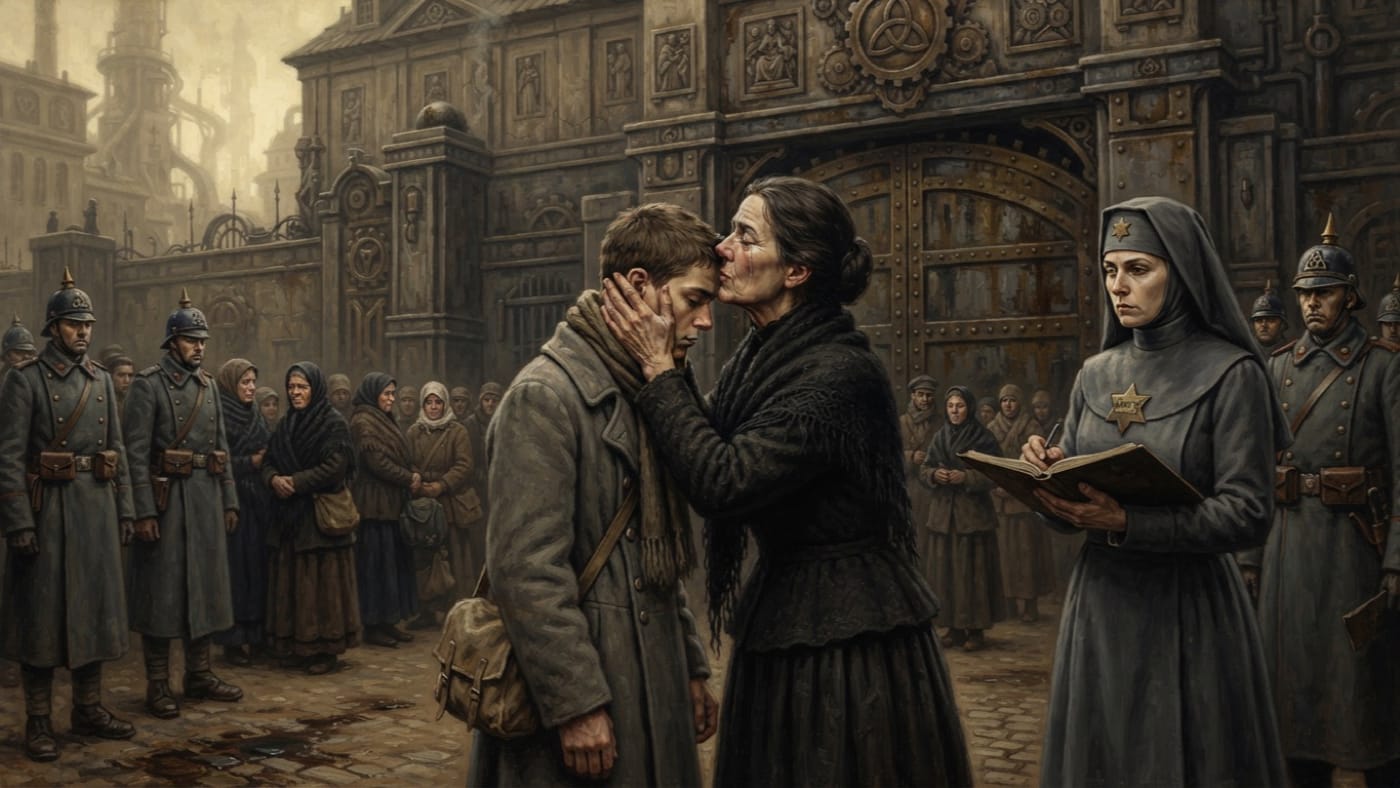
The instruction carried by that title was obeyed. Mothers kissed their sons at the mustering gates. Elsewhere in the Church's household teaching, parents are trained to kiss their children before handing them to the levy officers, and to smile as they watch them join the Continental March. I do not claim the smile is printed in this pamphlet. My claim is that the pamphlet found the smile already rehearsed and put it to use.
Consider the gate itself, since the reader has likely never stood at one. A boy stands in his own coat, the collar his mother turned last winter. A receiving officer of War has a ledger open along his forearm and a pen already dipped. The mother's hands are on the boy's face, because the kiss requires them there, and the officer waits with the patience of a man who has watched this four hundred times since dawn. She kisses him. She smiles, or makes the shape of it. The officer calls the next name before her hands have left the collar. The boy's wrist goes under the stamp of the Triune Knot while she is still standing with her arms half raised, holding air.
That is the entire ceremony. The pamphlet's accomplishment was to persuade her she had performed it of her own will.
#On the Third Chapter
The third chapter is titled "Why Tears Are Proof of Faith, Not Weakness."
I have it framed in my study. I have said so before, in print, and I say it again because guests keep failing to look at it.
What has come down to me is the heading, and it needs no help. A cruder Bureau would have forbidden weeping at the gate. That Bureau would have been disobeyed at every gate on the continent, and it would have filled the Index Damnatus with mothers, which is poor economy when the same households will owe another son next generation. Mercy did something subtler. It allowed the tears, and then it took title to them.
A mother weeps because her son is marching south toward Wrath's country, and she has heard what came back from the Balkans in a bone-case. That is grief. Grief is private, and the private is the one province Strasbourg has always found difficult to garrison. The heading carries the tears across the frontier. Once a tear is proof of faith, it no longer belongs to the woman who shed it. It belongs to the doctrine it proves. She may cry as much as she likes, and every drop is entered to the Church's account.
Mark the second half as well: Not Weakness. The compiler expected the accusation, which means somebody was making it. Perhaps a husband made it, or a neighbour, or a sergeant at the gate, or the mother herself in the small hours. The heading answers all of them and comforts her in the same stroke. You are not failing, it tells her; you are believing. A woman who has been told her sorrow is a sacrament will find it very hard to turn that sorrow into a complaint, because first she would have to argue against her own devotion.
What the chapter says beneath its heading, how long it runs, what exceptions it allows: these I cannot tell you, and I will not make them up to improve a paragraph. The Ledger forgives many sins in its Warden. Forgery is not among them.
#On Mercy's Place Beside War
Keep the competences distinct, because the Bureaus do. War holds the recruiting authority. It receives the boys, stamps them, drills them and spends them. Purity holds the punitive jurisdiction. Under the levy's terms, resistance counts as apostasy, and apostasy ends with a name in the Index and a household struck from the ration rolls.
Mercy holds neither power. Its pamphlet commands no officer and sends no one to the pyre. Mercy's province is the hospital, the orphanage, the asylum and the deathbed, the places where people are weakest and most inclined to talk. Its habit in all of them is to turn care into a record. Its own ward-sisters have a maxim for it: mercy without record is indulgence.
The pamphlet carries that habit out to the gate. It offers consolation, but approved consolation, in words the Bureau has chosen beforehand. A mother who has lost her son to War might lose herself next, to grief spoken in some unsanctioned language. Mercy spares her that by supplying the sanctioned language in advance. The pamphlet never needs to mention the apostasy classification that stands behind the whole proceeding, because every parent at the gate already knew of it. A consolation offered under a writ of apostasy is still a consolation. It is also the only one on offer.
Mercy claims Saint Sabina of Ghent as its founder, the Sabina who tended the wounded at Saint-Malo. I record the claim. I do not suggest she would recognise this pamphlet, and I would thank the reader not to suggest it on my behalf.
In my entry on the First Continental Levy I wrote that families complied, and I praised the sanctity of giving one's own blood willingly.
Families complied. The same decree classified resistance as apostasy. A gift made under that classification may be entered as willing, and I entered it so. The Bureau of Doctrine accepts both entries.
#On the Household's Continuing Obligation
The levy was declared temporary. It has been renewed every generation since. So the gate is no longer an event in the life of a household. It is a fixture of that life, like the font and the grave. A woman who kissed her son at the gate in A.S. 110 lived to see her daughters taught the same kiss. They had learned it by watching her.
Nor does the demand arrive unannounced. At baptism, children are entered in the Book of Promise, and futures are allotted there: one child for the levy, another for the choir, another for the ledger. Mothers rock their infants knowing what has already been sealed in Strasbourg. Measured against that, the farewell at the gate merely closes an account the household has watched since the christening. The Bureau of Mercy did not open the account. It supplied the proper expression for closing it.
Watch the hands at any mustering gate. Both palms go to the boy's face. Then the kiss, the step back, and the smile held until the officer calls the next name.
Then the arms come down. No chapter I know of gives instructions for that part. The mothers manage it unaided.