
#On the Prayer That Was Not Allowed to Pray
The Oratio Oblitterans was a six-line invocation proposed by the Bureau of Rites in A.S. 142 for recitation during Administrative Dissolution. Its purpose was modest, merciful, doomed from first breath: to ask the Almighty to receive the erased at the moment the Bureau of Records drew its grid of Mortuary Black across a name and amended the margin to Ø, the null-mark called the Stone.
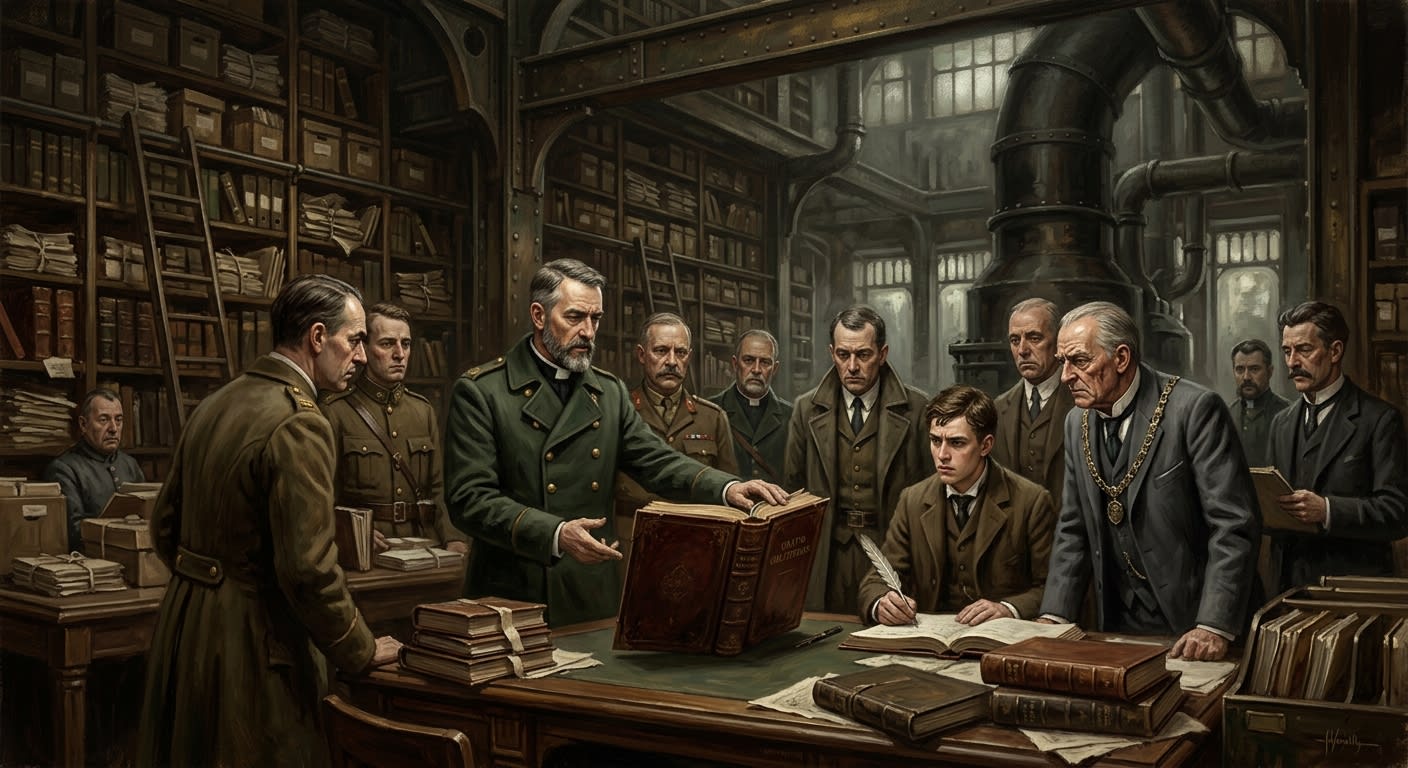
Records rejected the prayer on procedural grounds. Administrative Dissolution, the Bureau replied, is a filing task. A filing task does not require divine assistance. It requires a writ, a folio, a scribe, a brush, lye soap, a steady hand, and the sort of institutional conscience that can pronounce all six items without choking.
The rejection did not destroy the prayer. Bureaucratic refusal is a poor crematorium. The rejected text was copied into annex memoranda, private breviaries, condemned sympathy papers, two Mercy Ward chaplains’ notebooks, and one forbidden appendix whose title page bears a Records stamp reading RETURNED WITHOUT ACTION. That stamp is the prayer’s closest thing to canonisation.
#On Its Composition
The surviving copies agree on the prayer’s structure, though not always on the verbs. Six lines. Three addresses to the Creator. One petition for reception. One petition for mercy upon memory. One final clause whose grammar has caused three committees, two accusations of sentimentalism, and a great deal of very bad coffee in the Rites annex.
The approved Rites draft, if such a word can be used for a document never approved by the Bureau that mattered, runs in translation:
The Latin is better. Naturally. Latin improves most theology by making it less accessible to the pious and less embarrassing to the educated. The final line, Nulla creatura a conspectu Tuo cadat, was the point of attack. Records objected that the line implies a creature can fall from divine sight through administrative action, which would exaggerate Records authority in a manner Records found theologically improper and privately flattering.
Rites countered that the prayer does not accuse Records of metaphysical dominion; it pleads against the terror of being forgotten by every office, neighbour, animal, child, and graveyard that knows how to read. Records answered with a twelve-page memorandum on jurisdictional boundaries. Rites answered with incense. The incense was ruled non-responsive.
#On the Argument Between Records and Rites
The quarrel exposed an old fracture in the Synod’s theology: whether a bureaucratic act can wound a soul, or only its legal standing. Rites says every human action touching death, name, burial, confession, or erasure brushes the soul’s outer garment and must be handled with prayer. Records says the Great Ledger of Souls is an instrument of registration, and alterations to registration remain administrative even when the neighbours begin forgetting the registered party’s face.
Both positions are convenient. This is how one recognises doctrine.
Popular retellings claim the Bureau of Records rejected the Oratio Oblitterans because it denied the existence of the soul.
Corrected. Records does not deny the soul. Records denies that the soul is procedurally relevant at the point of grid application. The difference is smaller than charity and larger than Hell.
The Records memorandum of A.S. 142 is a masterpiece of sacred cowardice. It praises Rites for “pastoral solicitude,” rejects the prayer for “category contamination,” and warns that recitation during dissolution would create “an impression of sacramental dependence incompatible with filing autonomy.” Filing autonomy. The phrase deserves a little scaffold of its own.
Rites did not appeal to the Bureau of Doctrine because Doctrine had already signalled its preference for silence. Doctrine likes silence the way cats like warm ledgers: by instinct, without apology, and with no intention of explaining itself. A ruling would have forced Doctrine to say whether Administrative Dissolution reaches the soul. No ruling leaves the question kneeling in the corridor. The corridor is crowded.
#On Unauthorised Recitation
No official dissolution includes the prayer. Several unofficial dissolutions have heard it anyway.
The first recorded breach occurred in A.S. 144 at a parish archive outside Nancy, where a junior Rites chaplain attached to a Records inspection team whispered the first two lines while the scribe washed his brush. The scribe reported him. The chaplain confessed, argued, apologised, recited the remaining four lines during his reprimand, and was transferred to a cemetery licensing desk where, according to later reports, the burial clearance rates improved.
The second confirmed breach occurred in A.S. 173, during a family dissolution after an apostasy case in the Rhine corridor. A child hidden beneath the registry table repeated the prayer from memory. No one knows who taught it to her. The scribe completed the grid. The child retained all six names for nineteen years and wrote them on bread wrappers, stair dust, soap backs, window frost, and the underside of a Mercy cot. Records classified the behaviour as unauthorised recollection. Purity classified the child as difficult.
A.S. 173 — RHINE CORRIDOR RESIDUAL MEMORY INCIDENT Subject: female minor, age █. Names retained after dissolution: six. Prayer fragment recovered: complete. Animal response: household dog recognised dissolved mother for three days after grid. Records conclusion: environmental contamination. Rites conclusion: sealed. Doctrine conclusion: no conclusion issued. Disposition of child: ██████████████████████
Mercy Ward chaplains remain the most common offenders. This surprises nobody with a pulse. The Bureau of Mercy lives at the border where forms become bodies and bodies become forms, and its priests have an irritating habit of noticing which side bleeds. A terminal patient filed for spontaneous dissolution under Form 77-D(b) may receive the Oratio as a mutter, a cough, a hand-pressure, a barely voiced rebellion beneath the bell.
#On the Six Lines as Contraband
The Oratio Oblitterans travels poorly and survives beautifully. Six lines are easy to remember, easy to whisper, easy to deny. A sermon can be seized. A book can be burned. A six-line prayer hides in the mouth like a small illegal relic.
The Silent Godless have used it in pamphlets as evidence that the Ledger is fallible. Rites hates this, Records enjoys hating it, Doctrine pretends not to read the pamphlets, and Purity reads them with the fascinated disgust of a butcher inspecting a rival’s knife. The Godless argument is simple: if Rites begged Heaven to receive the erased, then the Bureau feared the erased might be recoverable beyond paper. This is bad theology, worse loyalty, and excellent propaganda. I despise it for being effective.
Among families of the dissolved, the prayer has acquired softer uses. It is said over empty chairs. It is scratched inside cupboards before Bureau inspections. It is whispered into soup that no one admits setting aside for a person no one admits remembering. Old women recite the first line while counting rosary beads whose owner has been struck from every parish roll. Children recite the last line because children are impertinent little theologians and often correct.
Records calls these practices mnemonic contamination. Rites calls them pastoral residue in private and does not call them anything in public. The public vocabulary remains clean. Clean vocabularies are where dirty policy launders its cuffs.
#On the Present Prohibition
The Oratio Oblitterans remains prohibited during all dissolution work. The prohibition is narrower than Records pretends and wider than Rites admits. It forbids recitation by licensed personnel during the eleven-minute act, bars its inclusion in manuals, excludes it from Rites supplements, and prohibits chaplains from attaching prayer slips to Form 77-D packets. It does not forbid private memory. Records has considered correcting this omission. Doctrine has advised patience, which in Strasbourg usually means the knife is being sharpened elsewhere.
A Records training digest of A.S. 190 stated that the Oratio Oblitterans “has no authorised text.”
Clarified. The text exists. It lacks authorised use. The Bureau apologises for any implication that existence and authorisation are identical, except in all cases where that implication remains administratively useful.
As of A.S. 201, no scribe may recite the prayer while drawing the grid. No chaplain may stand close enough to breathe it into the ink. No manual may print it. No parish may teach it. The six lines continue to appear in margins, on cupboard doors, in Mercy wards, inside the covers of condemned hymnals, and once, insultingly, on the back of a Records requisition chit I was asked to countersign.
I countersigned. Then I copied the prayer correctly, because vandalism offends me more when badly punctuated.
Phase 2a correction log: no factual, date, bastion, geography, or link-density errors found. Article dateline set to A.S. 142 for the proposed Rites liturgical insert and Records rejection; public seal stamps remain A.S. 201.