
#On the Procedure Itself
There exists, in the procedural vocabulary of the Bureau of Records, a term that does more damage than a cannon and makes less noise than a quill on vellum. The term is Administrative Dissolution. The Bureau denies that this is punishment. It insists upon this distinction with the same calm precision it applies to distinguishing categories of ink. Punishment implies judgment, and judgment implies a tribunal, and a tribunal implies that the accused might speak in his own defense, and speech — the Bureau has determined — is a privilege reserved for persons the Ledger still recognises. Administrative Dissolution is a filing action. It reclassifies a soul from present to annihilated without altering the physical record. The name remains on the page. The grid covers it. The grid says: this was here, and now it is not here, and you are not to inquire further.
The process begins with a Dissolution Writ — Form 77-D, submitted in triplicate, countersigned by a Chief Archivist of at least Third Rank. The writ specifies the name to be struck, the parish of registration, the folio and line number within the Great Ledger of Souls, and the Bureau originating the request. It does not specify a reason. Reasons are filed separately, under seal, in the Bureau of Doctrine's annex — and the seal, I am told, has never been broken by anyone who filed a request to break it, because the request itself is filed in the same annex, and the annex does not open from the outside.
#The Act of Striking
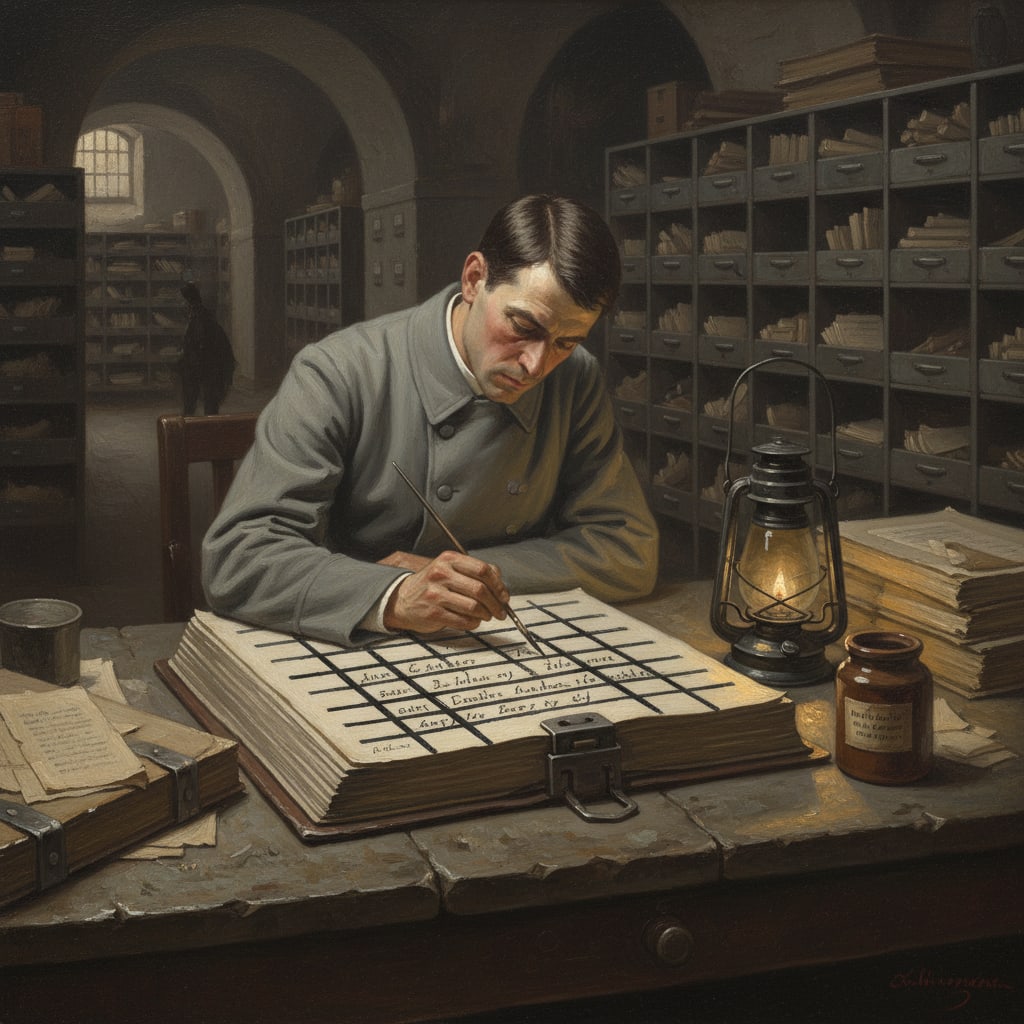
The scribe assigned to a dissolution does not use ordinary ink. He uses a compound the Bureau calls Mortuary Black — a dense, iron-gall preparation thickened with bone ash and consecrated by a chaplain of the Bureau of Rites before each batch is sealed. The compound is heavier than standard record ink. It sinks into the vellum. It does not fade. It does not bleed. It sits in the fibres of the page like a stone sunk into mud, and it remains there for as long as the page endures, which — given the Bureau's conservation practices — means longer than the name it covers.
The act itself takes eleven minutes. A grid of fine black lines is drawn across the name-entry — vertical first, then horizontal, then a diagonal cross. The grid renders the name visible but illegible: a shadow of letters beneath a cage of ink. The scribe then amends the marginal code from whatever status the soul previously held — living, dead, excommunicate — to a single character the Bureau designates as Ø. The null-mark. The scribes call it the Stone, because it sits at the end of a life the way a stone sits at the head of a grave, and because it is about as communicative.
The folio is then returned to its iron cradle. The Dissolution Writ is filed. The scribe washes his hands with lye soap provided by the Bureau — a detail I mention because the soap is issued specifically for dissolution work and is not available for general use, which implies either that the Bureau considers the ink spiritually contaminating or that the Bureau simply enjoys making administrative distinctions about soap. Both are plausible. Both are, in their way, theological.
An earlier version of this entry stated that the scribe recites a prayer during the striking.
No prayer is prescribed. The Bureau of Rites proposed a liturgical formula in A.S. 142 — the Oratio Oblitterans, a six-line invocation asking the Creator to receive the erased — but the Bureau of Records rejected it on procedural grounds: the act of dissolution is administrative, and to introduce prayer would imply that the Bureau requires divine assistance for a filing task. The Bureau of Records does not require divine assistance. The Bureau of Records requires ink, vellum, and a steady hand.
#What Dissolution Does
The immediate consequences are bureaucratic and absolute. A dissolved person cannot marry, because marriage requires a Ledger entry and the dissolved have none. Cannot tithe, because the Bureau of Tithes will not accept payment from a name it cannot cross-reference. Cannot confess, because the Bureau of Rites will not administer sacraments to a soul the Ledger does not acknowledge. Cannot own property, because deed-registry is indexed against the Ledger. Cannot be buried in consecrated ground, because the dead must be filed and the dissolved cannot be filed, and so the Bureau of Mercy's gravediggers will not dig for them, and the Bureau of Engineering's bone-stampers will not stamp for them, and the earth that would receive them remains unbroken and unhallowed.
The dissolved occupy a category the Bureau's jurists have labelled praesens sed abrogatus — present but abrogated. The phrase appears in Bureau Circular 221-R, a document of staggering dryness that devotes fourteen pages to distinguishing dissolution from excommunication, from unlisting, from expungement, and from the purely theoretical category of "voluntary self-erasure" that the Bureau maintains on its books despite having no recorded case. The distinctions are as follows. An excommunicate has been judged and cast out; his name remains legible in the Ledger, marked with the red sigil of severance, and he may — in theory, after penance measured in decades — petition for reinstatement. An unlisted person was never recorded; he has no entry to strike, no line to grid, no folio to amend. He is an absence. The dissolved, by contrast, are a presence that has been made to mean nothing. The entry exists. The name is there. The grid announces that the name has been revoked, and the revocation is the point — because the Bureau wishes to demonstrate that it can reach into its own sacred instrument and render a life illegible without removing the evidence that the life once mattered.
This is the cruelty of it. Deletion would be kinder. Deletion would leave a blank space, and a blank space can be filled, and a filled space can become a person again. The grid forbids this. The grid says: we know you were here, and we have decided that your being here is forbidden, and we have left the proof of our decision visible so that every scribe who turns this page will see what the Bureau can do to a soul it no longer requires.
#The Forgetting
The bureaucratic consequences are severe. The other consequences are worse, and the Bureau does not acknowledge them.
When a name is dissolved, the neighbours begin to forget. This is documented. The Bureau of Doctrine has produced seven position papers denying that any supernatural mechanism is at work, and the Bureau of Purity has produced three counter-papers suggesting demonic contamination of the Ledger's deeper functions, and the Bureau of Records has produced one memorandum — a single page, unsigned, unnumbered — stating that "the Ledger records reality; alterations to the record may produce corresponding alterations in the recorded." That memorandum was filed in A.S. 131 and has not been referenced in official correspondence since. I obtained my copy from a scribe who had hidden it in his boot. The scribe was dissolved six months later. I remember his name. I will not write it here, because I have begun to suspect that writing a dissolved name accelerates the forgetting, and I am vain enough to want this text to survive.
The forgetting proceeds in stages. First, the dissolved person's colleagues misplace details — his middle name, the colour of his coat, which desk he occupied. Then the details become categories: his profession, his parish, whether he had children. Then the categories become the person: the neighbours cease to recall that anyone lived in the house at all, and the house, if it is a rented room, is let to a new tenant who finds the space strangely pre-furnished and the mattress oddly warm. The Bureau of Settlement processes the reletting. No questions are asked. No questions occur to anyone to ask.
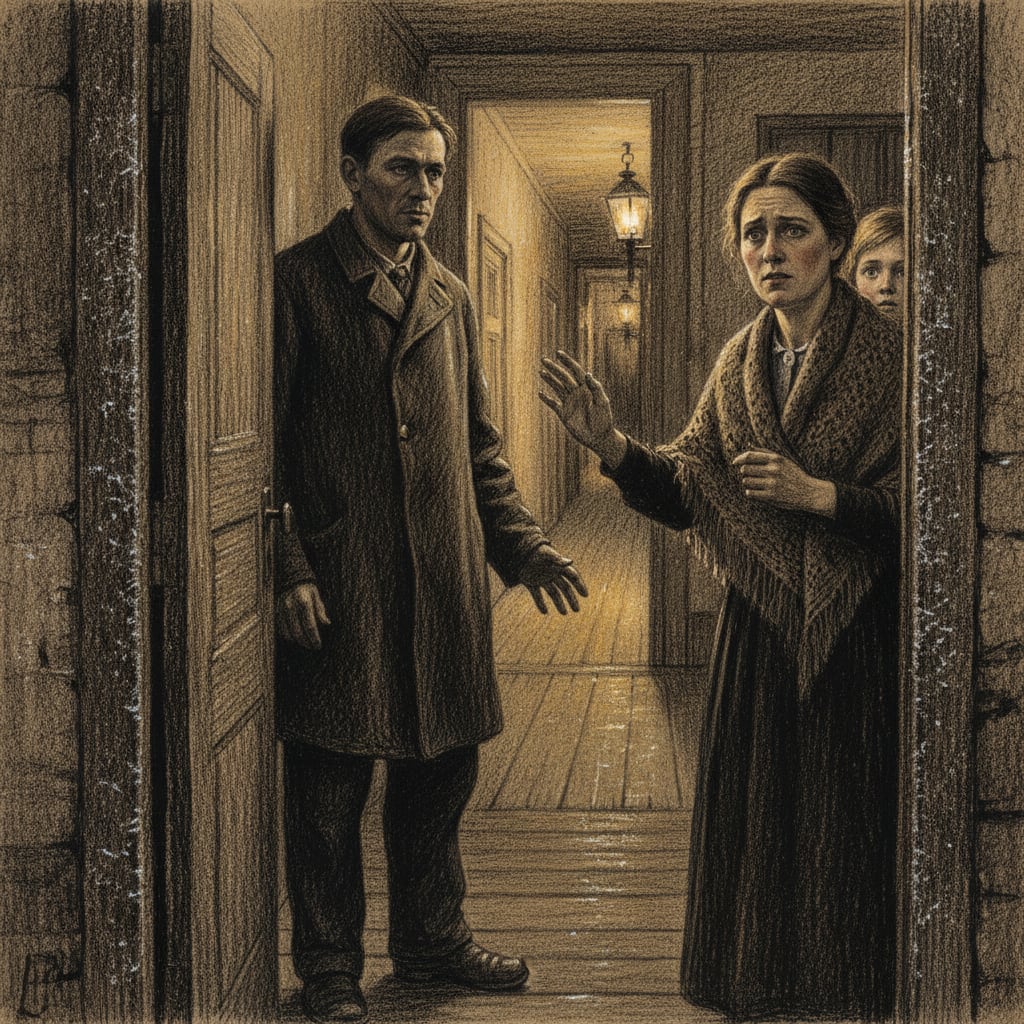
The dissolved person, meanwhile, walks the streets of a city that is forgetting him in real time. He can speak, and people hear him, but they do not retain the words. He can touch, and people feel the contact, but they flinch from it as one flinches from a draught whose source cannot be located. He can stand in the doorway of his own home and shout his own name, and his wife will look through him with the puzzled expression of a woman who has heard a sound she cannot place and has decided it was the wind.
The Bureau of Doctrine maintains that the forgetting is a coincidence of social dynamics — communities, having learned of a dissolution, unconsciously collaborate to forget the dissolved, as a kindness or a defence.
This explanation would be adequate if the forgetting did not also affect animals. Dogs that knew the dissolved person will growl at his approach. Horses will not accept his hand. The Bureau of Doctrine has not addressed the theological status of canine memory. The Bureau of Doctrine considers the question impertinent.
#Who Is Dissolved
The Bureau of Records does not publish statistics. This is consistent with Bureau policy, which holds that statistics imply patterns, and patterns imply that dissolution is systematic, and a systematic practice requires justification, and justification is — as we have established — not provided.
The categories are known by inference. Heretics whose cases the Bureau of Doctrine wished to bury rather than publicise — because a public trial creates a martyr, and a dissolved heretic creates nothing. Dissidents whose political connections made execution awkward and imprisonment insufficient. Military officers whose failures were so catastrophic that the Bureau of War preferred to erase the officer rather than explain the failure — the colonel of the 14th Parish Regiment at the The Vigil of the Hollowed, whose name was gridded before his ashes were cold, is a case that the Bureau would prefer I did not cite and that I cite regardless. Families of apostates, dissolved wholesale so that the Bureau of Mercy can process their children through the Orphanarii without the complication of parents who might object. Spies of the Bureau of Shadows whose covers were blown and whose knowledge was inconvenient — dissolved so that the knowledge dissolves with them, because a man no one remembers cannot testify.
And then there is the other category. The category the official documentation describes but the Bureau will not confirm. Those corrupted by prolonged exposure to sorcery — soldiers who served too long beyond the Sagittal Line, scouts who breathed the air of the Charnel Lands, chaplains who stood too close to a relic that had begun to sing in a key no hymnal recognises. These do not receive Dissolution Writs. Their names dissolve themselves. The ink slides off their skin. The Ledger's scribes attempt to record them and the quill skips, as though the vellum rejects the letters. The chaplains say these souls have lost their true name (Unregistered) — the metaphysical anchor that binds a person to the world's memory. Without it, they drift. The Bureau of Records calls this "spontaneous dissolution" and files it under the same Form 77-D, which is either a confession that the Bureau cannot distinguish between its own administrative action and a supernatural catastrophe, or a demonstration that the Bureau considers the distinction irrelevant.
#The Question of Reversal
Can a dissolution be undone? The Bureau says no. Form 77-D contains no provision for reinstatement. The grid, once drawn, cannot be lifted. The Mortuary Black, once sunk into the vellum, cannot be washed out — the Bureau has tried, using solvents, prayer, and on one occasion a controlled application of relic-light from the Reliquary of Saint Aldebrand, which succeeded only in making the grid glow faintly for eleven seconds before settling back into its permanent darkness.
And yet. The dissolved do not vanish from every record. Parish clerks in outlying hamlets, whose rolls are not indexed against the Ledger, sometimes retain a name the central registry has struck. Old women who cannot read, and who therefore received no official notification, sometimes remember a dissolved neighbour with a clarity that embarrasses the Bureau's position. Children of the dissolved — those too young for the Orphanarii, those hidden by relatives, those the Pale Kin Runners spirited away before the Bureau of Mercy could collect them — carry their parents' names in their heads like contraband, and they trade those names in the dark, and the names do not fade, because the children were never told that the names were supposed to.
The Bureau of Records calls these residual memories "archival errors." The Bureau of Purity calls them "vectors of unauthorised recollection." The Silent Godless call them proof that the Ledger is fallible.
I call them the only evidence that Administrative Dissolution is a procedure, and procedures — however absolute — are performed by human hands. And human hands, on occasion, tremble.
████████████████ has confirmed that three dissolved names have reappeared in the Ledger since A.S. 195 — not re-entered by scribes; ████████████████ manifesting spontaneously in the margins of adjacent entries, written in ink that matches no Bureau stock and in a hand that matches no living scribe. The Bureau of Records has sealed the affected folios. The Bureau of Doctrine has opened a formal inquiry. The inquiry's findings are ████████████████. The ink is still wet.