
Sources checked; writing the article now.
#On the Station of the Orchard Eye
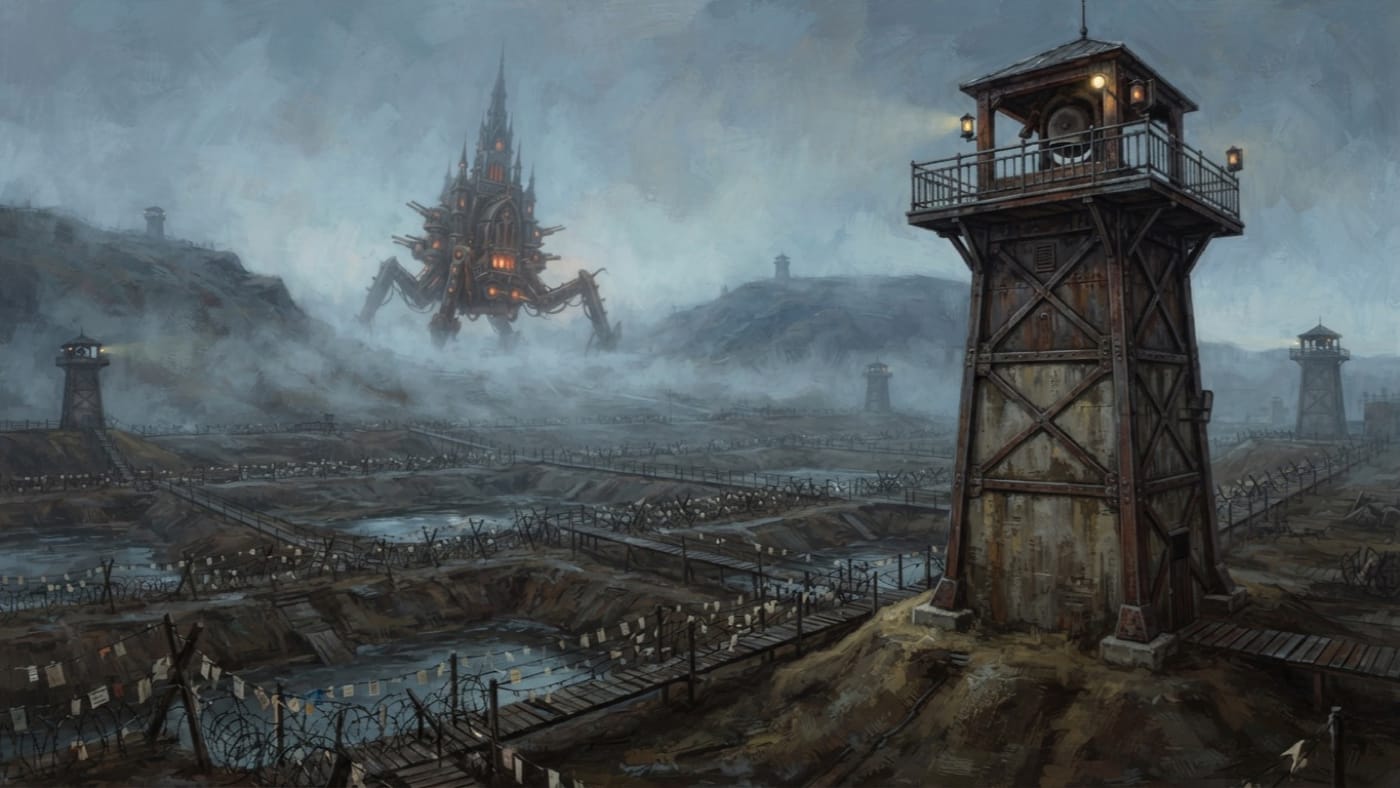
Tower Nine stands in the Wire Orchard of Bastion-Przemyśl, the western Carpathian fortress that holds the mountain passes for the Sagittal Line. The garrison calls it the Orchard Eye. The Bureau of War calls it an overwatch post. Both names are accurate, and only one has ever frightened a recruit.
Its duty is to look, in two directions. Eastward it watches across the ditchworks, the crater ponds and the trench-scrub, toward the broken saddle below the Ebon Heights, where Atheron, Sin-General of Pride, keeps his host on the high ground he so admires. Downward it watches the controlled lanes of the Orchard itself, where the provost decides who walks, who waits and who is hanged. The Eye was raised to see the enemy coming. It also sees the bastion going about its business, and at Przemyśl that business is mostly the inspection of its own people.
The Ledger holds no reliable year for the tower's raising. It names no architect, no patron and no consecration. I have looked. Engineering has its suspicions, and they do not count as evidence. The tower predates the morning that made it famous. The Ledger goes no further than that, and I will not go further on its behalf.
What the Ledger does record is a dawn in the autumn of A.S. 195, when a corporal on the Eye's platform saw something tall in the fog and said so.
#On the Watch Above the Wire
The men who keep the post are called Nine-Eyes in the bastion's slang. The name belongs to the tower, not to a headcount.
The surviving descriptions of the post are short. Cold wind, oil lamps, sniper lanes. Anyone who has stood a winter watch on the eastern salient will find the list complete. Przemyśl rations its light, and after curfew only the towers and the stamp halls glow. That makes the Orchard Eye one of the few lamps a frightened man in the lanes can see, and one of the few places from which a sniper can see him.
Below the platform runs the triple cordon of wire, flood-ditch and patrol trench. Catwalks cross the wire lanes, and the corridors hum with current. Paper hangs from the barbs: ration tags, travel chits and confession receipts, every one of them a statement of who is permitted where and for how many life-days. From above, the Orchard looks like a filing cabinet that has been left out in the rain. The bastion's defence doctrine is built on crossfire lanes between its towers. Its civil order is built on lanes of permitted movement. The two plans share the same ground, the same wire and the same watchers, and the garrison does not trouble to tell them apart.
Whether the Nine-Eyes ever logged a particular traveller, the files do not say, and I will not invent a reporting chain to flatter the institution. One more fact is known. Gallows Market will sell almost anything, including tags, seals, bounties and the occasional relative. Tower patrol schedules are among the few things it will not sell. Even the black market understands which papers keep it alive.
#On the Dawn Alarm
The autumn campaign of A.S. 195 had been ordinary in the Przemyśl sense, meaning wet, hungry and administratively hostile. At dawn the fog lay thick in the eastern saddle. Corporal Tamen Voss had the sentry.
He reported a dark line above the ridge, "like a chapel steeple walking behind a curtain."
His superior, whom the file does not name, rebuked him for poetic excess. Look at the order of events. The officer corrected the corporal's prose before he checked the corporal's claim. That is the Line's sacred order of operations, and I would not change a syllable of it. Having enforced the plain style, the officer put his eye to the observation glass. Then he rang the alarm bell so hard that the clapper cracked.
The cracked clapper is the most honest document of the morning. A report can be amended, and a glass can be accused of fogging. A clapper struck hard enough to split was swung by a man who has stopped worrying about requisition forms, and no reviewing officer can tidy that into calm.
At that first confirmed sighting the Spire-Crusher measured three hundred and forty feet. The figure belongs to the enemy. Engineering recorded no height for the Eye, and I will not lend it one. The thing stood some seven miles east of the outer Orchard. For the rest of that day it would grow.
The word confirmed deserves its due. The Bureau of War has since maintained that earlier Carpathian reports of "walking towers" describe fog, grief and faulty glass. The Bureau may hold that position. The Orchard Eye's claim is the narrower one: on that dawn, from that platform, a sentry was believed. That is rarer than a sighting.
Of Voss himself the Ledger records nothing further. It gives no commendation, no transfer, no burial and no pension. He made his report and left the record.
#On the Nine-Hour Rubric
What followed is set down at length under the Spire-Crusher, and I will not copy it here to inflate this entry's page count. Tower Nine's part in the battle is short and documented.
Battery Saint Ulrich opened the barrage. By the second hour, every heavy gun on the eastern salient had joined. The after-action account lists the Orchard Eye among the firing positions, beside Platform Casimir, Ulrich and Martyrs' Teeth, all firing in overlapping sequence. The record gives no calibre for the Eye, no ammunition allotment, no named gun captain and no decisive shell. The post fired with the others, which is all a post is asked to do and more than some managed.
The tower that the Eye had first reported grew to nine hundred feet by the time it reached the outer wire. Major Cestian Rell ordered every battery onto the narrowing of the forward pier. Sister-Adjunct Hilde Marek worked out the angle on a requisition form, because the range slates had cracked. In this battle everything cracked except the garrison, and it came closer than anyone likes to say. At the ninth hour the pier broke.
By every principle of masonry a nine-hundred-foot tower falling across the ditch should have flattened the Orchard Ring, Taghouse Row and Tower Nine itself. Instead it folded down into forty feet of rubble. The Eye survived. The files do not say that it came through untouched, and anyone who claims so has not read them.
For three days afterward the garrison looked up at empty air. Sky-fixation took the whole salient, and I decline to diagnose each watcher separately. The bastion had already passed through the Glass Rain of A.S. 194 a year earlier, which is a different file and a different misery. The Rubric gave Przemyśl a new habit of checking the clouds before dawn.
#On the Missing Patrol Book
Tower Nine kept a patrol logbook, and that logbook is missing.
That is the whole of the reliable record. The files give no date of loss, no culprit and no destination, and they give no word on what the pages said. To a bastion that measures a man's existence in stamped life-days, a missing book of patrol entries is worse than a missing gun. A gun can be replaced. A book of who walked where, and when, and under whose eye, is the kind of ledger that turns a provost's discretion into a matter for the tribunal.
The Wire Orchard also keeps a sealed archive room behind Tower Nine. Gossip has already set the two facts side by side and called it a solution. Neither the Bureau of Records nor this office accepts adjacency as proof. The book is missing and the room is sealed, and for now those are two separate grievances.
TOWER NINE — see also Palatine Switchyard of Lorn: sealed clock foundation; Silent Derailment.
Struck. Lorn's Switch-Tower Nine is a railway routing cage on the Heartlands fringe. It has its own foundation, its own derailment and its own inquiry, and none of them belongs on this hill. The Orchard Eye is a Carpathian overwatch post at Przemyśl. Two structures share a numeral. They share nothing else that this office will certify, and the index has been corrected.
#On the Continuing Watch
After the Rubric the bastion changed how its observers work. The Przemyśl Spire Alert Card, in its A.S. 201 revision, governs observation crews during any Spire alert. On that card the Eye's old craft of looking hard and reporting honestly has become a regulated hazard.
Watchers rotate every ninety seconds. Measurements go up the line by number only. "Five hundred feet" is a report. "Majestic" is an offence. Between reports the observer keeps his eyes down. Exposed brass is dulled, because Atheron's works enjoy a reflection. Below, the bells keep the Humility Sequence. Doctrine approves of all of it, and the gunners who lived through the Rubric approve with more feeling.
Corporal Voss would fail the card on two counts: his duty ran longer than ninety seconds, and his report contained a simile. His report also gave the bastion nine hours' warning of a nine-hundred-foot enemy. The Bureau has weighed these facts and kept the card as written.
I find the post in good order and its record incomplete. Both findings stand.