
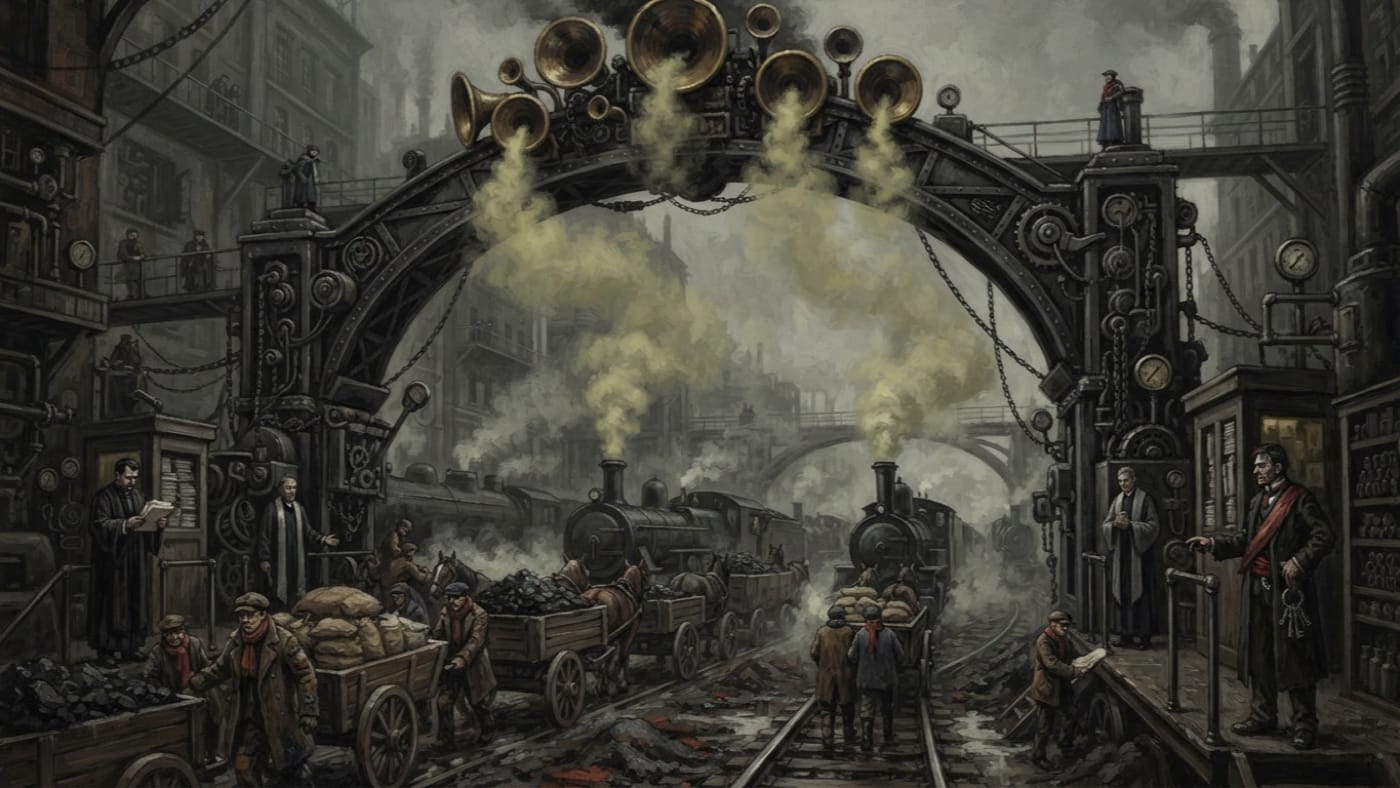
#On the Main Freight Ingress
The Palatine Gate is the mouth through which Lorn eats. Coal comes in under it, along with grain, wax and ink stock, spare iron, labor consignments, and the secured consignments the war requires and the ledgers describe in small type. A city that starves within seventy-two hours of a closed corridor cannot afford to be sentimental about its doors. Lorn is sentimental about this one anyway, in the way a debtor feels about a moneylender: with devotion, terror, and exact arithmetic.
It is an iron arch with bell horns. Every other fact grows out of those two.
Visitors confuse it with the city's other chokepoints, and visitors should stay home. The Needle is the single-track inspection pinch that keeps the rhythm of the whole yard. The Tri-Span Bridge carries the rails over the river and has its own reputation, which I decline to inherit on this page. The Palatine Gate is the main freight ingress, where cargo first becomes Lorn's property, Lorn's liability, and, before the day ends, someone in Lorn's opportunity.
At dawn the bell fog lies over the approach, steam and coal haze thick enough to muffle a sermon. The arch rises out of it riveted and soot-black. Its iron is gritted with the same coal it admits. Brake smoke drifts back along the waiting consists. When the horns sound, the fog takes the note, chews it, and returns it softened, so that a teamster a hundred paces back can never quite swear whether he was called forward or warned off. Slag berms and soot brick lie beyond, and beyond them the yard proper, which rings the central rail sea under catwalks of office.
Wealth in Lorn means a priority window, a quiet inspector, clean lungs, and a name that clears Records. The gate decides the first two before a wagon has been unloaded.
#On Permission to Enter
Everything in Lorn moves on stamped permission. The city is licensed in the way a cathedral is consecrated, entirely and with fees. At the gate this creed comes down to three trades and three kinds of hand.
The manifest clerk of the Bureau of Records checks papers. You know them by their ink cuffs, which are stained to the wrist and worn like a minor order of priesthood. The bell-cantor checks procedure. The ash stole and the brass throat tag mark a servant of the Bureau of Bells, whose task is to hear that what has been done was done in the sanctioned measure. The yard provost searches cargo, wearing a red sash and carrying a ring of keys heavy enough to serve as a weapon, and it is sometimes used as one. Papers, measure, and cargo: a consignment must satisfy all three. Satisfying two counts as failure, with paperwork.
Some things are refused outright. Unstamped relics, unsealed payroll crates, blank manifests, bell instruments, silent ink, and bodies lacking transit death receipts may not move through Lorn at all. The gate does not haggle over these, at least not on any schedule I can be shown.
Above the counters sits Palatine Yard Command, which is three authorities in one coat. Yard Palatine Odrin Kessel holds track priority and wants speed, because a stalled corridor means soldiers going hungry at the front, and hungry soldiers produce inquiries. Records Prefect Halden Wry holds manifests and documentary identity and wants inspection, because every inspection makes another page, and Wry has never met a page he would not keep. Bell Marshal Sister-Calder holds procedure certification and wants audible compliance, because an accident that has been properly sung belongs to whoever sang it wrong.
These three demands meet at the arch. Kessel's clock runs against Wry's cabinet. Sister-Calder's measure runs against both. The freight waits while they disagree.
Waiting has a price. Perishables sour. Labor consignments stand in the fog, and since labor consignments are men, they cough. Each hour a wagon stands before the horns is an hour charged in route-tolls, bell-fees, and manifest stamp fees, plus the labor-hours Lorn bills "for safety" with a straight face. A fair queue is an expensive queue, and any expensive queue soon develops a market.
#On the Guard Rotation
The Palatine Gate's corruption is not hidden. It is built into the guard rotation, the way a reliquary is built around a bone. Local usage calls it a bribe ladder, and the phrase is exact. A ladder has rungs, the rungs are fixed, and anyone who knows where they are can climb in the dark.
Here is the mechanism, so far as a gentleman may describe it without becoming a witness. A guard rotation is a schedule. A schedule can be read in advance. Once the reader knows which hands will be on the counters at which bell, the gate stops being a hazard and becomes a price list. The delay that fair procedure imposes on everyone becomes something a few can buy their way out of. The guard who would have held a wagon for an hour can also release it in a minute. He is paid for the hour he did not take.
The currencies are Lorn's usual ones: schedule favors, clean paper, candle wax, and union tokens. Shares, rates, shift lengths, and the final pockets are not set down in any record I was permitted to hold, and I will not invent a cartel to please the gallery. I can report the yard's own proverb. In Lorn everything is for sale except a clean bell waiver and a blank master-manifest. The gate sells the rest by the rung.
Stampedes are the gate's recorded hazard. I give no tally because none has been entered for my inspection, and I do not decorate a public page with corpses I have not been shown. The arithmetic is plain enough without them. Freight, riders, carts, and labor all press toward a single arch through fog that swallows sound. They are held back by men whose price changes at the bell, and they are ruled by horns whose meaning reaches the back of the crowd late and blurred. If a held queue is released at once, or a rumor goes round that the next rung costs more, the crowd stops being a queue and becomes a weight. Iron does not move for it, so flesh does.
The ledgers of Palatine Yard Command record that motion conducted under proper procedure at Lorn is "perfectly safe by hymn."
Corrected. Procedure is the Creator's gift to Order, and the hymn is sung with real devotion. Perfection has been struck out. Accidents happen at Lorn, and blame is assigned afterward. The hymn records the order of events.
#On What the Gate Cannot Account For
The arch commands the surface. Lorn does a great deal of its living elsewhere.
The Switchmen's Union, whom the yard calls the Thrown Hand, controls the skilled labor that turns admission into motion. A wagon cleared at the gate still needs a thrown switch, a set rail, and a crew willing to go. The Thrown Hand's weapon is the slowdown. If switchmen work one beat slower in the yard, the arch fills from behind, the fog fills with curses, and every guard on the ladder finds his rung suddenly worth more. Its long quarrel with the Bell Marshal's Cantor Corps concerns safety, fees, and blame, and all three are settled after the event by whoever controls the minutes.
The Hush Tunnel Runners work beneath the schedule entirely. Their under-yard routes and lamp signals carry contraband and people where no clerk's cuff has been inked. I have seen no evidence placing a tunnel mouth under the Palatine Gate, and I enter none here. Their existence is enough. Any honest account of the gate has to admit that the most watched entrance in Lorn is one entrance among several, and the only one with a horn.
Then there is the Payroll Spur. In A.S. 199 three sealed relic-payroll crates consigned to Bastion-Przemyśl arrived empty. Their seals were intact, their stamps genuine, and their cantor measure correct. No public finding sends those crates through this arch, and I invent none. But the Palatine Gate's whole creed is that seal, stamp, and measure together prove a crate. Every rung of the ladder and every counter beneath the horns assumes those three witnesses can be believed. In A.S. 199 all three gave correct testimony about crates that were empty.
#On the Arrival Still Pending
Under emergency commission issued in A.S. 201, Inquisitor-Regent Veyl Hark holds jurisdiction over the Payroll Spur, the Tower Nine bell codes, and the matter of the Hymn-Phase Slip. That is the yard's name for the occasions when a switch thrown clean sets wrong, an echo repeats a measure late, manifests smear as if wet, and crews swear the yard went briefly unfamiliar underneath them. She remains in Strasbourg reviewing the evidence. She has not reached Lorn.
Her title is an office of emergency and confers no permanent rank. Within her assigned jurisdiction she may audit, arrest, supersede, seal, reopen, requisition, depose, and require interim obedience from any officer below Archon seal. Lorn understands at once what this means for the gate. A stamp is a permission. A rung on the ladder is a permission. Kessel's priority, Wry's paper, and Sister-Calder's certificate are permissions too, and a commission of that kind can override them all with one signature.
The yard expects her to arrive at the Palatine Gate, and it is preparing accordingly. The fog will be thinned if fog can be bribed. The horns will be tuned. The clerks will put on clean cuffs, the cantors will polish their throat tags until the brass gives back their faces, and the provosts will carry fewer keys so as to look like men who have never needed so many. Somewhere in the Manifest Basilica a copy of the guard rotation is being reconsidered at length.
None of this has happened yet. The horns sound for coal at dawn, the fog takes the note, the rotation turns at its bell, and freight waits at the old rates. The Bureau of War still requires its corridor and Lorn still eats through this arch. Whoever holds the next rung still has no idea what it will be worth once she arrives.