
#On the Hand That Throws
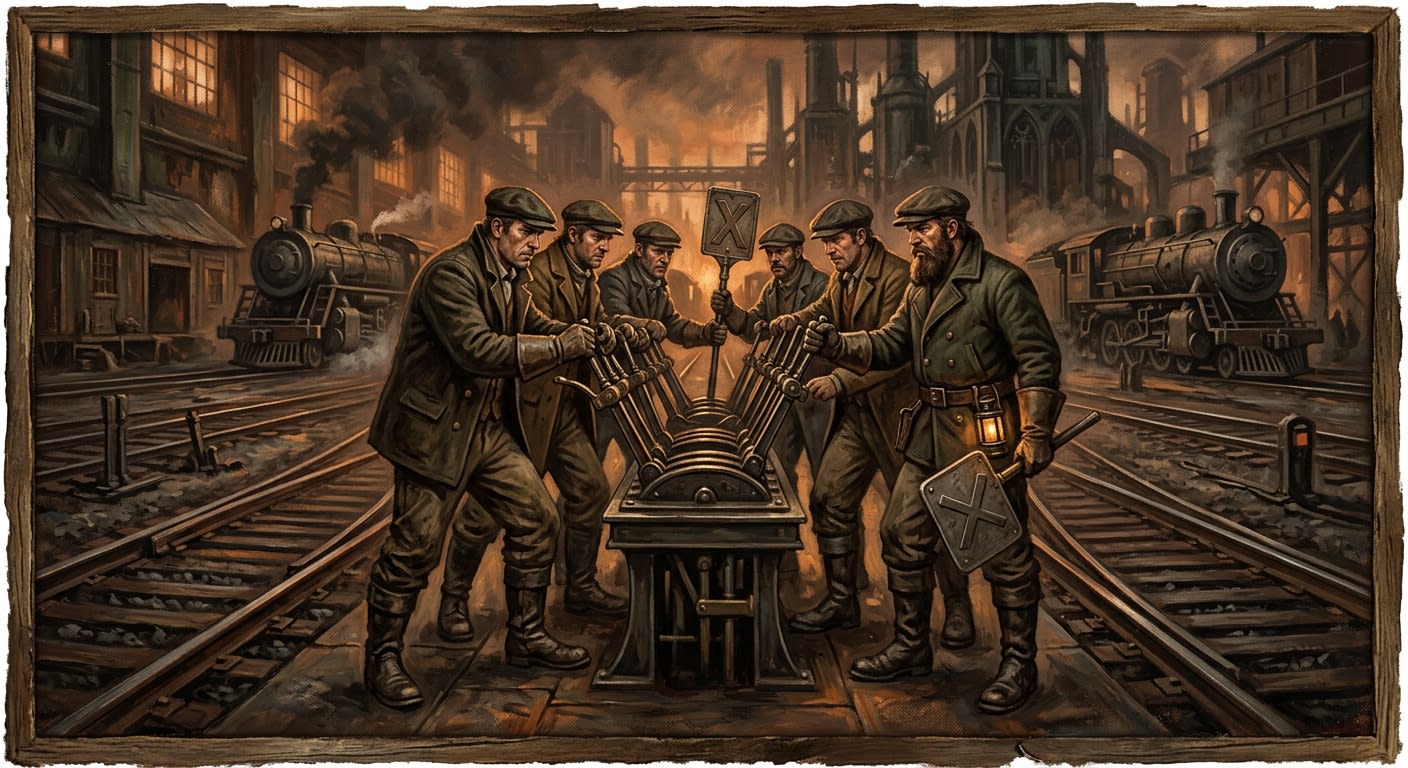
The Switchmen’s Union of Lorn, called the Thrown Hand, is a labour brotherhood, a safety society, a protection racket with devotional manners, and the only body in the Palatine Yard that can stop twelve rail lines without touching a bell. Its public face is labour safety. Its private appetite is bargaining power over the city’s throat. Its sign is a chalk band around the wrist, renewed at shift start and rubbed away before provost search. Among the Cinderrow workers it is spoken with the same wary warmth reserved for the Hush Tunnel Runners: gratitude first, suspicion immediately after.
The name is plain craft speech. A switchman throws points. His hand sends grain to Przemyśl, powder to Constantinople, conscripts to their appointed mud, relic-payroll to guarded sidings, and occasionally a train of inspectors into a loop long enough for them to reconsider zeal. It feeds the Sagittal Line by way of the Queue Road, the Rope-Ferry Chain, and every feeder ledger that pretends Lorn is merely one hub among many. Every switch requires a body near iron. Every body near iron may be crushed, scalded, blamed, erased, or promoted into death by the nearest manifest clerk. The Union began when the bodies noticed that crushed men were easier to replace than experienced hands.
No law admits that necessity grants power. Lorn admits it every morning when the first dispatch hymn rises and two hundred men in coal-stiff coats place palms on switch levers before the Cantor Corps opens its pious mouth.
#On Origin After the Silent Derailment
The Thrown Hand traces its useful birth to A.S. 112, after the Silent Derailment killed forty-one men on a siding the manifests denied existed. The official lesson belonged to the Bureau of Bells: no switch, signal, or departure without voiced hymnal measure. The unofficial lesson belonged to the men who had been standing beside the levers: if every action would henceforth require a hymn, every accident would henceforth require a scapegoat, and scapegoats should negotiate collectively.
By A.S. 113 the yard crews had formed burial funds. By A.S. 115 those funds had become oath funds. By A.S. 119 the oath funds had acquired enforcers, route books, widow stipends, and a quiet rule: no man throws alone after midnight. Lorn’s first Records Prefect (Unregistered) called this “fraternal prudence.” His successor called it “incipient labour sedition.” Both statements were true. The second man had better hearing.
The Union’s oldest article is recited without writing: the hand that throws may refuse if the hymn is false. This sentence has saved trains, delayed armies, enriched smugglers, and driven three Bell Marshals into memorable profanity. The Bureau of Records has never located the original charter because the original charter is carried in the wrists of the workers and cannot be conveniently burned.
Bureau of Bells digest A.S. 148 described the Thrown Hand as “an auxiliary workforce formed under Cantor supervision.”
Corrected. The Union predates the present Cantor Corps structure, has never accepted Cantor supervision, and considers the phrase “auxiliary workforce” a fighting insult. The digest clerk survived because he was in Strasbourg.
#On Members, Oaths, and Solidarity Fines
A switchman is trained by bruising. Apprentices begin as rod-runners at fourteen, carrying oil, chalk, cotter pins, and death receipts through the Palatine Yard. They learn the difference between a clean point and a lying point by touch; between frost-lock and sabotage by smell; between a cantor’s correct measure and a cantor’s frightened measure by the tightening of older men’s shoulders. By sixteen, a good apprentice can hear a misaligned tongue of rail beneath three bells and a sermon-horn. By eighteen, he has buried someone whose mistake was entered under “unsung procedure.”
The Union oath is sworn with the hand laid on a cold switch rod, palm bare, while three witnesses hold lanterns low enough that the oath-taker can see old blood in the grease. The words are modest by Synod standards, which is to say they contain fewer threats than a baptismal receipt. A member promises to throw true, warn true, bury true, and pay the widow before the clerk.
The Thrown Hand funds itself through dues, route tokens, oath-notes, fines levied on members who break stoppages, and penalties assessed against foremen who accept Cantor blame too eagerly. Solidarity fines are brutal. A man who throws during a declared caution interval pays in coin first, ration second, reputation third. A second offence costs tools. A third costs the wrist-band. Without the wrist-band, he may still work. He works alone. In Lorn that is a death sentence with wages.
#On the Cantor Corps and Holy Contempt
The Union despises the Cantor Corps with a purity that deserves liturgical setting. Bell Marshal Sister-Calder (Unregistered)’s one hundred and twelve certified cantors claim that sound is truth, silence is error, and error kills. The switchmen reply that a sung measure has never dragged a body clear of a wheel. Cantors stand on platforms, throats tagged in brass, and render route codes in authorized harmony. Switchmen stand in coal fog beside points that can take fingers faster than a confessor takes names.
Both parties need each other. This is why the hatred has matured into doctrine. A switch cannot be thrown without voiced hymnal count. A voiced hymnal count accomplishes nothing if no hand throws. A cantor who misses a measure may be disciplined by the Bureau; a switchman who obeys a missed measure may be dead before discipline arrives. The Union’s counter-cant says: we do not object to song; we object to being killed by music performed at a distance.
Sister-Calder keeps her Missed Measures. The Union keeps the Crushed Book: names of workers killed after correct hymns, correct manifests, correct orders, correct lies. The book is bound in black oilcloth and updated in Cinderrow after midnight. No complete copy exists. This frustrates Records and proves the book’s intelligence.
Cinderrow testimony, A.S. 200: after Switchman Roel Tamm (Unregistered) lost both legs under a munitions bogie routed by certified dispatch hymn, the Union chalked Sister-Calder’s platform with forty-one handprints and one word: AGAIN. By dawn the chalk was gone. By Sext the platform sang half a measure late. By Vespers three cantors had requested transfer and one signal tower reported a handprint inside locked glass.
#On Slowdowns, Sabotage Threats, and the Lawful Use of Delay
The Thrown Hand’s weapon is delay. Riot gives the Yard Tribunal a clean docket and the provosts a happy morning. The Union uses caution intervals, double-checks, grease inspections, frost-lock declarations in mild weather, tool inventories, witness disputes, widow-fund stoppages, and the ancient worker’s sacrament of standing in a circle around a problem until management discovers theology.
A citywide slowdown planned for A.S. 201 sits beneath every current conversation in Lorn like a loaded brake. Its declared cause is cantor overreach: more shaming, more certification fees, more attempts to charge switchmen for accidents caused by sung procedure. Its practical cause is money. Payroll cuts, ration fines, and widows’ arrears have sharpened righteous principle into something with teeth. Its secret cause is fear. The Payroll Spur losses, Tower Nine lamp sequences, and the coming arrival of Inquisitor-Regent Veyl Hark from Strasbourg have convinced the workers that a purge is being tuned.
The Union has sabotage capacity. This is not accusation; it is physics. Men who know every rod, cotter, bolt, lamp, siding, and inspection blind spot can make a yard fail politely. A missing pin delays. A misplaced wedge reroutes. A lamp shutter closed one blink too long changes a train’s fate. The Thrown Hand threatens sabotage rarely, since a threat too often spoken becomes evidence, and evidence attracts Purity like flies to jam.
Yard Palatine notices describe current Union action as “irrational obstruction of lawful throughput.”
Corrected for accuracy. The obstruction is rational, lawful when convenient, and directed at throughput because throughput is the one idol Lorn’s rulers actually fear.
#On the Hush Beneath the Yard
The Hush Tunnel Runners are not the Union’s arm. This official denial is useful, morally fragrant, and incomplete. The Union uses the Hush Tunnels, pays route fees, hides injured men below after accidents the Tribunal would prefer to classify as misconduct, and buys lamp-talk when tower codes begin blinking in sequences no Signal Manual (Unregistered) admits. The Runners sell movement outside the schedule. The Union sells pressure within it. These trades meet below the Cinderrow canteens, where cabbage steam hides footfalls and every bargain smells of salt.
The relationship is tense. Runners consider the Union loud, sentimental, and dangerously attached to above-ground legality. Union men consider Runners faithless, overpaid, and useful after curfew. Both judgments have merit. During the Payroll Spur scandal, Union crews swear they did not move the empty crates. Runners swear they merely followed routes older than the current marks. Kessel (Unregistered) produces audits. Wry produces corrected manifests. Sister-Calder produces tonal records. The crates produce absence.
#On the Present Hand
The Thrown Hand now stands where every useful faction in Lorn eventually stands: needed, hated, compromised, brave in portions, corrupt in others, and too deeply threaded through the machine to remove without taking the machine apart. Yard Palatine Odrin Kessel (Unregistered) needs the Union to keep seven hundred daily departures plausible. Prefect Halden Wry of Records needs its members legible. Sister-Calder needs them obedient. Veyl Hark will need one of them guilty.
They will give her several. That is the genius of collective action under a theocracy: it creates martyrs in batches and receipts in triplicate.