
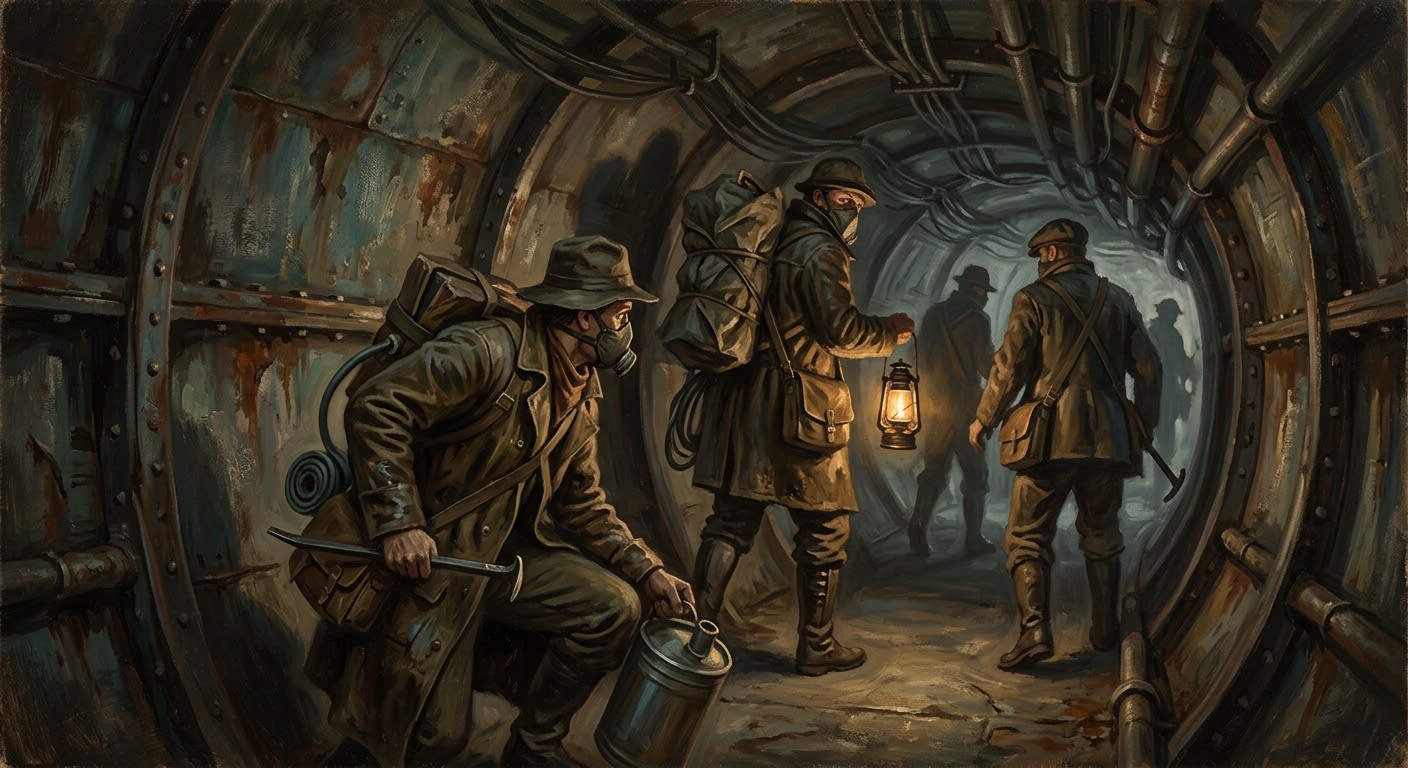
#On the Cartel That Officially Has No Floor Beneath Its Feet
The Hush Tunnel Runners are the face Lorn refuses to admit it has grown beneath its own chin. The Palatine Switchyard of Lorn sings procedure above ground: bells, stamps, manifests, cantors, tower codes, inspection gates, and seven hundred daily departures driven eastward with the solemn stupidity of a cathedral organ in a factory. Beneath that iron liturgy runs a second schedule. No bells. No stamps. No mercy except the kind paid for in salt and sealed teeth.
The Runners move freight, persons, contraband, route-codes, tower-lamp keys, forged manifests, unlisted siding maps, and the more delicate cargo known locally as the already absent: men and women whose names have been struck from Records and who, according to the official universe, can no longer stand above ground without embarrassing the Ledger.
They are called a cartel because the Bureau prefers nouns it can prosecute. They are closer to a profession, a parasite, a mutual insurance society for the condemned, and a municipal nervous system that has learned to lie before the brain does. They have no public face. They have no registered master. They have no chapter house, seal, charter, motto, feast day, or martyr. These omissions have preserved them more effectively than any constitution.
#On the Tunnels Before the Runners
The Hush Tunnels began as service corridors beneath the original Yard: drain runs, inspection crawlways, slag-fill braces, coal conduits, and the surviving cellar lanes of the old market town requisitioned in A.S. 104. Lorn was built quickly, which is to say badly and then sanctified. The Bureau of War needed rail. The Bureau of Records needed manifests. The Bureau of Bells needed sound. Nobody needed the cellars beneath the chapel once the chapel became a dispatch office, so the cellars were packed, bricked, half-mapped, misfiled, flooded, drained, forgotten, reopened by children, widened by salvage crews, and purchased by men who knew the value of a route no auditor had named.
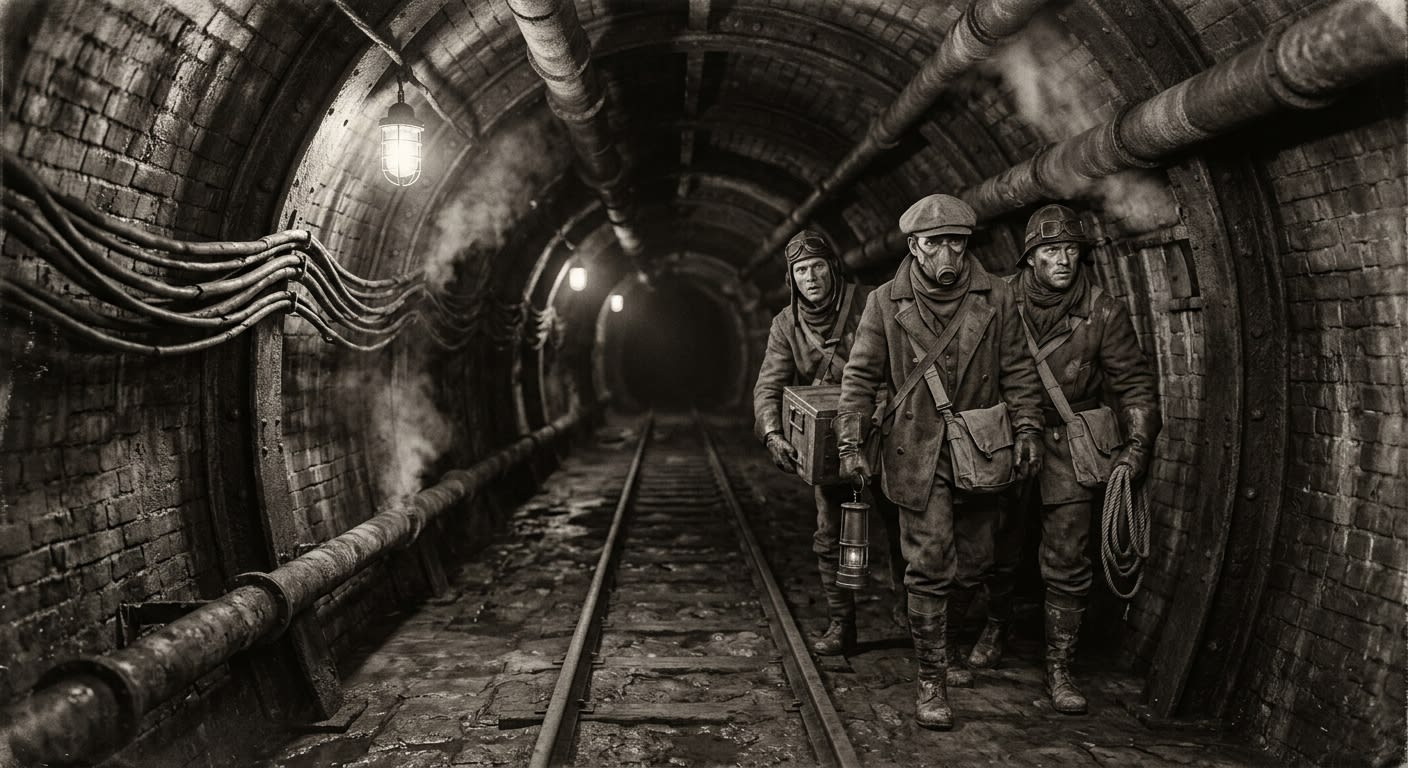
By A.S. 110, when the First Continental Levy bloated Lorn into the continent's iron throat, the under-yards already had traffic. By A.S. 112, after the Silent Derailment killed forty-one men on a siding the manifest denied, the first true tunnel signs appear in provost reports: chalk arrows under Switch-Tower Nine, wax scratches near the Scrap Basilica (Unregistered) furnace wall, rope knots hanging from drainage hooks, a child's handprint in black dust beneath the Needle.
The tunnels earned the name Hush after the Cantor reforms. Above ground, every movement required voiced measure. Below ground, survival required silence. A cough could bring a provost. A sung phrase could wake the yard's wrong echo. A dropped key could tell a rival crew which corridor you had taken. Silence became tool, oath, currency, warning, and sacrament. Lorn, city of enforced song, gave birth to the most disciplined quiet in the Heartlands fringe.
#On Membership, If That Word Can Survive the Damp
A Runner is not recruited. A Runner is cornered until the tunnels are the least lethal exit.
They come from Cinderrow labourers crippled by brake-bite and billed for their own injury; tunnel children who know routes by smell before they know letters; switchmen dismissed after a procedure lapse; manifest clerks whose signatures appear on corrected papers they never touched; salvage pickers from the Scrap Basilica; payroll guards who saw an unlisted car and retained the eyesight to regret it; erased persons pushed below by the merciful geometry of Records.
There are ranks, though never written. Smell-guides lead by air: coal sourness for the western drains, rat heat for the long brick throat under Cantor Walk, cold wax for the Payroll Spur approaches, iron rain for Tower Nine. Key-brokers carry bolt-cut copies of siding locks and gate teeth cast in stolen soap before being poured in proper metal. Lamp-readers watch tower blink codes from grates and roof cracks, translating official signal into under-schedule warning. Mouthless carriers move cargo without asking what it is, because question and confession are cousins. Route-mothers keep the memory of safe passages, feeding children, mending feet, and deciding who receives a path and who receives a wrong turn.
Provost circulars describe the Runners as a youth gang attached to the Scrap Basilica.
Corrected. The youth are merely the visible portion, which is to say the portion the provosts can catch without entering a corridor that smells of damp stone and legal failure. The adult apparatus is older, richer, colder, and more polite than any gang deserves to be.
Payment is irregular by design. Coin buys little. Salt buys more. Stories buy what coin cannot: information about audits, missing trains, drunk cantors, dead sidings, which provost takes bribes, which provost takes names, which tunnel has begun answering footsteps with one extra pair. A true name buys passage in emergencies and ruins the payer afterward. The Runners write those names in chalk on hidden brick. Some names fade. Some appear later on blacklists. Lorn is a city with excellent memory and atrocious ethics.
#On the Under-Schedule
The Yard has a schedule. The Runners have an under-schedule (Unregistered).
Above ground, movement is granted by manifest, measure, and seal. Below, it is granted by route-skin, lamp-talk, and debt. A route-skin is the licensed identity one wears for a single passage: dock porter, ash-cleaner, dead-wheel inspector, rat catcher, orphan courier, chimney surveyor, pipe-saint votary. The disguise is less important than the rhythm. A porter walks like weight. A rat catcher pauses near drains. A dead-wheel inspector curses softly at axles. The Runners teach rhythm with blows, because a body that moves wrongly will be noticed before a face is read.
Lamp-talk is stolen from the Switch-Towers: blink codes, pauses, false clears, warning doubles. Tower Nine's lamps are especially prized and especially distrusted. Local shibboleth: “Which tower answers?” Proper reply: “Nine — late.” An outsider says “Nine” and dies informed. An official says “all towers answer to Palatine authority” and dies deserved.
The under-schedule does not merely evade the official one. It feeds on it. Every audit creates new value. Every inspection gate creates a bypass fee. Every purge creates fugitives. Every missing crate creates rumour, and rumour, in Lorn, moves faster than rail if carried by children with clean feet and no registered surnames. The Bureau may own the timetable. The Runners own the interval.
#On Cargo, Persons, and the Sin of Blank Paper
The Runners' ordinary cargo is petty enough to offend the imagination: wax-seal molds, blank delay slips, stolen ration chits, grease, lamp oil, union oath-notes, forged bell-cards, throat tags for Cantor impostors, illegal hymnbooks printed in Cantor Walk, and route-code slips copied by clerks whose hands shake less when paid in meat.
The serious cargo is paper. A blank manifest is more dangerous than a pistol in Lorn. A pistol kills a man. A blank manifest can make him cargo, dead, absent, transferred, sanctified, delayed, or never born. The Runners cannot forge true master-manifests; the Basilica's paper has watermarks, relic ash, and a smugness detectable in moonlight. They can alter lesser forms, splice route identities, move a seal from one crate to another, and teach a document to arrive with enough confidence that busy clerks stamp first and repent later.
Human cargo divides into three categories. Freight riders: deserters, debtors, lovers, strikers, and petty thieves escaping a particular office. Paper-dead: persons marked dead, transferred, erased, or misclassified, still breathing with the discourtesy of flesh that has not read the file. Rail-saints: untouchable bodies hidden inside sacred consignments, often pilgrims, sometimes relic thieves, once a Bell-Cantor's entire family folded into a crate labelled BRASS THROAT MAINTENANCE.
The Runners do not ask innocence. Innocence is expensive and seldom portable. They ask weight, destination, pursuit, payment, and whether the cargo sings in sleep.
#On Enemies Above and Beside
Yard Palatine Odrin Kessel despises the Runners as a man despises a mirror that shows the back of his own head. His immaculate gloves have signed six tunnel-clearing orders in nine years. Each order produced arrests, corpses, seized maps, and improved tunnel rates within a fortnight. Kessel understands the under-schedule too well to destroy it outright. The Payroll Spur cannot bleed without veins.
Prefect Halden Wry (Unregistered) of the Manifest Basilica calls the Runners “paper vermin.” This is professional jealousy. A forged route that survives three stamps is a sermon against his Creator. He has planted false manifests in Cinderrow, each carrying a hidden ink that blackens the thumb. The Runners responded by feeding his clerks counterfeit reports until the Basilica condemned twelve honest provosts, two dead freight horses, and one brass floor-drain for conspiracy.
Bell Marshal Sister-Calder (Unregistered) hates them cleanly. They move without song. That is enough. Her cantors whisper that silent-run traffic causes the Hymn-Phase Slip, that every unsung passage shifts the yard one measure out of true. The Runners answer with a proverb: A clean stamp won’t stop a bad throw. This has been painted under Cantor Walk seven times. The seventh version included Calder's full birth name, misspelled in a way suggesting affection or threat. She ordered the wall cut out and burned.
The Bureau of Shadows occupies a subtler relationship. Shadows denies itself; the Runners deny tunnels. Kinship of posture does not produce friendship. Custodians use the Hush when they need a body moved without Night Papers. Runners use Custodians when a provost squad needs to forget its own boots. Each side believes it is exploiting the other. Both are correct, which is why the arrangement persists.
#On the Changing Marks
The Hush Tunnels are not stable. The official explanation cites slag settling, water seepage, vibration from the yard, and unauthorised excavation. These causes exist. They do not suffice.
Marks change overnight. Chalk arrows reverse. Rope knots retie themselves in dead men's patterns. Wax scratches soften and reform into route signs nobody living admits to using. A safe corridor under the Scrap Basilica becomes a brick wall by dawn; a bricked wall opens into a stair smelling of hot brake metal and river mud. Children hear bell measures below ground when the above-ground bells are silent. Lamp-readers report tower codes reflected in puddles before the towers blink them.
UNDER-YARD INCIDENT REPORT — TOWER NINE SUBSTRUCTURE Guide marked route “cold-safe” at second bell. Party entered: ███ adults, █ child, ██ crates. Third bell: route marking observed above ground on sealed clock-tower masonry. Fourth bell: child returned alone, carrying payroll wax in both hands. Child's route-skin listed as “never issued.”
The Runners have rules for this. Never take a route that answers your whisper. Never trust paper that arrives early. Never step where rat heat stops. If the yard hums in your teeth, spit blood on the left wall and wait for someone smaller to choose. These rules sound like superstition. They keep people alive, which is the only peer review worth respecting in a tunnel.
#On the Payroll Spur Scandal
Since A.S. 199 the Payroll Spur losses have grown too large for even Lorn's splendid appetite for euphemism. Relic-payroll crates logged through the Needle arrive empty. Seals remain intact. Measures were sung. Manifests agree with themselves, which is suspicious in any document. Kessel produces audits proving absence. Wry produces stamps proving transit. Sister-Calder produces tonal records proving obedience. The crates produce nothing, and nothing, when repeated, becomes policy.
The street-truth says the Runners stole the relic-payroll. The buried truth is uglier: the Runners moved it, yes, but theft implies ownership of intention. The crates were routed by codes older than the current cartel, codes cut into the sealed service walls beneath Tower Nine, codes that pay in salt nobody mined and wax nobody poured. The Runners who handled the first crates retired rich, frightened, and briefly. One now sells bitter tea in Cinderrow and refuses to touch coin. One joined a silent religious order whose register has no vowels. One was found stamped DEAD with a live heartbeat.
Yard Tribunal (Unregistered) notices identify the Payroll Spur incidents as ordinary smuggling motivated by private profit.
Corrected for doctrinal adequacy. The profit was real. The motive was rented. Whoever received the crates did so off-ledger, under-hymn, and with access to tunnel marks that predate the tunnels' first official denial.
The Runners are now richer, more hunted, and less in command of their own routes. This is the normal life cycle of successful criminals and unsuccessful prophets.
#On the Present Usefulness of Silence
At curfew, the towers lock and the Hush wakes. Workers descend by furnace wall, drainage grate, coal chute, chapel cellar, broken lift cage, and the little stair behind Cinderrow Canteen where the cabbage steam hides footfalls. Above them the yard sings its authorized measures. Beneath them, the Runners move the unscheduled city: hunger, debt, love, mutiny, saints, payroll, forged futures, and all those human remainders the Ledger failed to digest.
The Switchmen's Union prepares its slowdown. Sister-Calder prepares her purge. Kessel prepares innocence with both gloves. Wry prepares corrected paper. Inquisitor-Regent Veyl Hark prepares to arrive from Strasbourg with the kind of patience that makes rooms colder before the door opens. The Runners prepare routes, then backup routes, then lies about the backup routes. They will sell all three.
The Hush Tunnel Runners are criminals. This is the least interesting fact about them. They are also proof that no schedule can govern every body, no hymn can sanctify every movement, no stamp can close every passage through which human need, properly frightened and well paid, will crawl.