
#On the Paper Cathedral of Lorn
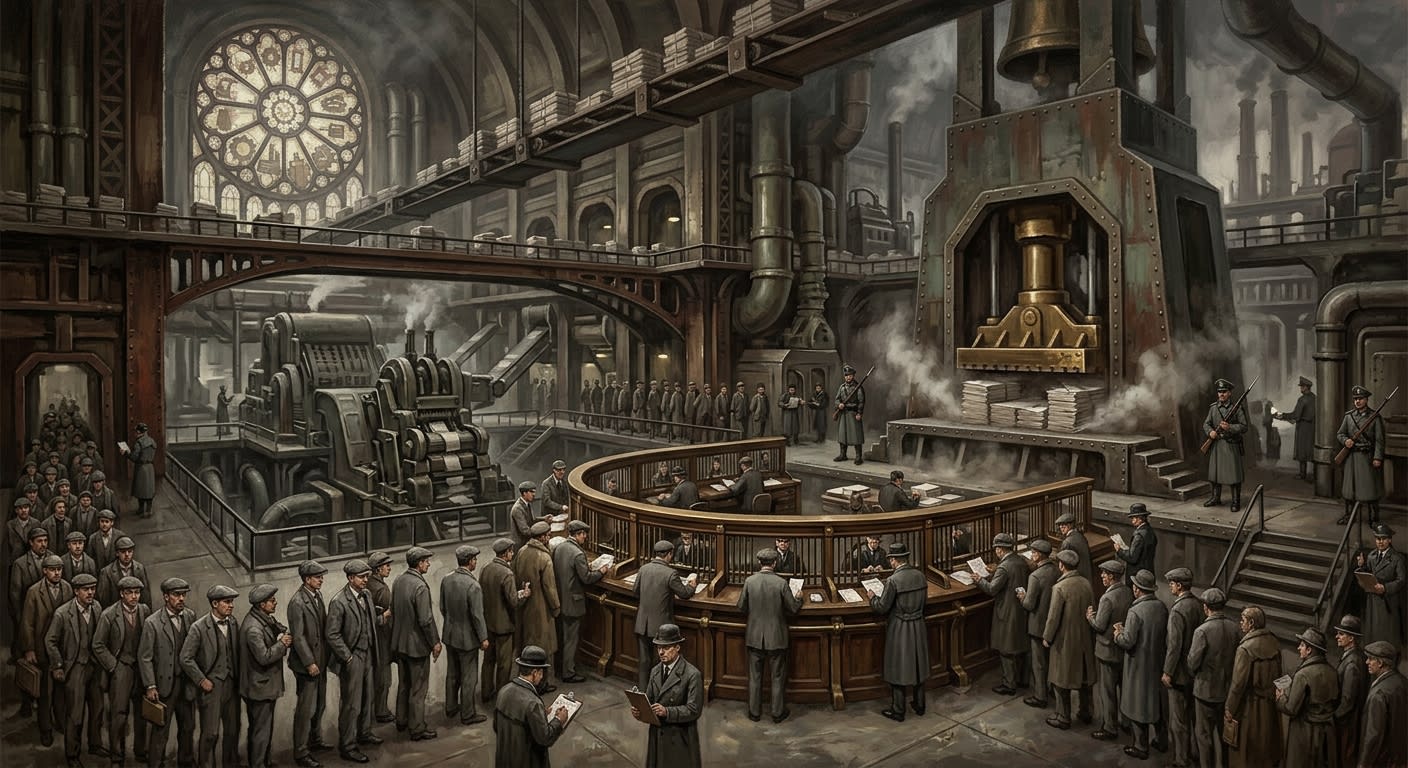
The Manifest Basilica stands on the western approach of the Palatine Switchyard of Lorn, built of soot-brick, riveted plate, stained glass too dirty for beauty, and that most durable of Synodal materials: anxiety pressed flat and filed. It is called a basilica because Lorn required a word large enough to make paperwork seem sacred, and because the Bureau, when embarrassed by scale, reaches for architecture. A warehouse of clerks would have sounded vulgar. A basilica of manifests sounds ordained.
There is no altar in the main hall. There is a master routing desk, which serves. There are no relic niches in the nave. There are document cages, which serve better. There is no choir in the sanctuary, though one hears the stamp presses from every corridor: a percussive heartbeat of ink, seal, wax, counterseal, correction, denial, and authorisation. The faithful may prefer bells. Freight prefers stamps.
Every departure, arrival, delay, reroute, cargo swap, priority window, death entry, seal variance, transfer dispute, and accident within Lorn passes through the Manifest Basilica, or through a lesser desk terrified enough to imitate it. The building processes more paper per day than many dioceses process in a season. It does so without wonder. Wonder slows hands. The Basilica hates slow hands.
#On the Founding of the Pulse
The Basilica began as a dispatch office in A.S. 104, when the old market town was requisitioned and taught the first lesson of Synodal mercy: a place may keep its stones while losing its name. The town's small Benedictine chapel was taken first. Chapels make excellent offices after one removes the benches and replaces prayer with a queue. The earliest manifests were handwritten at a table placed where the nave had been, seven wagons of flour bound eastward, two signatures, one route mark, one bell note, and enough confidence to ruin a century.
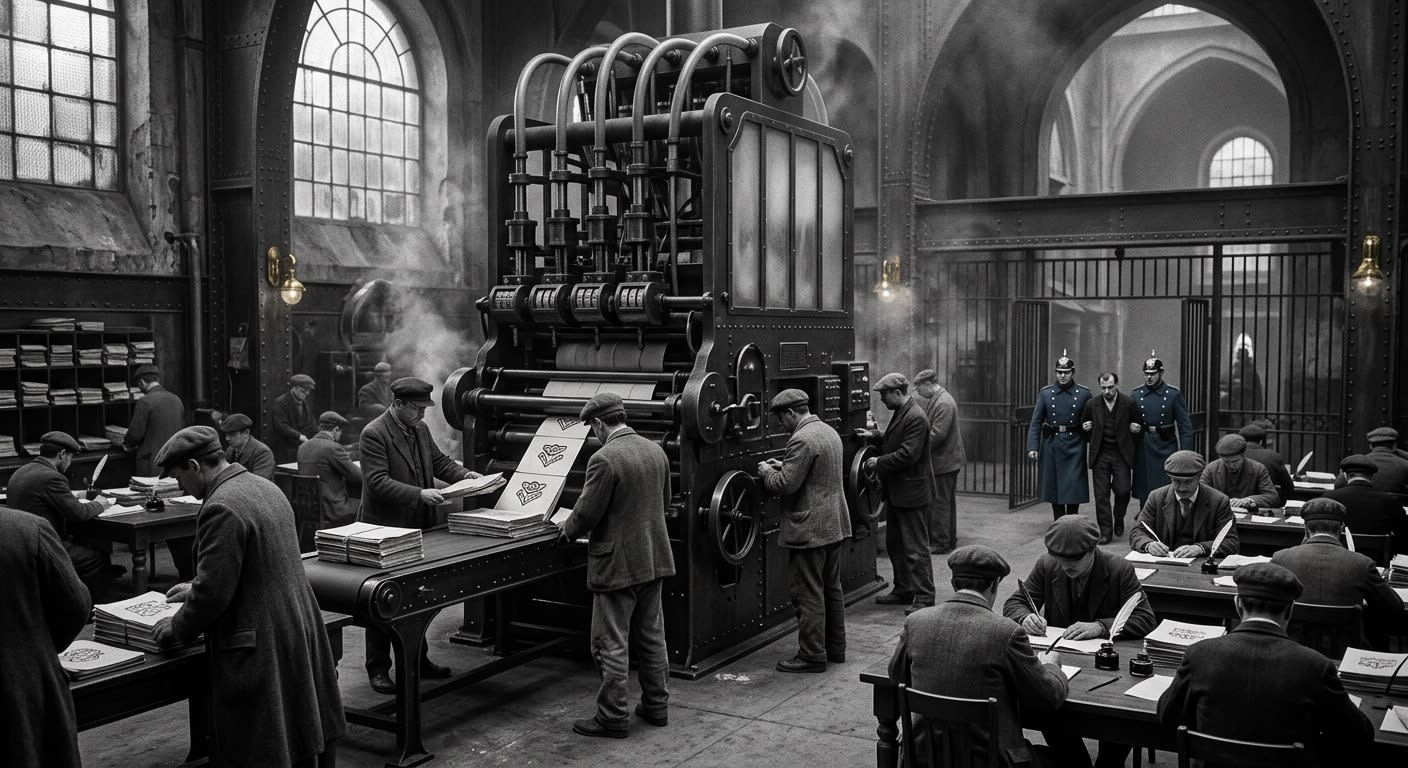
By A.S. 110, during the First Continental Levy, the dispatch office had swollen into an institution. The chapel vanished inside extensions: north stamping nave, south seal registry, east correction transept, west intake arch, cellar drying rooms, upper oathglass archive, and a long clerks' gallery where young hands learned to stamp without thinking and old hands learned to think only when the stamp failed to land. The workers began calling the sound the Pulse. Records attempted to discourage the term, then adopted it once discouragement failed, which is how folk speech becomes official property.
The Synod steals words more politely than it steals towns. The town notices less because the town is usually busy becoming a yard.
The A.S. 112 Silent Derailment fixed the Basilica's authority. Forty-one men died on a siding no manifest admitted. The Bureau of Bells responded with sung procedure. Records responded with paper discipline. The Basilica received both and made a religion of the joint between them. No switch without hymn. No movement without record. No record without stamp. No stamp without desk. The dead became names in a memorial register behind oathglass, revised quarterly because even martyrdom in Lorn is subject to clerical maintenance.
Early Lorn commemorative texts describe the Manifest Basilica as founded for “orderly coordination of growing rail traffic.”
Corrected. It was founded because freight multiplied faster than conscience, then enlarged because a catastrophe exposed the terror of unrecorded consequence. Coordination was the perfume. Fear was the body.
#On the Stamping Halls
The main stamping hall is a long industrial nave with iron ribs, high soot windows, bare electric lamps, paper hoists, ink troughs, stamp racks, drying wires, seal braziers, and rows of desks arranged with the punitive regularity of a military cemetery. Seven hundred clerks work in shifts by bell-order. Each clerk handles forty to ninety manifests per shift. Each manifest requires three to eleven stamps according to cargo: grain, coal, munitions, saint-bone, conscripts, wounded, condemned rolling stock, paper bales, medical freight, relic-payroll, dead, delayed dead, and those exciting little categories where the label says Sundries and the escort carries rifles.
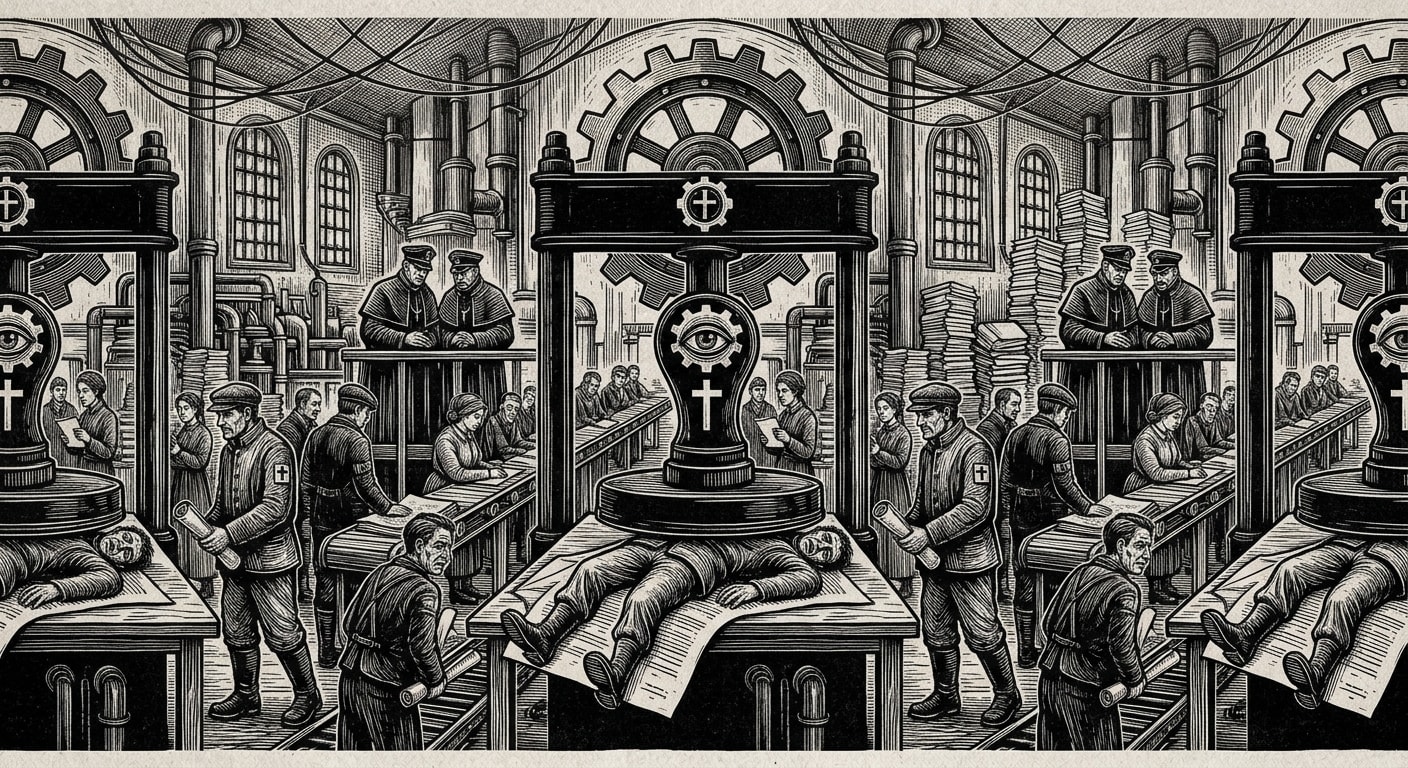
The Basilica's air is particulate: ink dust, paper fibre, coal soot, sealing wax, glue breath, damp wool, lamp smoke, old coffee, and fear. Hands stain permanently by the third month. Wrists swell by the second year. Eyes go by the fifth. Conscience, if present, is corrected earlier.
The desk hierarchy is written into the floor. Intake desks at the western arch receive raw manifests from the yard mouths. Verification desks check seals, cargo class, cantor notation, escort count, and whether the cargo smells like its description. Routing desks assign track, time, tower, priority, and liability. Correction desks alter what reality has made inconvenient. Seal custody holds the master dies under guard. Oathglass archive preserves the forms whose survival would embarrass someone powerful if left in ordinary paper.
The stamping hall rules are posted in black enamel: no manifest enters routing without seal witness; no correction enters in red after third bell; no relic-payroll manifest is copied by a single clerk; no death cargo is reclassified as machinery without two witnesses; no clerk asks why a corrected departure precedes its arrival. The last rule is unwritten. Naturally, it is the best obeyed.
#On Prefect Halden Wry
Prefect Halden Wry commands the Manifest Basilica with the thin patience of a man who has confused accuracy with salvation and discovered that salvation can be improved by better ink. He is small, cold, and almost theatrically untheatrical. His hands are permanently black at the nail beds, his smile appears only when a stamp lands with satisfactory force, and his office contains three clocks set to three different authorities: yard bell, rail time, and corrected time. Corrected time is the one he trusts.
Wry has held the Basilica for eleven years. Manifest accuracy rose under him. Clerk turnover rose faster. Corrected manifests multiplied so quickly that Records declared the figure statistically appropriate, which is the Bureau's way of placing a towel over a bleeding altar. He does not forge. He corrects. In Lorn, that distinction decides whether one receives promotion, indictment, or a private dinner with Yard Palatine Odrin Kessel.
He calls the Hush Tunnel Runners paper vermin, which is professional jealousy wearing a civic uniform. A forged route-skin that survives three desks disproves Wry's little theology for seven seconds. He cannot endure those seconds. His countermeasures are elegant and cruel: thumb-blackening ink hidden in false manifests, duplicate seal fibers visible only under vinegar steam, delay forms that change weight if altered, and trap schedules routed through desks staffed by clerks already marked expendable.
A Yard Tribunal commendation states that Prefect Wry “eliminated manifest forgery in the western halls.”
Clarified. Wry eliminated cheap forgery in the western halls. Expensive forgery moved inward, dressed better, and began using official ink.
#On Correction, Which Is the Basilica's True Sacrament
A manifest records what should happen. A correction records what authority prefers to have happened after events prove insolent. Records calls this custody; War calls it continuity; Purity calls it suspicious only when someone else profits. This is the Basilica's native genius. Lorn moves too fast for truth in its raw state. Truth arrives coughing, late, stained, full of witness, smelling of brake smoke and asking for a chair. The Basilica seats it at the correction desk, trims its edges, dries it, renumbers it, and sends it away improved.
Correction differs from erasure. Erasure is crude and attracts auditors. Correction preserves the page while altering its obedience. A delayed train becomes held by prudence. A missing crate becomes never loaded. A dead worker becomes transferred before incident. A misrouted wagon becomes assigned to investigation route. A Payroll Spur loss becomes absence established before shipment. The ink does not lie. It clarifies with a knife.
The Correction Transept (Unregistered) occupies the east arm of the Basilica. Its windows are narrow. Its desks are bolted. Its clerks wear grey cuffs to hide ink variation. Every corrected manifest receives a side mark, never in the same place two years running. The old marks are taught as history. The new marks are taught as necessity. A clerk who uses last year's correction discipline on this year's scandal is reassigned to paper drying, where mold may instruct him in humility.
CORRECTION TRANSEPT SEALED SAMPLE — PAYROLL SPUR SERIES Original entry: Relic-payroll crates ███, consigned to Bastion-Przemyśl. Transit: Needle clear; Tower Nine amber; cantor measure compliant. Arrival: sealed empty. Correction proposal A: cargo never present. Correction proposal B: cargo spiritually transferred. Correction proposal C: ██████████████████████. Marginal note in Wry's hand: “Do not invent theology until arithmetic fails twice.”
The Hark Commission (Unregistered) has requested correction ledgers from A.S. 199 onward. Wry has provided copies. I need not tell the reader what copies are worth in a city whose most powerful building exists to teach paper manners toward Tower Nine, the Payroll Spur, and Bastion-Przemyśl consignments.
#On the Manifest Court and the Lesser Litigants
Attached to the south side of the Basilica is the Manifest Court, where disputes over route, seal, priority, damage, loss, misclassification, and death are heard under the joint sneer of Records and Yard authority. The court avoids grandeur. Grandeur would suggest justice. It is practical: benches, docket cages, witness rail, stamp plinth, three appeal windows, and a wall of hooks where disputed seals hang like small hanged kings.
Here appear the lesser species of Lorn's administrative ecology: manifest litigants with cracked files; route widows demanding to know why husbands returned as cargo; switchmen contesting blame assigned by sung procedure; Vire factors arguing water stains; Hush informants selling maps that become false when unfolded; freight owners insisting delay has monetary substance; Mercy officers attempting to recover bodies that Records has reassigned as materials.
The court's favourite ruling is lack of standing. A dead man lacks standing. A transferred man lacks local standing. A cargo owner whose cargo never existed lacks material standing. A widow whose husband has been corrected into machinery lacks marital standing pending anatomical review. There are dozens of standings, each placed like a little trap before anyone rash enough to believe injury produces claim.
Public guides describe the Manifest Court as a “citizen remedy forum.” It remedies citizenship by exhausting it. Anyone still a citizen after three hearings has proved unusual endurance and should be charged a maintenance fee.
#On Hush Pressure Beneath the Western Hall
The Basilica denies the Hush Tunnels beneath it with particular passion because denial is hardest where the floor is warm. Under the western hall run clerk wells, paper heat vents, stamp-room drains, coal conduits, and old chapel cellars whose walls remember hymns less profitable than the present sort. The Hush Tunnel Runners call this district the Basilica Dries. It smells of hot paper, ink dust, and the faint sweetness of glue boiled too long.
Route-skins pass under the floor while legitimate manifests pass above it. A rat catcher pauses beneath Desk Row C. An ash-cleaner climbs through a paper-drying vent with three delay slips tucked under his tongue. A mouthless carrier waits under the seal custody stair until the stamp rhythm overhead changes from intake to correction. The Basilica stamps the universe into order while its underfloor sells exceptions by the breath.
Wry knows. Kessel knows. Sister-Calder (Unregistered) knows because song changes when sung over a hollow place. The provosts know because they keep arresting people emerging from walls the building plans call solid. The official position remains stable: no tunnel access exists beneath the Basilica, and all guards posted there are guarding against hypothetical misuse of nonexistent passages. This is why Doctrine must exist. Other Bureaus lack the literary discipline to make cowardice sound so architecturally firm.
#On the Pulse During Crisis
The Pulse has stopped three times in living memory. Once during the A.S. 187 toll-war escalation with Vire, when wet-transfer disputes clogged three desks and a Bridge-Scribe arrived with a receipt dated tomorrow from Lower Vire's Candle-Sump paperwork chain. Once during the first A.S. 199 Payroll Spur discovery, when an intact seal and an empty crate were brought into the hall together and every clerk looked at the stamp rack as if it had betrayed them personally. Once during a Tower Nine late-blink quarantine, when the Basilica received a manifest already bearing the confirmation mark of a train still waiting at the Needle (Unregistered).
Each stoppage lasted less than two minutes. Each produced disciplinary files thick enough to choke a mule. The lesson issued afterward was uniform: the Pulse must not stop. If the hall halts, the yard hears it. If the yard hears it, the towers hesitate. If the towers hesitate, trains become questions. Lorn cannot survive trains becoming questions.
The Emergency Pulse Order (Unregistered) is brief enough for frightened men to remember: if stamping rhythm breaks, resume with blank practice forms; if cause is unknown, resume before naming cause; if tower code contradicts manifest, isolate contradiction and continue adjacent desks; if a clerk refuses, remove the clerk, not the desk.
The clerks practice resumption drills twice weekly. At signal, they stamp blank forms for one minute while supervisors walk the aisles listening for irregular rhythm. Too fast suggests panic. Too slow suggests thought. Thought is the graver concern. Panic can be routed. Thought may ask for evidence.
#On Veyl Hark's Shadow
Inquisitor-Regent Veyl Hark has not yet entered the Manifest Basilica. The building has begun behaving as if she has. Grey corrections have increased. Red corrections have vanished from visible desks. Wry has ordered archive rebindings and called them routine. Seal custody changed its night roster twice, then changed the change. The oathglass memorial register of the Silent Derailment was cleaned, which means someone feared dust might testify.
Hark's commission names Tower Nine bell codes, Payroll Spur ledgers, corrected manifests, freight priority windows, and sealed Hymn-Phase reports. Every road leads through the Basilica. A crate cannot be lost in Lorn without passing a page. A hymn cannot be credited without notation. A late blink cannot become routing without a desk willing to receive its consequence. Hark will separate voice from record, record from route, route from profit, profit from alibi. The Basilica is where those separations were joined.
An ordinary inquisitor frightens guilty men. Hark frightens systems. Men can confess. Systems can only produce appendices.
The building's present panic is quiet. Clerks do not run. They align. Supervisors do not shout. They murmur over indexes. Wry does not destroy documents. That would be vulgar and probably unnecessary. He corrects the environment in which documents will be read. Lamps are replaced. Ink lots are reconciled. Witness stools are moved by two finger-widths. A room may confess through furniture if the inquisitor knows where to stand.
Lorn's public notice describes the expected audit of the Manifest Basilica as “cooperative documentary review.” Corrected for doctrinal hygiene: a cooperative documentary review is what a guilty archive calls an inquisition while hoping the inquisition is deaf.
#On the Present Condition
As of A.S. 201, the Manifest Basilica remains operational. The Pulse continues. Seven hundred clerks stamp, route, verify, correct, dry, file, and ruin lives at the speed required by the war. The yard receives its permissions. The Needle receives its priority windows. Tower Nine receives its lamp confirmations. The Hush receives its leaks. Vire receives disputes fat enough to charge. Przemyśl waits for consignments whose papers arrive cleaner than their crates.
The Basilica is no vulgar corruption. It is worse. It is adapted. Corruption suggests a clean original state violated by appetite. The Manifest Basilica was born from appetite: for control, speed, deniability, correction, and the comfort of a page that agrees after the fact. It does exactly what Lorn made it to do. It converts movement into paper, paper into authority, authority into outcome, and outcome back into paper before the blood dries on the rail.
At second bell, the hall stamps. At third, the hall stamps. At every hour men prefer not to count, the hall stamps. Under the floor, someone crawls where no passage exists. Above the floor, a clerk corrects a train that has not yet arrived. In the east, Tower Nine answers late. Wry smiles once, because the stamp lands clean.