
#On the River That Does the Province's Lifting
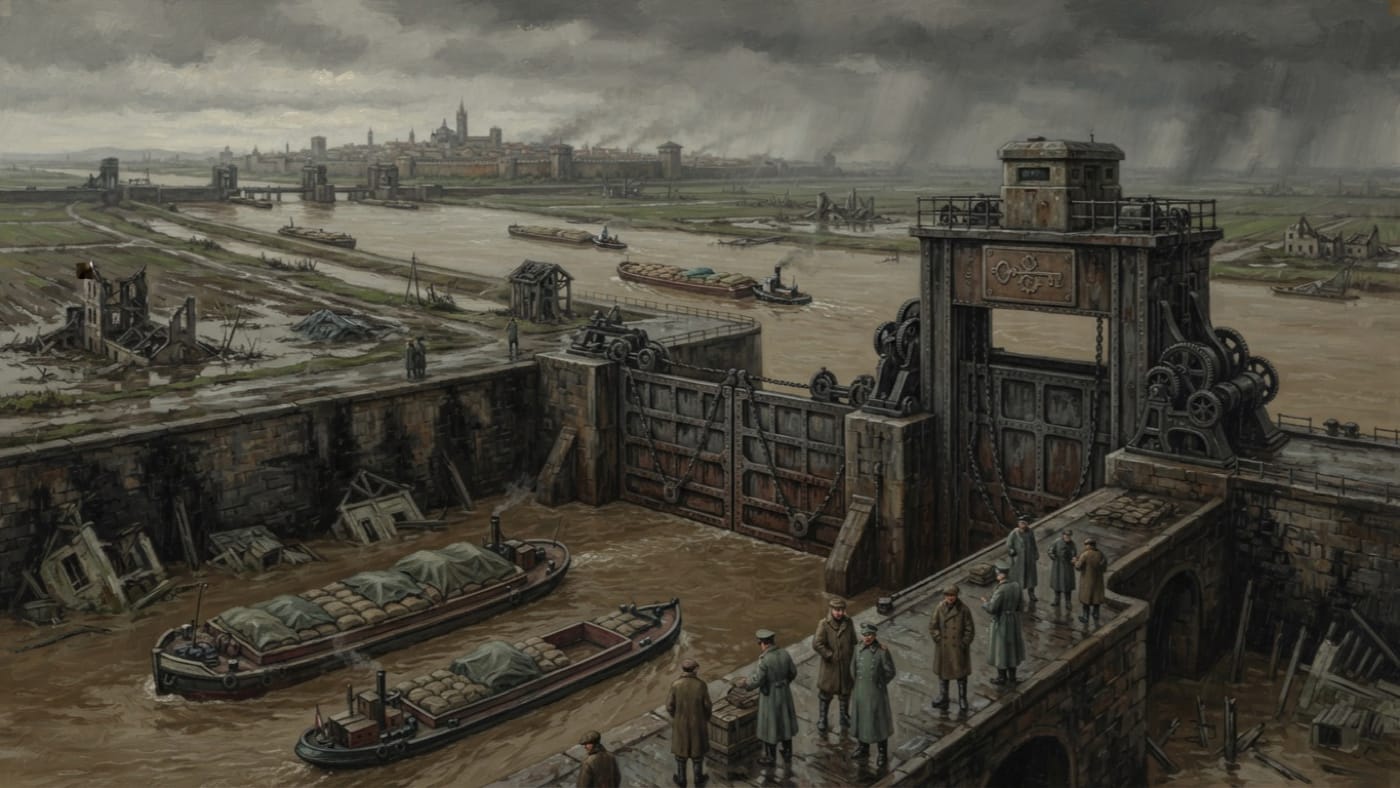
The Po is the working river of the Lombard plain: broad, brown, patient and employed. It waters the fields, turns the mills, floats the grain barges, and lays down silt with the industry of a clerk nobody has told to stop. Lombardy likes to credit its wealth to its own virtues. It should thank the river, and the long-dead engineers who taught the river manners. Embankments hold it. Gates meter it. Canals borrow from it and return what they please. A plain this rich does not come from the Creator's whim alone; it comes from sluice-keepers, dredging crews, and the hereditary quarrels of men who own the next field downstream.
The Synod files the province under Zone 2/7: safe heartland by military distance, attached to the southern corridor by supply. That classification belongs to Lombardy. I have seen no Bureau survey that walks every reach of the Po and stamps each bend, and I decline to invent one for the comfort of tidy readers. Where the river serves the province, it carries the province's classification. Beyond that it is water, and water has never applied for a zone.
#On Fields, Mills and Passage
Lombard prosperity is managed water. Every orchard ledger, every grain declaration, every silk house grown fat on mulberry leaves rests in the end on a channel somebody dug and somebody else maintains. Rice wants flooding at the proper season. Wheat wants the flood sent elsewhere. Mills want a steady fall. Barges want depth. The Po supplies all four, provided men argue about it without pause, and Lombardy has never run short of men for that.
The mills were the province's little cathedrals of convenience: wheel, race, stone and sack. Grain came off the fields and went under the stones, then onto the river or the roads toward depots, towns and the southern corridor. The grain brokers and dock factors stood along the wharves like the river's sacristans. They knew which sacks had been declared, which were damp, and which existed only in a cousin's memory. Tithes adored them for their records and distrusted them for their memories.
A river that feeds a province can also feed its correction. Every embankment is a wall that can be breached on instruction. Every gate decides where the water goes, and the decision belongs to whoever holds the gate. Lombardy built its prosperity on controlled flooding and never asked who would control it next. The Bureau of War read the same drawings the irrigation guilds read. It drew different conclusions.
#On the Dock Factors and the Keys
In A.S. 150 the Coalition of the Crossed Keys declared allegiance to the so-called True Successor of Rome. It held Como, Milan, and a third Lombard city whose name the Bureau keeps under wax. Father Ambrosius of Como supplied the sermons, and the river districts supplied part of the arithmetic. Grain brokers and dock factors along the Po stand among the Coalition's mercantile adherents. Beside them stand silk houses, and bankers whose accounts had grown tender consciences about inspection from Strasbourg.
I record that some of the river men joined. I do not record that all of them did. Many bargemen who loaded crossed-key sacks loaded whatever sack the factor pointed at, and the factor pointed at whatever paid. Purity spent years sorting the two kinds. It enjoyed the work.
The keys stood for Rome and conscience. The grain stood for something blunter. A rival administration that collects grain and issues road warrants must also move what it collects, and the Po was a road that asked for no warrant at all. The Coalition expected the river to stay neutral, as it always had under its own guilds. The Bureau had other plans.
#On Hydrological Pacification
The Bureau of War calls the operation hydrological pacification. The street calls it the Drowning of Lombardy. Doctrine prefers "correction," which has the merit of fitting on any document. I use all three as the context requires, and in Lombardy the context usually requires a towel.
War cut the roads first, because a cut road is a dry argument and dry arguments make the best opening statements. Then the sappers went to the water. They seized the embankment gates. They broke mills, so that races which had turned stones for Coalition grain ran wherever no one had asked them to go. They diverted canals through barricaded streets, and barricades built against bayonets found themselves standing in a current. They opened lower vents beneath river crypts, and water that had lain decently outside the churches came up through the floor.
The surviving accounts give no full engineering sequence, and I will not draw one. I do not know which gate opened first, which canal ran deepest, or how far the water spread across the plain. I know the method. Lombardy had spent centuries teaching the Po to go where men sent it. The Bureau sent it into cellars, chapels and warehouses, and into the low rooms where frightened people store what they mean to keep.
The violence went beyond water, and pretending otherwise would flatter the river. Soldiers followed the water with bayonets and writs. Tithes froze the accounts, so the storehouses behind the barricades could neither buy nor sell. Purity went from house to house asking which emblem had hung in which hall. The provincial annals say Lombardy drowned in blood. One Lombard account says the Po ran dark for a fortnight. I set both down as testimony. I have found no count of the dead in any file open to me, and I will not supply a number for some petitioner to quote against the Bureau.
On Father Ambrosius, the river keeps its own counsel. One account has him drowned in a crypt beneath an opened vent. Others have him shot, or escaped in a layman's coat. The Po stands accused of the first. It has not confessed, and its silence is the most disciplined testimony in the file.
#On What the Water Left in the Archive
Floods make poor archivists. They lift the ink off a page and leave the page. They take a ledger from its shelf and lay it in the mud with its spine broken and its names still legible to anyone patient enough to wade in after it. Records was patient. Its clerks went down into Milan's municipal undercrofts, waist-deep in what the river had brought, and came back carrying the Coalition's paper.
The papers came up soaked and stinking, and still legible. They were dried, flattened, copied and copied again. From them came the Crossed Keys Roll: the names of adherents, donors, guild officers and parish receivers, kept first for punishment and then kept longer so their descendants and associates could be watched. The Bureau of Doctrine supplied the reading that turned preservation into policy. The Po had destroyed the barricades. It had failed to destroy the minutes.
When the water went down, Bureau engineers repaired the sluices with the bland diligence of men mending a gate that had blown open in the wind. Mills were rebuilt where the owners could pay or the depots needed flour. The lower rooms of chapels and warehouses stayed damp, and some still are. Tithes found, without visible embarrassment, that drowned storehouses still owed their arrears, since a debt lives on paper and the paper had been rescued. Claims against those storehouses still surface in Lombard courts. The water was gone within a season. The accounts never close.
#On the Po at Present
In A.S. 201 the Po does what it did before A.S. 150. It waters the fields, floats the barges, feeds the rebuilt mills, and lays its silt over whatever lies beneath. Grain brokers file surplus declarations in very careful hands. Dock factors greet the inspectors by name. Lombardy remains rich, useful and watched, administered by every instrument Strasbourg can afford.
The gates are maintained. That is the whole policy, and it needs no proclamation. Every sluice-keeper in the province knows whose seal hangs on his key ring. Every miller knows what a broken race looks like. Every family with a cellar near a canal knows the water obeys the hand on the gate, and they know whose hand that is.
A recent provincial abstract described Lombardy as "fully pacified."
Corrected. Lombardy is fully administered, and its river works are fully inspected. Pacification is a word for a finished war, and the Bureau does not keep gates in repair for a war it has finished.