
#On the Revolt That Mistook a Key for a Crown
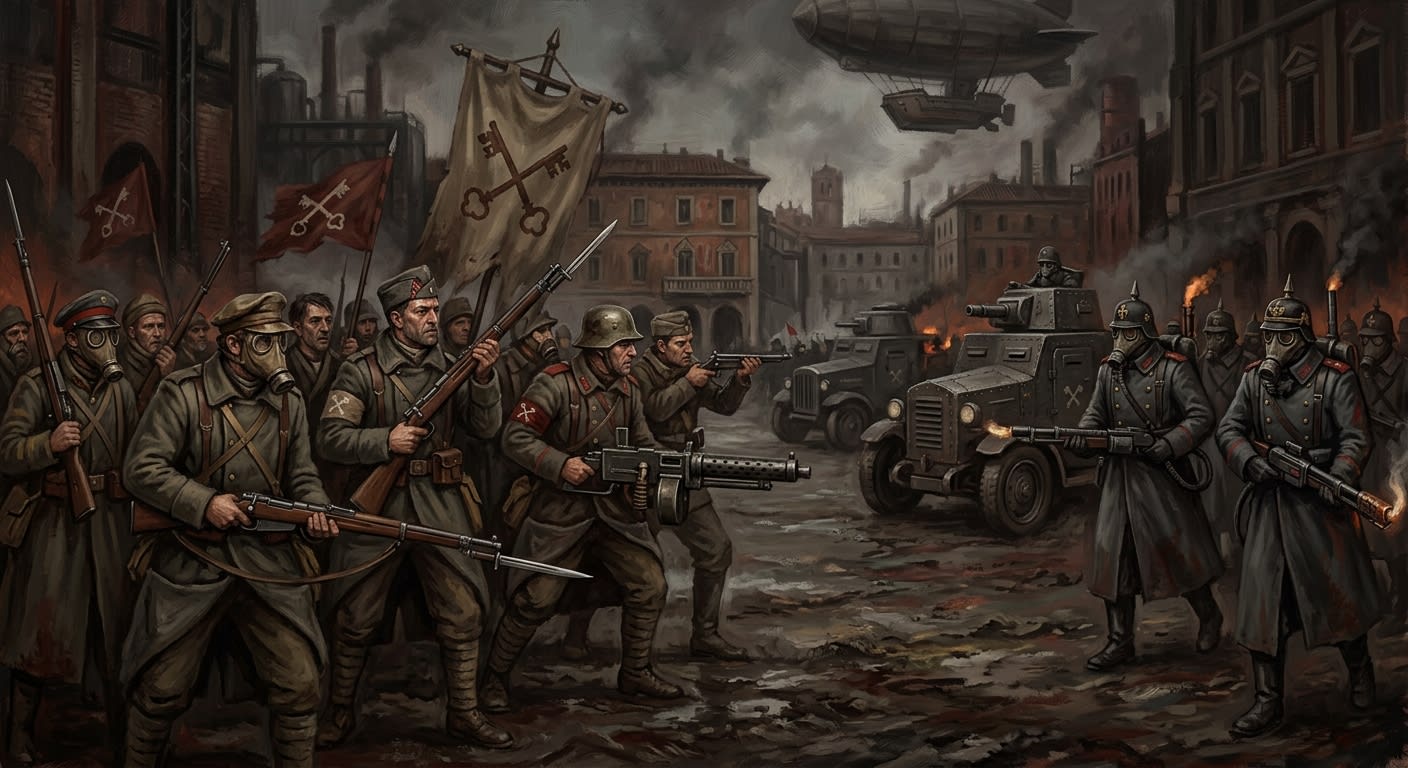
The Coalition of the Crossed Keys rose in Lombardy in A.S. 150, when Milan, Como, and one city whose name remains sealed decided that apostolic succession could be restored by merchants, parish fathers, silk-guild treasurers, and men who had mistaken the jingling at their belts for the sound of Heaven. The revolt declared allegiance to the so-called True Successor of Rome. It briefly held three cities. It died in water.
Spare me the sentimental category of peasant jacquerie. Lombardy was wealthy. Lombardy was literate. Lombardy owned ledgers, looms, chapels, counting houses, lake villas, gold-thread vestments, and a surplus of local dignity. Local dignity, left unlicensed, ferments into schism.
The emblem was simple: two keys crossed, one for Rome, one for conscience. A child could draw it. That was the danger. A doctrine must be memorised, defended, amended, ratified, misquoted, corrected, and taught by bored priests to inattentive children. A symbol may be hammered onto a gate before breakfast.
#On the Key-Bearers
Father Ambrosius of Como gave the Coalition its throat. He was the chief celebrant, the principal key-bearer, the man whose sermons turned guild irritation into sacrament. He preached that Strasbourg had stolen Rome's inheritance, that the Hierarchy had replaced apostolic hands with sealing wax, and that the Concordat was a locked cabinet containing the wrong the Creator. It was a handsome heresy. Handsome heresies are the expensive ones.
The Coalition's membership spread along three channels. The first was clerical: parish fathers who resented Bureau appointment tables, cathedral canons whose correspondence with old Roman houses had never ceased, and confessors who had grown weary of sending quarterly conscience tallies north. The second was mercantile: silk houses, grain brokers, dock factors along the Po, and bankers whose accounts had developed a pious objection to Tithes inspection. The third was civic: magistrates, ward captains, guild aldermen, and provincial ornaments who preferred the old arrangement under which local notables met in high rooms and mistook themselves for government.
They called themselves a Coalition because rebels enjoy sounding temporary. They were, in fact, a counter-administration. They issued road warrants under crossed-key seals. They collected grain in the name of the True Successor. They appointed parish receivers, militia vergers, and oath-clerks. They printed catechisms in which the word obedience bent southward. The Bureau of Records acquired copies within nine days, because Lombardy's printers, though schismatic, still sent invoices.
Intercepted catechism fragment, Milan press, A.S. 150: “Where is the Church's key kept?” “In the hand of █████████████████, not in the ink-well of Strasbourg.”
Doctrinal note: the answer is proscribed. The printer's children were reclassified under kinship watch. The type was melted into spoons for a Mercy ward. The spoons were later withdrawn after three patients unlocked their restraints by touch.
#On the Three Cities
Como was first, being beautiful, vain, and supervised by Ambrosius at close range. The crossed keys appeared on blue silk hangings during a lakefront Mass, then on warehouse lintels, then on the municipal tax office, which tells the informed reader exactly when piety became policy. Como's garrison hesitated. Its commander requested clarification from Strasbourg. Clarification arrived as three contradictory memoranda and one white-mantled observer. By the time the observer finished noting who kissed whose ring, Como had changed its bells.
Milan followed with greater theatre and poorer discipline. The city councils swore the Key-Oath in the old exchange while guild banners hung from the galleries. The silk houses pledged cloth for uniforms. The armorers pledged steel. The bakers pledged loaves. The poor were promised bread after victory, that oldest counterfeit coin, passed from demagogue to demagogue until even the hungry can hear the clink.
The third city is sealed. Its seal is part punishment, part bait. Every Lombard town has spent fifty-one years wondering whether its name lies behind the black wax. Each suspects its neighbour. Each over-complies in public and whispers in private. This is efficient governance: one redaction doing the work of seven garrisons.
Earlier provincial annals described the Coalition as “three cities unanimously restored to Roman allegiance.”
Corrected. Como turned by sermon, Milan by guild calculation, and the sealed city by a bargain the Bureau of Purity has not released because the families involved remain useful. Unanimity is what rebels call fear when fear is wearing their colours.
#On the Bureau's Answer
The Bureau of War did not answer with debate. Debate is for councils, students, and men insufficiently supplied with artillery. War answered with roads, sluices, pontoon companies, confiscated grain, and the cold arithmetical piety of officers who had learned from Wrath that fire is impressive but water enters everything.
The operation's polite name is hydrological pacification. The impolite name is the Drowning of Lombardy. Both are accurate; only one appears on schoolroom wall plates. Bureau sappers opened lower vents beneath river crypts, diverted canals through barricaded streets, broke mills, seized embankment gates, and turned the Po's obedient branches into instruments of correction. Barricades became sluices. Cellars became confessional cisterns. Churches flying crossed-key cloths were washed from within by soldiers carrying bayonets, writs, buckets, and municipal confidence.
Milan held longest because Milan had walls, money, and the intolerable conviction that magnificence protects against consequences. It does not. War cut the roads. Tithes froze the accounts. Purity stood at the fonts and asked each baptised child what emblem hung in his father's hall. Records copied the answers. Doctrine prepared the sermon in advance.
#On the Names Preserved
After the third city fell, the Bureau faced a choice: erase the Coalition or preserve it. Erasure has charms. Silence is clean. A blank archive pleases weak administrators because blankness resembles peace. The Bureau of Doctrine chose the sharper mercy. It preserved the Coalition's name and the name of every participant it could identify, because a list of heretics is not a memorial. It is a trap.
The Crossed Keys Roll began as twenty-seven crates of soaked paper, rescued from Milan's municipal undercroft by Records clerks who waded waist-deep through river filth while War officers complained about the smell. The clerks dried the pages between sermon boards, weighted them with confiscated reliquary plates, and copied every name twice: once into the punitive register, once into the instructional register. Punishment kills a man. Instruction pursues his grandchildren.
The rolls still serve. Ambrosian sympathy, Crossed-Key nostalgia, papalist ornament, local-privilege doctrine, unauthorized Roman devotions, suspicious key imagery, and excessive enthusiasm for lake processions all trace their legal ancestry to A.S. 150. The category is broad because Lombardy was imaginative. The Bureau repays imagination with classification.
A.S. 151 circulars stated that all Coalition symbols had been destroyed.
Clarified. All surrendered symbols were destroyed. All recovered symbols were destroyed. All denied symbols were entered into a separate schedule. The difference between surrender, recovery, and denial has funded three generations of Purity inspections.
#On the Present Stain
In A.S. 201, Lombardy is obedient in the same way a locked reliquary is peaceful: by pressure, inventory, and the threat of tools. Milan's children learn the Triune Alphabet with particular severity. Como's lake churches file bell schedules in duplicate. Guild keys are inspected yearly for devotional geometry. A crossed key found on a private seal is still enough to ruin a dinner, a career, and a bloodline.
The Po carries silt over whatever bones remain. It has carried worse. The Bureau carries names.