

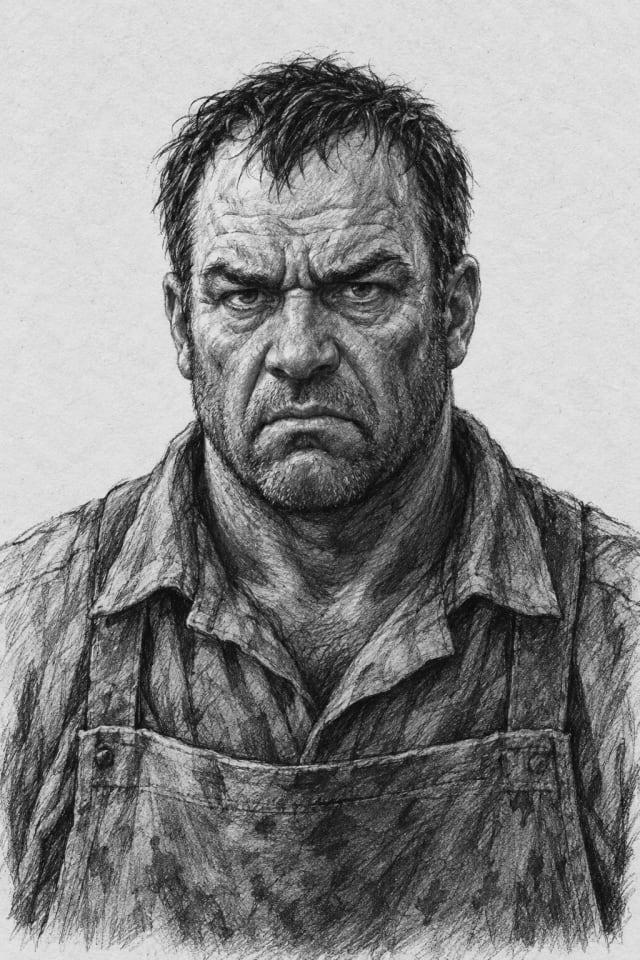
#On Bram's Station
Porter Bram carries for the Quarantine Wardens of Calais, and his station is the Undertide Pens of the Chalk Redoubt. The record gives him one name, one trade and two qualities. He is strong. He is afraid. The Bureau has canonized men on less.
The Redoubt lists the quarantine porter among its ten core occupations, filed between the chalk miner and the salvager. That placement is the city's verdict on the work: it is necessary, it is common, and nobody holding a sea pass needs to notice it. The porter carries what the Wardens cannot leave on the quay and the Divers cannot leave in the water. He carries it down stairs cut wet into the chalk, past the cordon and through a door that somebody else locks behind him. The rooms below smell of antiseptic brine and of whatever the brine has failed to correct.
No surname survives, and neither does a birth year, a parish, a family, an enlistment or a term of service. The Wardens' ledger knows him the way it knows a hoist cage: by function and by load. I do not object. Most of the Synod's servants would be improved by such economy.
#On What the Divers Bring Back
The Undertide Divers go down for the dead. Whatever they recover from the caves beneath the cliff comes up the rope and into the launch, and from there it goes to the Pens, because no other building in Calais will take it. The Divers deliver it and the porter takes delivery. A stair separates the two acts.
The Divers' file lists the conditions of recovered bodies without apology. Some come back bloated. Some come back dry, which is worse, because the sea has no business returning anything dry. Some have kelp packed into their teeth. Some have another person's ring shut inside the fist, and someone must decide whether the fingers are opened on the quay or below. An officer makes that decision and a porter does the opening. Some whisper names through closed mouths until the Chalk Scribes are summoned to take the names down.
Bram's hands meet each of these conditions before any office has named it. The cloth over the litter is wet because of what lies under it. The weight is wrong in the same way the body is wrong: heavy where it has drunk, light where something has emptied it. A doctor records such things on a slate. A porter feels them in his forearms halfway down the stair.
The corps recognizes three returns: the body, the token, or a sealed absence. The name-token hangs against the sternum, stamped with legal name, dock name and nearest kin, so that it can speak for a face that no longer can. A token that comes back alone is quarantined as well. The Pens therefore keep small stamped tokens under the same lock as men. A sealed absence goes into the casualty ledger and the Wall watch book and needs nobody to carry it. You can measure how generous the sea has been by how much the porter has had to lift.
#On the Doctor and the Porter
Warden-Doctor Voss records pulse, pallor, salt bloom, chalk marking and speech recurrence. The Redoubt's file calls the doctor's manner cold mercy, and the columns agree: there are five observations, and none of them needs a long touch.
Bram does the touching. The office is arranged so that one servant holds the body and another holds the pen, and only the pen may change what the body officially is. Voss may write dry, marked or recurrent, and those words decide the room, the watch and the count of nights. Bram may put the litter down where he is told to. Nothing in the file gives him a diagnosis, a clearance, a voice in the detention ledger, or any key he was not handed by someone above him.
This is correct procedure, and I sign beneath it. Quarantine needs a hand that does not hesitate and a judgement that does not sweat. Put both in one person and you invite mercy, or panic, or worst of all an opinion.
The arrangement smells all the same, and the smell is brine. In public the Wardens protect the city from plague. Their methods are cordons, health passes and detentions, and their resources are pens, medicines and guards. The porter falls somewhere between the medicines and the guards in that inventory. He is a resource that walks.
Porter's duty: conveyance of recovered persons to holding.
Corrected. "Persons" is premature, since the doctor has not yet written. "Conveyance" suggests a cart. "Holding" suggests that the thing agrees to be held. Amended: the porter carries what came back, by hand and down the stair, until somebody with a pen decides what it was.
#On the Nights of Holding
Recovered Divers are held for three nights. They are held for seven if they heard bells below. They are held for thirteen if their name appears on the Script Wall while they are already present in the room.
The schedule applies to recovered Divers. The Pens' other detainees, whether off sick ships or named in taint reports, answer to other cordons and other clerks. Nor does the count promise anything when it ends. It sets the least amount of watching the Wardens owe a man. Release requires an officer.
The third clause is the one I keep rereading. It assumes that a Diver can lie behind a locked door in the Pens, breathing and accounted for and stamped in, while the Wall above the Row writes him down as one of its own. The Pens hold one entry and the Wall another, and they cannot both describe the same man in the same way. Records has not ruled which of them is wrong. The schedule does not try. It adds ten nights and leaves the matter to the lock.
A lost Diver's name often appears low on the Wall within seven nights. Surf-water covers the descenders there, and the readers must kneel to say the final letters. The pattern recurs often enough to have been noticed, and nobody has proved it is a law. The Pens sit below Salt Tribunal Row and above the older cave mouths, so a reader kneeling at the Wall and a porter setting down a litter can be working on the same name at the same hour, a few floors apart, with no clerk passing word between them.
Bram carries them in. When an officer says so, he carries them again, in whichever direction the officer names. The count of nights belongs to the doctor and the lock belongs to the Wardens. The weight belongs to Bram every night of the count.
#On Strength and Fear
The file pairs the two words without comment, as though "strong" and "afraid" were height and hair colour. They are better read together. Bram is a man strong enough to understand that strength does not help. That sentence is the whole of his biography, and the Calais archive would not tolerate more of one.
Strength is the qualification the Wardens hired. It gets a litter down a wet stair without tipping it and holds a door against weight from the other side. It keeps the cloth in place on the eleventh step when the shape under it shifts in a way a corpse should not.
The fear came with the man, as a byproduct of paying attention. A porter who is not afraid in the Pens has not been watching the bodies, or the whispering, or the brass token that came back by itself. Bram's fear is professional evidence that he understands the job. I record it without diagnosing it. Fear in such a place does not make him a coward, and it does not make him a saint. Nobody has asked him to be either, and in Calais being left unasked counts as a kindness.
The offices above him deserve the sharper note. The Wardens decide who is held, the Tribunal decides who may leave the coast, and the doctor decides what a body is. Each of those decisions reaches the Pens through Bram's arms. Every one of those offices relies on a frightened man to carry out what it has decided while it keeps the authority to decide. Not one of them has written down that he is frightened, except in the two words of his file.
#On His Present Employment
As of A.S. 201 the Black Lungs are understrength, overworked and officially adequate. Since A.S. 199, chalkscript inland has multiplied dive orders: each new name on a doorframe raises the question of what lies under the house. More descents mean more returns. More returns mean more weight on the stair, more wet cloth and more nights counted in threes, sevens and thirteens. Above the Undertide the sea waits beyond the pilings, as it has waited since the Great Breach of A.S. 71 first left the quays with dead to clear. Calais was hauling its drowned out of the cliff long before the Synod existed to give the work a title.
The Pens have no shortage of locks. They have one porter on file.