
#On the Chalk That Writes
"Fog is only weather until it spells your mother's name." — Night-reader's proverb, Calais
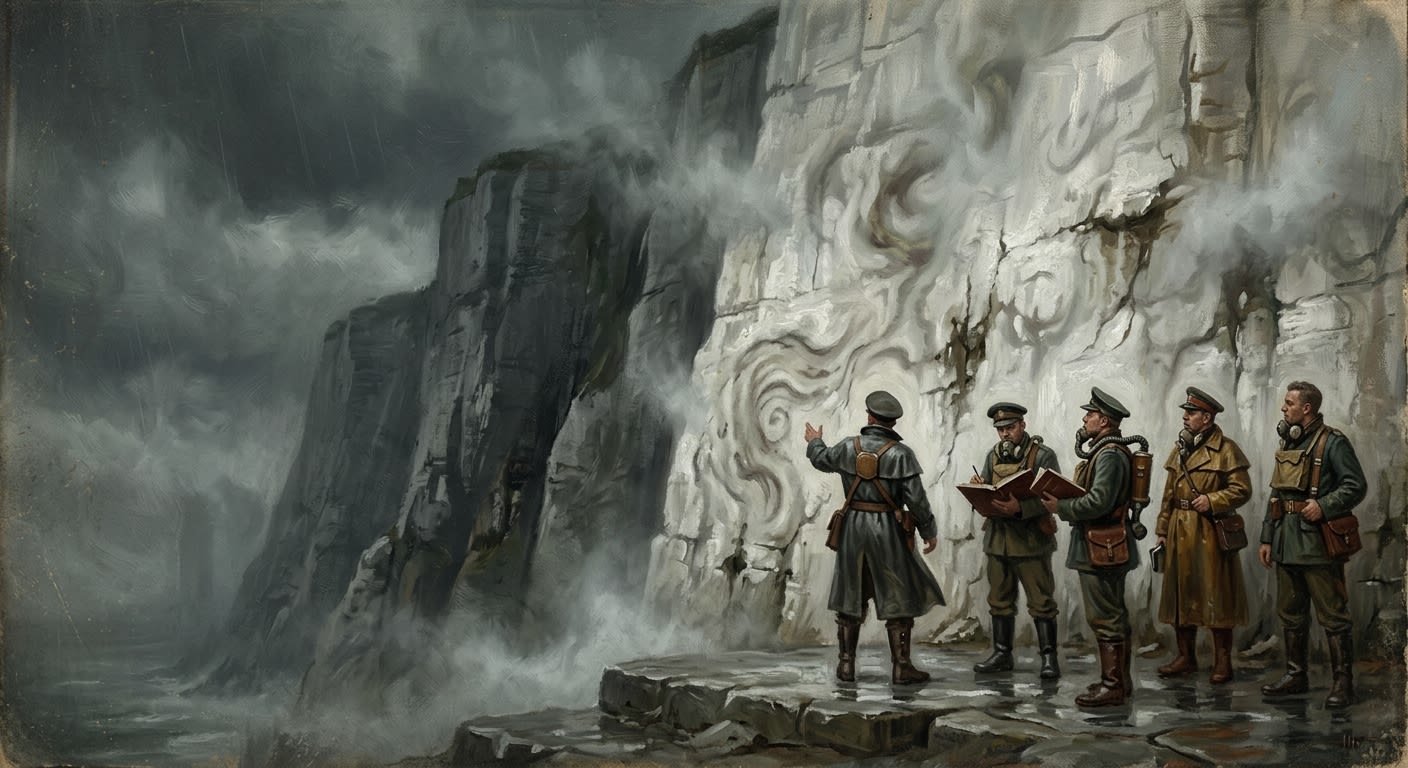
The Script Wall is seventy feet of exposed chalk at the Chalk Redoubt of Calais, between the Gun Galleries (Unregistered) and the Crownline (Unregistered), facing the Channel (Unregistered) with the clean white arrogance of stone that has not yet learned shame. On clear nights it is cliff. On fog nights it is a ledger.
The Bureau of Doctrine calls the Wall a Category Three Acoustic-Relic Event. The Bureau of War calls it a coastal hazard requiring voice discipline. The Salt Tribunal calls it evidence, provided the name is copied twice, witnessed, sealed, and entered before the letters sink. The locals call it the Name-Cliff, which is more accurate than all three and so unsuitable for official use.
Names form when fog beads on the chalk. The moisture darkens in strokes, curves, bars, ligatures, whole lines of script drawn from condensation rather than ink. No hand writes them. No chisel marks them. They arrive as if the stone sweats literacy.
The first verified manifestation followed the Great Breach of A.S. 71, when things from beneath the Channel forced the sea caves, drowned hundreds, and were driven back by an improvised bell-choir using signal bells, powder ladles, cracked cannon rims, and one chapel handbell now locked in the Index Damnatus for excessive acoustic efficacy without license. The harbour went still. The fog rolled over the blood-wet quays. The Wall wrote.
#On Haller's Fourteen Names
The sentry Haller (Unregistered) gave the first usable report. He was posted midnight watch beneath the Crownline, under orders to observe the cliff for seepage after the Breach. He saw letters appearing in the fog-water: fourteen names in a narrow, disciplined hand, left to right, top to bottom, as if the cliff had attended a Bureau of Records penmanship course and resented the curriculum.
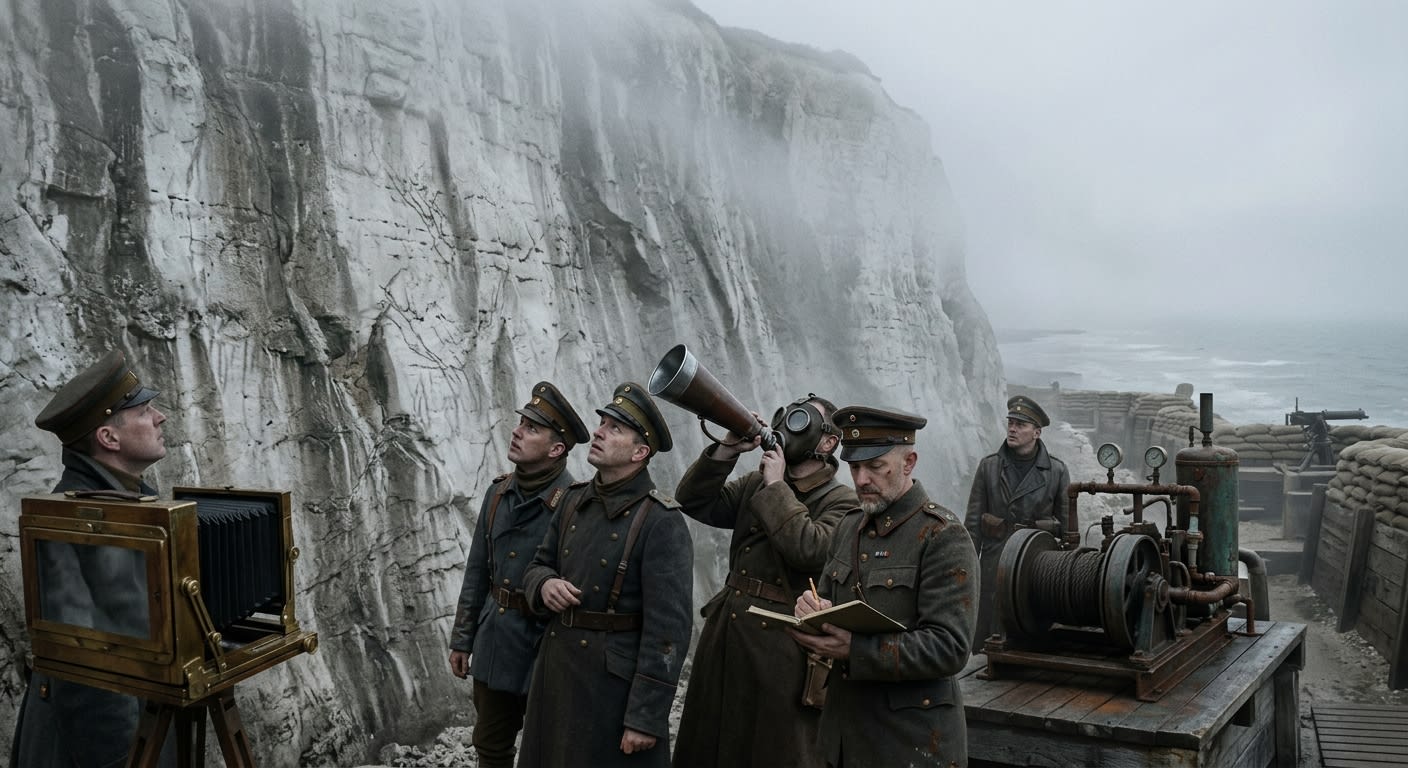
Haller read them aloud. That detail saves him from the contempt normally due to men who discover miracles and fail to fill the proper forms. He had no protocol, no priest, no superior officer within shouting distance. He saw names. He spoke them. By morning the letters faded and six of the fourteen named had drowned in calm water.
The other eight survived. This has troubled the Bureau ever since, because survival complicates a theory more efficiently than death. Six deaths suggest curse. Fourteen deaths would suggest execution. Eight survivors suggest selection, bargain, error, mercy, or appetite. The Bureau prefers categories that do not salivate.
The A.S. 83 digest, prepared long after the event by clerks who disliked the messiness of Breach chronology, incorrectly stated that the first names appeared fourteen years after the Redoubt's founding. That formulation survives in several training sheets. It is tidy, pious, and wrong. The first verified chalkscript followed the A.S. 71 Breach. Later cataloguing by the Bureau of Records mistook administrative recognition for birth, as clerks so often do with children, disasters, and institutions that should have been strangled in their cradle.
Previous Coastal Digest summaries dated the first Script Wall manifestation to A.S. 83.
Corrected under Doctrine Review A.S. 201. A.S. 83 marks the first standardized reading register, not the first writing. The Wall wrote in A.S. 71. The Bureau did not become aware in the official sense until it had invented a drawer suitable for the fact.
#On the Reading
The reading is Calais's central rite, sentence, tax, theatre, and wound. When fog descends, the Fog Bell Tower strikes three short, one long, three short. Readers assemble at measured intervals along the Wall. Lantern-bearers stand behind them, angled so the light falls on chalk without throwing reader-shadow across the letters. Chalk Scribes kneel with waxed slates. Doctrine copyists stand behind the Chalk Scribes, because the Bureau trusts no copy that has not been copied again by someone more frightened.
Every name must be spoken clearly. Every name must be entered. Every hesitation is marked. Every mispronunciation is corrected by the nearest senior reader, except when the Wall alters the letters mid-syllable, at which point the reader must complete the first reading, wait one breath, and read the correction. The correction is entered in red.
If a name goes unread, it sinks. The letters darken, bead, and withdraw into the chalk. The reader hears — or claims to hear, which in Calais carries the same operational weight — a small intake of breath from behind the stone. Then the harbour answers. A skiff fails to return. A diver's rope goes slack. A child found sleeping in the Chalk Warrens wakes with saltwater in his lungs. A boat docks with the correct crew number and the wrong faces.
The profession of Fog-Reader is both honour and punishment. Captain Lute Auvray assigns rosters with the precision of a magistrate choosing which prisoner loses which finger. Strong voices are prized. Steady eyes are rarer. Memory is forbidden during duty; a reader who recognizes a name must continue in the same cadence. Three readers have broken rank to run toward the harbour after reading kin. Two drowned. The third was recovered from the Silent Steps, alive, mute, and writing his sister's name on his own tongue with a shard of slate.
INCIDENT RECORD — READING ROSTER 14-F, A.S. 188 Reader recognized name: ██████████████ Relation: daughter Action: abandoned post before final consonant Result: name partially sunk; harbour west-hush began within seven minutes; three lamps extinguished underwater; recovered body count █████ Disciplinary finding: █████████████████████████████████
#On What the Names Are
The simplest doctrine says the Wall names those whom the sea intends to claim. Simple doctrines are tools for children, soldiers, and bishops addressing crowds. The Wall behaves with less courtesy.
Some names belong to those who drown within hours. Some belong to those who disappear from dry rooms. Some belong to the dead, especially lost Divers whose bodies never returned from Cave System Bravo. Some belong to people not yet born; those are filed under Provisional Natal Risk and produce correspondence from the Bureau of Records so beautifully useless that I keep examples for amusement. Some names appear twice, in variant spellings, on separate nights. The second appearance usually changes the fate. The Bureau calls this “orthographic drift.” The readers call it bargaining.
The Wall writes legal names, baptismal names, nicknames, private names, and once, in A.S. 145, a name known only to a mother and a child who had never spoken aloud. The child survived the sink-night and lost his tongue by dawn. Eleven other children in the same ward lost theirs with him. The event is known locally as the Crying Choir (Unregistered), though that name properly belongs to Thessaloniki's drowned anomaly and should not be used in official Calais documentation unless one wishes to be corrected by three Bureaus and a very tired woman in the Bureau of Bells.
The Bureau of Doctrine insists that the Wall does not prophecy. Prophecy would require theological authorization. The Wall records probable maritime risk in acoustically sensitive condensation patterns. The sentence is an offence against language, but it keeps three departments funded and four inquisitors dry.
#On the Undertide's Appetite
The relationship between the Script Wall and the Undertide is officially coincidental. So is smoke near a pyre, blood near a scaffold, and the sudden promotion of a clerk whose superior fell down stairs after questioning a seal. Coincidence is the Bureau's most loyal servant.
The Undertide gathers during active readings. The Divers hear tapping from inside the chalk. The Teeth breakwaters hum when multiple names sink. Lanterns draw shapes near the harbour mouth, yet without lanterns the readers cannot see. Bells repel the entities, yet the first bell that drove them back preceded the first verified writing. Sound saves Calais. Sound feeds Calais. Sound summons what sound must then drive away.
Brother Vell of the Unread (Unregistered) built his heresy upon that contradiction. His followers claim every spoken name stabilizes the mechanism; every reading lowers a hook into the Channel; every voice on the Wall is bait with a pulse. They hold up blank pages at dusk and refuse to read. The Bureau beats them, arrests them, conscripts them to quarry service, and files their silence as sedition.
The Bureau condemns the Unread hypothesis. The Bureau also forbids private comparison of reading density with Undertide movement, impounds chalk rubbings, controls roster records, and keeps three drowned cabinets of inadmissible evidence beneath the Salt Tribunal. Truth, when inconvenient, is stored below sea level.
Coastal Doctrine Circular 22-A stated that no evidence supports claims of causal relation between reading protocol and Undertide movement.
Clarified A.S. 201: no admissible evidence supports such claims. Inadmissible evidence remains inadmissible by virtue of being stored in cabinets which, due to flooding during A.S. 199, can no longer be opened without releasing whatever knocks from inside them.
#On Inland Writing
For one hundred and twenty-eight years the Wall kept to the cliff. This was the consolation Calais offered itself: horror fixed to a surface, bounded by patrol marks, approached with lanterns, read by roster, left behind at dawn. The consolation ended in A.S. 199.
Chalkscript appeared on doorframes in the Chalk Warrens, three hundred yards inland, in tunnels where no fog had ever reached. Names bled through limewash. Plaster sweated syllables. A lintel wrote the same child's name seven times in seven spellings. Scraping failed. Burning failed. Prayer whitened the letters for one bell-cycle and then they returned darker.
The child was removed to the Undertide Pens. The official ground was quarantine. The true ground was that nobody in command wished to sleep beneath a ceiling that could learn a name and practice spelling it.
Since then, inland writing has increased during oil shortages, fog weeks, and after Unread arrests. Commander-Prior Sabelle Morn has requested more lantern oil, more readers, more bell-riggers, and permission to seal boat tunnels used by the Grey Keel Syndicate. The Bureau of War sent a circular praising vigilance. A circular is cheaper than oil and burns less usefully.
Operational status, Calais script events: primary Wall active; inland chalkscript confirmed A.S. 199; doorframe manifestations ongoing; Amber seal maintained.
#On the Present Reading
The Script Wall writes nightly in fog season and intermittently in clear weather when the harbour enters west-hush. The readers are hoarse. The Chalk Scribes sleep in shifts under damp blankets and dream of alphabets. The Salt Tribunal has begun taxing emergency lantern allocations, proving that no anomaly is so sacred that a Bureau cannot attach a fee to it.
The Wall's hand has changed. Older entries are narrow and regular. Recent names swell at the descenders, hook at the terminals, and sometimes join neighboring letters with thin chalk veins that resemble capillaries. The Bureau of Records says script variation is expected in long-running field ledgers. The stone is developing a style. I resent this. Style should be earned by vanity, not damp.
On bad nights the lowest names appear so near the surf that readers must kneel in water to speak them. The Undertide waits beyond the Teeth. The bell-sequences sit in Cantor-Major Pell's locked chart. Captain Auvray points, and the readers read, and the sea listens like a clerk with all the time in creation and an empty line where your name should be.