

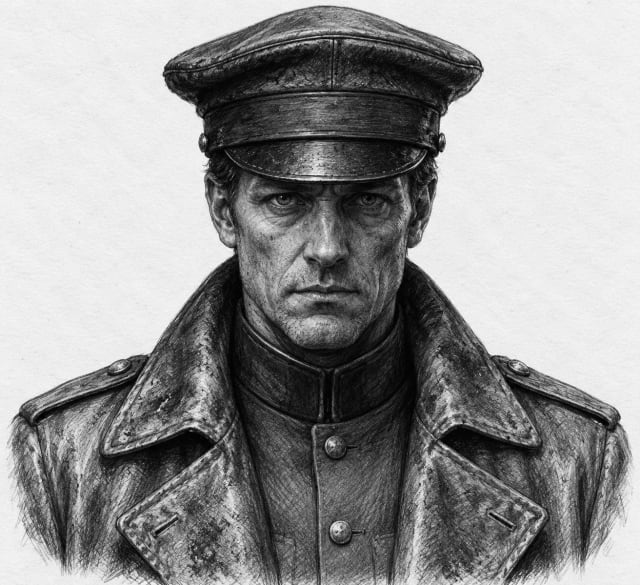
#On Voss's Station
Warden-Doctor Voss is the medical officer of the Quarantine Wardens at Calais. The doctor works in the Undertide Pens, the brine cellars that the annex plans call Quarantine and Recovery Chambers, Coastal Annex 71-P. This entry is a documentary survey of that employment as it stands in A.S. 201 / 1911 CE. The year is the survey's year. It does not date the doctor's birth or appointment. All it establishes is that the doctor is at work now.
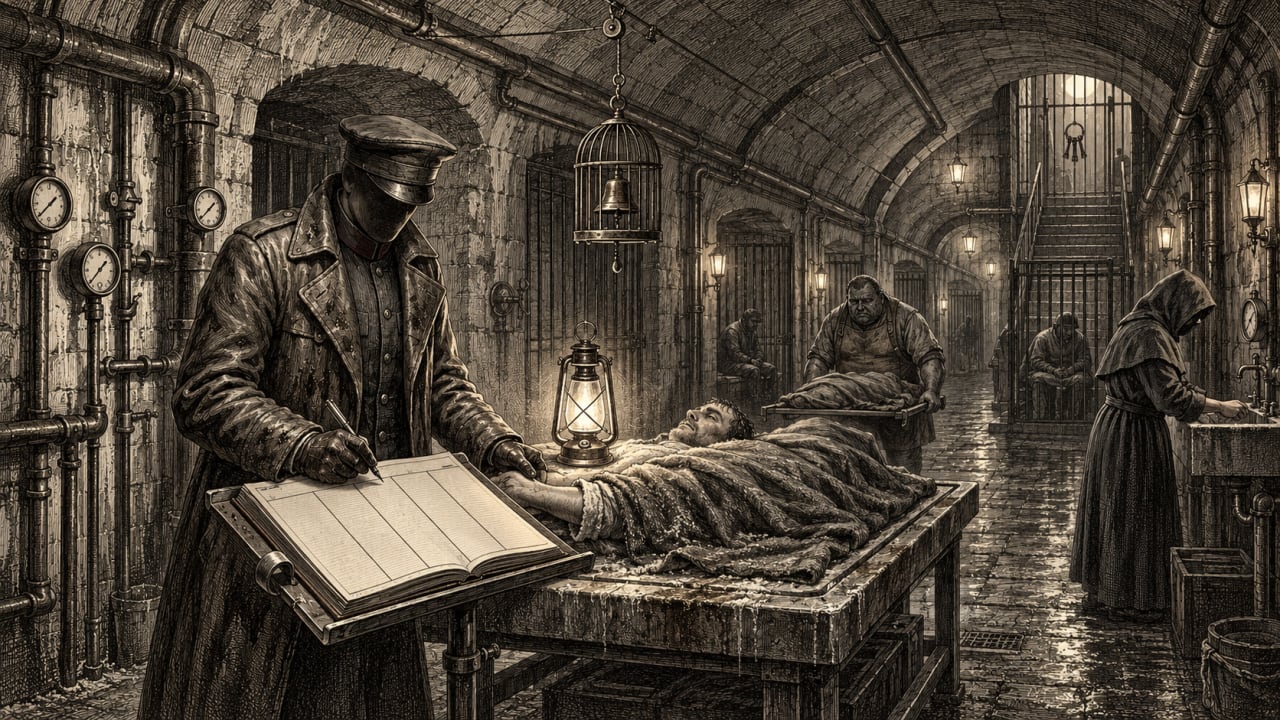
The work is observation. Whatever the Undertide Divers bring up from the caves beneath the Chalk Redoubt ends up on a table below the Net Quays, and at that table Voss writes down five things: pulse, pallor, salt bloom, chalk marking and the recurrence of speech. A good deal of Calais moves on the strength of those five columns. Rooms are assigned from them and nights are counted from them. Families are told something, or told nothing. The Salt Tribunal copies the findings into a ledger that outlasts the patient. Voss writes, and other offices act on what Voss has written.
The Redoubt's own register of factions describes the Quarantine Wardens in a few lines. Their public face is protection against plague. Their methods are cordons, health passes and detentions, and their resources are pens, medicines and guards. Their territory is the Undertide Pens. Under that entry the register names two servants. Porter Bram is strong, afraid. Warden-Doctor Voss is cold mercy. I take the phrase as the register gives it, as a description of manner drawn from the work, and I will not turn it into a diagnosis of temperament. Cold mercy may be the only kind a room like this can afford. It may also be the file's polite name for indifference. The file does not say which, and the doctor has not offered me a confession that would settle it.
The rest of the record is brief. I have found no first name in any file I am permitted to read. Nor is there an age, a parish, a family, a course of training, a year of appointment or an earlier posting. The Wardens' ledger knows Voss by title and handwriting, much as it knows its hook poles by their numbers. I have resisted the temptation to supply a childhood. The Codex already holds enough invented orphans, and clerks wrote most of them.
#On What Comes Up from the Water
The Pens occupy the substructure of the Net Quays, below the pavement of Salt Tribunal Row and above the older cave approaches. One account in circulation puts the annex under the quays and another puts it under the Row. Both describe the same stack of cellars as seen from different stairs. The doctor works in the middle of the stack, with paper above and water below.
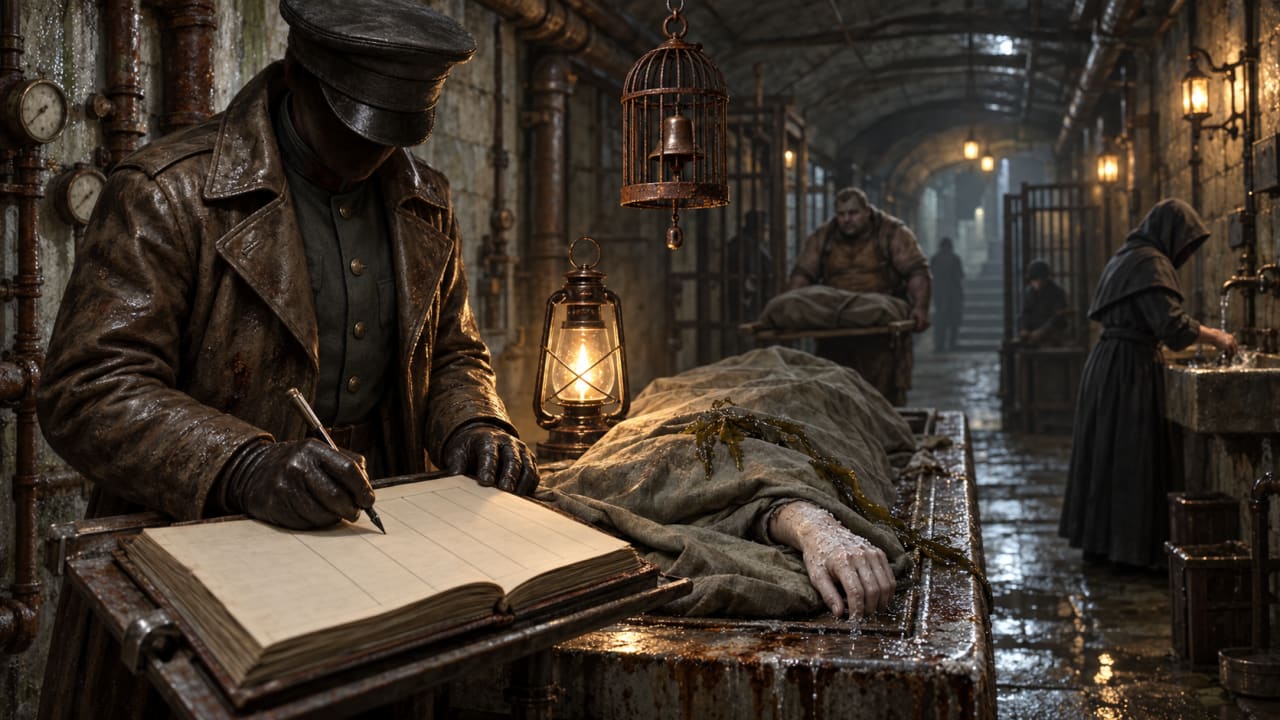
Nothing reaches Voss straight from the sea. A Diver goes down on a witnessed rope with a name-token against the sternum, stamped with legal name, dock name and nearest kin. Before the descent a Quarantine Warden has already examined the eyes, gums and fingernails on the shore. What comes back up is entered under one of the three categories the corps recognizes: body, token, or sealed absence. A sealed absence goes into the casualty ledger and the Wall watch book and needs no doctor. A token that returns without its owner is quarantined as a man would be, and it lies in brine on the object level among nets, knives and lamps. A body comes down the working stair behind the Net Quays, through a door wide enough for a stretcher and low enough that every officer must bow, carried in the arms of Porter Bram.
The Divers' file describes these returns more frankly than any Chapterhouse circular. Some come back bloated. Some come back dry, and the wardens fear that more than any amount of water, because the sea has no business returning anything dry. Some come back with kelp packed between the teeth and another person's ring clenched in the fist. Some come back whispering names through closed mouths. The doctor's work begins when these facts are lying on a slab and have to be written up as entries.
The rooms are laid out for that purpose. Every intake goes through the Salt Vestibule, where it is stripped, rinsed, named and weighed. The Body Rooms below hold chalk-lime slabs, iron drains and a small bell-cage over each table, so that a body which moves rings its own alarm. The rules posted on the Body Room wall read Token before face. Bell before knife. Salt before prayer. Those three lines set the order of the doctor's day. The name is taken first, the precaution second, and only after both does anyone put a hand on the body.
A body from the Undertide gives a physician no simple object to examine. A drowned man on an ordinary coast offers one cause, one death and one burial order. The bodies that reach Voss are less obliging. One is dead and dry. Another is cold and still answering. The Pens' own account records a barrel from the first recovery night that held one drowned watchman's head in the evening and two by morning, both claiming the same teeth. Medicine has no column for that, and nobody asks the doctor to invent one. The doctor's task is to write down what is there.
A Coastal Chapterhouse commemorative plate states that the Undertide Pens were "designed in advance as a rational quarantine improvement."
Corrected. The Pens began after the Great Breach of A.S. 71. Recovery crews on the Net Quays sorted the dead and the doubtful into lime barrels, and a sergeant had the barrels carried into the old net-drying cellars under what would become the Row. A clerk chalked temporary holding over the lintel. The design came after the barrels. I have found no record of when the annex first placed a doctor's desk among them, and the plate does not say either, although its wording implies the desk was planned from the start.
#On the Five Observations
Pulse is the first column, and the most easily misread. Recording a pulse does not certify that the patient is alive. The column must be filled for every return, including the ones carried down under wet cloth with no hope attached. The doctor's entry for a corpse is as much an observation as the entry for a diver complaining of the cold. In the Pens the column also has to accommodate stranger results. A body that ought to have no pulse may have one. A diver who ought to have a strong one may have a slow one. The form does not ask the doctor to explain either. It asks for the count, or for a note that there is none, and then it moves to the next column.
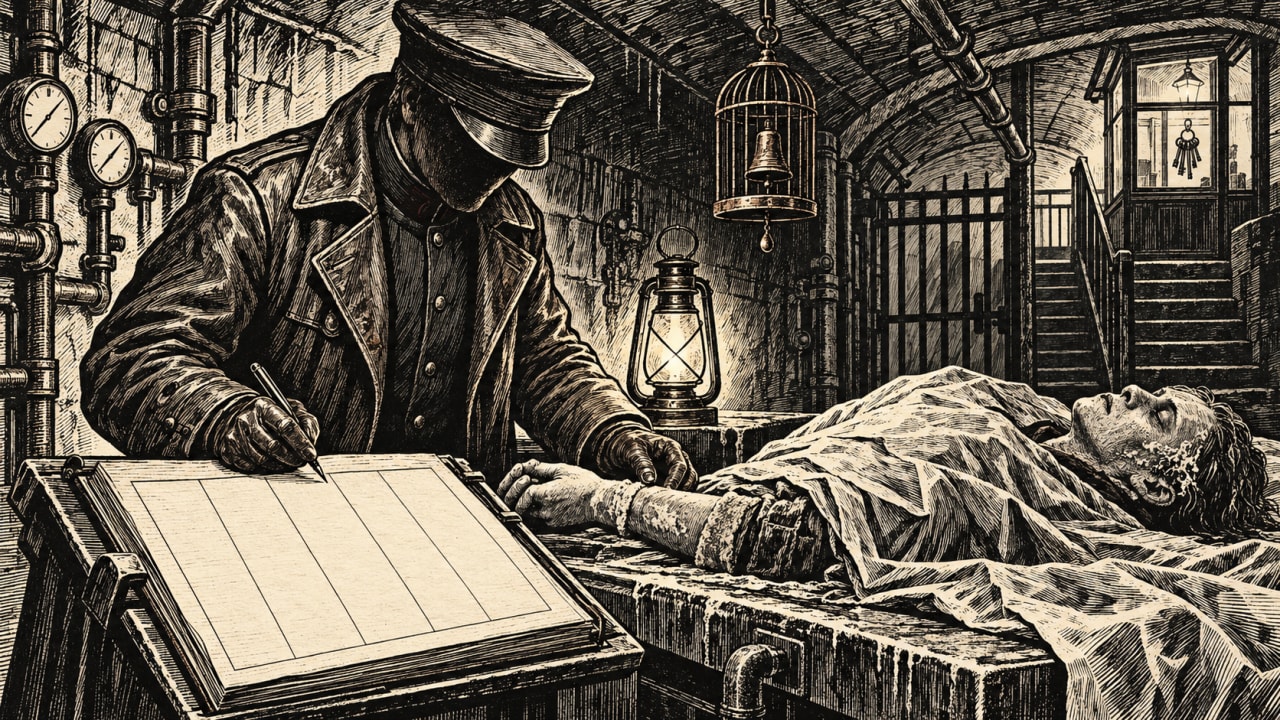
Pallor comes next. Calais is a city of chalk dust. The Chalk Warrens cough white, children carry lime in their hair, and nobody living below the Lantern Stair can remember a ruddy face. The column records pallor all the same, and its usefulness is in comparison. The face at intake is set against the face at the next bell, and the returned diver's colour against the colour noted before descent. No file I have read gives a threshold, and I will not supply one. Voss writes down what the face shows.
Families fear the salt-bloom column most once they learn it exists, because the word sounds like a sentence passed. It is only an observation. The sea leaves salt on everything it touches, and the Pens' intake accounts describe returns that arrive salt-bloomed. The doctor records where the bloom lies and how heavily, return by return. It might be ordinary brine residue, or a sign of the Undertide, or something the Bureau has not named yet. The column cannot say which, and the doctor has no licence to decide. As later sections show, the Tribunal does not wait for that question to be answered before making use of the entry.
Chalk marking is the most purely Calaisian of the five. The Script Wall has written names in chalk since the Great Breach of A.S. 71, and the first standardized reading register followed in A.S. 83. Since A.S. 199 chalkscript has also appeared inland, on doorframes and lintels in the Warrens, well away from the cliff face that once seemed to keep it to itself. A return that comes back carrying chalk marks therefore interests more than one office. Voss records the mark. If the mark speaks, writes, or refuses to fade in the ordinary way, Doctrine records its own interest on its own paper. The doctor's column makes no claim about where the mark came from, whether the caves, the Wall, the recovery rope or the porter's sleeve.
Speech recurrence is the last column, and the one most likely to bring in another office. Some returns whisper names through shut mouths, and when that happens the wardens send for a Chalk Scribe. The work is divided exactly. The Scribe listens and copies the names. Voss records the recurrence itself: that speech came, that it came again, and what state the body was in each time. The Scribe's duty stops at the slate, and the doctor's stops at the medical entry. No Pens procedure I have seen treats either the copying or the recording as a cure, or as a rite of expulsion. The Chalk Scribes' own file calls their part attendance.
Entries in this column last a long time. A whisper copied down in the Pens can outlive the person who whispered it. The names go into one ledger and the medical fact of their recurrence into another. The Salt Tribunal can consult both long after the patient has gone home, or been transferred, or been entered as a living absence.
#On the Hands Around the Examination
The Pens divide their labour among people who seldom agree and are never asked to. Bram carries the bodies and Voss records and assesses them. The Chalk Scribes copy, and the Brine Sisters wash. Chief Warden Mavet Rusk commands the annex. The Synod Coastal Chapterhouse issues the quarantine writ and supplies the guards. A bell observer from the Gunline Choir attends the bell-cages on rotation, and a Doctrine observer attends whenever an object speaks, sings, writes or fails to decay. Behind glass sit the clerks, copying wet facts into dry columns in the small, heavily pressed letters the annex calls the Pens Hand.
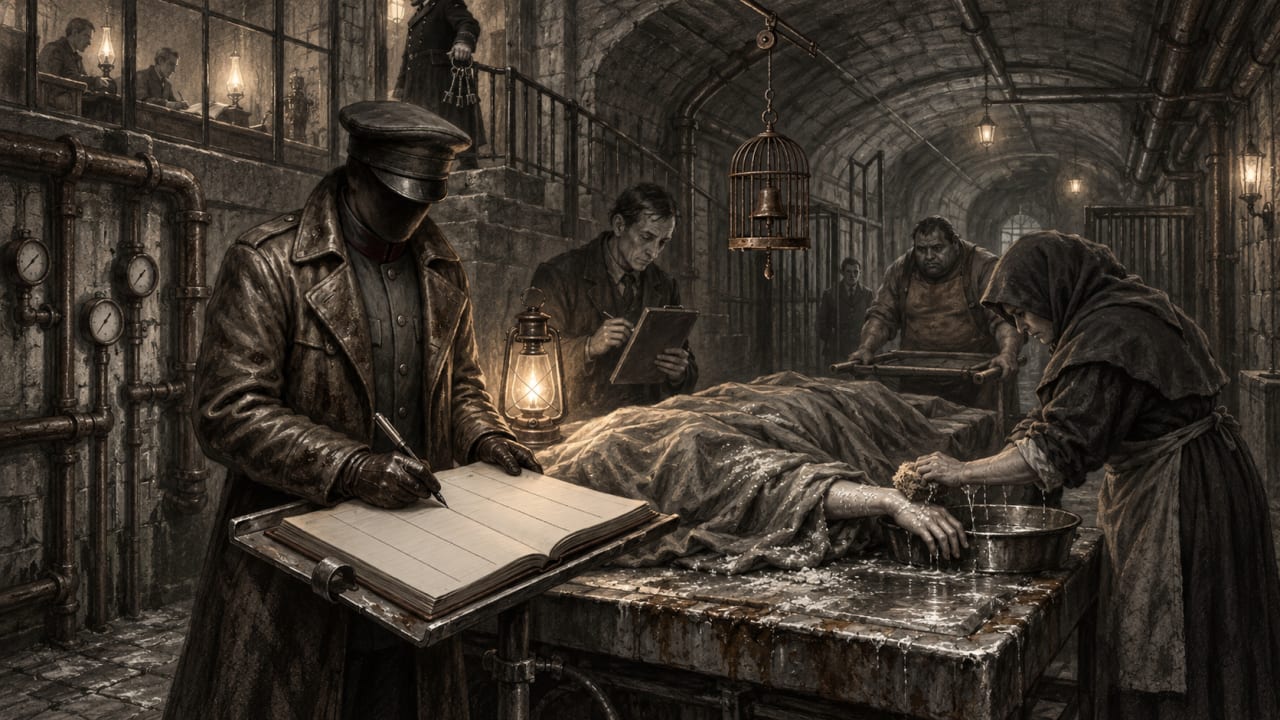
Porter Bram's file draws the line between carrying and assessing more sharply than any regulation does. The porter holds the body and the doctor holds the pen. Bram is recorded as having no authority over diagnosis, holding or release. Nothing in the doctor's record shows the medical office lifting anything heavier than a slate. In my dossier on Bram I wrote that only the pen can change what a body officially is. That was administrative commentary, and I stand by it on those terms. When the doctor writes dry, marked or recurrent, the room, the watch and the count of nights follow from that word. It does not follow that Voss decides what the returned thing really is. The Pens have no office for that question, and the doctor has never claimed to hold one.
The Brine Sisters are a hereditary work-guild of women from the Warrens. They are daughters of net-washers and granddaughters of the women who washed the quarry dead, and their present contract has them wash whatever comes out of the Pens without asking whether it was ever human. Visiting pilgrims take them for a religious order. They are not one, and their patron has no name. They handle the body before the doctor sees it and again afterwards. They can tell which bodies were loved from the mending on the clothes, and which divers expected to die from what was tucked inside the suit. None of that enters the doctor's columns. The Sisters guard their gossip more closely than the Choir guards its master chart.
Rusk commands and Voss serves as the annex's medical officer. I have found no document that sets out the exact relationship between those two posts, and I will not invent one. I can record two things. The Chief Warden sends Tribunal writs back damp when they lack a quarantine countersign. And nothing in the doctor's file grants the doctor power to countersign them.
#On Three Nights, Seven, and Thirteen
This schedule is part of the Divers' procedure. It is recorded in their file and repeated in the Chapterhouse's account of divided custody. The doctor's observations feed it more often than anything else, and it covers less than the families on Salt Row suppose. It applies only to recovered Divers. The other detainees in the Pens answer to other cordons and other counts: sailors taken off sick ships, households named in taint reports, a child removed from a lintel in the Warrens. The schedule is no medical law. It fixes the minimum watch the Wardens owe a returned Diver, and its last night unlocks nothing.
The first clause is plain. In the ordinary case the hold is three nights. The returned Diver lies under a lamp in the Living Rooms, answers the name-calls at each bell, and is watched through the slits. The doctor fills the five columns, and then fills them again.
The second clause depends on what the Diver reports. If the Diver heard bells below, the hold is seven nights. The bell might have been a rope bell, or a Choir tone carried through the rock, or something with no clapper listed in any inventory. The procedure does not ask which. A Diver who reports bells is held four nights longer, and each of those nights the doctor records pulse, pallor and salt in the same columns as before.
I cannot stop rereading the third clause. If the Diver's name appears on the Wall while the Diver is already present in the room, the hold is thirteen nights. The clause has nothing to do with an earlier appearance, a namesake, or an entry from some past fog season. It concerns the present. A recovered man lies in the Pens, stamped in and breathing, under the doctor's observation, while the readers kneel in the surf below the Wall to pronounce the last letters of his name. The Pens keep one record of him and the Wall keeps another. The procedure does not choose between them. It adds ten nights and leaves the lock to keep the question.
Medicine cannot say which record is wrong, and nobody asks Voss to try. What the doctor is asked, night after night while the chalk keeps writing the man's name, is whether he still shows the same pulse, the same pallor, the same salt and the same silence. Those are the only questions the five columns can put to such a case. They are small questions. Thirteen nights of asking them would wear the certainty out of most men, physicians included.
Two other counts are in circulation, and neither belongs to this schedule. The Pens' own account says that most returned divers leave the Living Rooms after three days and some after nine. I give those figures as that account states them. I will not convert days into nights, and I will not invent an exception to explain the nine. The Object Rooms keep separate watches of three, nine and forty-one days, for physical reaction, name correlation and bell response respectively. Those watches are for nets, lamps and buttons. They have never governed a patient, and no clerk should apply them to one.
#On Clearance and the Right to Leave
Clearance and release are separate acts. The families waiting at the public arch learn the difference at their own cost. The Salt Tribunal's file states the possible outcomes plainly. A detainee may be cleared by Warden-Doctor Voss and then held on a Tribunal objection. Or the detainee may be released because the Chapterhouse needs him, then seized again by Purity. Or the detainee may simply be lost between offices, under an annotation too small for grief to find. The doctor's clearance is a medical opinion that the observations no longer call for the patient to be held. It is not a key.
Release requires three seals. The annex falls under the Chapterhouse's jurisdiction, with a Tribunal counterseal and an attached Doctrine observer. The rule recorded in the Chapterhouse file is short enough to be cruel. Any one signature can hold a detainee, and no office can release one alone. So the doctor's assessment may support clearance while the cleared patient stays in the same room. The cause might be a Tribunal objection in a passage dispute, a Chapterhouse writ issued for its own reasons, or Doctrine's interest in a mark. I have found no fixed order for gathering the signatures, no deadline for appeal, and no form that decides which office prevails. I invent none.
The Row deals in papers and the Pens deal in bodies, one above the other. The Row's own description measures the distance between them in stairs, fees, medical vocabulary, and whatever Voss has written on a form the family is not allowed to see. The Tribunal controls the release papers. Families pay for docket visibility, meaning the privilege of keeping a name on the page long enough for someone to argue about it. At the clean arch on Salt Row a clerk is employed to tell relatives that there is no visitation, and that clerk does not consult the doctor first.
The clearance still has value. No sensible officer will release a patient the medical officer has not cleared. An objection against a cleared man at least has to be written on some other office's paper. The doctor's signature narrows the argument even though it cannot end it.
#On Ila's Visits
The clearest surviving example of Voss observing someone other than a patient concerns Ila "Kelp", second to Diver-Captain Sain among the Black Lungs. Ila spends a good deal of off-roster time near the Pens. Warden-Doctor Voss has reported this twice.
The two reports describe frequent visits. Two reports do not mean two visits, and I have not seen a tally. The observation note that survives records what was seen: Ila repairing rope in the outer passage, listening, humming without a tune, and eating salt bread. Its list of known contacts names Warden-Doctor Voss, Porter Bram, and sealed rooms three, seven and nine. Its instruction reads tolerate pending operational review. Ila has said the Pens are easier to hear from shore because the water "muffles the lies." Records classified the remark as metaphor and Doctrine classified it as possible testimony. Neither office has resolved the difference.
The surrounding reports must stay with their own witnesses. A quarantine warden, who is not identified as the doctor, heard Ila's laugh from behind a Pens door while she stood in the corridor eating bread. In A.S. 199 a chalk composite disappeared from a cell that stayed locked from the inside. Ila was underwater at the time, and her laugh was heard in the corridor. The Bureau of Purity opened an observation request on her that year. Nothing in the file says that Voss started it. None of these reports establishes a mechanism, a culprit, or any part played by the doctor.
What the two reports do establish is attention. The medical officer saw a Black Lung keeping vigil outside the medical officer's own rooms and sent the observation up the chain twice. Someone above decided to tolerate it, and I cannot see any trace of the doctor in that decision. Whether Voss regards Ila with suspicion, gratitude, professional curiosity, or the weariness of a physician whose corridor has acquired a lodger, the file does not say.
#On the Ledger Beyond the Pens
According to the Chalk Warrens file, Warden-Doctor Voss keeps ledgers of taint, and the Grey Keel Syndicate buys copies. The Tribunal denies the ledgers are marketable, then prosecutes those who buy them without paying the proper fee. Each of those three statements has a different subject, and I report them that way. The file does not say who sells the copies. Nor does it say how they are made, who carries them, what they cost, who receives them, or whether the doctor knows they exist. I accuse nobody of the sale. Pens' paper passes through clerks, runners, Tribunal desks and a counterseal before it reaches any buyer, and in Calais every one of those stages is damp.
The Tribunal keeps a wider ledger under Salt Row, and it holds more than medicine. It records detainees' marks, salt blooms and speech recurrences, and it also records their kin, their debts and their useful shame. I will not credit every column of it to Voss. Some columns plainly started at the doctor's table. Others started in confession booths, debt courts and pass queues. The ledger's declared purpose is to stop contaminated people from moving. In practice it is blackmail written in medical vocabulary. The Tribunal's own file gives the case of a fisher released after thirteen nights in the Pens, who can expect to spend ten years paying to keep his children from learning what he said through his teeth while the Chalk Scribes listened.
Quarantine reaches far into the Warrens. The Wardens and the Bureau of Medicine claim health authority over anyone exposed to black brine, chalkscript, wrong-water, Undertide tissue or a name-sink, and over anyone officially suspected of having been near one. Below the cliff it is worth bread to know who has been marked. Knowing who will be marked is worth a door left open during curfew. The doctor's columns were written to describe a body, and they end up deciding marriages, debts and rents.
So the Redoubt's poor fear quarantine more than drowning. Drowning closes a person's account in the ledger, while quarantine opens a new one. The physician whose five columns begin that account does not run the market in it, has never been shown to profit from it, and cannot stop it. Voss keeps the ledger, and others profit from it.
#On the Present Medical Watch
As of A.S. 201 the Pens hold more than they were built for. Inland chalkscript, confirmed in A.S. 199, has multiplied the dive orders. Lamp oil is short, so readings run longer. Longer readings draw more movement beneath the Teeth, more Divers go down, and more of them come back for the doctor to examine. The Black Lungs are understrength. The annex is over capacity. Body Rooms Two and Five share a single bell observer, and object trays are stacked in breach of the annex's spacing rules. The Living Rooms turn patients over too quickly during convoy weeks. Commander-Prior Sabelle Morn has requested quarantine surgeons along with oil, iron, riggers and divers. The Chapterhouse ledger lists that request as pending.
The cases themselves have also changed. This season a child was taken into the Pens under quarantine writ after inland names appeared in seven spellings, and he is held under the writ's wording. I have not found in any file the name of the officer who examined him, and I have not supplied one. The pressure on the medical office does not show up as a misconduct finding, a reprimand or a reform. It shows up as more slabs, more columns, more nights counted in threes, sevens and thirteens, and the same five questions asked of more bodies in less time.
Neither the doctor nor the doctor's form can say whether the five columns are enough. They describe what can be seen on a body that the sea has handled. They cannot describe the sea's reasons for handling it. Calais has hired a physician to keep an accurate account of an illness nobody has named, and has then shared that account among the Tribunal, the Chapterhouse, Doctrine and the smugglers in the tunnels. At the table below the Net Quays, Voss still writes: pulse, pallor, salt, chalk, speech.