
#On the Work at the Wall
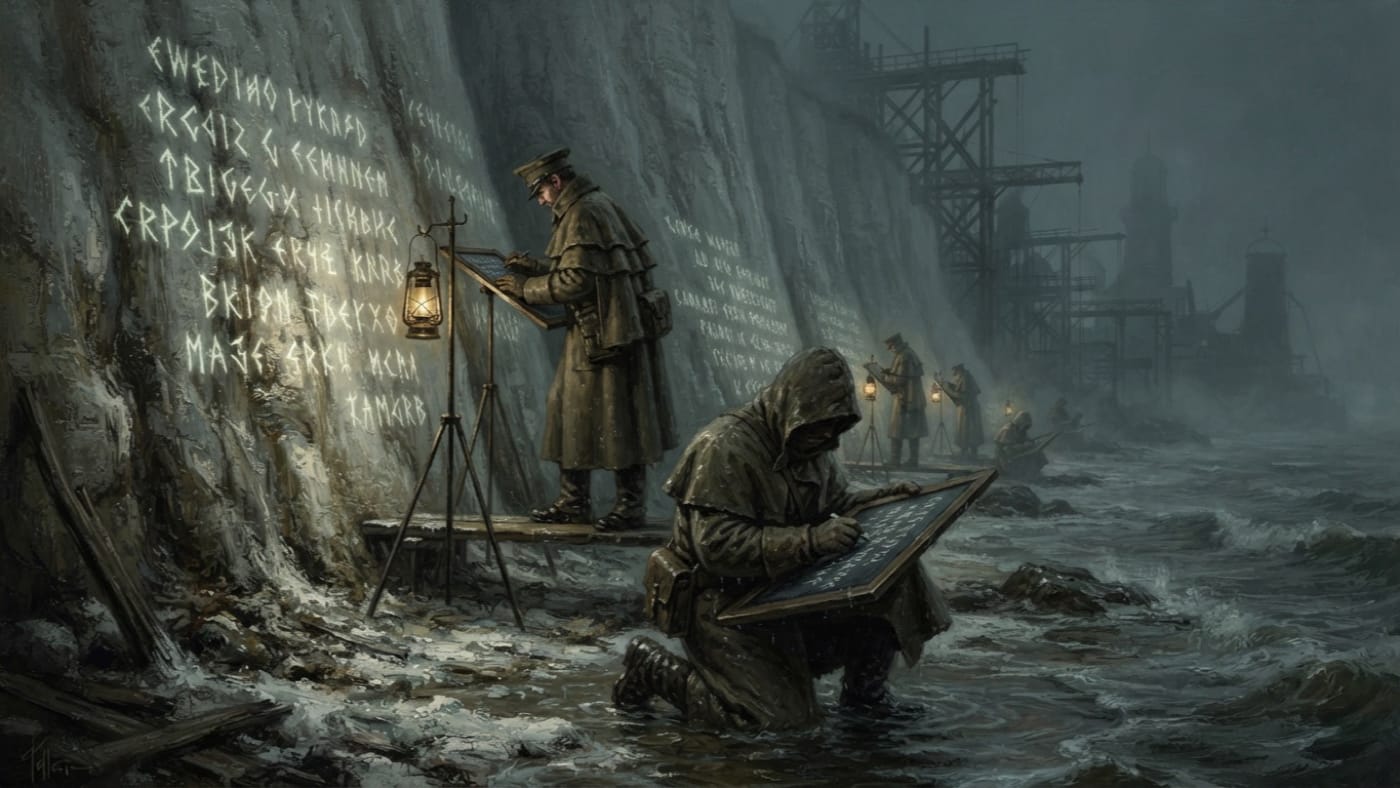
The Chalk Scribes of Calais kneel. This is the first thing to know of them, and in most official correspondence it is also the last. When the Fog Bell Tower strikes three short, one long, three short, the readers walk to their measured stations along the Script Wall and the Scribes go down onto wet chalk with waxed slates across their thighs. They copy what the fog has written. The reader gives the voice. The lantern-bearer gives the light, held low and to the side so that no reader's shadow falls across the letters. The Scribe makes the field copy. Behind the Scribe stands a Doctrine copyist who copies the copy, because the Bureau has never trusted a record made by only one frightened person.
Every name is served by three people: one to say it, one to write it down, one to write it down again. The Wall takes no notice of any of them.
The local survey of Calais types gives the Scribe a single line, saying that the Scribe copies the Script Wall into ledgers for the Tribunal. I have read longer epitaphs for horses. The line is accurate. What it leaves out is that the ledger in question decides who may board a boat, who is held below the waterline, and whose alias dies before its owner does.
Older Redoubt summaries, and several training sheets still handed to new copyists, date the first Script Wall manifestation to A.S. 83.
Corrected. The Wall first wrote after the Great Breach of A.S. 71. The sentry Haller read fourteen names that night with no one kneeling to take them down. A.S. 83 marks the first standardized reading register, the year the Wall acquired clerks. By then it had been writing for twelve years.
#On the Name and Its Corrections
Reading Protocol 9-C sets the order of work: left to right, upper chalk to lower. The reader must speak each name loudly enough for the second scribe to hear it. It is the only place the protocol admits the Scribes exist, and it treats them as a unit of volume. Every name is entered. Every hesitation is marked. When a reader mispronounces a name, the nearest senior reader corrects it, and the Scribe enters the name as corrected.
The difficult nights come when the Wall changes its letters partway through a syllable. The reader must finish the first reading, wait one breath, and then read the new form. The Scribe keeps both. The first version stays on the slate where it fell, and the correction goes in red beneath it. A good field copy from a bad night looks like a quarrel between two hands, and the Scribe is required to take neither side.
A Scribe takes down a name in the cadence of someone else's throat, on wax that chills the fingers, by lamplight that has been angled to serve the chalk and not the copyist. On the worst nights the lowest names form so near the surf that readers kneel in seawater to speak them. The Scribe kneels behind the reader in the same water and keeps the slate dry by holding it higher than the arms would choose.
Whether a clean copy makes any difference to the sea, no office will say. Reading is mandated because names left unread are observed to sink, and sunk names are followed by losses in the harbour. Reading, however, has never promised survival. Six of Haller's fourteen drowned after he read them aloud. The Scribe's accuracy serves the ledger, which shows what was copied and never whether the copy saved anyone.
The Silent Steps near the Wall forbid speech under penalty of the cudgel, but their code allows a Chalk Scribe to repeat a consonant. The allowance is exact, and the monks who enforce it are just as exact.
#On the Copy That Reaches Salt Row
Before dawn a Tribunal runner collects the slate abstracts, wraps them in waxed cloth, and carries them through the runner slit into Salt Tribunal Row. Clerks there check the night's names against pass applications, debt ledgers, tide-files, quarantine rosters and the Grey Keel suspicion lists. Registrar Yve receives them without looking up, as every document in Calais is received.
What the Scribe entered now becomes evidence. If a name appeared on the Wall, the holder's sea pass can be suspended. A name that half sank can bring a quarantine hold. A name that appeared twice can expose an alias. A variant spelling can lead to a hearing so delicate that no clerk will sit near the door. A hesitation mark is a single small stroke, and a lawyer for the Salt Tribunal can make a great deal of it.
The Scribes provide the evidence and nothing more. They grant no passes and release no one. Their slates go up the stairs and the decisions come down from Seal-Justice Hald's clean window.
The Tribunal condemns the trade in edited names. In that trade a letter is darkened before it is read, a lantern shadow clips a surname, or a misheard consonant is kept because correcting it would implicate somebody's cousin. The Tribunal also profits from correcting such edits, fining them, and now and then letting them pass. Anyone can see that a Scribe's hand is the one point where a consonant might slip without a witness. I have found no finding entered against any Scribe by name. I have found a great many entered against consonants. Ordinary abstracts circulate under seal. True Wall rubbings are restricted, not for sale, and impounded whenever found. They are sold anyway.
#On Names Heard Below
The work also goes below Salt Row, into the Undertide Pens. Some of the bodies and detainees brought back from failed dives return dry, which frightens the wardens more than soaking does. Some of them whisper names through shut mouths, and the wardens send for a Chalk Scribe.
Nobody has written down what the Scribe is expected to accomplish there. The Scribe listens and copies. Warden-Doctor Voss records pulse, pallor, salt bloom, chalk marking and recurrences of speech, and those observations go into the Tribunal's taint ledger. Medical custody remains with Voss. The Scribe's office ends at the slate. No Pens procedure I have seen treats the copying as a cure, a rite of expulsion, or even a complete transcription. It treats it as attendance.
A whisper taken down in the Pens can outlast the person who whispered it. Families have spent years paying to keep their children from learning what a returned father said through his teeth while the Chalk Scribes listened. The Tribunal holds those words under medical headings. In practice they are leverage over the family.
Lost Divers often appear low on the Wall within seven nights, written so near the surf that the descenders sit under water. A body may be lying in the Pens while its name forms on the chalk above. The two copies go into different ledgers, and as far as I can find, no clerk has ever been told to compare them.
#On the Refusal to Enter
The Unread Uprising of A.S. 187 tested what a Scribe owes, and to whom. At dusk forty-two registered readers held blank paper over their mouths. Lantern-bearers turned their lamps toward the harbour. Two Chalk Scribes entered no names at all. Each of them made a vertical stroke on the slate for every person standing silent beside them. By second bell the Wall had written thirty-one names. By third bell nineteen had sunk. The harbour fell into west-hush before midnight, and the Gunline Choir struck Sequence Three. No major breach followed.
The strokes differ from the Unread's blank pages. A blank page refuses the record. A stroke enters the refusal in it, one mark per closed mouth, in the field copy that the Tribunal would later read. The two Scribes declined to copy the Wall and copied the crowd instead. That is a faithful act of an unlicensed kind. I do not give their names here, and I do not claim that the nineteen sinkings were their doing. Forty-two readers were standing between them and the chalk.
The Unread hold that every spoken name is a hook let down into the Channel and that reading feeds the Undertide it claims to hold back. Doctrine condemns the claim, and I set it down here as theirs. Doctrine also forbids private comparison of reading density with movement in the harbour, and it keeps the supporting rubbings in cabinets beneath Salt Row that hum when the fog comes in. A Scribe who has knelt through a long night is unusually well placed to make that comparison. That is a reason to watch the Scribes, and the Bureau watches them.
#On the Present Watch
As of A.S. 201, the Wall writes every night of the fog season and from time to time in clear weather when the harbour goes into west-hush. Oil is short, so the readings run longer. The Scribes sleep in shifts under damp blankets and dream of alphabets. The senior Scribes lodge in the upper cuts of the Chalk Warrens, near the Lantern Stair and the Crownline lifts, above the same Warrens where doorframes began writing names in A.S. 199. One child's name came up in seven spellings. If those spellings are ever to count as evidence, someone must enter each of them as a variant.
The Wall's handwriting has also changed. The older entries are narrow and regular. Recent names swell at the descenders, hook at the ends of strokes, and sometimes join neighbouring letters with thin chalk veins. A Scribe trained on the old hand now copies one still changing, and every new letterform gives Salt Row fresh ground to dispute the copy.
Captain Auvray assigns the throats. Commander-Prior Morn watches from the Crownline. The Scribes are not mentioned in either of their requisitions, and they are still at the Wall every night.