
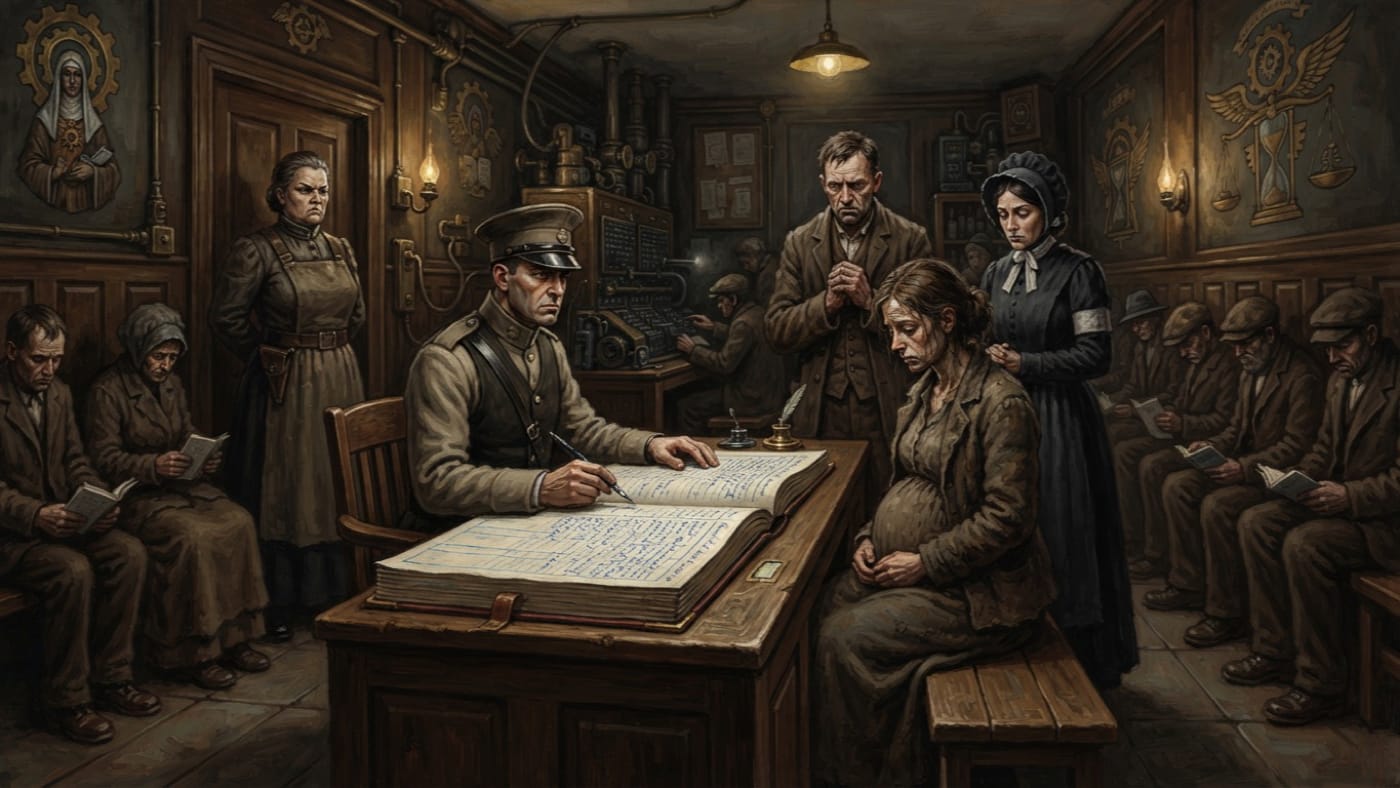
#On the Statutory Occasion
The Cradle Decree created the debt. The Prenatal Assessment Roll is how the debt finds its household. A law without a register is only a sermon, which people can admire, recite and ignore, and the Bureau of Tithes has never paid a clerk to be ignored. The Decree held that a household expecting a child owed dues on that child's projected ration consumption from the date of confirmed pregnancy. The Roll is the ledger in which that household is written down as owing them.
The occasion was famine. In A.S. 157 (1867 by the old epoch, for readers who still count that way) the Iberian campaigns had drained the western granaries. A Bureau facing empty bins does what Bureaus do and moves the date of collection earlier. An infant needs rations after birth, so the provision had to be found before it. The Roll is where "before" was given columns to sit in.
The title misleads antiquarians. The Roll is no scroll. It is a bound ledger, ruled and numbered, heavier than the people written in it would like. The Bureau does its sums at the Palatine Counting House in Strasbourg. Where each volume of the Roll is kept at night this article does not presume to settle. It is enough that each one is opened in daylight under a Route Assessor's hand.
#On Confirmation and Entry
Every line in the Roll starts outside it, on a pregnancy notice. A parish midwife signs the notice, or a licensed medical clerk, or a witness from the district matrons, and it goes to the Route Assessor. From there the matter belongs to ink.
The ink is blue-black. Red was retired from the Roll after the Widow Riot, when Tithes judged it inflammatory. The Bureau will not be accused of writing mothers down in blood, so it writes them in the colour of a three-day bruise. The Assessor dips, wipes the nib on the well's lip, and writes the mother's name first. The household follows. Then comes the expected child, under three designations as fixed as a responsory: Pending Issue, ration class provisional, soul status anticipated.
Doctrine has asked me to make clear that the third designation is a clerk's column and no theological finding. I make it clear. The Roll judges no soul, confers no baptismal standing, and does not suppose that a second debtor waits in the womb with a purse. The column marks an expectation. Expectations are cheaper to keep than verdicts, and they never need a confessor.
The household waits while the line dries. Nobody leaves early, because a smudged entry means a dispute and a dispute means a second visit. The witness stands near the door with nothing more to sign. The mother sits on the bench and reads her own name upside down, in a hand that will outlive the ink's patience. Somewhere behind the desk a receipt blank is counted, because blanks are always counted. The scale stays unused today. It is only a reminder that it exists.
#On Household Calculation
Once the household is entered, the Tithe Assessor calculates. The inputs are the household's current due, the district ration allocation, its prior arrears and its standing in the Burden Index. The decree abstract also names the household roll, the district ration class and the expected term. These are the figures the Bureau admits to. I print no coefficients. They are not mine to print, and an Assessor who recites them aloud is either drunk or under audit.
The household roll belongs to the kind of record Records scribes keep and certify for the Bureau of Records. Ration allotment for a pregnant household passes through the hands of the Mothers of Plenty, who register and provision the same bellies Tithes assesses. The Roll records the figures and says nothing about who carried them to the desk. I follow its example.
The arithmetic is easier to state than to watch. The Pending Issue enters the household score as projected consumption: a future mouth, counted now. The score rises and the due rises with it. The household's history then decides how the debt will be collected. A low Index softens the payment schedule and a high Index hardens it, so the house already behind on salt, chalked for arrears and remembered by escorts is asked to pay soonest and most strictly. The Bureau describes this as consistency, and the description is accurate. The household calls it worse names, and those are accurate as well.
No worked example appears here. A worked example would give a family something to check its own bill against, and the Roll was never meant to be checked from the bench side of the desk.
#On Payment and Future Work
The due may be paid in salt, coin, goods or labour tokens. Each payment brings a sealed receipt, the only proof a household has against a ledger that never forgets. A household that fails to pay receives what any household in arrears receives from the Assessor's ordinary machinery. That can mean an arrears mark, a scheduled seizure, a denied permit or a flag in the registry. None of these belongs to the Roll alone. The Roll only makes sure the Assessor knows which door to visit.
The labour token is how a household with no salt pays with weeks it has not yet lived. It is a brass disc stamped with the household number, the district mark, the gestation certification and the redemption category. The mother signs. The Assessor seals. The Quota Captain records. In that order a present obligation becomes a claim on future work, which can be redeemed through the Bureaus of War and Engineering, licensed factories, laundries, ration kitchens and any contractor whose papers have survived inspection.
In hardship districts redemption can come early, before recovery has been allowed to finish. The Bureau calls the substitution voluntary, a word that applies only while seizure stays the other choice.
#On Concealment and Correction
Once pregnancy became reportable, the bedroom gained a window onto the district office. Midwives now stand between the household and the Roll, reporting by licence or by fear, and any midwife who forgets to report can be reminded by someone else. Concealment invites denunciation. Neighbours learn to read absences: an empty place at the washhouse, a loosened apron, an aunt arriving early with broth.
A concealed pregnancy, once discovered, does not enter the Roll on the ordinary terms. Arrears are assessed back to the probable date of quickening, and a concealment penalty and a confession review are added. Confirmation is the ordinary trigger, and an honest household is assessed from the day it is confirmed. A household that hid is assessed from the day the Bureau decides it should have been found. The difference is a sum of money, and the sum is the point.
Fathers tested the Roll's edges sooner than mothers did. Some filed separation notices before the birth in the hope that the due would fall on the mother's kin. Records closed that route in A.S. 160 with the Presumptive Paternity Attachment. An attempted separation before the birth no longer removes liability automatically. If a man shared the household table during the probable conception season, that can support assessing him. Records does not claim to know who fathered anything. It claims to know who ate. For a fiscal instrument that is the only paternity worth proving.
A nursery catechism issued in A.S. 161 described the Cradle Decree as "a blessing of provision laid upon expectant households."
Withdrawn after parishes began citing the catechism as grounds for petitioning for grain advances. The Roll records what a household owes. Its columns run one way only.
#On Present Application
As of A.S. 201 the Cradle Decree remains active across Synod territory, and the Roll stays open with it. There are three exceptions: districts under plague suspension, districts under siege ration emergency, and households under clerical exemption pending review. The first two are emergencies and end when the emergency ends. The third is a courtesy, and courtesies have no end date.
There is one remission. On 11 Martius, the Feast of Balanced Scales, Saint Ysolt receives petitions, and a licensed Assessor may forgive one approved Cradle charge if it is properly sealed. One charge, one day, one seal. The feast grants no general right of appeal, and it offers no route by which a household might correct its own line in the Roll. It is a remission and nothing more is promised by it. The petitioners know this and queue anyway, and Tithes counts the queue.