
#On the Warm Ladle
“Enough, if obedient.” — Plenty House morning response
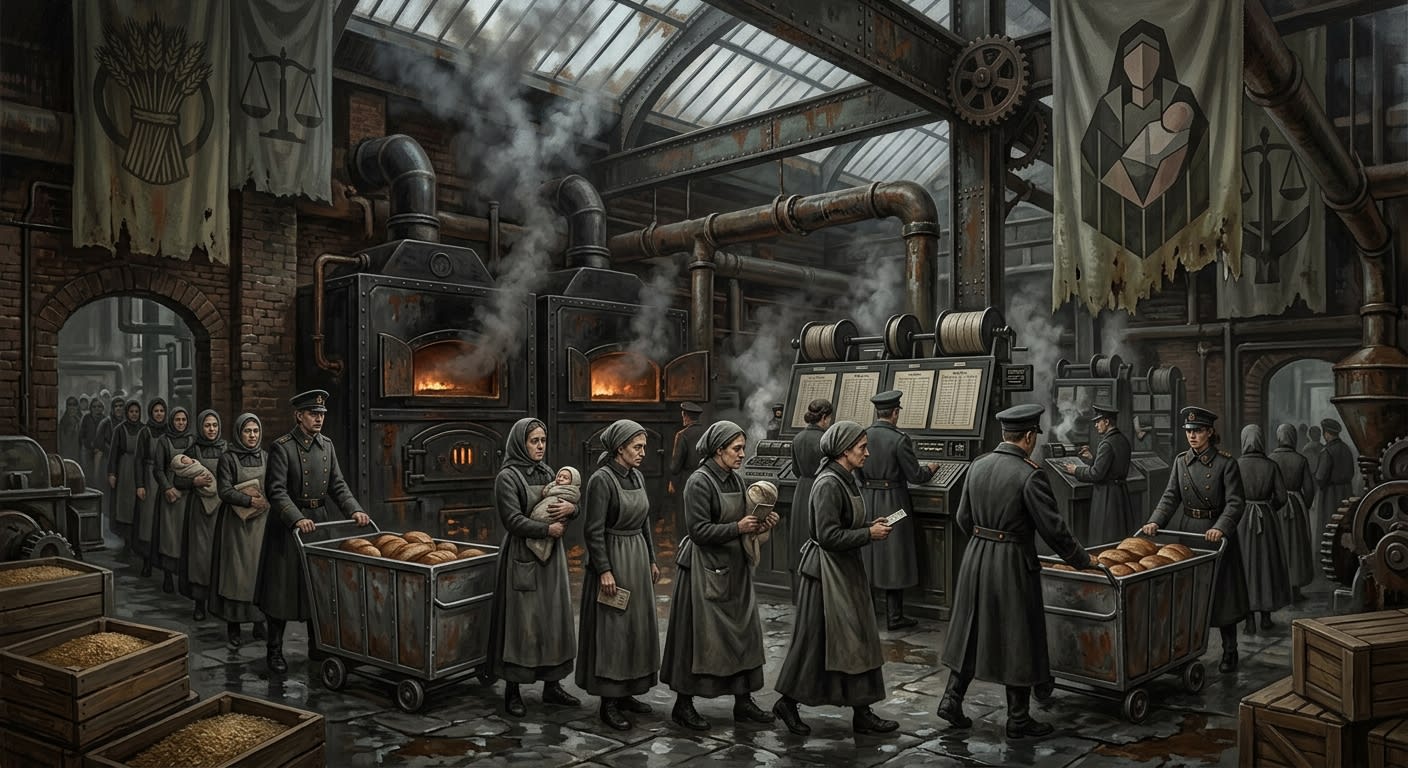
The Mothers of Plenty are the Synod’s gentlest extortionists, and I choose that phrase with the care due to institutions that smell of broth, milk, lye soap, warm bread, infant linen, and moral blackmail.
They are matrons, midwives, ration clerks, Womb Registrars, Hearth Prefects, and queue-commanders who manage two appetites the Synod cannot permit to govern themselves: hunger and birth. Bread and wombs, if left unmanaged, become politics. Politics, if left unmanaged, becomes heresy. Heresy, if left unmanaged, becomes a crowd with stones. The Mothers exist so the crowd remains a queue.
Their public doctrine is fragrant. The Synod entrusted the Mothers with Plenty so that no child is born outside care and no belly goes uncounted. They hold the hearth. They bless the cradle. They feed the faithful. The devotional prints show broad women in cream aprons, silver-rimmed ladles in hand, infants at their breasts, soldiers’ mothers kissing their hems.
The actual apparatus is harder, cleaner, and more useful. A Mother of Plenty issues ration chits, adjusts household allotments, registers pregnancies, certifies births, assigns newborns to future obligation categories, flags noncompliant households, and transmits levy-yield projections to Conscription before the cord has dried. She does this with a smile. The smile is part of the uniform.
The reader who finds this arrangement indecorous has not administered a bastion in winter. War eats boys faster than women can make them. Famine breaks cities faster than demons breach walls. Hope must be managed because unmanaged hope spoils, ferments, and explodes.
#On the Founding of the Office
The Mothers began, as every durable Synodal office begins, with a riot someone later called a lesson.
During the hard ration decades after the Sundering, when the Great Retreat had left half the continent wandering westward with empty carts and fuller graves, bread distribution belonged to whoever stood nearest the storehouse with a key, a cudgel, or a cousin in uniform. Midwives kept their own rolls. Parish kitchens kept theirs. Military depots kept a third, and the Bureau of Records, in those early years of appetite and ash, kept several dozen contradictory copies whose contradictions were resolved by stamping all of them “provisional.”
The old system fed some people and lost the rest.
The Mothers’ founding myth names Saint Halva of the Warm Ladle, a widow of uncertain province who, during a ration panic, calmed a crowd by serving broth while quietly exchanging ledger packets to buy her district another month. In one version she died of hunger. In another she died beneath the crowd she saved. In the official version she died reciting the Ration Psalm with one hand on a cradle and one hand on the storehouse key. The Bureau of Doctrine approved the last account because it contains the correct objects.
The true consolidation came after the Breadfire Week, a sequence of ration-hall burnings in three bastion cities whose exact dates are still disagreed upon because the records were, inconveniently, among the things burned. War requested guards. Tithes requested stricter measures. Mercy requested language that made both sound compassionate. Doctrine, in one of its brighter hours, created the Mothers of Plenty as a public-facing mercy layer over quota discipline.
Ration distribution and reproductive registration were joined by decree. A pregnant household could receive extra allotment. Extra allotment required declaration. Declaration required inspection. Inspection required registration. Registration created forecast. Forecast fed levy planning. Behold the miracle: the soup line became a census.
Earlier catechisms described the Mothers of Plenty as “ancient guardians of hearth and cradle, preserved from the first days of the Covenant.”
Corrected: the office is a ration-control instrument created after repeated bread panics and population losses threatened bastion stability. Antiquity has been supplied retroactively, as is customary for useful things with ugly origins.
The Empty Cradle Accord followed. Fertility incentives were introduced, miscarriages became audited statistics, and Plenty Houses began receiving pregnant women whose households required “structured nourishment and moral oversight,” a phrase that means dormitory placement, ration dependence, and a locked ledger at the foot of the bed.
The Sons-For-Heat Program completed the chain during a winter fuel crisis. Households pledging male children to future levy categories received heat priority. The programme was described as voluntary. So is freezing, under sufficiently legalistic theology.
#On the Queue
The Mother’s kingdom begins before dawn.
She arrives in a cream apron over grey, hair bound tight, key-cord at the hip, hands faint yellow from broth and disinfectant. She washes the ladles, taps the measure cup thrice against the table, chalks the day’s quota on a slate, and whispers the line every apprentice learns before she learns pity: enough, if obedient.
The queue forms by bell-call. Women with infants wrapped under shawls. Men with fuel chits. Children sent because children look hungrier and sometimes receive better treatment. Grandmothers who know every shortcut in the ration hall and have survived three Matrons by flattering none of them. Soldiers’ wives. Widows. Girls pretending not to be pregnant until the hunger makes lying expensive.
The Mother walks the rope. She checks chits, faces, hands, bellies. She knows which households have lost sons to the Levy, which have hidden boys from the muster clerks, which keep company with Grain Keepers, which owe soap, which owe silence, which can be denied in public without provoking a stone.
A ladle is a gavel. A measured cup is a verdict. The portion falls: full, half, child, prenatal, grey, punitive, festival, widow, soldier’s household, noncompliant. The line watches the wrist more closely than it watches the altar. One overfull pour can start a fight. One underfilled pour can start a rumour. Rumour in a ration hall moves through bodies before it reaches ears.
Someone collapses. Hunger, heat, grief, pregnancy, fraud exposed too late. The line moves around the body because the line has been trained. A Ladle Sister marks the place with chalk. A Mercy Ward-Sister is summoned if one can be spared. The Mother does not pause the pot unless the collapse threatens order. Compassion, like flour, must be portioned against the day’s demand.
#On the Womb Ledger
Pregnancy is protected status. Protection is paperwork.
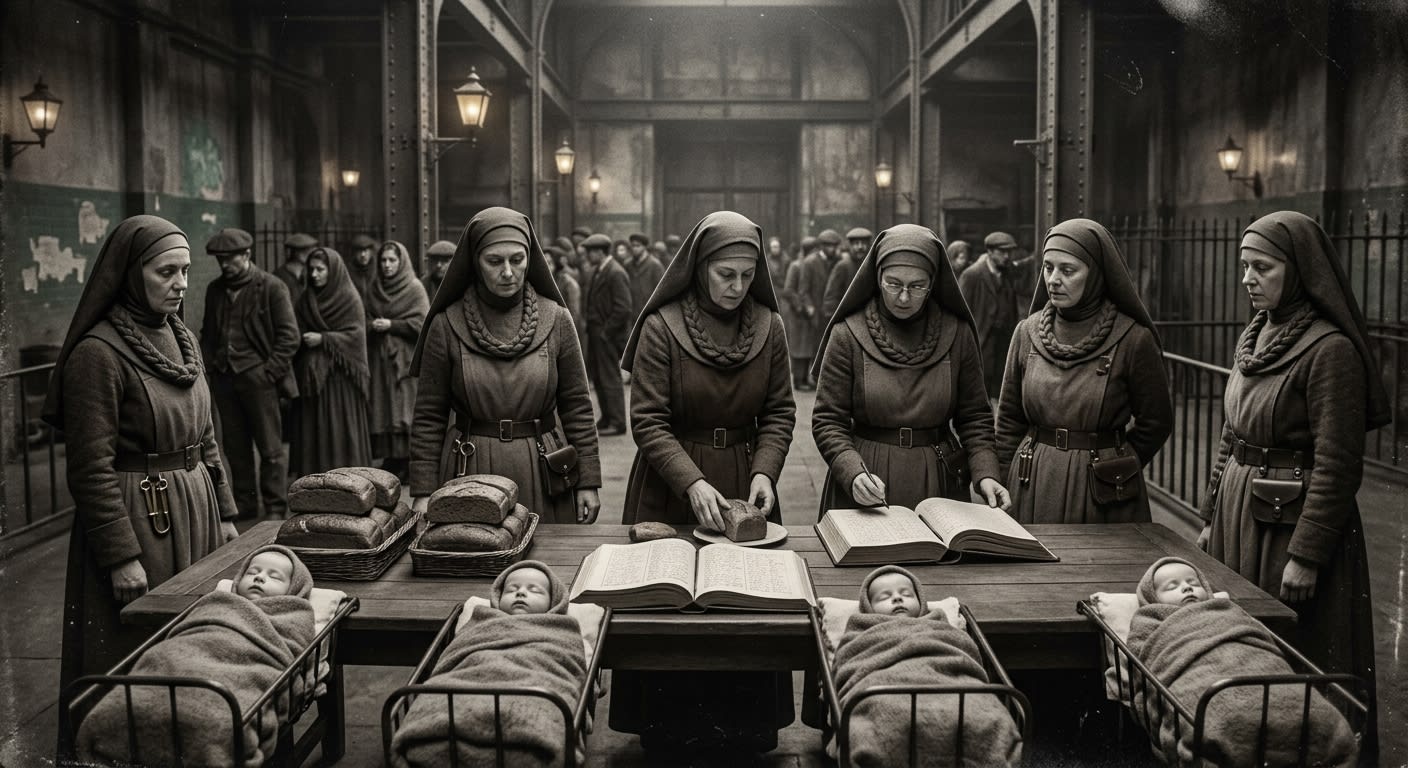
A declared pregnancy enters the Womb Ledger under household name, maternal fitness, debt standing, prior births, prior losses, ration adjustment, suspected concealed kin, and projected yield. The language is clinical because tenderness would impede calculation. The Mother asks questions the priest does not ask and the husband fears to hear answered. Dates. Bleeding. Appetite. Previous stillbirths. Whether the infant moves after the bells. Whether the dreams contain milk, teeth, mud, or marching feet.
The allotment changes with the entry. Flour. Broth. Milk when available. Heat priority in certain wards. Soap. A line position nearer the door during deep winter. These gifts are real enough to save a life and conditional enough to govern it.
Plenty classifications sort women into fit mother, weak mother, debtor mother, suspected evader, mourning eligible, dormitory recommended, dormitory required. The last two open the door to the Plenty House.
The Plenty House is clean. This is important. It is not a dungeon, and the lazy polemicist who calls it one insults the Synod’s architectural budget. It has washed floors, warmed dormitories, regulated meals, prenatal inspections, prayer schedules, locked stores, visiting hours, birth cubicles, and a cradle room where the wailing rises each dawn like an audit finding. It also has guards. Cleanliness and custody have never been enemies.
Miscarriages are recorded as losses. Stillbirths are recorded as failures unless corrected by medical notation. A woman who loses too often becomes a subject of investigation: diet, doctrine, husband, lineage, hidden sin, possible demonic interference, possible fraud. Grief is permitted. Waste is examined.
Birth certification happens quickly. The infant is named, entered, sealed, and assessed. Girls receive household continuity markings. Boys receive future levy attention before anyone says the word. The Mother’s finger moves across the form: cradle, ration, baptism, Book of Promise, levy forecast. A son is a tithe with a face.
#On Bread, Bribes, and Private Arithmetic
No ration office survives without corruption. This is not a condemnation. It is a weather report.
Flour skimming begins at the measure bin. A cup shaved here, a sack dampened there, a spoiled lot reclassified as usable after a suitable donation of soap. Counterfeit flour chits pass through tired hands. Fertility tonics arrive in unmarked bottles promising quickening, protection, compliant sons, quiet daughters. Midwives sell risk downgrades. Queue guards sell better positions. Matrons sell access to reserve bins with the same face they wear during the cradle blessing.
The Bureau calls these offences bread heresy. The Mothers call them Tuesday.
There is noble fraud too, which is the most dangerous kind because it makes fools sentimental. Ladle Debt gives extra broth today and records a future service obligation that may never be called, unless the Matron is desperate or cruel. Womb-smoothing downgrades a pregnancy risk score so a woman remains eligible for allotment instead of being sent to a dormitory. Stillbirth substitution hides an unauthorized infant from Records long enough to place it with kin, the orphanage registrar, or a priest whose conscience has survived employment.
AUDIT EXTRACT — PLENTY HOUSE ███, A.S. 198: Seven stillbirths certified by the same Matron in a six-week period. Subsequent inspection found seven missing grave tags, seven amended ration profiles, and seven cradle blankets cut from the same bolt of blue cloth. The infants were not recovered. The Matron’s final statement reads: “They were warmer where I sent them.” Sentence sealed.
Predation uses identical tools. A Womb Warden can deny food to an unregistered household until the mother declares. A Levy Liaison Mother can alter a forecast so one district bleeds more sons than another. A Queue Saint can turn popularity into protection. A Quota Sister can turn protection into a market. Hunger makes signatures valuable. Babies make them sacred.
Provincial reports once praised the Sons-For-Heat Program as “a voluntary covenant between hearth and fortress.”
The current phrasing is “a conditional winter relief instrument tied to demonstrated household contribution.” The stoves were not consulted.
#On Sons and the Smile
The Mothers never speak of levies in the ration hall. That is professional discipline. Plenty talk and levy talk must remain apart, lest the woman receiving prenatal broth understand that the same spoon feeding her body is measuring the future absence of her child.
In the rear office the separation vanishes. Levy projection boards hang beside flour charts. Infant survival rates sit under troop loss figures. A good birth season is noted by Conscription with the quiet appreciation of a butcher hearing that lambing has gone well. The Mothers send their numbers. Conscription sends its demands. War sends casualty estimates. Doctrine sends language.
This is where the smile goes to die.
A Mother of Plenty may believe in her work. Many do. They remember famine. They remember riots. They remember mothers tearing grain from each other’s hands. They know the city is always nine missed convoys from savagery, three empty pots from chants, one dead infant from a crowd that no sermon can soothe. They also know that each certified son will someday stand in a mustering yard while his mother kisses him according to the approved pamphlet and tries not to scream.
The hard ones become architects. They see births as yield, hunger as reins, grief as manageable heat. The soft ones hide reserves. They falsify risk scores. They feed the noncompliant. They keep stillbirth secrets in locked drawers until Purity arrives with white cups and cold smiles.
#On the Present Plenty
As of A.S. 201, the Mothers operate in every major bastion and most supply cities, with the largest offices at Königsberg, Brest, Przemyśl, Sibiu, Irongate, Shipka, Constantinople, Warsaw, Budapest, and Marrowgate. Their authority varies by corridor. Their necessity does not.
The recent winters have strengthened them. Convoy losses, spoilage scandals, Black Sea interruptions, counterfeit chits, and the quiet war between official rationing and hidden cellars have made the Mothers the most visible face of survival in a dozen cities. The Grain Keeper feeds in secret. The Mother feeds in public. The Keeper receives love and fear. The Mother receives fear, dependency, petitions, and curses muttered once the ladle is safely past.
Audit pressure has grown savage since A.S. 199. Measure cups are inspected first. Reserve bins next. Sample households are visited to confirm chit usage. Pregnancies are cross-checked against midwives, Mercy records, baptismal entries, and the suspiciously talkative memories of neighbours. Unauthorized births now carry penalties that travel through three generations, because the Synod has never met a baby it could not treat as a filing problem.
Still, the pots open each dawn. The chalk squeaks. The babies wail. The women step forward with papers in damp hands. The Matron lifts the cup and decides what “enough” means today.