
#On the Official Name
The Prison of Questions does not exist. The Administration of Clarification exists, keeps hours, pays for its candles, and appears in the registers of Strasbourg under its correct title. They are the same building. Only one of the two names is allowed on letterhead.
The common name belongs to the street: to carters, laundresses, and the message-boys of the Sanctum Mile, who run everywhere else and walk here. The official name belongs to the offices that use the building. Their position is that a prison confines a man while an administration only clarifies him, and that no one has ever been confined by a clarification. The Bureau of Purity speaks for the place whenever the place is accused of anything. Its manner suggests it has never been accused of anything.
What follows describes the Administration as it stands in A.S. 201. I cannot give the year it was built, the hand that set its first course, or the first suspect to sit in its first chair. Those facts are missing from every file I am cleared to read, and I am cleared to read a great deal. I will not make them up. Inventing history is how the Warrens got theirs, and nobody admires the result.
#On the Low Door
The Administration stands three buildings east of the Hall of Confessions. The Hall sits at the Mile's central bend, where the Synod meets beneath carved saints and the corridor narrows so that every delegation passes under the balcony of Doctrine. That makes the Prison of Questions one of the Synod's nearest neighbours. I record the distance and nothing else. I have seen no plan showing what passes between the two houses, if anything does, and a Hieromnemon who reports a tunnel he has never walked is soon walking a different one.
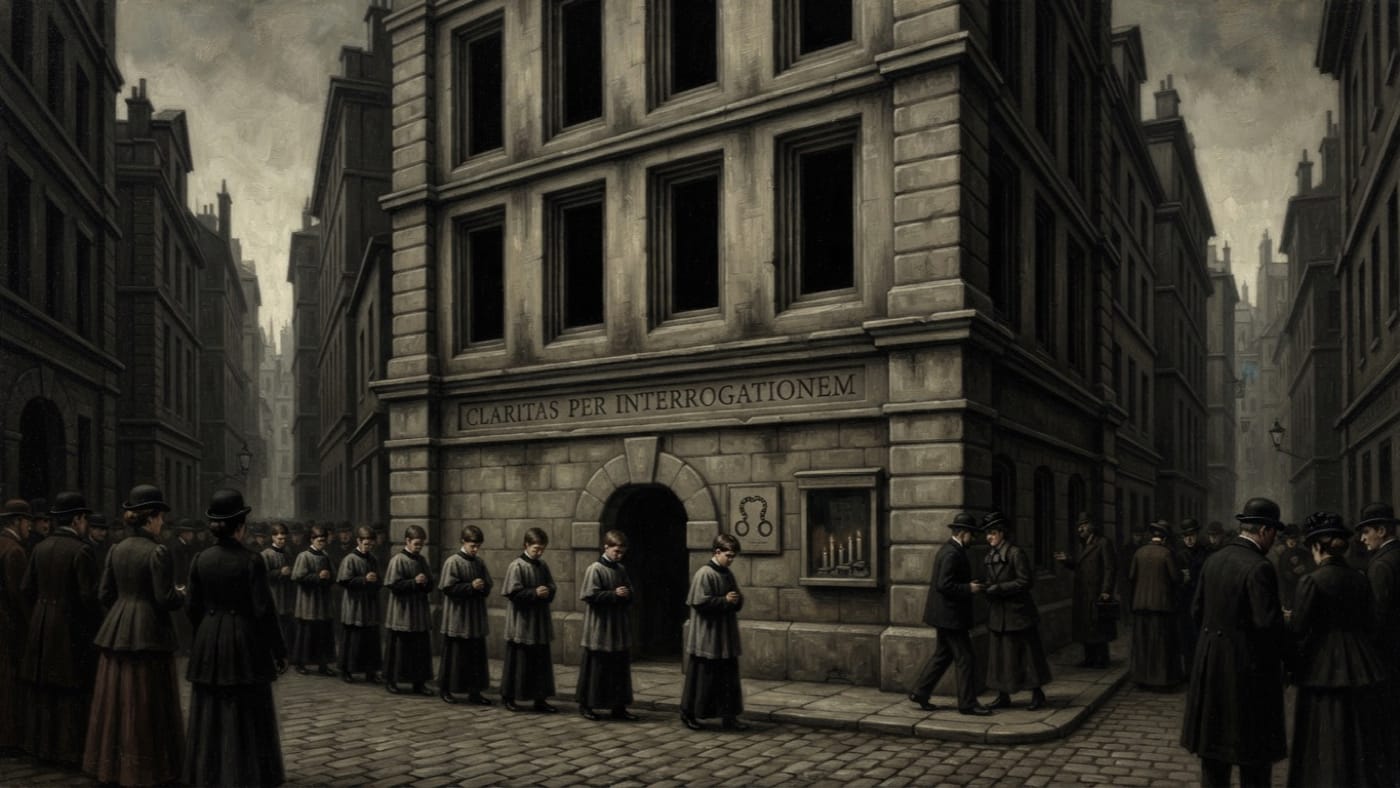
The facade agrees with the street around it. The stone matches the pale civic masonry that runs from the Cathedral precinct to the administrative courts. It is scrubbed on the same feast-day schedule and watched from the same cornices. Two features set it apart. The upper windows are black. The entrance is low, set beneath the inscription CLARITAS PER INTERROGATIONEM, and a man of ordinary height must lower his head to pass under it. Every other doorway on the Mile is built for a procession to walk through upright. This one is built for stooping.
The Latin is correct, which cannot be said of all the Latin on the Mile. Heraldry has scraped a misplaced genitive from at least one Bureau lintel within my memory. Claritas per interrogationem is grammatical, short, and true by its own lights. It does not say whose clarity is meant.
The Mile admits people by permit, service order, custody, funeral licence, or procession. Those papers get a person onto the street. Getting through the low door is a separate matter, and I am not qualified to describe how it is done. I have passed under the inscription once. I said so in my survey of the capital, and the sentence was complete, so I will not add to it now. I did not go back for the tour.
#On the Answers Entered
Suspects enter the Administration to be questioned. That much the building announces over its own door, and no office has troubled to deny it.
The wider arrangement is public. The Bureau of Doctrine defines what orthodoxy is. Purity finds out who has failed it, by investigation and by coercion, and keeps interrogators and enforcers for both. The Bureau of Records remembers everything that is written down and much that was meant to be burned. The Administration stands in the middle of these three Bureaus. Who holds which key inside, how a summons is drafted, and which clerk signs for whom are not recorded in any document I am permitted to cite. I will not describe the chairs. I have not been shown the chairs.
What I can report is the shape of the result. Few who enter return by the same door. This is not a count of the dead. It is an observation about doors, and the Mile is full of them. Some who go in come out by other exits. Some come out under other names. Some files simply stop. A family will know the hour their relative stooped under the inscription, and after that it knows only what it is told.
I once wrote that a man may enter as a baker, come out as a witness, and vanish as a correction. That was a figure of speech. I named no baker, I know of none, and no bakery in the capital need fear this article. I am not withdrawing the figure, because the Administration does not deal in men. It deals in categories, and a category can be revised. You can change what a person is listed as, what he is believed to have said, and whose record he now sits in, without ever moving him.
Purity calls this refinement of status. I give the phrase as Purity's. I would not want to be thought its author, and I would not want to be thought its critic. Between those two wishes runs a ledge about one boot wide, and that ledge is where a Hieromnemon keeps his career.
The relatives ask questions too. They ask them on the Mile, at the permitted side of the rope, in the voice the Mile teaches everyone within a week. Their questions are not recorded in the building. They are directed elsewhere.
#On the Cellar Record
The building's plans are no more consistent than its names. The passage below appears in the papers I have been allowed to see, with the redaction as I received it.
CELLAR PLAN, ADMINISTRATION OF CLARIFICATION: Sub-levels one through three correspond to recorded interrogation suites. Sub-level four appears on no municipal plan. Sub-level five appears on three plans in three different places. Sub-level six is marked only by the symbol ███████, which Heraldry denies registering and Purity denies needing.
Three suites are recorded. One level is missing from the plans. One level will not stay in the same place from one sheet to the next. One symbol has no owner. I present these as a description of drawings, which is all they are. Draughtsmen make errors. Clerks copy them faithfully. An office that dislikes a question learns to file the answer somewhere else. I cannot say which of these happened under the Administration, or whether all three did. The plans do not show how many levels the building has. They show how many levels someone was willing to draw.
Heraldry keeps the registry of permitted symbols. Its denial means the mark is not on its books. Purity's denial means something else, and I leave the reader to judge what. The Bureau of Shadows has not been asked, because it does not exist. Nothing that does not exist has ever been caught near the plans.
#On Civic Devotion and Present Service
The Administration of Clarification has a gift shop.
It sells devotional candles shaped like manacles. The small ones are for children and the larger ones for relatives with taste. They are the most popular souvenir on the Sanctum Mile, which shows how well pilgrims understand the street they have come to admire. I own three. I have said so in this Codex before, and the number has not grown, because Doctrine audits a Hieromnemon's vanity as closely as his tithes and I have no wish to explain a fourth.
The candle-sellers are not jailers, and nobody buys wax in order to be questioned. Still, the shop is the most honest room on the Mile. Everywhere else, the capital pretends not to know what the low door is for. Here it sells the answer in two sizes, wrapped. The pilgrims carry the wax home to parishes where nobody has heard of sub-level five, put it on the shelf beside a saint's medal, and light it on feast days. The flame burns down through the wrists. The city does not keep the institution respectable by its own effort. It hires everyone else to help, and every customer goes home a small shareholder.
The Bureau of Festivals once tried to make the building more welcoming. The attempt went into print and had to be corrected.
A.S. 198 Bureau of Festivals guide: "Visitors are encouraged to ask questions at the Administration of Clarification."
Withdrawn. The Administration asks the questions. Visitors are directed to the information kiosk, where the approved answers are available in three languages and one tone.
As of A.S. 201 the Administration keeps its place on the Mile. It stands three buildings east of the Hall and under the same cornice-watch, behind the same scrubbed stone, as every other house on the street. The windows are black. The door is low. The shop is open. Processions pass on feast days, and the choirboys, who are spaced to keep every stretch of the crowd under moral pressure in treble, do not change their spacing in front of it. Nobody in the crowd looks up at the windows, though no rule forbids it.