
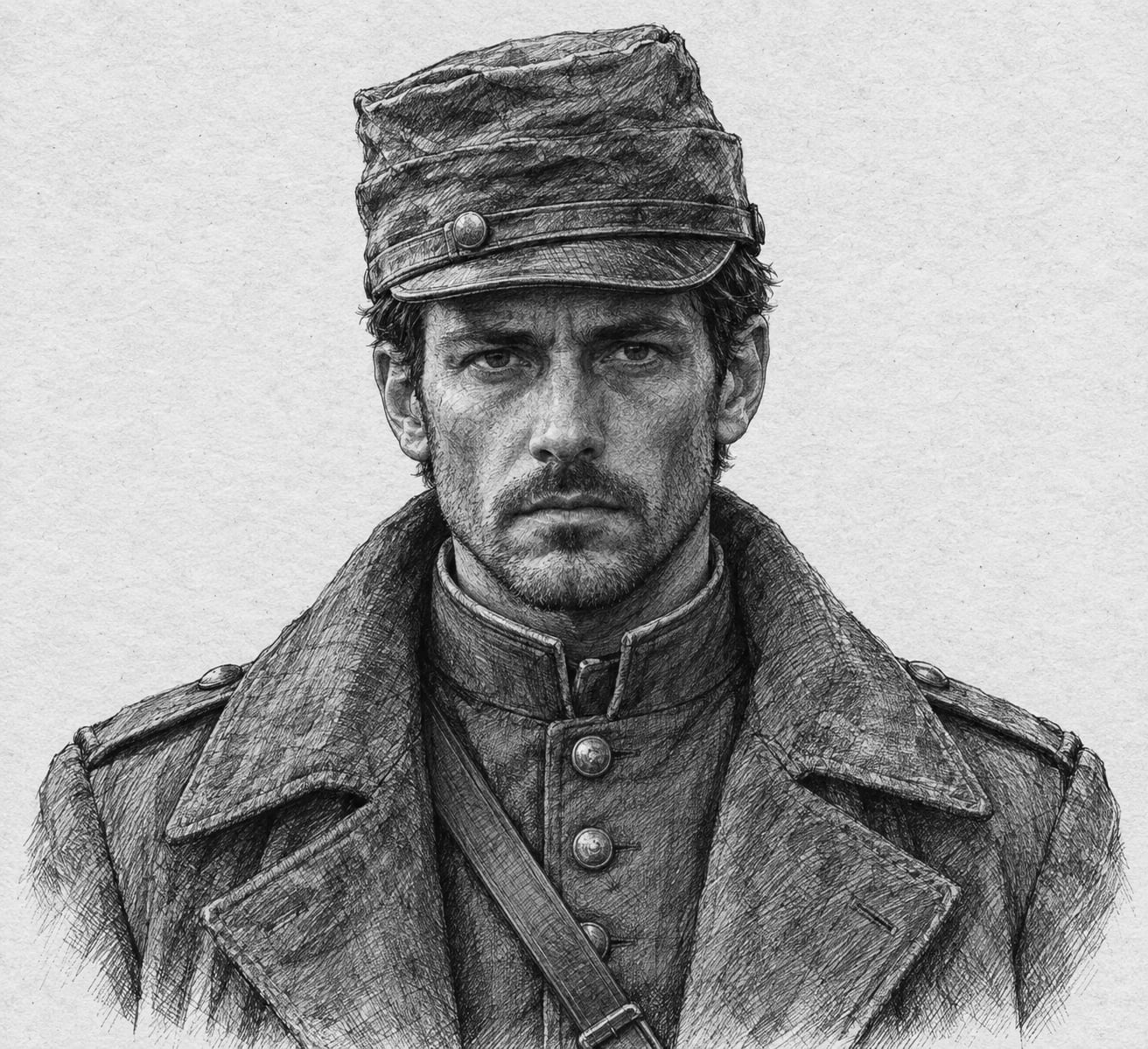
#On His Station
Quartermaster Ilven Kraut survives in the record as a name, a rank and a book. The Church has canonized men on less. It has hanged men on less as well, and the Bureau of Records keeps both kinds of file in the same cabinet. I have always considered that cabinet the most honest piece of furniture in the building.
The archive gives up almost nothing about the man himself. His unit is unrecorded, and so is his employer. In A.S. 71 the early wartime administration kept its quartermasters under so many overlapping warrants that one convoy might answer to a bishop, a colonel and a grain committee in the same week. The record also declines to give his birthplace, age, family, face, promotions or vices. I have read fuller entries for tent-pegs.
The title alone is enough to justify the file. A quartermaster on the Transylvanian approaches in those years held the thinnest and most necessary office in the war. He counted what left, counted what arrived, and answered for the difference. Every sack of meal and every barrel of powder passed under his pen. So did every bolt of wool meant for men who had already spent one winter eating shoe-leather. Soldiers fear the enemy. Commanders fear the quartermaster's arithmetic, because it tells them which of their soldiers will still be fed in a fortnight.
The convoy account was the instrument of that office. It was the running record that bound goods, beasts, wages and liabilities to a single responsible hand. When the record speaks of "the entire convoy account of Quartermaster Ilven Kraut," it names that instrument and everything the instrument governed. The archive does not say what it governed. That is the first question it leaves unanswered.
#On the Nine Days
After the Sundering of 1 November A.S. 45, Kargath's famine emptied the highlands, and Velmora arrived offering relief on credit. By A.S. 50, seven highland communities had pledged their mine rights to lenders whose seals matched no mortal house. By A.S. 58 the old shafts were deepening without labour. By A.S. 66 the miners had stopped coming back up, and the authorities designated Sibiu to hold against Velmora's reach. In those years the Line was defensible and unfinished. It was a wall in the way a promissory note is money.
Sibiu would not be ratified until A.S. 72. In the year before that, the ground settled its own accounts.
The Bureau of Records dates the formal rupture of the Gilded Chasm to A.S. 71, or 1781 by the old reckoning. A ridge south of the Transylvanian passes opened over nine days. The record does not name the pass, and I will not name it on the record's behalf. It also gives no month and no day on which the ground began to part. Nine days is how long the rupture lasted. It is no calendar, and the clerks who tried to count backward from it to a feast-day produced only bad liturgy.
The ridge swallowed four things. It took the road. It took two tollhouses. It took a chapel of Saint Baruch, with whatever bells and benches it held. And it took Quartermaster Kraut's entire convoy account.
Read the last item twice. The clerk who wrote it could have chosen wagons, cargo, drivers, or Kraut himself, and chose the account. The wording might mean that everything the account covered went into the ground. It might mean that the account itself, as a standing obligation, was swallowed: closed and absorbed into the Chasm's own books. I cannot tell from the page, and neither can anyone else. Anyone who claims otherwise is selling something, and on this frontier that is never a figure of speech.
#On the Animals and the Ledger
Two things came back. They must be examined separately, because they were found separately. The Bureau's habit of stapling unrelated papers together has also produced more heresy than the printing press.
The first is the animals. The convoy's beasts were later found above ground. The record says only "later," and gives no interval, place or finder. The animals were in harness and had been brushed. They carried ingots with no mint mark.
Start with the brushing. A beast that wanders out of a collapsing ridge comes out lame, lathered or dead. These came out groomed. Someone, or something, took the trouble to curry the coats and set the harness straight, and the record does not say who. It records the care, and the care is the horror. Thieves do not groom stolen beasts. Stewards do.
The ingots are worse because they are blank. The record gives no metal, number or weight, and I forbid the reader to call them gold just because the Chasm's walls are. A mint mark tells you who answers for a coin's weight and purity. An unmarked ingot answers to no house at all. It is value with its parentage scraped off: payment without a payer, which means payment from the one quarter that prefers not to sign.
The second thing is the ledger. It was left at the edge of the rent, where the road had been, and every page had been balanced.
I have kept ledgers for longer than most of my readers have been literate. I have audited the ledgers of saints, generals and two archbishops, and I never found one in which every page balanced. Rations spoil and barrels leak. Drivers steal a little, and honest quartermasters write the theft down as spoilage, because the alternative is a court-martial and a widow. A real convoy book is a record of small failures, carefully confessed. Kraut's book confessed nothing. Every debit met its credit, and every column closed.
The record does not say who balanced it, or when. Kraut may have made the final entries before the ridge opened. Or the pages may have been in arrears when he last held the pen and been brought to order by another hand since. The entries are not listed. Nor does the record say where the book went afterward, and I have found no shelf-mark that tells me.
#On Accounting Under Velmoran Influence
This section is my reading. It is not evidence, and I sign it as my own.
The Church learned slowly, and at great expense, what a balanced account means on the Velmoran front. The Bureau of Tithes learned it in A.S. 114. Its auditors walked to the Chasm's rim, issued their levies, and were paid at once in bullion of perfect weight. They came home with full wagons. Within a year two of them had embezzled eleven thousand Crowns apiece. The books of that expedition were flawless too.
Contract Theurgy, as the Bureau of Doctrine now teaches it, works through instruments that are always honoured to the letter. Velmora does not falsify sums, because she has no need to. A transaction can close perfectly while the thing truly exchanged appears in no column at all: a habit, a loyalty, a name, a future. A balanced book proves only that the arithmetic was obeyed. It says nothing about what the arithmetic was made to carry.
Later field instruction, A.S. 171, described Velmoran contract-craft as "compulsion hidden in legal form."
Corrected by the Bureau of Doctrine. Compulsion is the wrong word. The signatory chooses, but the choice is priced, staged and witnessed. This correction is later doctrine, cited here for context. It is no ruling on any instrument in Kraut's hand, and no such instrument is recorded.
I must be exact, because exactness is the one virtue this case has left us. No contract bearing Kraut's name exists in any file I have seen. No witness puts a lender at his elbow. No register of the Ten Thousand Keys lists him. That cult's organization belongs to a later age, and I will not dress a dead quartermaster in its brass. The famine made bargains easy, and Velmora made them warm. A man in Kraut's post would have been offered many of them. Whether he accepted any is exactly the question the ledger was built to answer, and the ledger, by being perfect, refuses to answer it.
#On the Limits of the Account
So much for the book. The man is harder.
The record does not say that Ilven Kraut died. It is equally silent on whether he survived, deserted, fled south, walked into the rent, signed, refused, or was paid. The road, the tollhouses and the chapel are accounted for by their absence. The animals and the ingots are accounted for by their presence. Kraut is accounted for by neither. His name heads a column whose total is missing.
I will not acquit him either. For every honest quartermaster on that frontier, the file holds a brother who took the warm coat and the forgiven debt, and the book cannot tell us which of the two Kraut was. He may have balanced the pages himself on the eighth day, with the ground opening under the wagons, because a quartermaster leaves his book in order when nothing else will stay in order. Someone else may have balanced them for him. The page fits either reading, and that is the whole indictment against the page.
The ledger was balanced. Nothing else in the case is.