
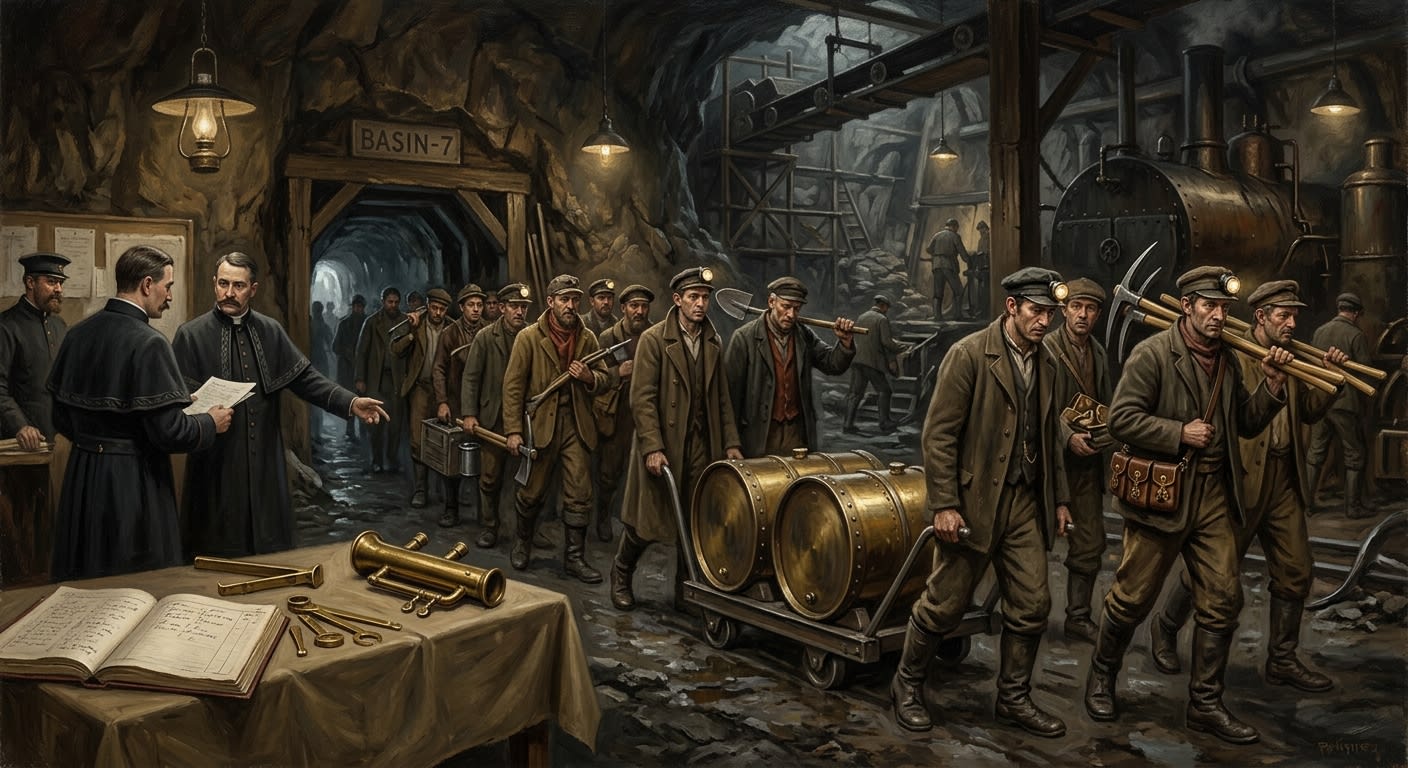
#On the Basin That Returned Its Drums
The Quiet Basin Incident, designation Basin-7, occurred in A.S. 178 in the southern extraction corridor, where licensed Wound-Site Prospectors had been making profitable trespass into wounded ground for sixty-six years under the Fuel Monopoly Acts. Fourteen crewmen, one hymn singer, one ward setter, and one survey scribe entered the site. They did not return.
Their drums did.
This is the story the profession does not tell recruits until the recruits are too deep in debt to leave. They will joke about breathing drums. They will joke about wrong flame. They will joke about auditors who stand three hills away and ask whether the seam could be encouraged toward greater output. Mention Basin-7 and the joking stops as if a bell rope has been cut.
#On the Entry
Basin-7 lay within the southern corridor’s licensed extraction grid, in ground listed as dormant after two prior surveys and one profitable shallow tap. Dormant, in extraction language, means the wound is pretending. The crew assigned to the site carried current charter papers, escort clearance, pre-filed purity declarations, gasket clamps, ward spikes, chalk salt, hymn wax, pressure needles, and a chapel sled whose axle had passed inspection three days prior. The survey scribe wrote the opening conditions in a hand later described by Records as “calm.” Records is easily impressed by handwriting.
The crew crossed the basin lip after first bell. The hymn singer established cadence on consecrated ground. The ward setter placed two exit stakes, poured salt lines, and marked the tap-mouth. Pressure pitch read low, with no harmonic deviation recorded. The first drum filled by third bell. The second began by fourth. At some point between fourth and fifth, exterior observers lost sight of the crew through ground vapor.
The escort sergeant’s testimony ends with the phrase “the basin became quiet.” That phrase survives in all later summaries. Not silent. Quiet. Silence is absence. Quiet is attention.
#On the Recovery
At seventh bell, the vapor cleared. The crew was gone. The drums stood at the basin lip, stacked neatly, still warm, sealed with perfect gasket hymns. Cadence marks, wax pressure, clamp bite, and closing verse were all textbook. The yield was the highest single-site extraction on record.
The tools were arranged on a tarpaulin in order of use: augers cleaned, siphon hoses coiled, tap-spears oiled, clamps aligned, survey chain wiped, chalk-salt scoop placed beside its bag. No panic scatter. No blood. No broken ward line. The chapel sled stood upright. Ward spikes were driven into fresh ground. Salt lines remained unbroken. The hymn singer’s pitch pipe lay on the chapel floor, still vibrating.
BUREAU OF BELLS — ACOUSTIC APPENDIX, BASIN-7 Pitch pipe frequency: ███████████ Hz. Comparable table: none. Human hearing response: nausea, prayer impulse, childhood memory recurrence. Recommendation: do not sound in enclosed chapels. Bells refusal to classify: accepted.
The bodies were not found. This statement has been repeated so many times that readers mistake it for a fact with edges. Bodies were not found; neither were boot prints beyond the outer stake line, torn cloth, dropped masks, heat shadows, struggle marks, final chalk notation, or the survey scribe’s folio. The folio matters. A prospector might drop a glove. A ward setter might drop a spike. A survey scribe does not drop the folio. If he does, Records invents a punishment and applies it to his heirs.
#On the Problem of Gift
One unsigned handwritten note, appended to a denial of my second access petition, supplies the only sentence in the case worth preserving: “The Basin gave back more than it took. That is the problem.”
The arithmetic is obscene. An extraction site takes seventeen persons and returns record yield, perfect drums, clean tools, intact warding, and no evidence of rupture. A stupid office celebrates efficiency. A clever office seals the file. The Bureau of Shadows sealed it in A.S. 179 under Classification Order 7-QBI, which tells us that at least one clever office survived the review.
The Bureau of Tithes wanted the yield credited. The Bureau of Engines & Furnaces wanted the drums tested. The Bureau of Mercy wanted the seventeen names preserved as casualties. Records wanted the folio. Shadows wanted everyone to stop wanting. Doctrine, which is to say my glorious and burdened office, wanted a sentence that would satisfy public curiosity without feeding private panic. We failed, which is rare enough to deserve commemoration.
Initial district notice classified Basin-7 as “a routine extraction loss with exemplary equipment recovery.”
Withdrawn after the pitch pipe continued vibrating under lock and three clerks assigned to copy the notice wrote the same childhood address in the margin, though none had lived there.
#On the Amendment of A.S. 189
The Fuel Monopoly Acts of A.S. 112 had already survived greed, incompetence, seam rupture, charter fraud, black drill crews, and the Charter Wars settled by amendment in A.S. 167. Basin-7 wounded the Acts more delicately. It revealed that a charter could be obeyed in every visible respect and still produce a result no charter could digest.
The A.S. 189 amendment added quiet provisions. Extraction houses were required to file anomaly-adjacent yields under sealed annex. Pitch instruments from recovered abandoned sites were no longer to be sounded in rooms containing children, pregnant women, open ink, or unconfessed clergy. Record yields from personnel-loss incidents required tri-Bureau review before furnace routing. The term “gift-yield” was banned within three months of its appearance.
The amendment did not name Basin-7 in public text. It did not need to. Every prospector knew the shape of the omission. The profession reads omissions the way monks read illuminated capitals: closely, reverently, with suspicion.
#On the Profession Afterward
After Basin-7, crews changed habits faster than offices changed forms. Veterans refused stacked drums unless they had watched the stacking. Hymn singers began breaking pitch pipes after anomalous cadence, despite the replacement fee. Ward setters scratched a third exit mark outside the official pattern, then denied doing so under inspection. Survey scribes tied folios to their belts with wire. Charter houses called these superstitions. Charter houses also added Basin hazard premiums to private ledgers while keeping public confidence notices unchanged.
The joking changed. Before A.S. 178, “the wound gives back” meant bonus yield. Afterward it meant shut your mouth.
The last instruction was violated twice before A.S. 189. Both violations produced excellent revenue and poor sleep.
#On Present Silence
As of A.S. 201, Basin-7 remains sealed in public doctrine and active in professional dread. The site does not appear on pilgrim maps. It does not appear on commercial extraction schedules. It does appear in private route cautions, encoded by scar-diggers as a small empty circle with no tap-mark. The sign means: do not enter; do not sing; do not accept what waits at the lip.
The recovered drums were routed under seal. Their contents burned clean, hot, and without smoke in three separate furnace chapels. This fact was nearly suppressed, then preserved, then hidden in a restricted annex, because the Bureau could not decide whether clean fuel from an impossible disappearance proved divine economy, infernal courtesy, or an accounting opportunity. The third interpretation had supporters.
Earlier oral accounts state that the Basin returned exactly what it took.
Incorrect. It returned more. That is the doctrinal injury.
Prospectors still say “nothing happened at Basin-7” when rookies ask. The phrase is not denial. It is warding. Nothing happened there; nothing came back with the drums; nothing cleaned the tools; nothing stacked record yield at the lip; nothing left a pipe singing a frequency Bells would not name. Nothing, in the Synod’s territories, has always been one of the hungriest things.